We’d like to remind Forumites to please avoid political debate on the Forum.
This is to keep it a safe and useful space for MoneySaving discussions. Threads that are – or become – political in nature may be removed in line with the Forum’s rules. Thank you for your understanding.
PLEASE READ BEFORE POSTING: Hello Forumites! In order to help keep the Forum a useful, safe and friendly place for our users, discussions around non-MoneySaving matters are not permitted per the Forum rules. While we understand that mentioning house prices may sometimes be relevant to a user's specific MoneySaving situation, we ask that you please avoid veering into broad, general debates about the market, the economy and politics, as these can unfortunately lead to abusive or hateful behaviour. Threads that are found to have derailed into wider discussions may be removed. Users who repeatedly disregard this may have their Forum account banned. Please also avoid posting personally identifiable information, including links to your own online property listing which may reveal your address. Thank you for your understanding.
📨 Have you signed up to the Forum's new Email Digest yet? Get a selection of trending threads sent straight to your inbox daily, weekly or monthly!
The Forum now has a brand new text editor, adding a bunch of handy features to use when creating posts. Read more in our how-to guide
Boundary problem
Comments
-
Their online portal only has full documentation from 2001 online. It does show the dates the planning applications were decided. I've phoned them and been told docs from the later applications should be available on microfiche ( wait of at least four weeks to get to see these) The earlier docs from 1975 have probably not survived.Section62 said:....it is unusual for LA's to have their whole back catalogue of plans online. Digitising large plans (especially when they've been folded up and stored for decades) is expensive, so many authorities have only have a few years worth of plans prior to them moving over to digital record-keeping.
Many authorities have kept all their plans going back to the year dot. Sometimes the originals, sometimes microfilmed. So it would be worth asking the question, but....BrainDrained said:Today I'm going to get on to the local authority planning dept to see if they still have plans available for his extensions. Not holding out much hope TBH, they are dated 1975, 1978 and 1985.Bendy_House said:Try the Planning Dept's on-line portal - most LAs have these records on-line now. Just search for your postcode.Are you hoping it shows the property boundaries?
Often authorities have added an entry in the online database to show a planning application exists, but typically with no more than a brief description and application date.
So... a lack of information on the online system doesn't mean they don't have it, and don't expect to find plans from the 1970's online - it would be a bonus if they are.2 -
That's pretty much what I'd expected.BrainDrained said:
Their online portal only has full documentation from 2001 online. It does show the dates the planning applications were decided. I've phoned them and been told docs from the later applications should be available on microfiche ( wait of at least four weeks to get to see these) The earlier docs from 1975 have probably not survived.Section62 said:....it is unusual for LA's to have their whole back catalogue of plans online. Digitising large plans (especially when they've been folded up and stored for decades) is expensive, so many authorities have only have a few years worth of plans prior to them moving over to digital record-keeping.
Many authorities have kept all their plans going back to the year dot. Sometimes the originals, sometimes microfilmed. So it would be worth asking the question, but....
Often authorities have added an entry in the online database to show a planning application exists, but typically with no more than a brief description and application date.
So... a lack of information on the online system doesn't mean they don't have it, and don't expect to find plans from the 1970's online - it would be a bonus if they are.
I'd also add that you shouldn't pin too much hope on the plans containing useful information in terms of the boundary location - they may well show a line representing the boundary, but that alone won't be proof of very much. But there could be useful information such as a note which says (or implies) the hedge belongs to the 'neighbours' (as in you).
0 -
I suspect that Question 2.2 of the TA6 form might be a difficult question to answer in this case......
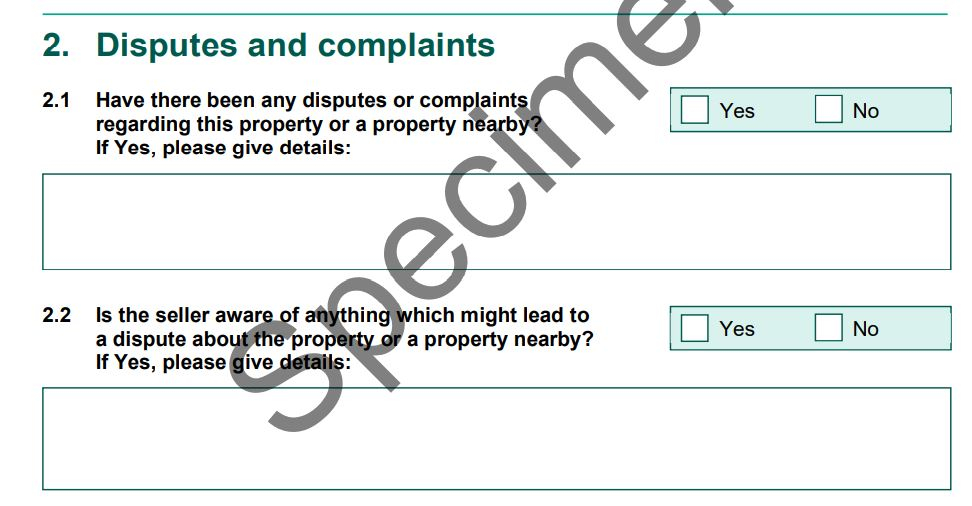
The truthful answer would/should be....Absolutely!!!
I think that the issue in this case, with the OP looking to sell up, is that no matter how anyone looks at it, this is something that can 100% lead up to a dispute, and theoretically must be included in the TA6 form. Should the OP 'go legal', sort it now and have done? Or let the issue brew until she sells? Difficult choice.
Personally I would go down the legal route, and get it sorted. I could then truthfully answer 2.1, declare that there was a dispute, but it has been handled/resolved by the courts. To answer yes to 2.2, imo, leaves too much to go wrong (we all hear of long, drawn out boundary disputes that can last years and £00,000's), and if I was a buyer, I would be checking out at that point.1 -
I'm afraid the legal route is beginning to look like the best way forward.
I'll point out that the current position makes his property just as unsellable as mine and unless he intends to stay there for the rest of his life it has to be sorted out properly. I'm not sure agreeing to some sort of compromise over the front boundary is going to be possible.
0 -
The options though are "Yes" and "No". With space to write in some details if the answer is 'Yes'.warwick2001 said:
The truthful answer would/should be....Absolutely!!!
There isn't much in law which is 'absolute' - lawyers earn their money arguing over shades of grey. What does 'dispute' mean? What does 'complaint' mean? (What does 'nearby' mean?) And how far back in time do you need to go in answering 2.1?
Whilst there are standards and plenty of case law which guides how these questions should be answered, there can be multiple interpretations of exactly what needs to be said, and what doesn't.
I think there is still some room for interpretation here. I wouldn't suggest anyone is untruthful, but what I have suggested earlier in the thread is a good conveyancing solicitor could help with giving answers which don't cause unnecessary alarm to a buyer. And as such I would suggest that instructing a solicitor very early in the sale process (if not prior) could be the best overall approach.warwick2001 said:
I think that the issue in this case, with the OP looking to sell up, is that no matter how anyone looks at it, this is something that can 100% lead up to a dispute, and theoretically must be included in the TA6 form.
But that does mean giving the solicitor something to work with. Which means any actions now which narrow the options available needs to be done with care. The more someone (e.g. the OP) turns an issue into a formal 'dispute' the less scope there is for handling the situation in a less worrisome way.warwick2001 said:
Should the OP 'go legal', sort it now and have done? Or let the issue brew until she sells? Difficult choice.
Personally I would go down the legal route, and get it sorted. I could then truthfully answer 2.1, declare that there was a dispute, but it has been handled/resolved by the courts. To answer yes to 2.2, imo, leaves too much to go wrong (we all hear of long, drawn out boundary disputes that can last years and £00,000's), and if I was a buyer, I would be checking out at that point.
This is indeed a dilemma.
One of the issues is that the legal route is not necessarily quick or cheap. As you point out, it can take years and £00,000's to resolve this kind of dispute, even especially with the involvement of the courts. The legal route might result in a satisfactory conclusion which can be noted on the TA6 as resolved - but in reality of course whoever buys the property may still face simmering resentment from the neighbour with occasional outbreaks of total hostility. The fact the neighbour had lost a court case wouldn't make me keener to buy the property than if the boundary issue was still an open question.
Ultimately, as I said earlier in the thread, the OP needs to think about the overall strategy. Going down the legal route could take several years. Being forced into a position of not selling, and instead living next door to an unpleasant neighbour for (say) 5 years while the legal process grinds on, isn't something which should be entered into lightly.
The legal route is not necessarily a quick fix, nor is there any guarantee of a good outcome. "Sort it now" is certainly an attractive option, but if "now" means five year's time - and after spending £00,000's - would you look back and say that was the right call?
1 -
This isn't necessary - he just needs to be confident that he'll be living there longer than you.BrainDrained said:
I'll point out that the current position makes his property just as unsellable as mine and unless he intends to stay there for the rest of his life it has to be sorted out properly. I'm not sure agreeing to some sort of compromise over the front boundary is going to be possible.
[Trying to be as tactful as possible here....] Are you confident you can stick with this longer than he can? Can you envisage a situation where you may need to sell before this is all over if it does go via a 'legal' route? His actions are already causing you stress... how long would you (and your OH?) be able to cope with that before throwing in the towel?
Sometimes the people who win in a legal battle aren't the people who deserve to win, but rather those who had more money and have the kind of character that enjoys conflict.
0 -
BrainDrained said:I'm afraid the legal route is beginning to look like the best way forward.
I'll point out that the current position makes his property just as unsellable as mine and unless he intends to stay there for the rest of his life it has to be sorted out properly. I'm not sure agreeing to some sort of compromise over the front boundary is going to be possible.
The easiest route out is to look at the deeds, and agree that it does look like they own the land up to the edge of your drive and the hedge was theirs. Then you need to live with it and start working out if you can put up the fences you want just on your own land. As I said earlier, so long as there is room to park, any buyer won't care that you used to think the boundary was somewhere else. How would you feel if you went the legal route and it came back with this conclusion after that?
But a banker, engaged at enormous expense,Had the whole of their cash in his care.
Lewis Carroll2 -
In practice, going the 'legal route' will very likely follow a process where mediation will be recommended as the initial step. In this, most likely the results from a paid surveyor will be the key factor. When presented with such clear information, and in front of a proper mediator, most people - even idiots - become quite sensible.If med were to happen, and the neighbour simply tries to dismiss such information, it will serve them very badly indeed when the legal process moves on.0
-
I wouldn't raise their hopes up if they do. I did and when the house next door to me was sold the buyer got planning permission to build a house very near to my boundary. The builders damaged a concrete fence post that was mine, they then dug out the footings for the house and after heavy rain the mud collapsed into the footings taking out 5 fence panels of mine that fell down completely.Bendy_House said:Do you have LP on your House Insurance?
After complaining and wanting the fence replaced straight away as it gave open access to my back garden they didn't bother. So I turned to the legal protection through Direct Line and after sending in several photographs showing the collapsed footings and my fence laid flat on the ground and several following letters the insurance company decided there was only a 50% chance of winning a legal case so didn't bother and closed the case.
In the end they were absolutely hopeless and only suggested to me that they were interested in sending several letters so they could claim their expenses.2 -
Hi,
Its the claim of a right of access via the back garden which would be difficult to hide. For there to be no dispute the OP would need to grant that right to the neighbour and inform purchasers as part of the sale.[Deleted User] said:
Unless there is some evidence, like letters or complaints registered, you wouldn't get anywhere. The seller would just say that they were not disputing the boundary and you couldn't prove otherwise.doodling said:Hi,
I can't see how the OP isn't obliged to declare this already. It appears that there is a dispute as to the location of a boundary and the next door neighbour believes he has right of way over the garden.[Deleted User] said:
All that will do is make the house impossible to sell due to the dispute with the neighbor.Bendy_House said:Do you have LP on your House Insurance?
If this came to light after I bought the house I would be sueing the OP, either for my costs in moving somewhere else or my legal costs in resolving the dispute - that could be a 5 figure sum - can the OP afford that risk?
I wouldn't buy a house which has a right of way through the back garden - if the OP tried to hide the dispute then it would come to light fairly quickly when I found the neighbour on my land and he said he had a right to be there. At that point I've got the choice between having a neighbour dispute or suing the OP for the costs of moving somewhere else - I'd probably choose the latter.
0












Confirm your email address to Create Threads and Reply

Categories
- All Categories
- 354K Banking & Borrowing
- 254.3K Reduce Debt & Boost Income
- 455.3K Spending & Discounts
- 247.1K Work, Benefits & Business
- 603.7K Mortgages, Homes & Bills
- 178.3K Life & Family
- 261.2K Travel & Transport
- 1.5M Hobbies & Leisure
- 16.1K Discuss & Feedback
- 37.7K Read-Only Boards