We’d like to remind Forumites to please avoid political debate on the Forum.
This is to keep it a safe and useful space for MoneySaving discussions. Threads that are – or become – political in nature may be removed in line with the Forum’s rules. Thank you for your understanding.
📨 Have you signed up to the Forum's new Email Digest yet? Get a selection of trending threads sent straight to your inbox daily, weekly or monthly!
BITCOIN
Comments
-
Adyinvestment said:2 US Senators (1 Democrat and 1 Republican) have just put a Crypto bill to the senate, to regulate all things crypto.
I believe (hope) it will get through eventually in some kind of finalised bill after a great deal of rewording. This will finally give the relevant parties the framework to regulate.
I expect it will be some time before we see how it all fits in to law etc, but this will legitimise it, which in turn will allow all the institutional money to pile in
Unfortunately it is unlikely to pass as it is. The best that can be hoped for is that it starts the ball rolling. I agree regulation is essential but I fear it won't lead to a rush of institutional money. Instead it will reveal the dirty underside of crypto. Stable coins such as Tether will be shown to lack the assets they claim are backing up their coins. A spotlight on Ethereum will highlight utterly illegal (in the stock market) practices such as "front running" are being actively encouraged, allowing miners to rip off investors. Most institutions won't touch crypto until it is has all been cleaned up.
Even if nothing negative is found against Bitcoin the whole crypto marketplace will be damaged by the spotlight in the same way Luna negatively impacted confidence in all crypto.
Yes I am looking forward to regulation (though doesn't that contradict the beliefs of many crypto investors?) but I don't expect it to have a positive benefit on Bitcoin for many years.2 -
I can’t be bothered to quote all of that post.
“But they also aren't trying to be money either, that category has been won and Bitcoin is the winner.”
Really? Because Bitcoin is pretty useless as money. In the same way that I could use a shovel to play cricket, both a bat and fiat are far better suited to the job.1 -
Hi darren232002
Forgive the question without highlighting your specific posts but I’m trying not to make my question indigestible.
I haven’t worked my way through all of this thread but have read a few of your later posts which without wishing to sound patronising I have found to be thoughtful and articulately and impressively argued. I’m interested in clarifying and crystallising your view of BTC into something more simple so I can understand. So I just wanted to check whether or not I have understood you.Is your position basically that you are not claiming or stating that you believe BTC to be a currency or a “traditional” investment (which you seem to be wrongly accused of believing) but simply see it as a punt or gamble more comparable with other types of bets but with this “bet” you feel able to place your bet with a personal belief of a more informed grasp of the background economic variables against which BTC might more likely perform. So your “investment” edge is your economic knowledge and judgements about BTC’s trajectory. Are you saying that you basically see BTC as simply being something to be bought and sold?
Is it also your position that in simple terms the current drop in BTC value is most likely attributable to short-termism amongst more traditionalists flighting back to buy opportunities in traditional investments but that these markets are in economies where the medicines and levers needed to “repair” economies are more likely to kill the patients than cure them and that this might inevitably lead to flight and swing back into BTC in the future.
Am I grasping it?Hope my question doesn’t seem so dumb they are too irritating.
Thanks,
Jeff0 -
Firstly, echoing Jeff, I too find your posts genuinely thought-provoking Darren, even if I don't agree with them. The discussion is definitely interesting.
To take the last point first, I think we should avoid using short-term performance as any sort of indicator of investment quality. Gamestop is still up >3000% since the covid lows, does that make it even better than bitcoin as an investment?
My reference to the 70% drop wasn't to illustrate that BTC is a bad investment - that doesn't prove that. It was to say it's currently bad money. It's almost equally as bad that it's up whatever hundreds of percent since the covid lows. In my view your comparision point there is the £ or $, not the S+P 500.
If we look at a typical definition of money, we see it includes the need for it to be recognisable, and stable. Well, it's clearly not stable and it's clearly not being recognised for the vast majority of worldwide transactions either. From that list, I'd also argue it's nowhere near portable enough given the perils of storing it conveniently with any 3rd party at present.
Re: the economic outlook, I don't disagree with your views on interest rates, but for me still there's an awful lot of words missing in how "challenging macroeconomic outlook and downward pressure on interest rates" becomes "bitcoin is the answer".
I've seen the "they won't have a choice' argument put forward before in reference to Govts, and I simply don't see how that can be the case. China has already banned bitcoin hasn't it? They seem to have had the choice. Meanwhile, in more delicate terms, the Western World is clearly on a path to regulate crypto extensively. It's well within their remit and power to do so.
If a Government says "bitcoin is illegal" whilst still theoretically being possible to transact in bitcoin using VPN's and specialist software, how many people in a normal population are going to be up for that? I'd put it at about 1%? That's not a viable option.
Re: "the volatility is decreasing over time" - is it? It's fallen faster and further in % terms than it did in 2018, doesn't seem like it to me.
Re: "Bitcoin is the risk off asset and I think that will be vindicated in time" Well, it's certainly not behaving like one, and never has done yet in it's short history.
Re: "I have no issue with 'boom & bust' being 'situation normal' if it generates growth and prosperity at a higher average rate than any other system"
Well, so far capitalism under the $ has generated growth and prosperity by far and away better than any other system. Look at how rich the World has become since 100 or even 50 years ago - hugely.
Meanwhile, let's say all the hurdles were overcome, if we all adopted bitcoin as a society, how would it be better? That's a genuine question. Would it abolish inflation without abolishing economic growth, somehow? Would it reduce inequality? Would it place power in better hands, and who would those hands be?
You say "The end state of Bitcoin will be a globally adopted asset that is incredibly liquid and stable".
Well, if that's right, but the path is potentially very long and uncertain as you seem to acknowledge, what's the value in buying so much of it now?
Because as the hypothetical gradual population level realisation of its inevitability dawns, Bitcoin will either:
a) shoot up hugely in real asset-buying value, leaving oligarchic wealth in your hands and abject poverty to almost everyone else. Governments powerless to provide core services as they no longer hold the money. Normal people's pensions worthless, whilst Michael Saylor rules the World. Is that what we actually want the future of money to look like?
or
b) Be boringly stable, in which case why are you bothering to pin so much of your wealth right now in it when it's too soon and very difficult to say when all of this will happen?
It just doesn't all add up for me, Darren. The arguments twist in the wind. It's both a much superior and stable financial system that is also going to shoot hugely up in value when adoption occurs meaning we should get in early ideally, but that doesn't matter because of how darn stable it's going to be.
3 -
Want to buy some tulip bulbs?darren232002 said:
The end state of Bitcoin will be a globally adopted asset that is incredibly liquid and stable.
You might be able to find enough bag holders to maintain the price, but BTC is not an asset.
1 -
I'm overdoing the bitcoin thread today, but I do find it interesting.
I think with the history you've refreshed us on Darren, I'm starting to see why you feel the way you do.
In buying lots of BTC in April 2020, you feel vindicated by the idea of escaping the consequences of the FED's money printing with how much it has soared in value against the $. Your thesis seems to have been correct.
In my view though, your thesis is faulty. You did well, but not really for the reasons you bought it for. You're in a not much different position to the spec-tech investors going big on Peloton and Zoom and ARKK. You've ridden the wave of a hyper-accommodative monetary policy, which is now being reversed.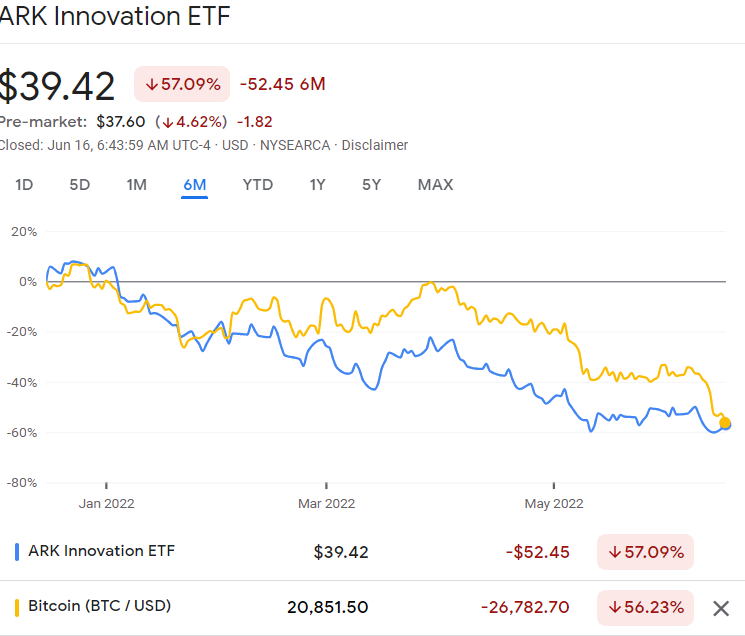
Whilst I suppose it could still theoretically be correct, the difficult position your thesis has is that it's currently being systematically dismantled.
It's falling just like a tool of rampant speculation would.
Inflation is becoming worse, but Bitcoin is falling harder.
A war started in Ukraine, and people fled to Gold, not Bitcoin.
It's not becoming less volatile, it's becoming more.
Your argument that BTC is still up from COVID lows higher than the stock market doesn't really hold water, and you know it.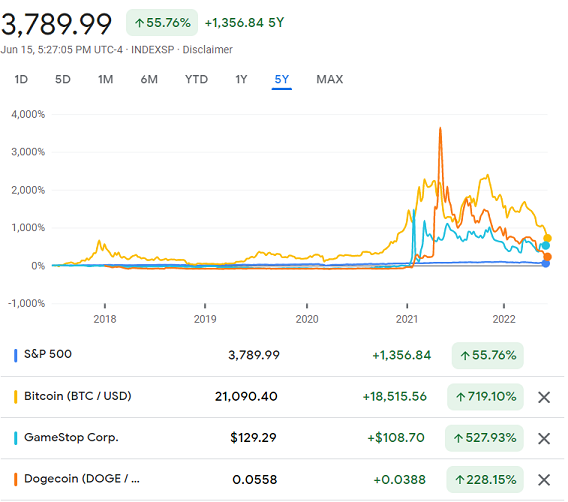
Because, look, so is GME. So is Dogecoin, for crying out loud.
Why do I pick those 2 to compare against? And why are those two still up against the stock market despite any rational person knowing that they're worth nowhere near that?
Well the other leading thesis is that they've all become a cult. Their temporary success has blinded a (now diminishing) cadre of people to their flaws, leading to all sorts of implausible claims engineered to create belief that number will continue to go up. There are diminishing but real sets of people who still believe in all of them.
It's also why ARKK hasn't had the good fortune to still be looking good. Ultimately, it's an investment in a hotchpotch collection of tech firms, not "the future of money". It doesn't have a story for people to believe in.
I think at this stage, everything has to go in reverse for your competing idea to be right. It's not enough for people not to trust the FED and go through a recession to suddenly love bitcoin. What's happening right now shows that. They also have to find a reason to believe in Bitcoin.
The trouble is that all Bitcoin is doing at present is giving people lots of reasons not to trust it.
2 -
Some good discussion at last, rather than the usual "bro" insults and repetitive drivel...
You make some good points @Frequentlyhere
I would say ARKK is a rubbish investment because they are essentially a mutual fund with Bitcoin + loads of sh*tcoins.
On the points of GME and Doge etc, they are simply flavour of the year meme stuff. Bitcoin has been crashing upwards since 2009.
Its violently volatile, but anyone buying it by now really should know what they are getting into...
0 -
0
-
As having confessed to NOT having read the whole thread I am in the advantageous or disadvantaged position of not being over-burdened with all the background.
The issue of this thread as shown in some recent posts and with many fora generally is that some - in my view far too many - derive satisfaction, reassurance and validation from the support from others who hold exactly the same views as they do. They also sometimes seem to then go on to hunt in packs and offer mutual support in deriding others. It often simply becomes disrespectful and in the end those with the most interesting views don’t bother which is a loss to those that like to hear other people’s views. The fact is that people who have identical views to one’s own may provide a feeling of safety but often prevent one from benefiting from considering and realising that one isn’t always right. You can only learn from people who hold views that are different from one’s own or who have views that you haven’t heard before. It also seems to me that when some find something in another persons views with which they disagree, they seem to need to find fault with everything they say. I am bewildered as to why so many are unable to agree completely with some of what something someone else thinks but not all of it. And some are selective about their use of history. A lot of the cleverest and dumbest people made a lot of cash out of tulip bulbs and a lot of clever and less clever lost. Perhaps some of the vlevere people understood the game better and hyped the investment and got out when their judgement was that there were sufficient people in the game for them to leave it too them. And what is wrong with that if you were one of those that got the timing right. Caveat emptor.
To me what has emerged from the thread is that too many want to simply argue about what the word “investment” means. Does it really matter, so long as people are able to make informed choices about what the risk actually is? Is a punter who believes themselves to genuinely be a racing horse expert see himself as a punter or investor and doesn’t it turn out rather to rely more on whether he has a great track record or poor track record?
Two people with the same set of “facts” can arrive at the opposite conclusions. One punter notices that the ball has fallen consecutively ten times on red at the roulette table and convinces himself that the chances are that therefore the odds are that the odds favour that it must be black the next turn. Another with the same facts is convinced that as it’s been red ten times in a row it must surely be red again next time. It turns out that the table is cleverer than both.
I’ve found Darren’s views - or what I think I understand of them - fascinating and I do so hope that the debate isn’t stifled by those that seem to enjoy stifling rather than being open-minded and treasuring breadth of opinion.
Jeff2 -
Frequentlyhere said:
To take the last point first, I think we should avoid using short-term performance as any sort of indicator of investment quality. Gamestop is still up >3000% since the covid lows, does that make it even better than bitcoin as an investment?
You say this, but then go on to make lots of references points to other short term events and performances. If you want to take a longer term view, thats something I very much agree with. How about we compare the performance of BTC vs other asset classes over the last decade? Your argument is not logically consistent.Frequentlyhere said:
My reference to the 70% drop wasn't to illustrate that BTC is a bad investment - that doesn't prove that. It was to say it's currently bad money. It's almost equally as bad that it's up whatever hundreds of percent since the covid lows. In my view your comparision point there is the £ or $, not the S+P 500.
If we look at a typical definition of money, we see it includes the need for it to be recognisable, and stable. Well, it's clearly not stable and it's clearly not being recognised for the vast majority of worldwide transactions either. From that list, I'd also argue it's nowhere near portable enough given the perils of storing it conveniently with any 3rd party at present.
The fact its unstable doesn't prove its bad money; it simply shows that for short term use its not ideal - which is why I, and many others here, suggest you buy it with money you won't need for years. You can't birth a multi-trillion dollar asset class without volatility. Have you seen a gold chart from say 1900? Lots of volatility in that which is conveniently forgotten about today.
As for recognisable, this doesn't mean 'accepted as payment.' You can convert Bitcoin very easily via an exchange in any country to any currency, that's pretty recognisable. Again, many people present the argument that Bitcoin isn't being 'adopted' because its instantly converted to whatever fiat currency the shop owner operates in, which kinda proves the point that it is recognisable as a money.Frequentlyhere said:
Re: the economic outlook, I don't disagree with your views on interest rates, but for me still there's an awful lot of words missing in how "challenging macroeconomic outlook and downward pressure on interest rates" becomes "bitcoin is the answer".
If everyone saw it, it wouldnt be at the price it currently is. For me, the key is what happens when we get to a point where the current tools don't work and how that plays out.Frequentlyhere said:
I've seen the "they won't have a choice' argument put forward before in reference to Govts, and I simply don't see how that can be the case. China has already banned bitcoin hasn't it? They seem to have had the choice. Meanwhile, in more delicate terms, the Western World is clearly on a path to regulate crypto extensively. It's well within their remit and power to do so.
If a Government says "bitcoin is illegal" whilst still theoretically being possible to transact in bitcoin using VPN's and specialist software, how many people in a normal population are going to be up for that? I'd put it at about 1%? That's not a viable option.
China have banned Bitcoin about 17 times. Of course, courts in Shanghai and Beijing recognised Bitcoin as property about a month ago; thereby unbanning it, again. They ban it every time it gets frothy, stopping their citizens from buying the top. But China and Russia have been incredibly strategic over the last decade dumping USTs and acquiring gold reserves. They know that no western country is going to willing pay for goods in RMB or RUB, so they are in need of a trustless international payment system....
Well, in every country that has banned Bitcoin previously, it has traded at a premium to the global market price, not a deficit. So data doesnt support your theory, but even if we assume it to be true there are however two key problems with this theory;
(1) The people that own Bitcoin tend to be educated, technical people with disposable income. These people have the ability to move elsewhere relatively easily (compared to say a labourer). You don't want to alienate these type of people for economic reasons. Then there's a load of productive capital in mining (US is now the largest single mining country) and BTC on the balance sheets of S&P500 companies. Its inflicting pain on oneself for no gain.
(2) Having a reserve currency is both a privilege and a burden. It ensures you run a fiscal deficit with the rest of the world; the Triffin dilemma. Many people making the argument that 'governments will ban it' just assume that reserve currency = power, but don't understand that it may not be in the US' interests to hold reserve currency status forever.Frequentlyhere said:
Re: "the volatility is decreasing over time" - is it? It's fallen faster and further in % terms than it did in 2018, doesn't seem like it to me.
Volatility is a mathematical quantity. Your opinion is not a calculation. Find a graph of BTC volatility and fit a trendline to it.Frequentlyhere said:
Re: "Bitcoin is the risk off asset and I think that will be vindicated in time" Well, it's certainly not behaving like one, and never has done yet in it's short history.
I have never made the point that Bitcoin currently behaves like a risk off asset. The argument is that it will do so in the future.Frequentlyhere said:
Re: "I have no issue with 'boom & bust' being 'situation normal' if it generates growth and prosperity at a higher average rate than any other system"
Well, so far capitalism under the $ has generated growth and prosperity by far and away better than any other system. Look at how rich the World has become since 100 or even 50 years ago - hugely.
I have no issue with capitalism. In fact, I think you can respresent my views as arguing for more capitalism, not less. I want failing companies to go bankrupt and have more profitable companies pick up those pieces and market share, thereby improving capital efficiency. This is prevented right now by lax CB monetary policy.
Whilst capitalism has been great overall, I would certainly contend that the current incarnation is not serving us as well because of the above. If you divide the markets by the increasing money supply, they have been flat for the last 15 years or so. I think that's a more realistic view of the current situation.Frequentlyhere said:
You say "The end state of Bitcoin will be a globally adopted asset that is incredibly liquid and stable".
Well, if that's right, but the path is potentially very long and uncertain as you seem to acknowledge, what's the value in buying so much of it now?
Right now its an investment because as it undergoes that monetisation process its buying power will increase. However, when it becomes stable it would be somewhere to store wealth but it won't be something to expect a return from.
At the end of the 19th century, Germany, the UK and other nations abandoned their silver standards and switched to gold. China and India remained on a silver standard. Gold appreciated in silver terms immensely over the next 50 years, essentially ruining the wealth that China and India had for almost a full century. Gold was a good investment at the onset of this because its purchasing power was set to increase, but now that its stable, people buy gold to maintain their purchasing power, not increase it.
Take the story above and replace gold with BTC and silver with fiat currencies. I expect it to play out over a far shorter timescale, but it will still take 10, perhaps 20 years, to fully complete.Frequentlyhere said:
Because as the hypothetical gradual population level realisation of its inevitability dawns, Bitcoin will either:
a) shoot up hugely in real asset-buying value, leaving oligarchic wealth in your hands and abject poverty to almost everyone else. Governments powerless to provide core services as they no longer hold the money. Normal people's pensions worthless, whilst Michael Saylor rules the World. Is that what we actually want the future of money to look like?
or
b) Be boringly stable, in which case why are you bothering to pin so much of your wealth right now in it when it's too soon and very difficult to say when all of this will happen?
There are too many strawman arguments in here to even begin discussing.Frequentlyhere said:
Meanwhile, let's say all the hurdles were overcome, if we all adopted bitcoin as a society, how would it be better? That's a genuine question. Would it abolish inflation without abolishing economic growth, somehow? Would it reduce inequality? Would it place power in better hands, and who would those hands be?
My personal view is that Bitcoin will exist in tandem with fiat currencies. However, the money supply will be negatively correlated with the Bitcoin price for each fiat currency individually. If you want to print to provide fiscal stimulus, your citizens have an option to opt out of your debasement. This provides;
An incentive for responsible central bank monetary policy. No longer can money be printed by those in power to maintain power or hand out to their cronies. Zombie companies go bust and those resources and workers are allocated to other sectors increasing overall productivity (which has been on a straight downward trajectory in most western countries btw). Moral hazard of companies running share buy back programs or gambling on CDOs is erased.
An incentive for long term strategic thinking by governments. If you're going to inflate your money supply, it better provide a corresponding boost in productivity. Right now, governments squander capital because its easy to print, I mean produce. The four year election cycle only exacerbates this problem. Capital becomes allocated more efficiently to projects that will provide returns over time. Right now, economic growth has been illusionary for the last decade or so and simply due to money printing in my opinion.
Decreasing inequality. All global citizens have access to a monetary savings layer preventing them from being taken advantage of. Its open and accessible to all. This works both on a nation to nation level, and within countries with class against class. Inequality in a fiat system trends up over time because well connected people are closer to the money printer and can therefore spend that money before the inflationary effect of that money has taken hold - the Cantillon effect. People protest about large BTC whales, but if these whales are not producing things of productive value to society continually then they will have to sell their BTC to live. Thus, over time, BTC is acquired by those that provide value to society and spent by those that are no longer producing. This is the same process that causes many millionaires inheritances to disappear after a number of generations. It gives everyone an equal playing field.
Decreasing financialisation of goods needed to live. Houses have both a utility value and an investment value presently, because people that generate excess value want somewhere to put their wealth that won't debase. These people know that saving hundreds of thousands in fiat currencies is a bad idea, but by financialising things like RE and equities we have priced normal people out of home ownership and priced companies at ridiculous P/E ratios. This is a direct result of bad money which has caused other things to be used as money. If the world has an easily accessible financial product to absorb this excess monetary value, the value of these goods that people need to live is removed of the monetary premium they currently possess. We all accept gold has an 80 - 90% monetary premium, but people are less aware that RE and equities also have a monetary premium (albeit for far less as a %).
Trustless international trade, with aligned incentives. The network belongs to all, so it can't be manipulated by any single participant (and if they have 51% power, they are incentivised to protect the network, not destroy it). China, India & Russia aren't going to want to use SWIFT ever again given that the US just confiscated $600BN dollars because they didn't like something Russia did. Many countries would not wish to use the Chinese payment system, and indeed, China probably does not want an open capital account and reserve currency status itself anyway. So how are we going to conduct international trade between participants that don't trust each other to run the system in a neutral way? The answer is to have a credibly neutral system ran by code and self interested participants.
Hardly.Frequentlyhere said:
Whilst I suppose it could still theoretically be correct, the difficult position your thesis has is that it's currently being systematically dismantled.Frequentlyhere said:
It's falling just like a tool of rampant speculation would.
Actually, I think I have others have made it very clear that we expect cyclical price action due to the Bitcoin halving events reducing the issuance of supply. I knew when I bought it that it would go up a lot, then down a lot, then up a lot more, then down a lot and so on....
The problem with your argument is that it doesnt hold up to scrutiny because people made this argument in 2018 when Bitcoin started falling from $20k and detractors said the ponzi was finally unravelling. But yet here we sit with Bitcoin having gone substantially beyond that previous ATH and you still making the same argument. And when, in a few years time, Bitcoin goes beyond $70k again, detractors on this forum will no doubt tell me that this isn't evidence of anything. Ponzi schemes and tools of rampant speculation don't reinflate repeatedly over yearly timescales.
If there was one up and then one down, you might be correct. Many 'alt coins' were bubbles and will never come back (safemoon, luna etc) but the argument can't be true for something that has undergone this process multiple times now with an overall upward trajectory. You argue that using short term data is irrelevant but then ignore the long term data; A moving average for Bitcoin over a long enough time line is basically straight up.Frequentlyhere said:
Inflation is becoming worse, but Bitcoin is falling harder.
I have stated in this thread that Bitcoin is not an inflation hedge; it is a debasement hedge. I changed my mind on this about 18 months ago and you can search that phrase and see that I've posted it about 3 times ITT already. I don't expect Bitcoin to go up just because inflation is high.Frequentlyhere said:
A war started in Ukraine, and people fled to Gold, not Bitcoin.
Gold price on 24 February 2022 (Invasion date): $1900
Gold price now: $1830
Not sure your assertion is correct (or in any way relevant to BTC price tbh)Frequentlyhere said:
It's not becoming less volatile, it's becoming more.
Again, this is your perception. It is however factually incorrect. Volatility is math, it doesn't care what your perception is.Frequentlyhere said:
Because, look, so is GME. So is Dogecoin, for crying out loud.
Why do I pick those 2 to compare against? And why are those two still up against the stock market despite any rational person knowing that they're worth nowhere near that?
Well the other leading thesis is that they've all become a cult. Their temporary success has blinded a (now diminishing) cadre of people to their flaws, leading to all sorts of implausible claims engineered to create belief that number will continue to go up. There are diminishing but real sets of people who still believe in all of them.
Have you seen a long term graph of Dogecoin? It looks like this;
Again, its hypocritical to compare something with price action like this (which basically screams 'pump and dump') with Bitcoin, which as stated earlier is basically up and to the right over a long term timeline.
Sure, its absolutely a cult. I ignored DOGE because it lacks the fundamental properties that make BTC great and I, incorrectly, assumed that people would realise this. For starters, DOGE has an inflationary money supply and poor chain security (it doesnt even have its own miners). DOGE is an advert for peoples stupidity. My opinion is that the value of DOGE is ~$0 and the value of BTC is several hundred $k. Over time, the fundamentals catch up to the price - which is what you are seeing above in the case of DOGE and in the BTC price chart.
As to the rest, Bitcoin is money and money is backed by faith that you believe this thing will be valuable in the future. As people lose faith in central banks, they will turn to something else to have faith in. You can call that a cult if you want, but that's basically what we have now where we all believe that a dollar will have value in the future for little reason other than it did in the past.Frequentlyhere said:
I think at this stage, everything has to go in reverse for your competing idea to be right. It's not enough for people not to trust the FED and go through a recession to suddenly love bitcoin. What's happening right now shows that. They also have to find a reason to believe in Bitcoin.
You're partially correct. I do think Bitcoin has an image problem which is holding back adoption. Terra has nothing to do with BTC, but people believe it does. That's incorrect, but I can agree that people need educating on the distinction.
However, the reason to believe in Bitcoin will become obvious to all when they look around them and see who is doing well and who isn't. Results speak volumes. If Bitcoin spends a year or two around here and then goes to $100k there will be people that find this thread and see us discussing it having 'crashed' by 70% to $20k and see the bigger picture. Over the last two years, the people that dismissed Bitcoin have begrudingly accepted it and bought in. In 2017, Dimon said that if he caught anyone buying it he would sack them. Now, its regularly discussed on financial news shows. Acceptance is broadening.
When you look back and see tweets like this, it gets harder and harder for people to maintain credibility whilst dismissing Bitcoin.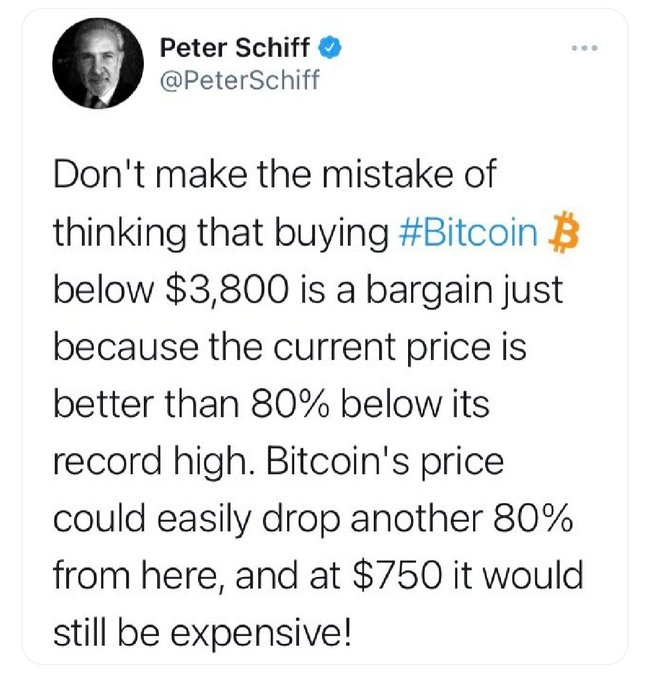
And then when he follows it up with this;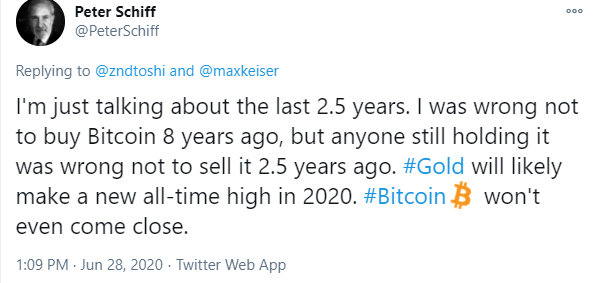
3










Confirm your email address to Create Threads and Reply

Categories
- All Categories
- 355.7K Banking & Borrowing
- 254.9K Reduce Debt & Boost Income
- 456.1K Spending & Discounts
- 248.3K Work, Benefits & Business
- 605.9K Mortgages, Homes & Bills
- 179K Life & Family
- 263.7K Travel & Transport
- 1.5M Hobbies & Leisure
- 16.2K Discuss & Feedback
- 37.7K Read-Only Boards