We’d like to remind Forumites to please avoid political debate on the Forum.
This is to keep it a safe and useful space for MoneySaving discussions. Threads that are – or become – political in nature may be removed in line with the Forum’s rules. Thank you for your understanding.
📨 Have you signed up to the Forum's new Email Digest yet? Get a selection of trending threads sent straight to your inbox daily, weekly or monthly!
Triple lock increase for April 2027 is 3.9% (probably)
Comments
-
Of course we aren't in a demographic steady state because the number of births has been below the replacement rate of about 2 (or 2.1) children per female.
If we were in a demographic steady state, a link to solely earnings would make perfect sense. With demographic issues added there is a question mark about such a link. Doesn't mean we shouldn't do it but if an unintended consequence was that SPA went up further to deal with the demographic issue, I don't think that would be a good thing.
Even in a steady state the triple lock is unaffordable long term because it outputs increases above earnings increases over time, but as we have the demographic issue also it's even less affordable.
The triple lock has done a useful job in bringing up the state pension to a reasonable level after many years of inflationary increases only, but there is no stop switch that politicians of all parties, motivated by getting elected are willing to press.
I came, I saw, I melted1 -
Agree although I thought the increase in SPA was more related to longevity than falling birth rates, the latter is a new and more difficult problem
I think....1 -
You're missing the impact of net immigration. The UK population is actually increasing, despite the low birth rate, so the birth rate is largely irrelevant to the affordability or otherwise of pensions. Lets not get into the politics around that though or bye bye thread.
1 -
Certainly you read that it is about longevity, or more precisely the proportion of adult life spent in retirement. People are projected to live longer but if their working lives are proportionately longer too because of existing legislated SPA increases, it cancels out. When you look at the data you come to the conclusion it isn't about the proportion of adult life spent in retirement, although I've not heard anyone else say that.
As part of the third state pension age review the Government Actuary is required to produce a report that looks at whether the rules about pensionable age mean that, on average, a person who reaches SPA within a specified period can be expected to spend a specified proportion of their adult life in retirement. The Government Actuary has been asked to give figures based on proportions of 30% ('to account for historical data showing that average retirement proportions have fluctuated between 30% and 31% in recent years'), 32% (the % from the first review) and 31% (the % from the second review). But the methodology and data (the 2022 mortality projections) are all set out so we can do the calculations now and I have done. It isn't difficult and anyone with a reasonable grasp of numbers can replicate this.
If you look at the blue line you will see that by the time the legislated transition of SPA from 67 to 68 is due to start in 2044 the proportion of adult life spent in retirement has only just got back up to around the current figure just before the current transition from SPA 66 to SPA 67. So why the need to accelerate the SPA increase to 68?
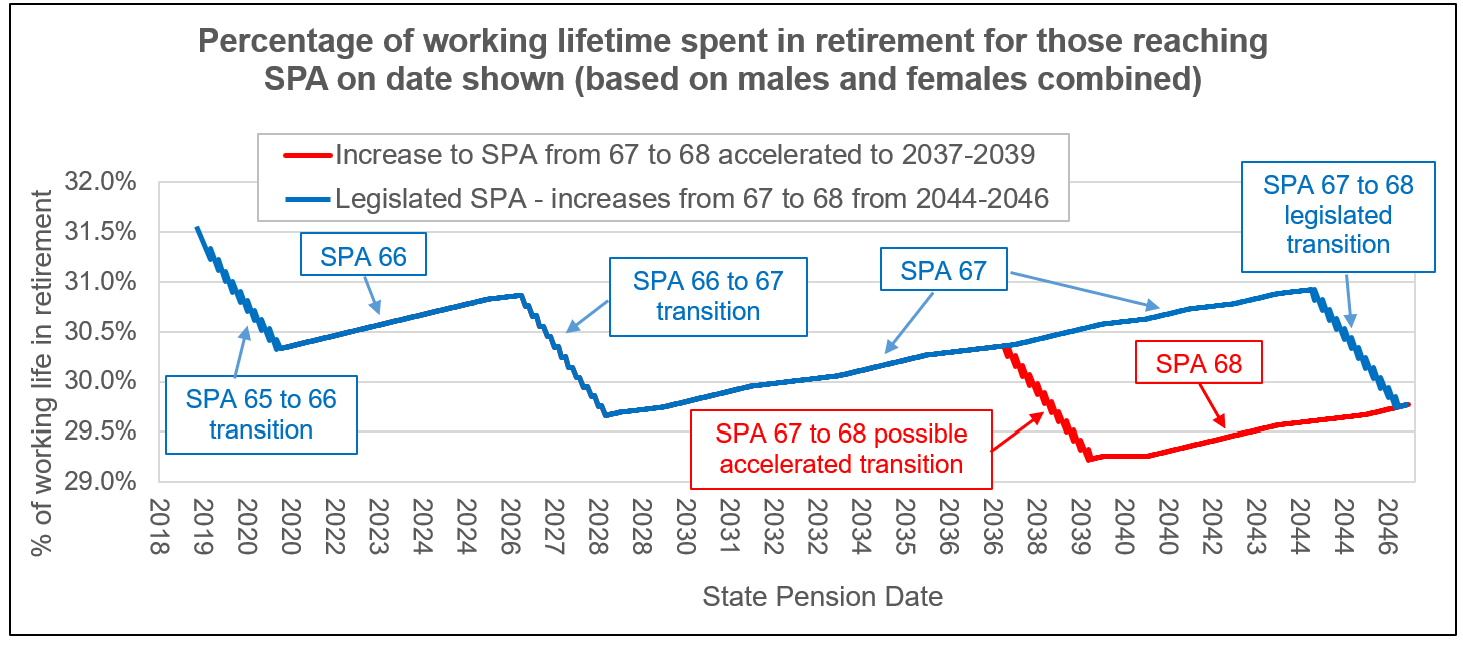
To justify accelerating of SPA from 67 to 68 to 2037-2039 they've got to change the target proportion of adult life to close to 30%, 31% won't cut the mustard.
When they first came up with this proportion methodology following the 2013 autumn statement they were using a constant 33.3% (one third) proportion. This constant lasted exactly zero reviews, because Cridland in the first SPA review in 2017 reduced that to 32% arbitrarily to 'justify' a recommendation of the acceleration from SPA 67 to SPA 68 to 2037-2039 (the red line above but based on earlier mortality projections). And then the second SPA review in 2023 arbitrarily reduced the constant proportion to 31% to 'justify' accelerating the SPA increase from 67 to 68 to 2041-2043 (projected life expectation had reduced since the first review).
And now projected life expectancy has again reduced. So if they want to justify 2037-2039 for the SPA 67 to 68 increase from the awaited third pension review they are going to have to reduce the constant proportion to nearer 30%. My understanding of a constant as something that doesn't change over time is clearly wrong. They could of course abandon the proportion criteria completely and switch to a fiscal rule stating that total government spending on the State Pension should be capped at some maximum of GDP to bring in demographics.
It is worth saying this is all based on mortality projections produced by the ONS which assume a long term improvement of mortality of 1.1%pa (at ages up to 90). Of course this 1.1% can only be a wild guess. Where current actual mortality factors in, is in the starting rates and taper to this improvement rate, which is based on current trends. And it is those starting rates and current trends that have been pushing estimates of future projected life expectancy down.
Meanwhile many of the papers have been reporting that the government have been confirming that the SPA 67 to 68 increase will be accelerated to 2037-2039. This is on the basis of the OBR using 2037-2039 in their July 2026 Fiscal Risks and Sustainability report, but that is something they have doing since the first SPA review. The wording has changed a bit but you can't easily read anything new into that.
If the government do want to accelerate the SPA 67 to 68 timetable to 2037-2039 they will need to report before April 2027 (because of the 10 year notice principle). At the moment they seem to have linked the SPA review to the Pension Commission findings which some might think is a delaying tactic. If the SPA increase to 68 is accelerated you can see a political opportunity for opposition political parties to oppose this and like removing the triple lock it could be a vote loser.
I came, I saw, I melted10 -
Presumably at some point the complexity/expense/loss of tax revenue of trying to bodge it becomes so high that just updating DWPs systems to handle PAYE becomes the cheaper option
1 -
You raise a good point and agree let's avoid things that will get the thread removed.
I can't say I've studied it carefully, so welcome any challenge to what I'm saying, but I am going off information such as the ONS National Population Projections where they say
Old-age-dependency ratio
The numbers of people in each life stage are used to calculate dependency ratios, which inform government financial planning. A common measure is the old-age-dependency ratio (OADR), which is the number of people of pensionable age for every 1,000 people of working age. It is projected that OADR will increase from 280 in mid-2024 to 310 in mid-2034, and reach 329 by mid-2049.
To keep the OADR flat using migration alone, a country would require exponentially escalating waves of new, younger immigrants every year to offset the ageing of previous arrivals. So even if the population is increasing because net migration offsets the shortfall of births relative to deaths, that doesn't mean the OADR can't increase over time.
'Pensionable age' means State Pension Age based on current legislation.
At face value that does suggest at first glance demographically there is an issue (?)
I came, I saw, I melted0 -
Doing some back of the envelope calculations:
Given that the proportion of adult working life spent in retirement is lower in mid-2049 to that in mid-2024 (and so none of that increase from 280 to 329 can be attributed to an increased proportion of working life spent in retirement) that means that at least an increased relative spend of 17% (= 329/280 - 1) on state pension because of demographics is involved over the period 2024 to 2049.
That equates to about 0.7%pa. And so perhaps a best estimate is that state pension has to increase at 0.7%pa below earnings, while keeping the proportion of adult life spent in retirement constant by sticking to the legislated SPA increases, to keep the cost of state pension under control. That's taking into account the need to balance the interests of working age people and pensioners, and assuming a balanced cost is the sole criteria we are using
I came, I saw, I melted2 -
All these posts are assuming that every pensioner gets the new SP minimum which will breach the tax allowance. New SP introduced 2016! M
Many SPs are on old SP where the minimum is way below 13K.
So ….. will anybody on the basic old SP who gets a small 'other' pension which brings them to the same level as the basic new SP be taxed? Guess so!
Unfair? I think so.
(Disclosure: I deferred old SP for several years and benefit from the 10% interest rate accumulated. I also have DB pensions so do pay tax via PAYE and am not affected by the tax argument. However I would prefer my old SP to increase annually by a fair amount - not all of it does increase. Some of how it is made up appears to be static. However I could be wrong - math was a struggle at O level though got it in the end!)
1 -
I'm not sure that everyone is assuming that every pensioner receives the new SP, but suspect that most posters are focusing specifically on the thread topic, i.e. the 2027 triple lock increase, rather than comparing future taxation of old and new schemes, or the differential increases applied to the separate components of the 'old' SP…
0 -
Wow. I had missed the detail of the percentage reduction having just read the headline text of keeping the proportion fixed (which is problematic on its own with healthy life expectancy standing still). It is one of those where probably very few understand the scale of the impact from what sounds like a rounding error. Given most can't even see the wood from the trees between the gross extra increase in the state pension and the change in real post tax pensioner income, we get the governance we deserve.
I think....1












Confirm your email address to Create Threads and Reply

Categories
- All Categories
- 355.8K Banking & Borrowing
- 254.9K Reduce Debt & Boost Income
- 456.2K Spending & Discounts
- 248.3K Work, Benefits & Business
- 605.9K Mortgages, Homes & Bills
- 179K Life & Family
- 263.8K Travel & Transport
- 1.5M Hobbies & Leisure
- 16.2K Discuss & Feedback
- 37.7K Read-Only Boards