We’d like to remind Forumites to please avoid political debate on the Forum.
This is to keep it a safe and useful space for MoneySaving discussions. Threads that are – or become – political in nature may be removed in line with the Forum’s rules. Thank you for your understanding.
📨 Have you signed up to the Forum's new Email Digest yet? Get a selection of trending threads sent straight to your inbox daily, weekly or monthly!
Triple lock increase for April 2027 is 3.9% (probably)
Comments
-
A few jabs of Ozempic will sort that problem out! Or a stockpile of chocolate.
I'm a Forum Ambassador on the housing, mortgages & student money saving boards. I volunteer to help get your forum questions answered and keep the forum running smoothly. Forum Ambassadors are not moderators and don't read every post. If you spot an illegal or inappropriate post then please report it to forumteam@moneysavingexpert.com (it's not part of my role to deal with this). Any views are mine and not the official line of MoneySavingExpert.com.1 -
"Not sure there is any other way to look at this"
Well, here's one other way: If you were previously on £12,500, you will need to be on £12,500+CPI of 3%, or £12,875 in order to continue to buy 12,500 chocolate bars.
The triple lock of 3.9% raises your £12,500 to £12,987, which costs you £83 in tax, leaving you with £12,904, which will buy you 12,528 chocolate bars. So slightly better off.
3 -
Whether you take the affect on income tax of the freezing of the personal allowances into account, in assessing the April 2027 state pension increase, depends on the question you are asking.
Let’s consider as an example someone who is a basic rate (20%) taxpayer and not pushed into higher rate tax by the higher rate allowance freeze. Then two questions for example you can ask are:
Question 1:
Will the state pension income of someone in receipt of full new state pension, after allowance for deduction of income tax, increase by at least inflation into 2027/2028, if their state pension increase is 3.9%?
Answer 1:
If inflation is more than/less than 3.1% (= 3.9% x 0.8), then their net state pension income will increase by less/more than inflation*.Question 2:
In terms of after tax income, is a state pensioner relatively 'better off' than a worker of working age, if they get a 3.9% average earnings increase to their state pension?
Answer 2:
A worker is affected by the personal allowance freezes, as is the state pensioner. So one way of looking at this is to say if the pensioner receives an average earnings increase of 3.9%, then their increase taking into account tax is the same as that of an average worker.*Although in 2026/2027 the full new state pension is below the personal allowance it is assumed to be reasonable to take into account the effect of the loss in relation to the remaining personal allowance above the new state pension in this calculation. For the April 2028 increase it will be more obvious it is reasonable to take the full affect of the allowance freeze into account as the state pension is above the personal allowance in both 2027/2028 and 2028/2029.
I came, I saw, I melted2 -
Indeed, I used cpi of 3.2%. I guess relevant number is next April reading.
Either way no where near the 488 quid the BBC etc reporting suggests. Perhaps we need to have a default real terms filter applied to all such reporting and then they can move on to the nuances of the tax threshold freeze.
Salience for this board is that a retirement plan involving a fixed real terms gross income is potentially (probably) actually a plan for long term falling real net income and that to maintain your spending power through a 30 or 40 year retirement you actually need a gross income that increases in real terms year on year. Good luck finding such a guaranteed product.
I think....0 -
I think most people would get very confused if the BBC ( or others) only reported the real increase.
Perhaps we need to have a default real terms filter applied to all such reporting
So to follow this through- then all Media; Govt. and opposition party announcements/policies should be presented 100% accurately and all caveats explained fully and with no spin?
Not going to happen.
3 -
Allowing for basic rate tax and the personal allowance, in particular the loss in real terms of spare personal allowance to offset against other taxable pension income historically, then I calculate, hopefully correctly, the actual real increases over CPI since the introduction of the new state pension are as follows in purple. I've shown the real increases also that don't allow for tax alongside in yellow. I've assumed September CPI is 3.2% for the increase into 27/28 which is what is currently predicted. And that additional private pension taxable income is enough to push the pensioner into basic rate tax throughout the period, so at least about £3,200 per annum in 2017/2018.
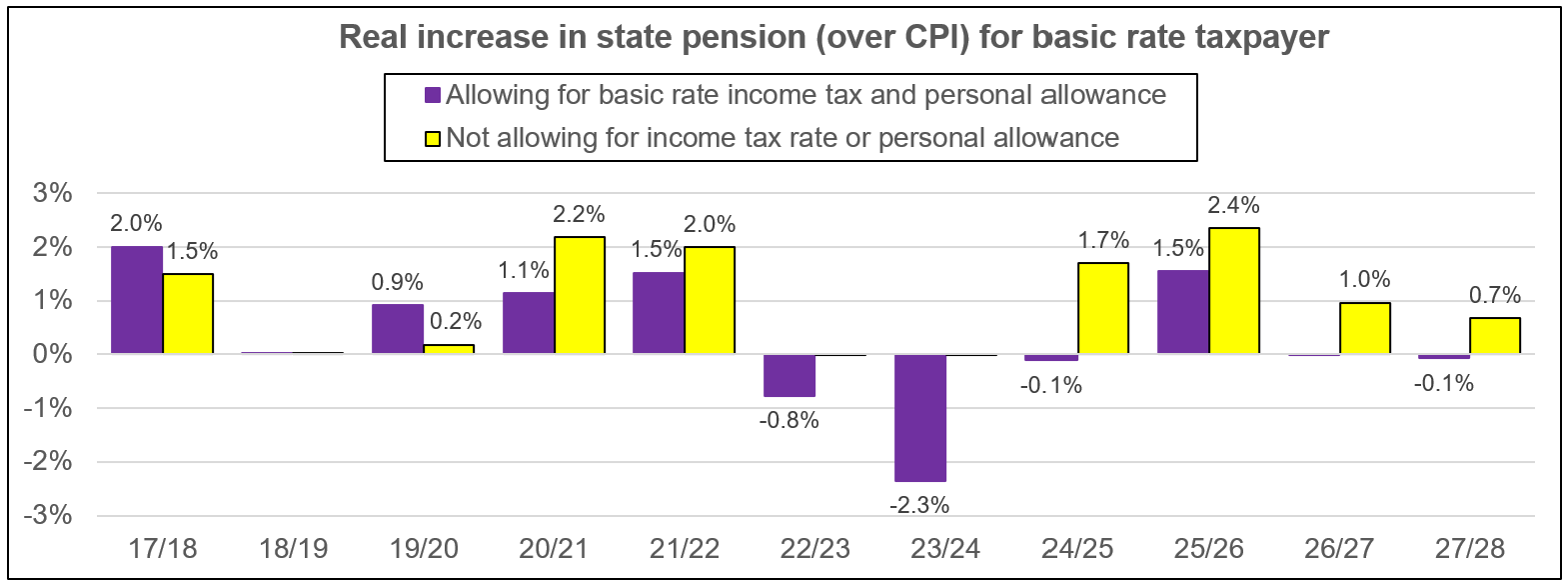
Overall and allowing for compounding the full new state pension has increased by 1%pa above CPI since its introduction. But allowing for the tax affect it has increased by a lower 0.3%pa above CPI inflation.
I came, I saw, I melted1 -
Doesn't answer 2 need to factor in employee National Insurance, where theresholds are also frozen?
0 -
The new information that has come out following Torsten Bell's (minister for pensions) statement to Martin Lewis yesterday is that we will find out more about how they will address the issue of the commitment in the budget. That commitment was stated in the budget as
The government will ease the administrative burden for pensioners whose sole income is the basic or new State Pension without any increments so that they do not have to pay small amounts of tax via Simple Assessment from 2027-28 if the new or basic State Pension exceeds the Personal Allowance from that point.
Almost certainly (because of subsequent comments for example given to Martin Lewis in an interview following the budget by Rachel Reeves and information given to the press following Andy Burnham coming into office) this will mean those small amounts of tax will be written off over the duration of the parliament for this very specific cohort. But there is nothing I can see in Torsten Bell's statement yesterday to confirm absolutely that the tax will be written off, despite what Martin Lewis implies. All the statement says is that this cohort won't have to pay the tax in a way that involves administrative burden.
I came, I saw, I melted1 -
I don't see that the simple assessment is any form of admin burden, they send a bill, you pay it, job done, surely?? As the emphasis for the policy is on reducing the admin burden for the pensioner rather than HMRC....
......Gettin' There, Wherever There is......
I have a dodgy "i" key, so ignore spelling errors due to "i" issues, ...I blame Apple 1
1 -
they’ve been doing it so far but presumably it’s a small volume of people with odd pensions? From next year it’ll be everyone in receipt of full new state pension
0















Confirm your email address to Create Threads and Reply

Categories
- All Categories
- 355.8K Banking & Borrowing
- 254.9K Reduce Debt & Boost Income
- 456.2K Spending & Discounts
- 248.3K Work, Benefits & Business
- 605.9K Mortgages, Homes & Bills
- 179K Life & Family
- 263.8K Travel & Transport
- 1.5M Hobbies & Leisure
- 16.2K Discuss & Feedback
- 37.7K Read-Only Boards