We’d like to remind Forumites to please avoid political debate on the Forum.
This is to keep it a safe and useful space for MoneySaving discussions. Threads that are – or become – political in nature may be removed in line with the Forum’s rules. Thank you for your understanding.
Triple lock increase for April 2027 is 3.9% (probably)
Comments
-
we’re about 10 years out from pension freedoms and autoenrollment being more widespread. Perhaps a good time to have an independent review of how private pensions under autoenrollment are tracking vs where they think they shoudl track in providing an income? combine that with refreshing the needs of the SP
the fact theyr’e potentially 10 years apart makes it a little hard to combine them unless they’re suggesting people really retire at 70 (surely SP is trending towards that). so some staircasing/phasing has to be assumed I would think
output could be a recommendaiton to phase out triple lock and replace with a tie to earnings/CPI/minimum wage, an adjustment to autoenrolment to address any gaps there etc.
0 -
Former MP John Redwood has an unusual opinion as to the affordability of the triple lock:
Factual comments (that is, not simply political opinions) are welcome!
1 -
Affordability of an expenditure area cannot be discussed in isolation. Any one thing is almost certainly affordable; all spending pressures together are probably not.
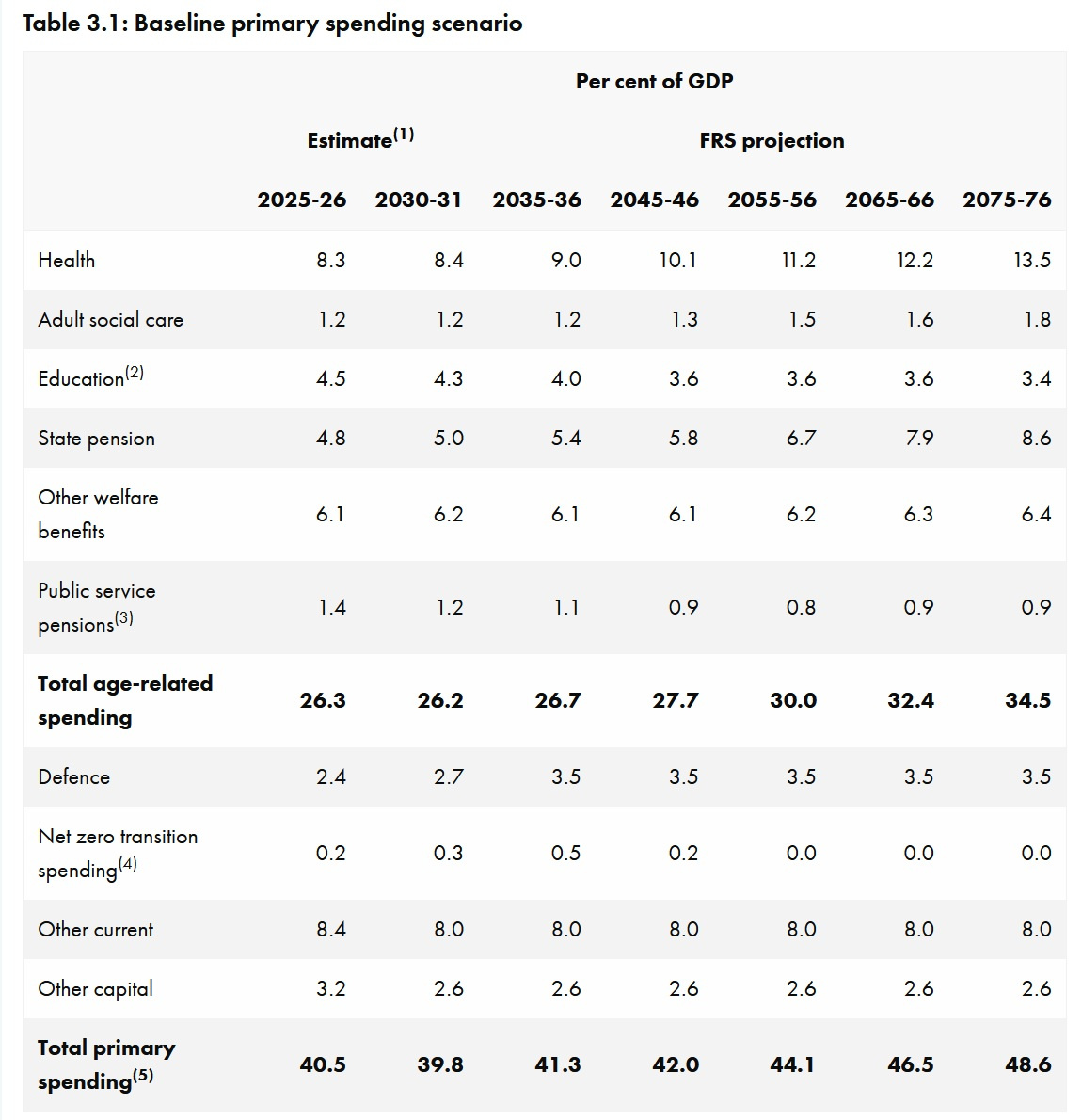
The long-term picture is very challenging, as the OBR sets out:
Servicing the growing national debt burden is in addition to this, with both the level of debt and the yield increasing. meaning the UK is spending about twice the amount on debt as it is on defence.
With age-related spending forecast to grow by nearly 50%, from 26% of GDP to 34.5% over the next 50 years, there needs to be a coherent plan for the growing cost of age-related health and State Pension expenditure, which are the major components of spend. Social care needs to be a part of that too.
Unfortunately, I suspect that the nature of politics being what it is, the table above will be interpreted as no big problem for the next 20 years, so no need to do anything until then. As long as the debt-as-a-share of GDP ratio is forecast to fall in 5 years time (even if under optimistic assumptions), all is good.
6 -
there used to be a higher personal allowance for older people; the world managed to cope
0 -
surely most of these activities contribute to GDP as much as they cost. For example, if you cut pensions, pensioners spend less and shops and manufacturers suffer reduced business. The money doesn’t disappear, it recirculates. Paying for the services only becomes an issue if it results in a labour shortage elsewhere in the economy.
Given the greatly reduced number of directly productive jobs over the past 100 years labour shortage would not seem to be an issue. AI tells me that over the past 100 years the % of working people in manual occupations (skilled and unskilled) has reduced from about 75% to 20%.
0 -
surely most of these activities contribute to GDP as much as they cost.
Why don't we dedicate 100% of GDP to pensions then.
The question really has to become how much of a % of GDP are we happy spending on pensions, considering there'll be many other things competing for spending commitments too, alongside the need to get the public finances on a stable footing for the future generations.
The table hugheskevi sent conveys this problem nicely.0 -
Surely it's not pound for pound? I don't know how much is recirculated but I'd have thought it would be substantially less than 100%, albeit not 0% either…
1 -
- Because by definition gdp covers all activities, so there would be nothing else that could be done. How would pensioners spend their money?
- If income is far in excess of consumable needs the result is going to be high inflation in asset values.
0 -
Interesting, it seems by far the two most significant increases in spending pressures over the next half century are predicted to be health and state pension.
For health, the increase is hardly anything to do with demographics (so it's not the "ageing population" we keep hearing about) - look at the alternative scenario in 3.17 where "additional cost pressures" other than demographics and income are removed, there's hardly any increase wrt GDP over 50 years. These "other pressures" appears to be lower productivity growth in healthcare (maybe AI to the rescue?) and increase in chronic conditions (maybe new drugs/treatments could help).
For the state pension it's interesting that the growth wrt GDP could be almost be halved if earnings were used alone rather than the triple lock. Which might seem a bit odd as earnings are usually the higher and so the triggered measure, and over the long term will almost certainly be the higher measure.
It comes about because of the "lumpiness" of using individual years, as demonstrated during COVID when sticking with the triple lock would have resulted in a massive anomalous increase in state pension due to earnings plummeting about 10% and then recovering about 10%. They "suspended" the triple lock that year as the anomaly was widely recognised and there wasn't much of an outcry. But this effect happens regularly at a much smaller level, but cumulatively over 50 years will have a big effect.
So perhaps the triple lock could be kept but worked out on a long term index base, ie from a base year eg 2026, the state pension will be the higher of the 2026 amount indexed by earnings, CPI or 2.5% compounded annually since that base year not since the previous year. This would almost certainly give the same long term result as if only earnings was used as that'll probably be the higher long term increase, and it will keep the promise that the state pension will keep pace with earnings/CPI/2.5% whichever is the higher.
0 -
Comparing that table with the predicted rise in pensioner numbers shows that although the state pension %GDP cost per head will increase marginally the predicted total age related %GDP cost per head will actually decrease. The problem is not the triple lock but the number of pensioners. The biggest rise in pension costs will be with those born this century so maybe a case of turkeys voting for Christmas.
Never associate with idiots on their own level, because, being an intelligent man, you'll try to deal with them on their level - and on their level they'll beat you every time.
Being hated by idiots is the price you pay for not being one of them.
Jean Cocteau 1889-1963
2















Confirm your email address to Create Threads and Reply

Categories
- All Categories
- 355.8K Banking & Borrowing
- 254.9K Reduce Debt & Boost Income
- 456.2K Spending & Discounts
- 248.3K Work, Benefits & Business
- 605.9K Mortgages, Homes & Bills
- 179K Life & Family
- 263.7K Travel & Transport
- 1.5M Hobbies & Leisure
- 16.2K Discuss & Feedback
- 37.7K Read-Only Boards