We’d like to remind Forumites to please avoid political debate on the Forum.
This is to keep it a safe and useful space for MoneySaving discussions. Threads that are – or become – political in nature may be removed in line with the Forum’s rules. Thank you for your understanding.
📨 Have you signed up to the Forum's new Email Digest yet? Get a selection of trending threads sent straight to your inbox daily, weekly or monthly!
33% domestic stocks bias
Comments
-
Very interesting indeed. Some fixed income does seem sensible in medium term. How much have you allocated? What about value vs growth stock?Alexland said:
I think it depends on where valuations are at the time and how close you are to retirement.thegentleway said:The consensus is that 100% equities (assuming you have the risk tolerance and capacity) is preferable for accumulation phase.
Maybe equities will do best over the very long term but over the medium term the jury is out on if equities will outperform bonds - it might be another decade like 2000-2010 where equities start very overvalued and bonds start attractively valued and so do better.
To quote the CEO of Vanguard at the recent Bogleheads conference (from 41min) "we think the 10 year environment for bonds is extraordinarily good both as a diversifier of equities as well as a source of return".
A few years ago (before their prices crashed) I was arguing here that bonds were overvalued and people shouldn't blindly follow portfolio theory to assume they reduce risk in a portfolio. Now I'm arguing the opposite that bonds are good value and people should't assume equities will beat them in the medium term.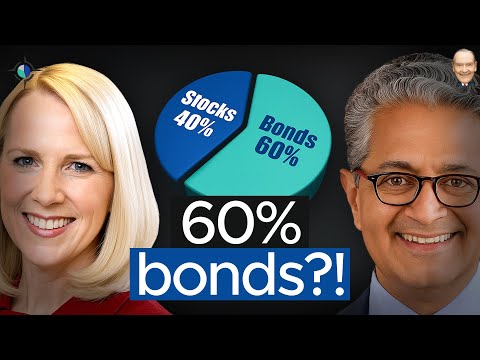 https://www.youtube.com/watch?v=CnzQ2EEgyecNo one has ever become poor by giving0
 -
This "clearly defining my objective" is something that resonates strongly with me and is something I have been trying to really grasp in the past couple of months.Linton said:The more you can define your objective in numerical terms, say £x as a lump sum in time y or an income of £x rising with inflation for the next n years, the easier it is to choose appropriate investments. This should reduce the chance that you will choose unnecessarily risky ones that result in failure to meet the objective. Conversely it should help keep you ambitions within reasonable bounds.
But of course circumstances may lead to a change in objectives. The expectation should be that you will also need to change your investment allocations.
I believe I have enough money with DB and SP pensions and cash and investments. I don't believe I need to take unnecessary risks now. However, I have a huge FOMO and have struggled to get over this. This is just a psychological thing.
I have now got to a point of being more sensible and have a very clear objective for my future finances. Much of this is about removing financial risk for the rolling next 10 years (to ensure I have my desired income). I have sold equities and MA funds to invest in ILGs (holding to maturity) to give me a guaranteed income for the next 10 years - subject to neither inflation or investment risk. I plan to sell equities each January to add an additional year of ILGs. If ILG prices are too high, I can wait for years to buy). I am sure I may sacrifice returns by doing this, but I know I have a rock solid income for the next 10 years. It took me a very long time to conclude what my real financial objectives are in retirement - but I have got there and this has given me a real sense of achievement and settled me more.2 -
I'm now around 50/50 equities and bonds. I have already in my 40s (and despite a pension sharing withdrawal) made all the required pension contributions and benefited from sufficient investment growth to retire early on more income than I currently spend so only need gains of around 2% above inflation on my portfolio for the rest of my life to meet my investing objectives. Even during the brief and modest Covid crash there were days where my mostly equities portfolio was dropping by more than I would spend in a year. I don't want to see my portfolio crash 50% and take many years to recover especially when there are other decent return and mostly uncorrelated things I can now invest in.thegentleway said:Very interesting indeed. Some fixed income does seem sensible in medium term. How much have you allocated?
I've got no skill in guessing which factor will do better over the next period so I just use Developed World trackers for equity exposure. People may think that's US heavy and incomplete without Emerging Markets exposure but I am diversifying with bonds and you can never really own Chinese companies anyway and I've had better performance over recent years avoiding them. Trackers still contain a lot of value shares it's just that those companies are lower valued so are a smaller proportion of the asset value.thegentleway said:
What about value vs growth stock?4 -
Very impressive. Must have made some serious contributions or have a very modest lifestyle, probably both to get financial independence so early. Do you have any children? Mine are very young so the world has plenty of time to change until they get to working age but currently the young generation don't have the opportunities I had to make money. In particular home ownership is out of reach and University comes with ridiculous debt. I'm keen to continue growing my investments so I can help them buy a house each, pay for University etc...Alexland said:
I'm now around 50/50 equities and bonds. I have already in my 40s (and despite a pension sharing withdrawal) made all the required pension contributions and benefited from sufficient investment growth to retire early on more income than I currently spend so only need gains of around 2% above inflation on my portfolio for the rest of my life to meet my investing objectives. Even during the brief and modest Covid crash there were days where my mostly equities portfolio was dropping by more than I would spend in a year. I don't want to see my portfolio crash 50% and take many years to recover especially when there are other decent return and mostly uncorrelated things I can now invest in.thegentleway said:Very interesting indeed. Some fixed income does seem sensible in medium term. How much have you allocated?
And you're not 100% bonds because there's a risk that indexed linked bonds won't return 2% above inflation in perpetuity?
Very interesting. Isn't it the same though. I.e. growth stocks are massively overvalued but not value stocks so makes sense to diversify into value stocks, like it makes sense to diversify into fixed income?thegentleway said:
I've got no skill in guessing which factor will do better over the next period so I just use Developed World trackers for equity exposure. People may think that's US heavy and incomplete without Emerging Markets exposure but I am diversifying with bonds and you can never really own Chinese companies anyway and I've had better performance over recent years avoiding them. Trackers still contain a lot of value shares it's just that those companies are lower valued so are a smaller proportion of the asset value.
What about value vs growth stock?No one has ever become poor by giving0 -
Yes probably an average of around 25% total pension contributions since I got my first proper job which worked great because having that income automatically taken each month has always given me the motivation to work at a slightly higher level to get enough take-home pay than I otherwise might have settled at.thegentleway said:Very impressive. Must have made some serious contributions or have a very modest lifestyle, probably both to get financial independence so early.
Annoyingly I'm not financially independent yet as I had to take out a new mortgage to buyout the family home in the divorce so am paying for the same house again (previously we had ISAs bigger than the old mortgage value) it's just my pensions that are sorted and it's still quite a number of years before my earliest pension access age.
Yes it's a worry. I'm using JISAs to invest for their university (if it's still worth going in future) and my LISA to help with their house deposits as when I am 60+ they will be in their 20s. As a result of the divorce they might eventually inherit 2 houses so the current financial pain won't have been for nothing. I might eventually downsize to a smaller house to further help them as this is bigger than I need and an inheritance tax liability. When we first moved in, having sold our 2 previous individual properties, sales people would come to the door and ask if our parents were home.thegentleway said:
Do you have any children? Mine are very young so the world has plenty of time to change until they get to working age but currently the young generation don't have the opportunities I had to make money. In particular home ownership is out of reach and University comes with ridiculous debt.
There's a limit to how much I trust the government on it's debt obligations and yields are curently less attractive before/after 2050 so I think equities still have a role as they are probably still very good long term and if you go too heavy into bonds that brings it' own lack of diversification issues as investors found out in the huge bond crash a few years ago.thegentleway said:
And you're not 100% bonds because there's a risk that indexed linked bonds won't return 2% above inflation in perpetuity?
But the index tracker already owns lots of value stocks they just look like a smaller proportion of the fund because they are cheaper share prices. I guess you could tilt further into value or away from the US if you wanted to but I don't see the need to do that for my purposes it's fine and easy owning global trackers and I would rather make decisions at asset class level (as they need to be made anyway) than get into the weeds of trying to be smart on geographic, factor, etc within equity investing.thegentleway said:Very interesting. Isn't it the same though. I.e. growth stocks are massively overvalued but not value stocks so makes sense to diversify into value stocks, like it makes sense to diversify into fixed income?
3 -
Thanks for sharing. Very interesting. How have you gone about holding bonds?Alexland said:
Yes probably an average of around 25% total pension contributions since I got my first proper job which worked great because having that income automatically taken each month has always given me the motivation to work at a slightly higher level to get enough take-home pay than I otherwise might have settled at.thegentleway said:Very impressive. Must have made some serious contributions or have a very modest lifestyle, probably both to get financial independence so early.
Annoyingly I'm not financially independent yet as I had to take out a new mortgage to buyout the family home in the divorce so am paying for the same house again (previously we had ISAs bigger than the old mortgage value) it's just my pensions that are sorted and it's still quite a number of years before my earliest pension access age.
Yes it's a worry. I'm using JISAs to invest for their university (if it's still worth going in future) and my LISA to help with their house deposits as when I am 60+ they will be in their 20s. As a result of the divorce they might eventually inherit 2 houses so the current financial pain won't have been for nothing. I might eventually downsize to a smaller house to further help them as this is bigger than I need and an inheritance tax liability. When we first moved in, having sold our 2 previous individual properties, sales people would come to the door and ask if our parents were home.thegentleway said:
Do you have any children? Mine are very young so the world has plenty of time to change until they get to working age but currently the young generation don't have the opportunities I had to make money. In particular home ownership is out of reach and University comes with ridiculous debt.
There's a limit to how much I trust the government on it's debt obligations and yields are curently less attractive before/after 2050 so I think equities still have a role as they are probably still very good long term and if you go too heavy into bonds that brings it' own lack of diversification issues as investors found out in the huge bond crash a few years ago.thegentleway said:
And you're not 100% bonds because there's a risk that indexed linked bonds won't return 2% above inflation in perpetuity?
But the index tracker already owns lots of value stocks they just look like a smaller proportion of the fund because they are cheaper share prices. I guess you could tilt further into value or away from the US if you wanted to but I don't see the need to do that for my purposes it's fine and easy owning global trackers and I would rather make decisions at asset class level (as they need to be made anyway) than get into the weeds of trying to be smart on geographic, factor, etc within equity investing.thegentleway said:Very interesting. Isn't it the same though. I.e. growth stocks are massively overvalued but not value stocks so makes sense to diversify into value stocks, like it makes sense to diversify into fixed income?
Which funds are you using if any?
Thanks0 -
I'm mostly holding TR50 (2.1% above inflation for 25 years) directly in my AJ Bell SIPP, a bit of INXG (which has a better duration spread but lower average yield and ongoing fees so around 1.5% above inflation) in my Fidelity SIPP and MMFs in my ISAs. People might argue that I could further diversify into conventional government bonds and corporate bonds which I have owned at times in the past but I'm happy with these for now. INXG is the first to get sold in a rebalance.homestraight said:Thanks for sharing. Very interesting. How have you gone about holding bonds?
Which funds are you using if any?
A lot of the people I have worked with have around half their pensions in DB schemes and I didn't get that opportunity (which is why I started with a healthy DC contribution rate) so by buying into IL gilts at current valuations then that now gives me a proportion of DB-like safe inflation linked income if I later convert them into a proper gilt ladder.2 -
I'm taking a similar approach to Alex. I have just over 20% of my portfolio in Index Linked Gilts, including a lump sum in TR56 which will be just over 15 years to maturity when I hit 60, giving me an index linked annuity lock-in option near today's ~4.4% RPI/CPIH-linked rate, which beats a typical SWR for a UK retiree. To cover the years before that, I have a ILG ladder covering my 50s (intended to be used as rolling) and cash as insurance for my late 40s. I have not yet pulled the trigger, but it could be imminent.I've reduced equities to a little under 60% (10% cash equiv, 10% split between commodities and corporate bonds).In my current workplace pension I am holding Vanguard's U.K. Inflation-Linked Gilt Index Fund, since I cannot trade individual gilts there. That will be moved across to my SIPP in 2026 and used to buy more individual ILG around the 2050s maturity window.3
-
I'm looking forward to reinvesting my modest TR50 coupons in other ILG durations that will hopefully look more attractive at the time as the yield curve changes (and maybe reallocating the capital into other durations if/when they overtake the TR50 yield). I have found that the INXG distributions cover both the coupons and inflation on the capital so it's a similar income as a conventional bond fund. I've quite enjoyed learning more about ILGs now they are attractive again and as you say they support a decent drawdown rate so no need to be too conservative about sequence of return risk if retiring early.masonic said:I'm taking a similar approach to Alex. I have just over 20% of my portfolio in Index Linked Gilts, including a lump sum in TR56 which will be just over 15 years to maturity when I hit 60, giving me an index linked annuity lock-in option near today's ~4.4% RPI/CPIH-linked rate, which beats a typical SWR for a UK retiree. To cover the years before that, I have a ILG ladder covering my 50s (intended to be used as rolling) and cash as insurance for my late 40s. I have not yet pulled the trigger, but it could be imminent.
However I hesitate to build the full gilt ladder now as it's a lot of trading, other ILG durations are currently lower yield. and if ILG prices rise and they start offering a lower or negative real yield again then I might take profit back into equities if they are looking attractive at the time (or if not, it's still fine I can just hold to redemption and still get the expected total return). If ILG prices reduce and yields get higher then that will help coupon reinvestment so I have a plan that wins whatever happens. It's only bad if the UK government goes into debt restructuring.2 -
Alexland said:
I'm looking forward to reinvesting my modest TR50 coupons in other ILG durations that will hopefully look more attractive at the time as the yield curve changes (and maybe reallocating the capital into other durations if/when they overtake the TR50 yield). I have found that the INXG distributions cover both the coupons and inflation on the capital so it's a similar income as a conventional bond fund. I've quite enjoyed learning more about ILGs now they are attractive again and as you say they support a decent drawdown rate so no need to be too conservative about sequence of return risk if retiring early.masonic said:I'm taking a similar approach to Alex. I have just over 20% of my portfolio in Index Linked Gilts, including a lump sum in TR56 which will be just over 15 years to maturity when I hit 60, giving me an index linked annuity lock-in option near today's ~4.4% RPI/CPIH-linked rate, which beats a typical SWR for a UK retiree. To cover the years before that, I have a ILG ladder covering my 50s (intended to be used as rolling) and cash as insurance for my late 40s. I have not yet pulled the trigger, but it could be imminent.
However I hesitate to build the full gilt ladder now as it's a lot of trading, other ILG durations are currently lower yield. and if ILG prices rise and they start offering a lower or negative real yield again then I might take profit back into equities if they are looking attractive at the time (or if not, it's still fine I can just hold to redemption). If ILG prices reduce and yields get higher then that will help coupon reinvestment so I have a plan that wins whatever happens.Yes, I agree it is good to keep options open. I wanted a ladder in my short-term bucket to fall back on if equities crash, but the intention is to draw down from equities during the good times and roll the ladder forward. Meanwhile in the long term bucket, I wanted the option to annuitise part of it, build a collapsing ladder, or rebalance in the future depending on what happens.If we see recession tanking equity prices while governments slash interest rates, then fixed interest could once again soar in price and again deliver paltry YTM, and in that scenario I would likely over-rebalance to greater than 60% equities and/or shift to shorter duration.In contrast if inflation starts to bite again and interest rates resume an upward trend, I might see my portfolio valuation shrink somewhat, but it will be pushing cashflows into the future rather than depriving me of capital. Or perhaps there really will be a new AI industrial revolution. I can live with any opportunity costs because I will still meet my objectives.0












Confirm your email address to Create Threads and Reply

Categories
- All Categories
- 355.8K Banking & Borrowing
- 254.9K Reduce Debt & Boost Income
- 456.2K Spending & Discounts
- 248.3K Work, Benefits & Business
- 605.9K Mortgages, Homes & Bills
- 179K Life & Family
- 263.8K Travel & Transport
- 1.5M Hobbies & Leisure
- 16.2K Discuss & Feedback
- 37.7K Read-Only Boards