We’d like to remind Forumites to please avoid political debate on the Forum.
This is to keep it a safe and useful space for MoneySaving discussions. Threads that are – or become – political in nature may be removed in line with the Forum’s rules. Thank you for your understanding.
📨 Have you signed up to the Forum's new Email Digest yet? Get a selection of trending threads sent straight to your inbox daily, weekly or monthly!
33% domestic stocks bias
Comments
-
Purpose and objectives are different things. An objective needs to be specific, well defined and easily recognisable. In my case, my objective is to realise a 12% pa gain, as quickly as possible, whilst maintaining risk within my risk tolerances. Purpose is the use for which the profits will be used, if the objective is met, which can be variable and changed at will. I don't think I could suddenly change my objective, without needing to change my strategy and approach. In your example, those emergency funds for unplanned expenditure might form part of your asset allocation, rather than your objective.LHW99 said:Another aspect of the "clearly defined objective" is surely that it be flexible.I began with the idea that I needed to make sure I always had enough reserves to cover whatever emergency happened - because growing up that wasn't always a given in the family. Later that changed to ensure there was enough to support my own family as they grew and needed (perhaps unplanned) expenditure. next stage was to ensure there was enough extra to provide sufficient income to be able to retire at a point in the future without worry. Finally to be able to give some help to grown up children and have something for care / inheritance.So objectives yes (but to be honest rarely clearly defined!) provided they changed as life changed0 -
The more you can define your objective in numerical terms, say £x as a lump sum in time y or an income of £x rising with inflation for the next n years, the easier it is to choose appropriate investments. This should reduce the chance that you will choose unnecessarily risky ones that result in failure to meet the objective. Conversely it should help keep you ambitions within reasonable bounds.
But of course circumstances may lead to a change in objectives. The expectation should be that you will also need to change your investment allocations.2 -
Thank you for all the comments. Only just catching up with this as I have been recovering from chest infection.
Please correct me if I’m wrong as I’ve only been investing for a handful of years and would like to learn from the experienced investors on here that have invested through different economic cycles.
The consensus is that 100% equities (assuming you have the risk tolerance and capacity) is preferable for accumulation phase. I don’t think anyone is debating this although some strong caution should be given for investors overestimating their risk tolerance, especially for investors like me who have not lived through a market crash.
The consensus for consolidation/preservation, and distribution/spending phases is that some allocation to fixed income is beneficial. However I gather there are now a number of papers that cast doubt on this for distribution/spending phase and propose that 100% equities is also preferable for this phase. This makes a lot of sense to me over long horizons (again with the assumption that you have both risk tolerance and capacity).
I am 41 so in accumulation phase and will be for good few years to come so not something I need to worry about yet but I find this interesting and want to educate myself for this future decision.
There is also the currency hedge aspect which would like to know more about. This does apply to me now. I have not considered this previously and just have a global equity index with no home bias or currency hedge.
Thank you for your help and Merry Xmas!No one has ever become poor by giving0 -
What’s for lunch?0
-
The relatively new research I think you are referring to (https://papers.ssrn.com/sol3/papers.cfm?abstract_id=4590406 ) suggests a mix of 1/3rd domestic and 2/3rds international stocks for US retirees. Leaving aside some methodological limitations to that paper, psychological aspects (e.g., such as your pension pot dropping more than 50% in short order) are ignored. During the after effects of 2008 there were even threads on bogleheads where people close to retirement capitulated and got out of stocks (and, in some cases, found it difficult to get back in).thegentleway said:Thank you for all the comments. Only just catching up with this as I have been recovering from chest infection.
Please correct me if I’m wrong as I’ve only been investing for a handful of years and would like to learn from the experienced investors on here that have invested through different economic cycles.
The consensus is that 100% equities (assuming you have the risk tolerance and capacity) is preferable for accumulation phase. I don’t think anyone is debating this although some strong caution should be given for investors overestimating their risk tolerance, especially for investors like me who have not lived through a market crash.
The consensus for consolidation/preservation, and distribution/spending phases is that some allocation to fixed income is beneficial. However I gather there are now a number of papers that cast doubt on this for distribution/spending phase and propose that 100% equities is also preferable for this phase. This makes a lot of sense to me over long horizons (again with the assumption that you have both risk tolerance and capacity).
In retirement, there is mixed evidence for 100% equities. For example, Figure 2 in https://www.financialplanningassociation.org/sites/default/files/2021-10/DEC10%20JFP%20Pfau%20PDF.pdf suggests that the best domestic equity allocation was at 100% equities for some countries and not for others (not even the US).
The nominal bonds used in the historical studies tend to be relatively long maturities (e.g., UK studies have typically used consols or 15 or 20 year maturity bonds, while a commonly used free US dataset uses 10 year maturities). Longer nominal bonds suffer from interest rate risk (e.g., dropping in value when rates rise) and inflation. Inflation linked bonds (gilts in the UK, TIPS in the US, etc.) have not been around long enough to feature in the much of the literature, although using ladders to provide an inflation linked floor of income has become a topic of interest in recent years (e.g., Zwecher's book, Retirement Portfolios: Theory, Construction, and Management discusses the transition from accumulation to retirement albeit from a US perspective).
Provided you have a good sized emergency fund in cash (e.g., 6 months expenditure in easy access or short term fixed accounts) then 100% equities in accumulation is likely (but not certain) to provide the largest pot at retirement, but it might very well be a bumpy ride!
0 -
Just reading that excerpt echoed my early investing thoughts so here's how my approached evolved. Starting a financial independence plan I preferred ISAs over SIPPS as I hoped to step back from permanent full time employment before 55. I'd add enough to take the maximum from employer. In those days ISAs had lower limits and dividends and capital gains were treated more benignly and I accumulated unsheltered savings. A decade into that I was older so nearer to accessing the pension with a pot of several years' of allowances that now needed shelter from dividend and capital gains with reducing allowances.masonic said:Back when I began investing, my objective was to have something I could fall back on in the event of some unknown adverse event such as losing my job and unable to find other suitable work, or needing to go economically inactive in circumstances where I wouldn't have other support. My target was fairly modest: to beat inflation by at least 1% and had a fairly vanilla asset mix of mostly equities that I tried to keep 'balanced'. That had me focused on ISAs and only contributing a minimum employer match to a pension. I don't regret that, but over the years I've revisited the objective and it has matured, to the point I put much more emphasis on pension contributions and have specific investments and buckets earmarked for years of retirement.
For a couple of years I maxed both ISAs and SIPPS, that allowed some useful tax leverage taking me out of income tax on employment earnings and I can fettle my income sources between ISA and SIPP to keep a zero tax bill, probably until I take state pension.
In hindsight if I'd switched more into the SIPP earlier on I'd have a bigger pot: my FIRE plan was knocked back a few years by an unexpected redundancy and global pandemic.1 -
chiang_mai said:
Purpose and objectives are different things. An objective needs to be specific, well defined and easily recognisable. In my case, my objective is to realise a 12% pa gain, as quickly as possible, whilst maintaining risk within my risk tolerances. Purpose is the use for which the profits will be used, if the objective is met, which can be variable and changed at will. I don't think I could suddenly change my objective, without needing to change my strategy and approach. In your example, those emergency funds for unplanned expenditure might form part of your asset allocation, rather than your objective.LHW99 said:Another aspect of the "clearly defined objective" is surely that it be flexible.I began with the idea that I needed to make sure I always had enough reserves to cover whatever emergency happened - because growing up that wasn't always a given in the family. Later that changed to ensure there was enough to support my own family as they grew and needed (perhaps unplanned) expenditure. next stage was to ensure there was enough extra to provide sufficient income to be able to retire at a point in the future without worry. Finally to be able to give some help to grown up children and have something for care / inheritance.So objectives yes (but to be honest rarely clearly defined!) provided they changed as life changedI understand your point. However, if you start wih zero, having an x% gain as an objective is a dream, not an objective (should be realistic, attainable etc). You could say, first objective was to ensure an emergency fund of y months salary. Second was to ensure there would be an additional savings fund to cover school uniforms, trips, additional eg music lessons in addition to the emergency funds etc.When you are at that stage "asset allocation" cannot be part of a plan.0 -
I think it depends on where valuations are at the time and how close you are to retirement.thegentleway said:The consensus is that 100% equities (assuming you have the risk tolerance and capacity) is preferable for accumulation phase.
Maybe equities will do best over the very long term but over the medium term the jury is out on if equities will outperform bonds - it might be another decade like 2000-2010 where equities start very overvalued and bonds start attractively valued and so do better.
To quote the CEO of Vanguard at the recent Bogleheads conference (from 41min) "we think the 10 year environment for bonds is extraordinarily good both as a diversifier of equities as well as a source of return".
A few years ago (before their prices crashed) I was arguing here that bonds were overvalued and people shouldn't blindly follow portfolio theory to assume they reduce risk in a portfolio. Now I'm arguing the opposite that bonds are good value and people should't assume equities will beat them in the medium term.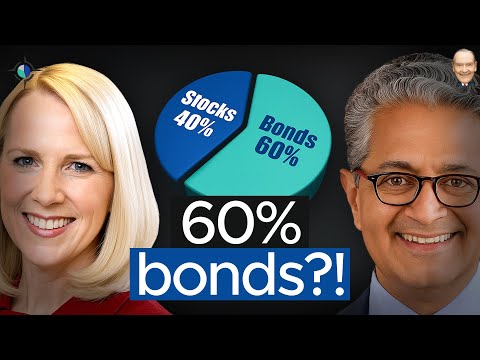 https://www.youtube.com/watch?v=CnzQ2EEgyec
5 -
Fair enough, raising a family can be tough on finances, I remember that, sorry if I appeared not to. I was focussing on just the investment segment of finances and not the bigger picture.LHW99 said:chiang_mai said:
Purpose and objectives are different things. An objective needs to be specific, well defined and easily recognisable. In my case, my objective is to realise a 12% pa gain, as quickly as possible, whilst maintaining risk within my risk tolerances. Purpose is the use for which the profits will be used, if the objective is met, which can be variable and changed at will. I don't think I could suddenly change my objective, without needing to change my strategy and approach. In your example, those emergency funds for unplanned expenditure might form part of your asset allocation, rather than your objective.I understand your point. However, if you start wih zero, having an x% gain as an objective is a dream, not an objective (should be realistic, attainable etc). You could say, first objective was to ensure an emergency fund of y months salary. Second was to ensure there would be an additional savings fund to cover school uniforms, trips, additional eg music lessons in addition to the emergency funds etc.When you are at that stage "asset allocation" cannot be part of a plan.1 -
I have been leaning the same way for several weeks and am now increasing duration from very short and am considering this:Alexland said:
I think it depends on where valuations are at the time and how close you are to retirement.thegentleway said:The consensus is that 100% equities (assuming you have the risk tolerance and capacity) is preferable for accumulation phase.
Maybe equities will do best over the very long term but over the medium term the jury is out on if equities will outperform bonds - it might be another decade like 2000-2010 where equities start very overvalued and bonds start attractively valued and so do better.
To quote the CEO of Vanguard at the recent Bogleheads conference (from 41min) "we think the 10 year environment for bonds is extraordinarily good both as a diversifier of equities as well as a source of return".
A few years ago (before their prices crashed) I was arguing here that bonds were overvalued and people shouldn't blindly follow portfolio theory to assume they reduce risk in a portfolio. Now I'm arguing the opposite that bonds are good value and people should't assume equities will beat them in the medium term.https://www.youtube.com/watch?v=CnzQ2EEgyec
https://global.morningstar.com/en-gb/investments/funds/0P0000WGSV/quote0
![[Deleted User]](https://us-noi.v-cdn.net/6031891/uploads/defaultavatar/nFA7H6UNOO0N5.jpg)










Confirm your email address to Create Threads and Reply

Categories
- All Categories
- 355.8K Banking & Borrowing
- 254.9K Reduce Debt & Boost Income
- 456.2K Spending & Discounts
- 248.3K Work, Benefits & Business
- 605.9K Mortgages, Homes & Bills
- 179K Life & Family
- 263.8K Travel & Transport
- 1.5M Hobbies & Leisure
- 16.2K Discuss & Feedback
- 37.7K Read-Only Boards