We’d like to remind Forumites to please avoid political debate on the Forum.
This is to keep it a safe and useful space for MoneySaving discussions. Threads that are – or become – political in nature may be removed in line with the Forum’s rules. Thank you for your understanding.
📨 Have you signed up to the Forum's new Email Digest yet? Get a selection of trending threads sent straight to your inbox daily, weekly or monthly!
The Forum now has a brand new text editor, adding a bunch of handy features to use when creating posts. Read more in our how-to guide
33% domestic stocks bias
Comments
-
Yes it's quite a concern particularly as the Mag 7 are becoming increasingly leveraged for an arms race of capital investment amplifying the risk of disappointing. A crash in Mag 7 share prices would likely have a broad impact on both companies and consumer confidence around the world. It could be triggered by as little as a bad earnings season. It doesn't take much to start a chain reaction when both prices and leverage are high.chiang_mai said:Just because the S&P500 equal weight index has only risen by 1% in the past year, doesn't mean that a failure of the Mag 7 would mean the remaining index stays as it is. The entire index would fall and along with it, the value of other company shares, some because of contagion, others because of the business losses resulting from Mag 7 failure.
1 -
I am a committed proponent of diversification beyond traditional retail markets. As much as I might like to, I chose not to invest more than 15% in the UK market and because of over valution risks, more than 30% in the US. I have however gone overweight in other markets including Europe, Emerging Markets, Japan and Developed Asia. Because I don't know how the Mag 7 scenario will unfold over time, I have reduced my exposure to equities, to 50% of my portfolio and am happy to sit back and watch to see what happens, whilst remaining invested to a lesser degree and overweight in cash. If Mag 7 goes from strength to strength for the next X years and I miss out on substantial earnings, I will at least have been able to sleep at night knowing that my planned income was safe.2
-
It's a good time to be diversified as there are now other attractive opportunities elsewhere without betting heavily on increasingly risky equities continuing to defy gravity.chiang_mai said:Because I don't know how the Mag 7 scenario will unfold over time, I have reduced my exposure to equities, to 50% of my portfolio and am happy to sit back and watch to see what happens
People seem to focus on asset class returns (with a recency bias, and not realising how much returns can be due to growing valuation premiums as other investors pile-in) but miss how much additional return can be gained from rebalancing on a fixed allocation or even 'over-rebalancing' tactically to ensure you are always favouring assets that are priced to be a good opportunity going forward.
2 -
Alexland said:
It's a good time to be diversified as there are now other attractive opportunities elsewhere without betting heavily on increasingly risky equities continuing to defy gravity.chiang_mai said:Because I don't know how the Mag 7 scenario will unfold over time, I have reduced my exposure to equities, to 50% of my portfolio and am happy to sit back and watch to see what happens
People seem to focus on asset class returns (with a recency bias, and not realising how much returns can be due to growing valuation premiums as other investors pile-in) but miss how much additional return can be gained from rebalancing on a fixed allocation or even 'over-rebalancing' tactically to ensure you are always favouring assets that are priced to be a good opportunity going forward.I agree it is a good time to be diversified (compared to the long period of low rates prior to a few years ago) given non-equities have now a reasonable looking return. But there is no certainty in rebalancing or favouring assets like bonds will result in a superior performance compared to full on equities. Over any time period.0 -
I'd question whether the objective should be to match or consistently beat the performance of full on equities. Someone who is very young and has little invested so far should probably seek to match the returns of full on equities, as they can in the worst case pound cost average in. However, those who have substantial assets will tend to have less emphasis on maximising growth potential and more on preservation of capital (in real terms) and not running out of money.itwasntme001 said:Alexland said:
It's a good time to be diversified as there are now other attractive opportunities elsewhere without betting heavily on increasingly risky equities continuing to defy gravity.chiang_mai said:Because I don't know how the Mag 7 scenario will unfold over time, I have reduced my exposure to equities, to 50% of my portfolio and am happy to sit back and watch to see what happens
People seem to focus on asset class returns (with a recency bias, and not realising how much returns can be due to growing valuation premiums as other investors pile-in) but miss how much additional return can be gained from rebalancing on a fixed allocation or even 'over-rebalancing' tactically to ensure you are always favouring assets that are priced to be a good opportunity going forward.I agree it is a good time to be diversified (compared to the long period of low rates prior to a few years ago) given non-equities have now a reasonable looking return. But there is no certainty in rebalancing or favouring assets like bonds will result in a superior performance compared to full on equities. Over any time period.4 -
masonic said:
I'd question whether the objective should be to match or consistently beat the performance of full on equities. Someone who is very young and has little invested so far should probably seek to match the returns of full on equities, as they can in the worst case pound cost average in. However, those who have substantial assets will tend to have less emphasis on maximising growth potential and more on preservation of capital (in real terms) and not running out of money.itwasntme001 said:Alexland said:
It's a good time to be diversified as there are now other attractive opportunities elsewhere without betting heavily on increasingly risky equities continuing to defy gravity.chiang_mai said:Because I don't know how the Mag 7 scenario will unfold over time, I have reduced my exposure to equities, to 50% of my portfolio and am happy to sit back and watch to see what happens
People seem to focus on asset class returns (with a recency bias, and not realising how much returns can be due to growing valuation premiums as other investors pile-in) but miss how much additional return can be gained from rebalancing on a fixed allocation or even 'over-rebalancing' tactically to ensure you are always favouring assets that are priced to be a good opportunity going forward.I agree it is a good time to be diversified (compared to the long period of low rates prior to a few years ago) given non-equities have now a reasonable looking return. But there is no certainty in rebalancing or favouring assets like bonds will result in a superior performance compared to full on equities. Over any time period.Of course, I agree completely of the need to reduce risk as the size of assets grow large enough to be closer to meeting your objectives, so a less need to take risk. There is also less opportunity cost in reducing risk given bonds yield a decent return compared to recent history.But my point was that there is no such thing as gaining any sort of performance benefit by "rebalacning" or reducing risk when alternative assets are provding a competitive return, at least with any sort of certainty.0 -
Indeed, I was going to point out Ukraine next. The UK economy is more like the EU's for the Ukraine situation, so it's no surprise the currencies reacted in a similar way, while the US's oil situation was far different. And Trump's tariff changes are still ongoing. And the UK relationship with Ukraine is very similar to the EU's, while it's the USA that is going rogue.masonic said:EthicsGradient said:
It'll be more like the last 5 years, since it's been more stable against the euro after the Brexit referendum - and we can't leave again. And even with the referendum, the volatility against the euro from Dec 2015-Dec 2020 was only just more than against the dollar, while the Dec 2020-Dec 2025 difference was larger. That large dollar volatility in the past year has an obvious cause - Trump tariffs - and he's around for the next 3 years.masonic said:EthicsGradient said:masonic said:MA260 said:Just a thought on the balance of portfolios and currency risk, maybe being overweight in Europe is a way to reduce the currency risk, as EUR/ GBP tend to move in same direction against USDI'm not really seeing much better alignment with EUR as compared with USD: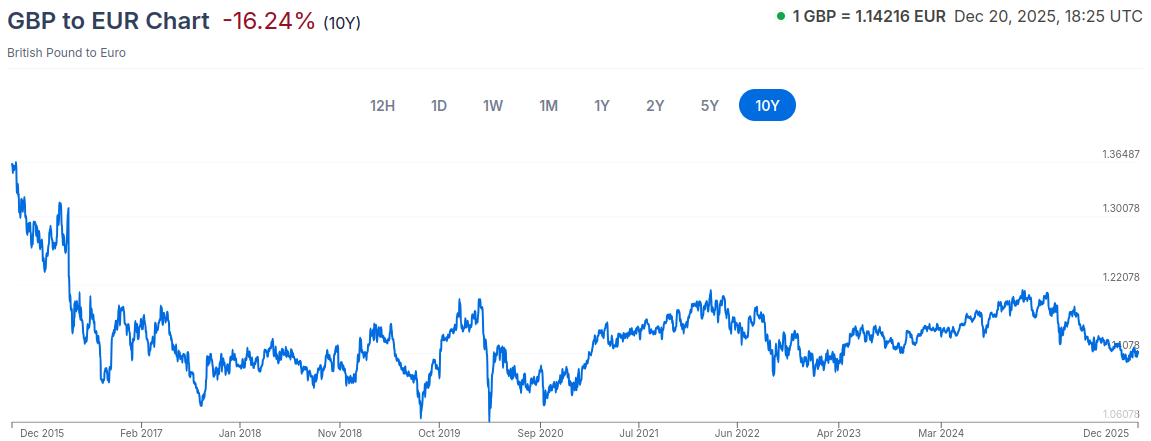
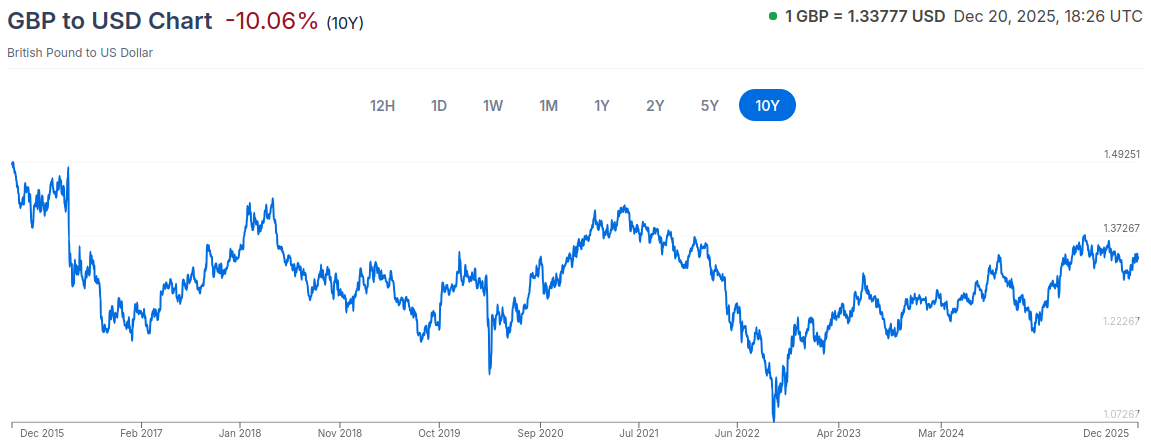 But currency matters little when you are investing in a productive asset like a company.
Well, in the past 5 years, GBP:EUR has stayed within a range of about 1.10 to 1.22; GBP:USD from 1.08 to 1.42; in the last year, GBP:EUR from 1.13 to 1.22, GBP:USD from 1.22 to 1.37. The pound does seem more stable against the euro than the dollar.masonic said:MA260 said:Just a thought on the balance of portfolios and currency risk, maybe being overweight in Europe is a way to reduce the currency risk, as EUR/ GBP tend to move in same direction against USDI'm not really seeing much better alignment with EUR as compared with USD:But currency matters little when you are investing in a productive asset like a company.Sure, but will the next 5 years be more like the last 5 years, or the 5 years prior to that where it was more volatile against EUR.I would not be making any bets. Geopolitics seems to be regressing into a much less stable state.You seem confident in your ability to predict forex movements, but I'm not convinced by your arguments.GBP fell about 13% vs USD between Dec 2015 and the end of Jan 2020 when we finally exited the EU. Compared with a 15% fall against EUR. This is not an appreciably a larger difference. Comparing the largest peak to trough change within the period, it was about 20% for GBP:USD vs 32% for GBP:EUR which is an appreciably larger 12% difference. But, since then, the largest discrepancy between USD and EUR movements has been between Jan-Oct 2022, where GBP fell about 22% vs USD and about 7% vs EUR - a larger 15% difference. I'd suggest that doesn't have anything to do with either Brexit or Trump. It seems to coincide with the invasion of Ukraine, and inflation and interest rates rising sharply.Trump's tariffs have been a 2025 phenomenon, and during this year, GBP:USD has fluctuated by about 11% while GBP:EUR has fluctuated about 7%.Going back further to the last financial crisis in 2007-8, GBP fell about 30% vs both currencies, but we did not see anything like that during the Covid crash.It seems to me that massive fluctuations in inflation and interest rates have been the largest driver of exchange USD:GBP rate volatility in the last 5 years or 10 years, and that is unlikely to be seen again in the short term. There are plenty of options of things that could drive exchange rates over the next 5 years, some of them, such as the evolution of the Russian aggression, EU political fragmentation, the UK-EU trade reset, sovereign debt stress, or a global stockmarket crash, could affect GBP:EUR more than GBP:USD.I don't know which currency pair will be more stable over the next 5 years, and I don't think anyone else does either.
But of the things you list that might drive exchange rates, some are things we've already established that the UK is more similar to the EU on, and none are things that the UK is more similar to the USA on.0 -
There's no certainty that equities will outperform bonds over the next time period either. Listed companies tend to get bought or go bust eventually (only a small proportion are responsible for the majority of historic returns - what if a few of them hadn't existed or had been privately owned?) and investment grade bonds tend to repay eventually. They are very different and that's where rebalancing can help.itwasntme001 said:I agree it is a good time to be diversified (compared to the long period of low rates prior to a few years ago) given non-equities have now a reasonable looking return. But there is no certainty in rebalancing or favouring assets like bonds will result in a superior performance compared to full on equities. Over any time period.
I'm happy to own either if they are presenting a good enough opportunity in the medium term. Overvaluation can get to the point where the assets become uninvestable (as bonds were a few years ago) and while we are probably not quite there yet on equities it's hardly looking attractive to go heavy on them at least in the medium term as the PE ratios and equity risk premiums suggest an elevated chance of another lost decade. The market is euphorically risk-on at the moment and prices are outpacing business performance. Higher risk doesn't always equal higher returns sometimes it just leads to disappointment.
2 -
EthicsGradient said:
Indeed, I was going to point out Ukraine next. The UK economy is more like the EU's for the Ukraine situation, so it's no surprise the currencies reacted in a similar way, while the US's oil situation was far different. And Trump's tariff changes are still ongoing. And the UK relationship with Ukraine is very similar to the EU's, while it's the USA that is going rogue.masonic said:EthicsGradient said:
It'll be more like the last 5 years, since it's been more stable against the euro after the Brexit referendum - and we can't leave again. And even with the referendum, the volatility against the euro from Dec 2015-Dec 2020 was only just more than against the dollar, while the Dec 2020-Dec 2025 difference was larger. That large dollar volatility in the past year has an obvious cause - Trump tariffs - and he's around for the next 3 years.masonic said:EthicsGradient said:masonic said:MA260 said:Just a thought on the balance of portfolios and currency risk, maybe being overweight in Europe is a way to reduce the currency risk, as EUR/ GBP tend to move in same direction against USDI'm not really seeing much better alignment with EUR as compared with USD:But currency matters little when you are investing in a productive asset like a company.
Well, in the past 5 years, GBP:EUR has stayed within a range of about 1.10 to 1.22; GBP:USD from 1.08 to 1.42; in the last year, GBP:EUR from 1.13 to 1.22, GBP:USD from 1.22 to 1.37. The pound does seem more stable against the euro than the dollar.masonic said:MA260 said:Just a thought on the balance of portfolios and currency risk, maybe being overweight in Europe is a way to reduce the currency risk, as EUR/ GBP tend to move in same direction against USDI'm not really seeing much better alignment with EUR as compared with USD:But currency matters little when you are investing in a productive asset like a company.Sure, but will the next 5 years be more like the last 5 years, or the 5 years prior to that where it was more volatile against EUR.I would not be making any bets. Geopolitics seems to be regressing into a much less stable state.You seem confident in your ability to predict forex movements, but I'm not convinced by your arguments.GBP fell about 13% vs USD between Dec 2015 and the end of Jan 2020 when we finally exited the EU. Compared with a 15% fall against EUR. This is not an appreciably a larger difference. Comparing the largest peak to trough change within the period, it was about 20% for GBP:USD vs 32% for GBP:EUR which is an appreciably larger 12% difference. But, since then, the largest discrepancy between USD and EUR movements has been between Jan-Oct 2022, where GBP fell about 22% vs USD and about 7% vs EUR - a larger 15% difference. I'd suggest that doesn't have anything to do with either Brexit or Trump. It seems to coincide with the invasion of Ukraine, and inflation and interest rates rising sharply.Trump's tariffs have been a 2025 phenomenon, and during this year, GBP:USD has fluctuated by about 11% while GBP:EUR has fluctuated about 7%.Going back further to the last financial crisis in 2007-8, GBP fell about 30% vs both currencies, but we did not see anything like that during the Covid crash.It seems to me that massive fluctuations in inflation and interest rates have been the largest driver of exchange USD:GBP rate volatility in the last 5 years or 10 years, and that is unlikely to be seen again in the short term. There are plenty of options of things that could drive exchange rates over the next 5 years, some of them, such as the evolution of the Russian aggression, EU political fragmentation, the UK-EU trade reset, sovereign debt stress, or a global stockmarket crash, could affect GBP:EUR more than GBP:USD.I don't know which currency pair will be more stable over the next 5 years, and I don't think anyone else does either.
But of the things you list that might drive exchange rates, some are things we've already established that the UK is more similar to the EU on, and none are things that the UK is more similar to the USA on.While I do agree that the UK is currently well aligned with the EU by most measures, whereas the USA is going rogue, that is the status quo that is currently priced in. But I would say that the UK and US both share some geographical and structural insulation from the Russia-Ukraine conflict, though the UK doesn't benefit to the same extent as the US. This would lead to EUR bearing the brunt of an escalation to the conflict. Though it would probably go the other way if there was a peace deal.The US doesn't have much scope for increasing the crazy, whereas the upcoming mid-term elections are looking very dicey for Trump and his radical policies, which may end up being frustrated or walked back. That, or a global stockmarket crash would likely reverse the strengthening of the pound vs the dollar that has previously been seen and return things to a more natural order.Whereas in Europe, some of the things I listed could cause a shift in exchange rates. There is the risk of fiscally radical parties gaining power in France or Germany and causing unease in EUR debt markets. It might become the EU's turn for a bit of crazy. Aside from that, a fiscal crisis in one of the weaker Eurozone economies could see a flight of capital that the UK would probably benefit from, along with the US. Making us more similar to the US than the EU.1 -
And then in 2029 it'll be the UK's turn for a bit of crazy.1












Confirm your email address to Create Threads and Reply

Categories
- All Categories
- 354.4K Banking & Borrowing
- 254.4K Reduce Debt & Boost Income
- 455.4K Spending & Discounts
- 247.3K Work, Benefits & Business
- 604K Mortgages, Homes & Bills
- 178.4K Life & Family
- 261.5K Travel & Transport
- 1.5M Hobbies & Leisure
- 16K Discuss & Feedback
- 37.7K Read-Only Boards