We’d like to remind Forumites to please avoid political debate on the Forum.
This is to keep it a safe and useful space for MoneySaving discussions. Threads that are – or become – political in nature may be removed in line with the Forum’s rules. Thank you for your understanding.
📨 Have you signed up to the Forum's new Email Digest yet? Get a selection of trending threads sent straight to your inbox daily, weekly or monthly!
33% domestic stocks bias
Comments
-
masonic said:MA260 said:Just a thought on the balance of portfolios and currency risk, maybe being overweight in Europe is a way to reduce the currency risk, as EUR/ GBP tend to move in same direction against USDI'm not really seeing much better alignment with EUR as compared with USD:
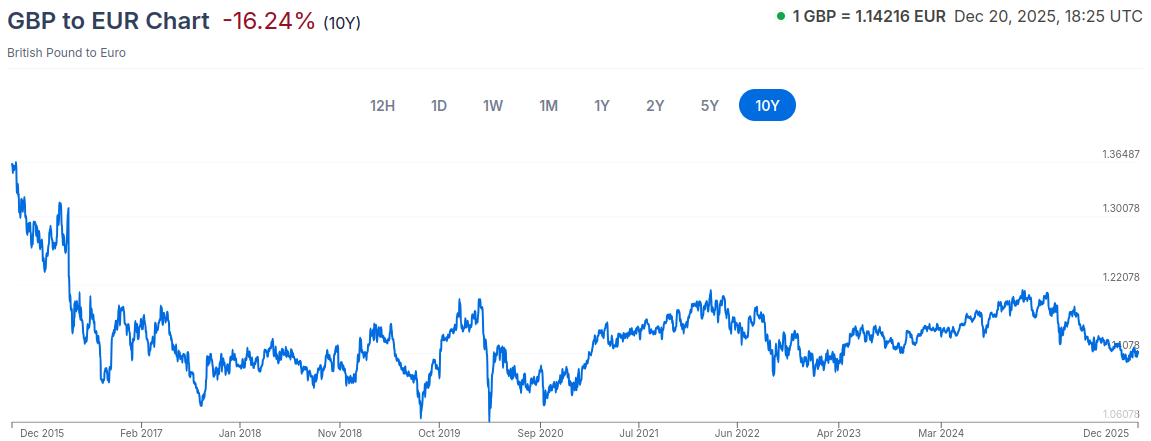
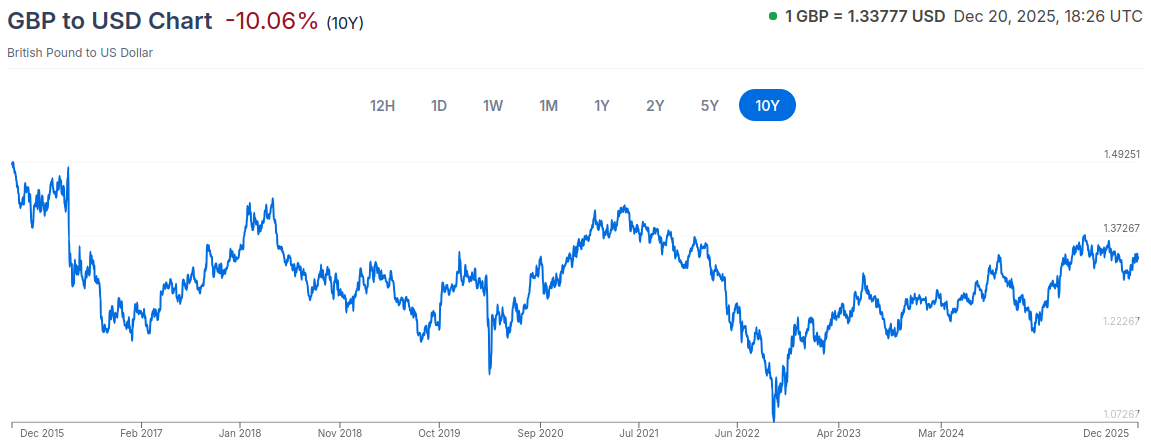 But currency matters little when you are investing in a productive asset like a company.
Well, in the past 5 years, GBP:EUR has stayed within a range of about 1.10 to 1.22; GBP:USD from 1.08 to 1.42; in the last year, GBP:EUR from 1.13 to 1.22, GBP:USD from 1.22 to 1.37. The pound does seem more stable against the euro than the dollar.masonic said:MA260 said:Just a thought on the balance of portfolios and currency risk, maybe being overweight in Europe is a way to reduce the currency risk, as EUR/ GBP tend to move in same direction against USDI'm not really seeing much better alignment with EUR as compared with USD:But currency matters little when you are investing in a productive asset like a company.0 -
EthicsGradient said:masonic said:MA260 said:Just a thought on the balance of portfolios and currency risk, maybe being overweight in Europe is a way to reduce the currency risk, as EUR/ GBP tend to move in same direction against USDI'm not really seeing much better alignment with EUR as compared with USD:But currency matters little when you are investing in a productive asset like a company.
Well, in the past 5 years, GBP:EUR has stayed within a range of about 1.10 to 1.22; GBP:USD from 1.08 to 1.42; in the last year, GBP:EUR from 1.13 to 1.22, GBP:USD from 1.22 to 1.37. The pound does seem more stable against the euro than the dollar.masonic said:MA260 said:Just a thought on the balance of portfolios and currency risk, maybe being overweight in Europe is a way to reduce the currency risk, as EUR/ GBP tend to move in same direction against USDI'm not really seeing much better alignment with EUR as compared with USD:But currency matters little when you are investing in a productive asset like a company.Sure, but will the next 5 years be more like the last 5 years, or the 5 years prior to that where it was more volatile against EUR.I would not be making any bets. Geopolitics seems to be regressing into a much less stable state.0 -
It'll be more like the last 5 years, since it's been more stable against the euro after the Brexit referendum - and we can't leave again. And even with the referendum, the volatility against the euro from Dec 2015-Dec 2020 was only just more than against the dollar, while the Dec 2020-Dec 2025 difference was larger. That large dollar volatility in the past year has an obvious cause - Trump tariffs - and he's around for the next 3 years.masonic said:EthicsGradient said:masonic said:MA260 said:Just a thought on the balance of portfolios and currency risk, maybe being overweight in Europe is a way to reduce the currency risk, as EUR/ GBP tend to move in same direction against USDI'm not really seeing much better alignment with EUR as compared with USD:But currency matters little when you are investing in a productive asset like a company.
Well, in the past 5 years, GBP:EUR has stayed within a range of about 1.10 to 1.22; GBP:USD from 1.08 to 1.42; in the last year, GBP:EUR from 1.13 to 1.22, GBP:USD from 1.22 to 1.37. The pound does seem more stable against the euro than the dollar.masonic said:MA260 said:Just a thought on the balance of portfolios and currency risk, maybe being overweight in Europe is a way to reduce the currency risk, as EUR/ GBP tend to move in same direction against USDI'm not really seeing much better alignment with EUR as compared with USD:But currency matters little when you are investing in a productive asset like a company.Sure, but will the next 5 years be more like the last 5 years, or the 5 years prior to that where it was more volatile against EUR.I would not be making any bets. Geopolitics seems to be regressing into a much less stable state.0 -
masonic said:It depends what you mean by "domestic stocks". If you buy a FTSE100 or All Share index, or most active funds in the sector, then you'll hold primarily multinational companies with significant overseas earnings. Just because a stock is priced in sterling, it does not mean its share price is immune to currency risk. The explicit currency hedged ETFs may give you more protection. There must be quite a small number of truly insular companies whose costs and sales are independent of global markets, where goods and services are priced in various currencies according to exchange rates.Indeed. I only purchase "UK stocks" which are roughly split into 3 portfolios. The largest segment is UK investment trusts - but only about 31% of their holdings are in actual UK companies and many of those are multinationals. The next largest uses set rules to select stocks and whilst it tends to favour UK based companies, that is because the rules are designed to choose smaller, under-appreciated companies. But even so, several of the current holdings earn a substantial proportion of their revenues outside the UK. The final segment are basically legacy holdings which are doing too well to dispose of and they all have far more revenues outside the UK than within it.Overall, however, my exposure to the UK economy is massively higher than the UK's actual contribution to the global economy. But I'm absolutely fine with that since most of our costs are UK based with most of our foreign cost exposure being in discretionary spending.OTOH, if we had an allocation more in line with global proportions, we would run a real risk to our retirement income if the GBP were to rise significantly compared to other economies. eg I would have real trouble sleeping at night if we were as dependant on the US economy & currency as many UK investors - especially so-called "passive" ones - seem to be.
0 -
I might adopt that strategy if I was a US investor but there are too many reasons not to do so when the UK is your home country, currency and hedging issues not withstanding. The size of the UK market share by comparion to other markets and the extent to which FTSE UK companies derive their income from overseas, make that 33% UK home country bias appear not sensible. I have a 17% UK allocation which, when based on uk earnings alone, dwindles to less than 8%, which seems about right to me.0
-
Imo, if you ignore any currency fluctuations or at least isolate them as a separate 'investment bet', then the real decision is whether you feel that one country index is undervalued versus another, in this case FTSE 100 versus s&p500. I feel that there are reasons why the S&p is overvalued versus the FTSE that are not company related. Will that difference revert, or will the disconnect continue for ever?0
-
But it is not the US market as a whole which can reasonably be considered over-valued. For example US Small Companies has performed poorly in recent years. The problem arises from the the size of the Mag7.Cus said:Imo, if you ignore any currency fluctuations or at least isolate them as a separate 'investment bet', then the real decision is whether you feel that one country index is undervalued versus another, in this case FTSE 100 versus s&p500. I feel that there are reasons why the S&p is overvalued versus the FTSE that are not company related. Will that difference revert, or will the disconnect continue for ever?In my view this demonstrates a good reason not to over simplify one’s asset allocation by purely looking at the high level indexes. In this case it is leading to a decrease in diversification.0 -
I'm unconvinced on the correlation between the prospects of companies that operate in the UK economy and maintaining UK spending power. Long term UK inflation has been higher than US inflation yet our companies haven't performed better. For home bias in my portfolio, at current valuations, I prefer index linked gilts.phlebas192 said:Overall, however, my exposure to the UK economy is massively higher than the UK's actual contribution to the global economy. But I'm absolutely fine with that since most of our costs are UK based with most of our foreign cost exposure being in discretionary spending.0 -
EthicsGradient said:
It'll be more like the last 5 years, since it's been more stable against the euro after the Brexit referendum - and we can't leave again. And even with the referendum, the volatility against the euro from Dec 2015-Dec 2020 was only just more than against the dollar, while the Dec 2020-Dec 2025 difference was larger. That large dollar volatility in the past year has an obvious cause - Trump tariffs - and he's around for the next 3 years.masonic said:EthicsGradient said:masonic said:MA260 said:Just a thought on the balance of portfolios and currency risk, maybe being overweight in Europe is a way to reduce the currency risk, as EUR/ GBP tend to move in same direction against USDI'm not really seeing much better alignment with EUR as compared with USD:But currency matters little when you are investing in a productive asset like a company.
Well, in the past 5 years, GBP:EUR has stayed within a range of about 1.10 to 1.22; GBP:USD from 1.08 to 1.42; in the last year, GBP:EUR from 1.13 to 1.22, GBP:USD from 1.22 to 1.37. The pound does seem more stable against the euro than the dollar.masonic said:MA260 said:Just a thought on the balance of portfolios and currency risk, maybe being overweight in Europe is a way to reduce the currency risk, as EUR/ GBP tend to move in same direction against USDI'm not really seeing much better alignment with EUR as compared with USD:But currency matters little when you are investing in a productive asset like a company.Sure, but will the next 5 years be more like the last 5 years, or the 5 years prior to that where it was more volatile against EUR.I would not be making any bets. Geopolitics seems to be regressing into a much less stable state.You seem confident in your ability to predict forex movements, but I'm not convinced by your arguments.GBP fell about 13% vs USD between Dec 2015 and the end of Jan 2020 when we finally exited the EU. Compared with a 15% fall against EUR. This is not an appreciably a larger difference. Comparing the largest peak to trough change within the period, it was about 20% for GBP:USD vs 32% for GBP:EUR which is an appreciably larger 12% difference. But, since then, the largest discrepancy between USD and EUR movements has been between Jan-Oct 2022, where GBP fell about 22% vs USD and about 7% vs EUR - a larger 15% difference. I'd suggest that doesn't have anything to do with either Brexit or Trump. It seems to coincide with the invasion of Ukraine, and inflation and interest rates rising sharply.Trump's tariffs have been a 2025 phenomenon, and during this year, GBP:USD has fluctuated by about 11% while GBP:EUR has fluctuated about 7%.Going back further to the last financial crisis in 2007-8, GBP fell about 30% vs both currencies, but we did not see anything like that during the Covid crash.It seems to me that massive fluctuations in inflation and interest rates have been the largest driver of exchange USD:GBP rate volatility in the last 5 years or 10 years, and that is unlikely to be seen again in the short term. There are plenty of options of things that could drive exchange rates over the next 5 years, some of them, such as the evolution of the Russian aggression, EU political fragmentation, the UK-EU trade reset, sovereign debt stress, or a global stockmarket crash, could affect GBP:EUR more than GBP:USD.I don't know which currency pair will be more stable over the next 5 years, and I don't think anyone else does either.2 -
Just because the S&P500 equal weight index has only risen by 1% in the past year, doesn't mean that a failure of the Mag 7 would mean the remaining index stays as it is. The entire index would fall and along with it, the value of other company shares, some because of contagion, others because of the business losses resulting from Mag 7 failure. If Mag 7 is the prop of the US index, it is also the prop to a considerable volume of earnings by other companies in the index, in that respect the market as a whole might be considered to be over valued.Linton said:
But it is not the US market as a whole which can reasonably be considered over-valued. For example US Small Companies has performed poorly in recent years. The problem arises from the the size of the Mag7.Cus said:Imo, if you ignore any currency fluctuations or at least isolate them as a separate 'investment bet', then the real decision is whether you feel that one country index is undervalued versus another, in this case FTSE 100 versus s&p500. I feel that there are reasons why the S&p is overvalued versus the FTSE that are not company related. Will that difference revert, or will the disconnect continue for ever?In my view this demonstrates a good reason not to over simplify one’s asset allocation by purely looking at the high level indexes. In this case it is leading to a decrease in diversification.1
















Confirm your email address to Create Threads and Reply

Categories
- All Categories
- 355.8K Banking & Borrowing
- 254.9K Reduce Debt & Boost Income
- 456.2K Spending & Discounts
- 248.3K Work, Benefits & Business
- 606K Mortgages, Homes & Bills
- 179K Life & Family
- 263.8K Travel & Transport
- 1.5M Hobbies & Leisure
- 16.2K Discuss & Feedback
- 37.7K Read-Only Boards