We’d like to remind Forumites to please avoid political debate on the Forum.
This is to keep it a safe and useful space for MoneySaving discussions. Threads that are – or become – political in nature may be removed in line with the Forum’s rules. Thank you for your understanding.
📨 Have you signed up to the Forum's new Email Digest yet? Get a selection of trending threads sent straight to your inbox daily, weekly or monthly!
33% domestic stocks bias

thegentleway
Posts: 1,106



 Forumite
What are experienced investors thoughts on “The optimal weights remain near one-third domestic stocks and two-thirds international stocks regardless of age—with no material fixed income allocation”
EDIT: would one use FTSE350 for uk domestic stocks?
No one has ever become poor by giving
0
Comments
-
This is a US study. The US makes up 60% of the global stock market, the UK just 4%.
Many US investors a mostly in domestic stocks and bonds so a suggestion they tilt to one third domestic is vastly different to suggesting a UK investor does. Not sure basing investing choices on the back of a single study is good either.5 -
Sound like a financial salesperson touting for business and using buzz words to impress prospective customers!1
-
As a UK based investor, I would agree with the first part of the advice ("The optimal weights remain near one-third domestic stocks and two-thirds international stocks regardless of age") IF you are following a total return strategy. If you are following an income strategy AND you are reliant on the income to meet your basic living expenses, you might need to have a bit more in domestic stocks (say upto 50%) - this is my approach.
I disagree with the second part of the advice (" - with no material fixed income allocation"), or at least would qualify it. Analysis shows that a fixed income allocation reduces volatility. I would dispense with it during the 'accumulation phase' of your life - that period when your main aim is to grow your portfolio, but for a retirement portfolio switching to a 60% equity/40% fixed income allocation makes a lot of sense to reduce the volatility as this has a very significant effect on the safe withdrawal rate.The comments I post are my personal opinion. While I try to check everything is correct before posting, I can and do make mistakes, so always try to check official information sources before relying on my posts.0 -
Right… but there is a currency hedge from investing in domestic stocks?PixelPound said:This is a US study. The US makes up 60% of the global stock market, the UK just 4%.
Many US investors a mostly in domestic stocks and bonds so a suggestion they tilt to one third domestic is vastly different to suggesting a UK investor does. Not sure basing investing choices on the back of a single study is good either.No one has ever become poor by giving1 -
Or three academics who have used historical data and detailed analysis to find the 'optimal weights' for US retirees (whether the optimum is the same for UK retirees is not addressed). There are, in my view, some limitations to their analysis, but that is a different question.Eyeful said:Sound like a financial salesperson touting for business and using buzz words to impress prospective customers!
For the OP: For UK investors, using a global market index will probably be good enough.2 -
thegentleway said:
Right… but there is a currency hedge from investing in domestic stocks?PixelPound said:This is a US study. The US makes up 60% of the global stock market, the UK just 4%.
Many US investors a mostly in domestic stocks and bonds so a suggestion they tilt to one third domestic is vastly different to suggesting a UK investor does. Not sure basing investing choices on the back of a single study is good either.There are currency hedged options if looking at ETF's, e.g. Invesco S&P 500 GBP Hedged ETF (ticker symbol G500) with TER 0.05% which is up around 18% for the year verses unhedged (like Vanguard's VUAG TER 0.07%) which are around 9% due to the weakening dollar. However if you consider last 6 months or 3 months then you find the unhedged versions have done better.For the long term investor, investing in terms of decades, then whether hedging is beneficial is very much debatable. For one there is a cost for the hedging and for two over the long term currency fluctuations are less likely to have an effect if using a strategy such as pound-cost-averaging. Sometimes it will make the foreign stock cheaper to buy, others less so. It's not all in one direction.As to investing in domestic stocks as a hedge, surely the factor there is the overall return. FTSE100 has had a good year in 2025 (up 21% for the year, and FTSE 250 just 9%), but last year it was under 14% and approx 6%(annualised) when looking at last 10 or 20 years, much lower than S&P 500's 10% average.However I do think a home bias is a good option, but you need to consider your reasoning and whether it should be a third. Mine is roughly 10% (of the equity portion) as some very nice dividend payers. This might increase once I reach about 5 years to retirement, but similarly I will rotate from growth US to value US as whilst it introduces withholding tax, can still be worthwhile.
0 -
Two concerns with investing significantly in a FTSE100 companies...
1) You are not really investing in the UK. Many of the FTSE 100 companies do much more business overseas than in the UK, but just happen for historical reasons to be registered with the LSE. A few do no business in the UK at all. So just investing in the FTSE100 does not shield you from the world economy.
2) The FTSE100 has a rather different sector allocation to the world as a whole. In particular Tech + Comms is at about 3.6%, whereas in a global index those 2 sectors represent 36% of the total. I know that many people believe that the tech sectors are overvalued but choosing to ignore them virtually completely is perhaps an over-reaction. Conversely energy+raw materials in the FTSE100 represents about three times the global allocation.
I believe the differences in sector allocation is a far more important driver for differences in performance than whether the companies you choose to invest in are quoted on the LSE.
2 -
thegentleway said:
Right… but there is a currency hedge from investing in domestic stocks?PixelPound said:This is a US study. The US makes up 60% of the global stock market, the UK just 4%.
Many US investors a mostly in domestic stocks and bonds so a suggestion they tilt to one third domestic is vastly different to suggesting a UK investor does. Not sure basing investing choices on the back of a single study is good either.It depends what you mean by "domestic stocks". If you buy a FTSE100 or All Share index, or most active funds in the sector, then you'll hold primarily multinational companies with significant overseas earnings. Just because a stock is priced in sterling, it does not mean its share price is immune to currency risk. The explicit currency hedged ETFs may give you more protection. There must be quite a small number of truly insular companies whose costs and sales are independent of global markets, where goods and services are priced in various currencies according to exchange rates.However, this is very different for bond markets, where you are buying a specific sequence of cashflows over a finite period of time. In that situation, currency risk introduces uncertainty in future returns that is not present in sterling bonds.Coming back to the original article, it is advocating 33% USA and 67% global ex-USA, which is an allocation that would have disappointed over the last 20 years, but some are reducing their US exposure for other reasons.0 -
Just a thought on the balance of portfolios and currency risk, maybe being overweight in Europe is a way to reduce the currency risk, as EUR/ GBP tend to move in same direction against USD0
-
MA260 said:Just a thought on the balance of portfolios and currency risk, maybe being overweight in Europe is a way to reduce the currency risk, as EUR/ GBP tend to move in same direction against USDI'm not really seeing much better alignment with EUR as compared with USD:
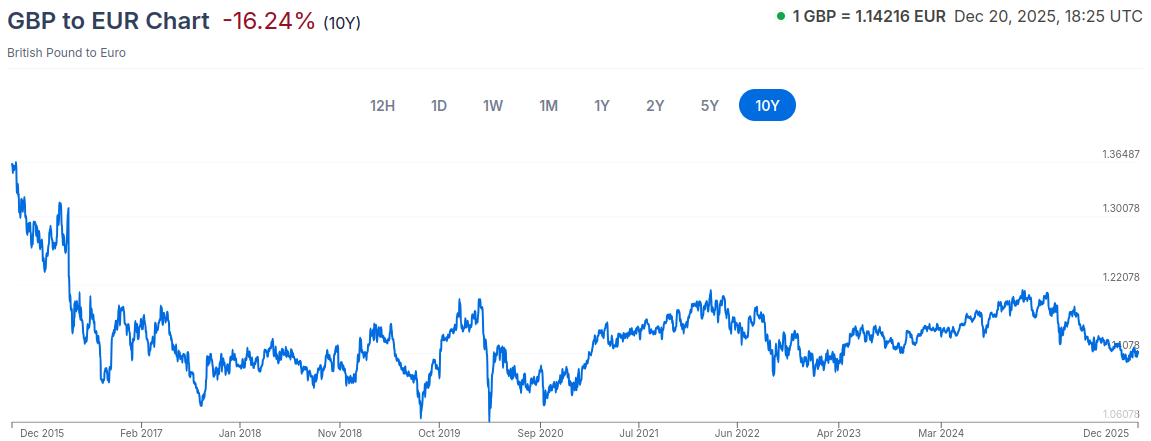
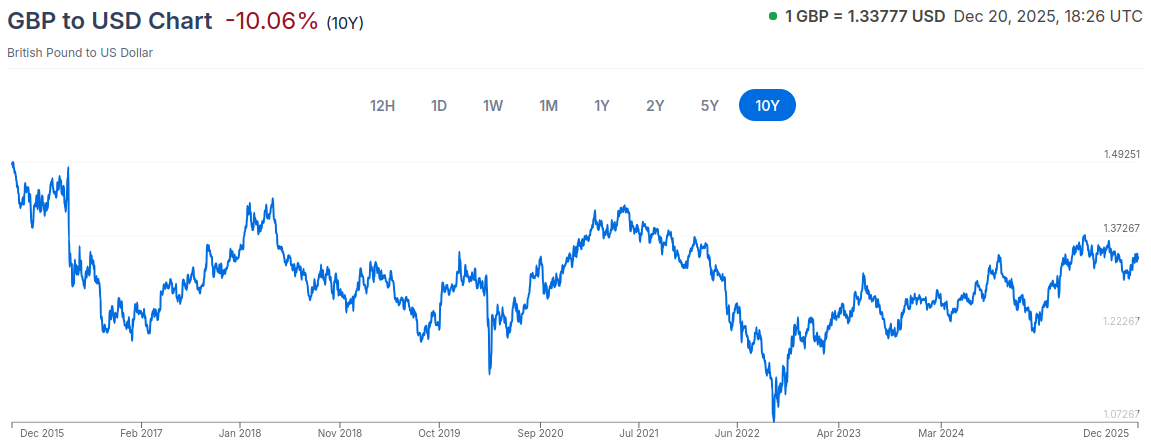 But currency matters little when you are investing in a productive asset like a company.0








Confirm your email address to Create Threads and Reply

Categories
- All Categories
- 355.8K Banking & Borrowing
- 254.9K Reduce Debt & Boost Income
- 456.2K Spending & Discounts
- 248.3K Work, Benefits & Business
- 605.9K Mortgages, Homes & Bills
- 179K Life & Family
- 263.8K Travel & Transport
- 1.5M Hobbies & Leisure
- 16.2K Discuss & Feedback
- 37.7K Read-Only Boards