We’d like to remind Forumites to please avoid political debate on the Forum.
This is to keep it a safe and useful space for MoneySaving discussions. Threads that are – or become – political in nature may be removed in line with the Forum’s rules. Thank you for your understanding.
GMP equalisation workings - Barclays pension
Comments
-
xylophone said:As a matter of interest, have you tried a calculation on this theoretical basis.
When the pension came into payment, the GMP was not included at all, so that all you received at that point was the excess revalued to Scheme NRA.
Up to GMP age, this increased under scheme rules. (x)
To this figure add the GMP revalued to GMP age. (y).
Is there much difference between (x + y) and what you actually received after the step up calculation at GMP age?
These are my figures (left handside) using the table I put together with Mike Floutier and your help in 2018. Which WTW agreed as the correct methodology for a male reaching GMP at 65.
On the RHS I have cobbled together the equivalent for a female reaching GMP at 60. I have had to estimate because obviously we do not have the starting figures. I cannot see why they should be too far out though.
I have asked WTW for their calculation of the 'alternative' at 60 on the basis that they offered to confirm my 'male' figures closer to age 65.
Hopefully this also answers your question?
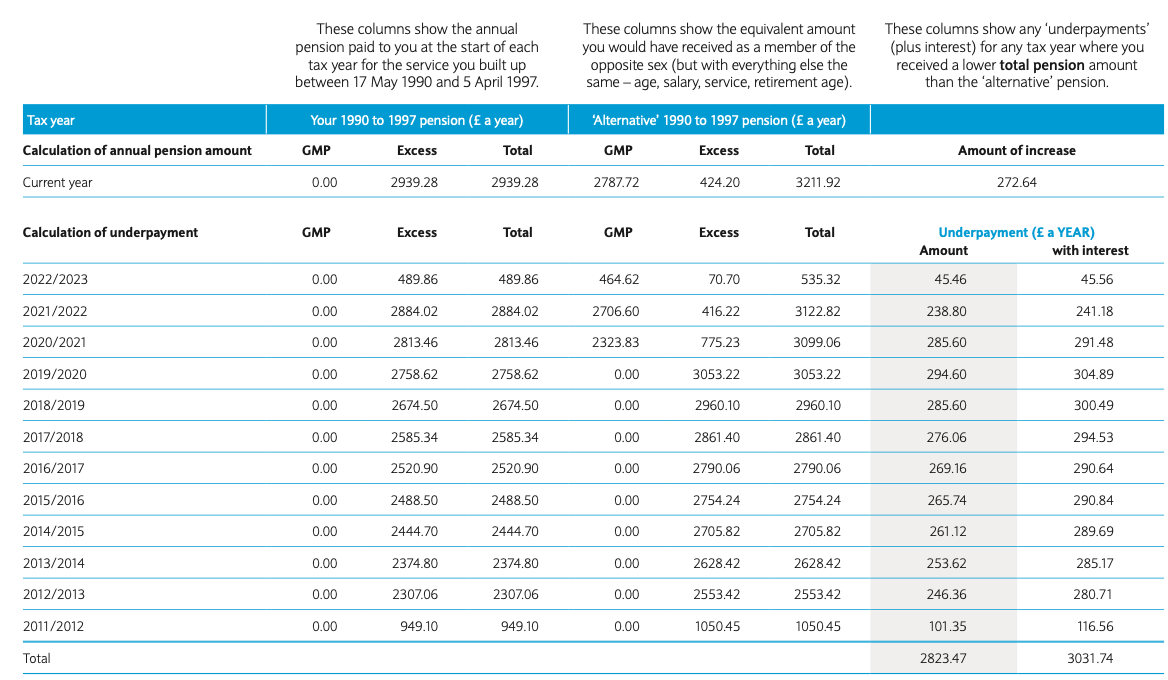
Table from WTW also attached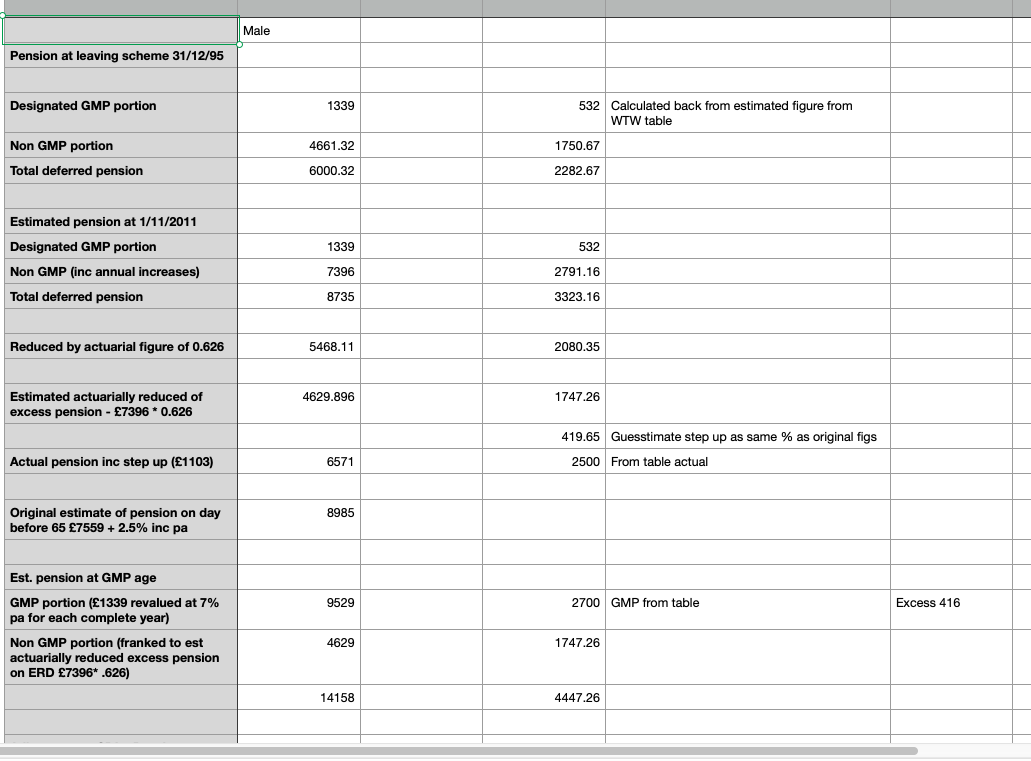
1 -
Ok, firstly I feel it would be helpful to clarify some basic info, so (and please correct me...):1. You were born in mid 1960,2. Left COE with Barclays on 31/12/1995,3. Accepted offer of ERD pension on 1/11/2011,4. Will reach GMP age mid 2025.5. Current pension, in payment, includes actuarially reduced GMP, plus a figure of £1103 reflecting your anticipated GMP step-up,6. Your Barber Window is 17/5/1990 - 31/12/95.Anyway, suffice it to say you have agreed that your current pension is correct, and that the estimated step-up at GMP age is correct.——Moving on to the new issue of GMP equalisation, I think we all agreed the methodology used in the WTW chart, and it’s just a matter of checking the numbers.You mentioned that you’d been able to verify your portion of the chart’s figures but couldn’t do so for the Alternate portion (Her) since you didn’t have Her starting GMP figure.I would suggest using the methodology contained in https://www.gov.uk/guidance/how-to-calculate-your-scheme-members-guaranteed-minimum-pension , firstly to verify your own starting GMP and to rehearse the actual calculations.Then, simply apply the same formula to Her in order to check the Her portion of WTW’s chart.Hopefully that helps.1
-
DT, I can't remember whether you have ever said, have you obtained a state pension forecast?0
-
Read with interest. Looked at my original thread about GMP and see ‘we’ discussed and decided the rules excluded full franking.xylophone said:Is this fairly recent article of interest in this connection?
https://expertpensions.co.uk/lets-be-frank-what-do-you-know-about-gmp-franking-by-douglas-watson/#:~:text=Simply put, the term “franking,member left contracted out employment.
I also reread letters from Barclays Pension Admin in 2011 (before the job was moved to WTW) and they never mention franking.
With the confirmation of methodology by WTW in 2018 I hope they have got it correct!1 -
Ok, having looked a little more closely at the instructions for calculating starting GMP, it looks simple but not easy, as much of the basic figures needed would be pretty hard to collect, eg. Do you still have a record of the contracted out NICs you paid in the 1970’s? Etc...MikeFloutier said:Then, simply apply the same formula to Her in order to check the Her portion of WTW’s chart.
Anyway, since most of these figures will be the same for both Him and Her, I did a quick and dirty calculation assuming similar earnings figures for both pre and post 1988; allowing for the natural increase in earnings over time being balanced by the fact that there are only 7 years post, and 10 years pre that affect things.
All else being the same, the only difference is the number of Working Years (not to be confused with years worked 😂); being 47 for you and 42 for Her.
This yielded a percentage difference from you to Her of 11.6% which is very close to the actual differences we see in the WTW chart; ie. 10.6%.
Lets mull this over, but to my mind, this appears to represent gov.uk confirming Barclays’ figurework.
If this is accepted, then I would tend to leave it at that with regard to the underpayments. You would then want to be happy with the monthly increase since it will be worth a lot going forward.
0 -
As per your questions :-MikeFloutier said:
Firstly,DT2001 said:...As part of the early retirement calculation a “step-up” test is carried out. This test compares the assumed increases that will be applied to your pension between your actual retirement date and age 65 against the increase in the GMP element of the pension. If the increase in the GMP is higher then the difference is given as a ‘step-up’ in the pension benefits from the early retirement date and not the GMP date.
If you have any questions please contact us.
It seems to me that the “step-up test” mentioned by WTW amounts to full Franking, ie. the GMP increase is reduced by the level of the increase in “the pension” between (in your case) ages 51.5 and 65.
Four things:
1. According to Xylophone’s “expert pensions” link, ERD pensions can be fully Franked.
2. It's unclear to me, when referring to “the pension”, whether WTW mean the entire pension, or just the excess. Clearly this would make a big difference.
3. They refer to the: “Pre 6 April 1997 Excess Scheme Pension amount”. I’ve not come across this term before, any ideas?
4. Also WTW mention that, “a ‘step-up’ in the pension benefits from the early retirement date and not the GMP date.” It’s unclear, to me, just what this means; is it a back-dated increase?
—-
Secondly,
I wonder if you have, as I did, roughly worked out the benefits of your ERD pension, calculating forward to say age 85, and compared this with the benefits that would have accrued, had you taken the NRD pension.
This would go some way to allaying any doubts you may have regarding the calculation of your ERD pension.
Presumably you would need to factor in a figure to represent the opportunity cost of deferment implicit in the NRD figures (although I'm just speculating here)
1. Down to the scheme - in my original thread on GMP you kindly covered that and WTW’s confirmation of methodology in 2018 supports partial franking (no guarantee of course!)
2. Not sure
3. Refers to the Barber ruling, I think, and accumulation 1990 to 1997
4. It is interesting. If my pension had remained without ‘equalisation’ I think unless inflation stays high I would need a top up/step up at 65 (assuming full franking) having already had one at ERD so it contradicts WTW’s assertion.
I did do a worksheet to see where the crossover happened. I didn’t understand anything about GMP and obviously what happens at 65 with ERD and NRD has a big impact. For me pre SPA income has been mostly tax free so ERD was attractive. The other factor was the rule change/interpretation and under funding of the scheme at the time.0 -
With the confirmation of methodology by WTW in 2018 I hope they have got it correct!
Indeed!
A change of administrator can throw up some funnies (not so funny for those affected)!
https://forums.moneysavingexpert.com/discussion/comment/79407703/#Comment_79407703
1 -
Until I reach 66 and 2 months, my SPA, when the theoretical last adjustment is made I’ll treat any ‘confirmation of payment due’ with a degree of scepticism.
I am grateful for what I get HOWEVER it does annoy me that we are all told to plan (especially by banks) but the basis for those decisions changes.1 -
In their reply to you WTW said:DT2001 said:Until I reach 66 and 2 months, my SPA, when the theoretical last adjustment is made I’ll treat any ‘confirmation of payment due’ with a degree of scepticism.
“An early retirement calculation does this ‘step-up’ test immediately at your actual retirement age. It projects the future increases applied to your pension based on assumptions provided by the Scheme Actuary and then compare this to the GMP that will come into payment at age 65, which is known as it revalues at a fixed rate. If the value of your GMP is higher, then a ‘step-up’ will be given at your retirement date.”
Since the gap, for you, between your actual retirement age and GMP age (65), is nearly 14 years, I guess it’s important to compare the actual increases in your pension with the projected “future increases” used to calculate your “step-up’ ... given at your retirement date.” This may show that an additional Step-up is needed at GMP age.
Finally, to my mind, I’d like to be satisfied that the principle of Franking your Step-up back to actual retirement age (51.5) is sound; not only in terms of pension law (see expert
pension link) BUT also in terms of the Pension Fund Scheme rules, which, of course, can be more generous than pension law.0








Confirm your email address to Create Threads and Reply

Categories
- All Categories
- 354.8K Banking & Borrowing
- 254.5K Reduce Debt & Boost Income
- 455.6K Spending & Discounts
- 247.7K Work, Benefits & Business
- 604.6K Mortgages, Homes & Bills
- 178.7K Life & Family
- 262.3K Travel & Transport
- 1.5M Hobbies & Leisure
- 16.1K Discuss & Feedback
- 37.7K Read-Only Boards