We’d like to remind Forumites to please avoid political debate on the Forum.
This is to keep it a safe and useful space for MoneySaving discussions. Threads that are – or become – political in nature may be removed in line with the Forum’s rules. Thank you for your understanding.
GMP equalisation workings - Barclays pension
Comments
-
I'm still trying to puzzle through this BUT, in the meantime, whilst working out the tax overpayment Barclays have applied to my GMP equalisation payment I started to wonder about the interest element of the payment.
The monthly bank statement entry for our pensions always includes (in the details) our gross pay and our tax code. Having checked, it's clear that the interest isn't included in this figure.
What is not clear, is whether the interest is taxable, AND also, whether it's included in Barclays's tax calculations.
Any ideas?
0 -
Effectively, you have been offered compensation representing the underpayment of GMP. Interest on compensation payments is usually taxable.MikeFloutier said:I'm still trying to puzzle through this BUT, in the meantime, whilst working out the tax overpayment Barclays have applied to my GMP equalisation payment I started to wonder about the interest element of the payment.
The monthly bank statement entry for our pensions always includes (in the details) our gross pay and our tax code. Having checked, it's clear that the interest isn't included in this figure.
What is not clear, is whether the interest is taxable, AND also, whether it's included in Barclays's tax calculations.
Any ideas?1 -
It is taxable according to HMRC tax manual Saim9115.MikeFloutier said:I'm still trying to puzzle through this BUT, in the meantime, whilst working out the tax overpayment Barclays have applied to my GMP equalisation payment I started to wonder about the interest element of the payment.
The monthly bank statement entry for our pensions always includes (in the details) our gross pay and our tax code. Having checked, it's clear that the interest isn't included in this figure.
What is not clear, is whether the interest is taxable, AND also, whether it's included in Barclays's tax calculations.
Any ideas?
It does not qualify as tax on savings interest (annual £1k allowance) https://www.gov.uk/apply-tax-free-interest-on-savings
However WTW does include a letter to send to HMRC to give you the option to spread the payment across the tax years that your GMP compensation related to.
1 -
Thanks for confirming that it is taxable, I’ve sent HMRC Barclays’ suggested letter (and their breakdown of the compensation payment + interest) which they’ve confirmed has been dealt with. Just waiting their 10-14 days to get their reply.DT2001 said:
However WTW does include a letter to send to HMRC to give you the option to spread the payment across the tax years that your GMP compensation related to.
At that stage I’ll be able to check how it’s been calculated. Will report back.
1 -
I’m posting this to re-focus on the main point of this thread. (Having slightly hijacked it)DT2001 said:WTW’s reply is below
I do not think it answers my question as why the excess is reduced by so much as with what I have been told before you only frank increases in the excesses.
As we are equalising just part of the pension and do not have the original figures for the GMP earned it becomes more complicated but I wonder if I need to produce a ‘what if’ scenario as Mike Floutier did originally.
Any thoughts?
The GMP equalisation calculation takes your pension earned between 17 May 1990 and 5 April 1997 and compares it to the pension a member of the opposite sex would have received. When a member reaches GMP payment age, the GMP is incorporated into the total value of the pension and is not added on top, so the excess is reduced. As the GMP age for a woman is age 60, the alternate calculation splits the pension at age 60. Please note that the equalisation exercise only relates to your pension between 17 May 1990 and 5 April 1997, not your entire pension.
When you took early retirement from the Scheme, a test was carried out to ensure that upon reaching age 65 your total pension amount would be enough to cover the level of GMP that you are entitled to.
In order to calculate your early retirement pension, your excess, or non-GMP, benefits were revalued to the date the calculation is produced and then assumed future increases were applied up to your Normal Retirement Age (NRA) of 60. Your GMP (as at your date of leaving) was then added to this value and an early retirement reduction factor was then applied to these benefits, which gave you your Total Pension amount (at your early retirement date).
Your Total Pension will continue to increase in line with the Retail Price Index (RPI) capped at 5% each October until your GMP payment age of 65. Upon reaching age 65, your GMP will be incorporated into the total value of your pension and your pension is split into three sections, and increased as follows:
Non-GMP (increased in line with RPI capped at 5% each October)
Pre 1988 GMP (no increases applied by the Scheme)
Post 1988 GMP (increased in line with CPI capped at 3% each April)
Total Pension as at 65
I appreciate that it may appear that your excess value is being reduced to incorporate your GMP into your pension. However, your GMP value is already included in your Total Pension when you retire but can only be broken down, as shown above, upon reaching age 65.
However, as your GMP benefits could receive a large increase when you reach age 65, a test is carried out to determine whether your benefits are entitled to receive a ‘step-up’. This test involves comparing the increases applied to your pension between your actual retirement date and age 65 against the increase in the GMP. If the increase in the GMP is higher, then the difference is given to you as a ‘step-up’ in your benefits. The example in page 10 of the ‘What happens to your pension when you leave Barclays’ booklet is demonstrating a ‘step-up’.
An early retirement calculation does this ‘step-up’ test immediately at your actual retirement age. It projects the future increases applied to your pension based on assumptions provided by the Scheme Actuary and then compare this to the GMP that will come into payment at age 65, which is known as it revalues at a fixed rate. If the value of your GMP is higher, then a ‘step-up’ will be given at your retirement date.
Please be assured that when working out your pension increases in future, we will check that we are treating benefits equally for men and women, and will make the necessary adjustments.
If you have any further questions, please do not hesitate to contact us.
With regard to the WTW reply, I think their explanation may be correct but it takes some close study.
Firstly, and please correct me, my understanding of Franking, in this context (ie. the entire point of my original thread on this subject) is that the Fund felt able to offset the cost of a GMP step-up, at 60/65, by a corresponding reduction in the excess.
In the “Alternate” column of your chart in the 2020/21 year we see what looks like a huge reduction in Her excess.
In reality, because an Early Retirement Date pension was taken the pension simply consists of a figure which is weighted upwards, anticipating the benefit of the GMP step-up, less the deprecating effect of drawing it early.
What is displayed in this current chart is a rather different thing. The Total pension figure is probably correct but (for the purposes of GMP equalisation), the GMP figure (post step-up) is introduced, at Her GMP age of 60. The “Excess” figure quoted, is simply the difference between Her total pension and her stepped-up GMP. It doesn’t imply any Franking, although it might look like it, it’s simply an artefact of the GMP equalisation process.
The important factor now (assuming you are satisfied with the calculation of your pension) must surely be the calculation of Her pension.
At the time, I made the decision to reject the ERD pension offer (see quotes above) in favour of a NRD (60) pension; simply based on my life expectancy plus my GMP step-up.
Because of this decision, I never really analysed the ERD option carefully.
Since your ERD/NRD decision was made many years ago, I guess that, unless it’s calculation was erroneous, the main question of interest now is whether Her figures follow yours in terms of calculation.
Both sets of figures, Hers and yours, are to some extent a reasoned fabrication. However, presumably a reference to GMP is included, as that, along with your basic pension, are known starting points.
To be honest, reading this back, I’m not really sure if it’s any help, but maybe some points may be. As ever, just my Starter for 10.0 -
My understanding of Franking is that increases in the excess since drawdown can be offset against the GMP revaluation.MikeFloutier said:
I’m posting this to re-focus on the main point of this thread. (Having slightly hijacked it)DT2001 said:WTW’s reply is below
I do not think it answers my question as why the excess is reduced by so much as with what I have been told before you only frank increases in the excesses.
As we are equalising just part of the pension and do not have the original figures for the GMP earned it becomes more complicated but I wonder if I need to produce a ‘what if’ scenario as Mike Floutier did originally.
Any thoughts?
The GMP equalisation calculation takes your pension earned between 17 May 1990 and 5 April 1997 and compares it to the pension a member of the opposite sex would have received. When a member reaches GMP payment age, the GMP is incorporated into the total value of the pension and is not added on top, so the excess is reduced. As the GMP age for a woman is age 60, the alternate calculation splits the pension at age 60. Please note that the equalisation exercise only relates to your pension between 17 May 1990 and 5 April 1997, not your entire pension.
When you took early retirement from the Scheme, a test was carried out to ensure that upon reaching age 65 your total pension amount would be enough to cover the level of GMP that you are entitled to.
In order to calculate your early retirement pension, your excess, or non-GMP, benefits were revalued to the date the calculation is produced and then assumed future increases were applied up to your Normal Retirement Age (NRA) of 60. Your GMP (as at your date of leaving) was then added to this value and an early retirement reduction factor was then applied to these benefits, which gave you your Total Pension amount (at your early retirement date).
Your Total Pension will continue to increase in line with the Retail Price Index (RPI) capped at 5% each October until your GMP payment age of 65. Upon reaching age 65, your GMP will be incorporated into the total value of your pension and your pension is split into three sections, and increased as follows:
Non-GMP (increased in line with RPI capped at 5% each October)
Pre 1988 GMP (no increases applied by the Scheme)
Post 1988 GMP (increased in line with CPI capped at 3% each April)
Total Pension as at 65
I appreciate that it may appear that your excess value is being reduced to incorporate your GMP into your pension. However, your GMP value is already included in your Total Pension when you retire but can only be broken down, as shown above, upon reaching age 65.
However, as your GMP benefits could receive a large increase when you reach age 65, a test is carried out to determine whether your benefits are entitled to receive a ‘step-up’. This test involves comparing the increases applied to your pension between your actual retirement date and age 65 against the increase in the GMP. If the increase in the GMP is higher, then the difference is given to you as a ‘step-up’ in your benefits. The example in page 10 of the ‘What happens to your pension when you leave Barclays’ booklet is demonstrating a ‘step-up’.
An early retirement calculation does this ‘step-up’ test immediately at your actual retirement age. It projects the future increases applied to your pension based on assumptions provided by the Scheme Actuary and then compare this to the GMP that will come into payment at age 65, which is known as it revalues at a fixed rate. If the value of your GMP is higher, then a ‘step-up’ will be given at your retirement date.
Please be assured that when working out your pension increases in future, we will check that we are treating benefits equally for men and women, and will make the necessary adjustments.
If you have any further questions, please do not hesitate to contact us.
Firstly, and please correct me, my understanding of Franking, in this context (ie. the entire point of my original thread on this subject) is that the Fund felt able to offset the cost of a GMP step-up, at 60/65, by a corresponding reduction in the excess.
In the “Alternate” column of your chart in the 2020/21 year we see what looks like a huge reduction in Her excess.
In reality, because an Early Retirement Date pension was taken the pension simply consists of a figure which is weighted upwards, anticipating the benefit of the GMP step-up, less the deprecating effect of drawing it early.
What is displayed in this current chart is a rather different thing. The Total pension figure is probably correct but (for the purposes of GMP equalisation), the GMP figure (post step-up) is introduced, at Her GMP age of 60. The “Excess” figure quoted, is simply the difference between Her total pension and her stepped-up GMP. It doesn’t imply any Franking, although it might look like it, it’s simply an artefact of the GMP equalisation process.
To be honest, reading this back, I’m not really sure if it’s any help, but maybe some points may be. As ever, just my Starter for 10.Without all the actual figures (which WTW will probably not give me) we have to hope they will give us sufficient information about the GMP for Her.
We can then maybe work out the split between GMP and excess at ERD.
Having said all of that GMP does spin my mind…….0 -
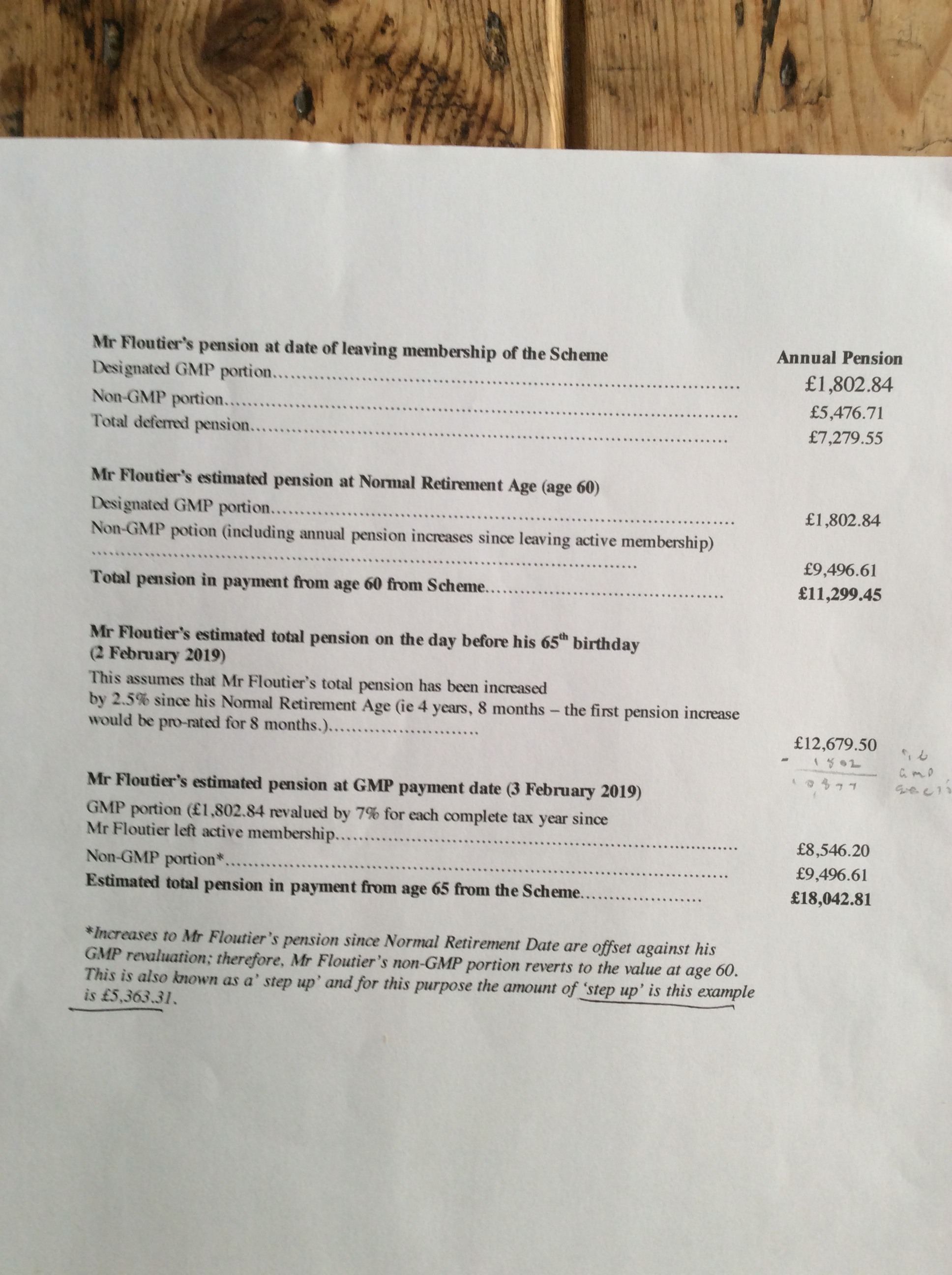
Barclays’ proforma
0 -
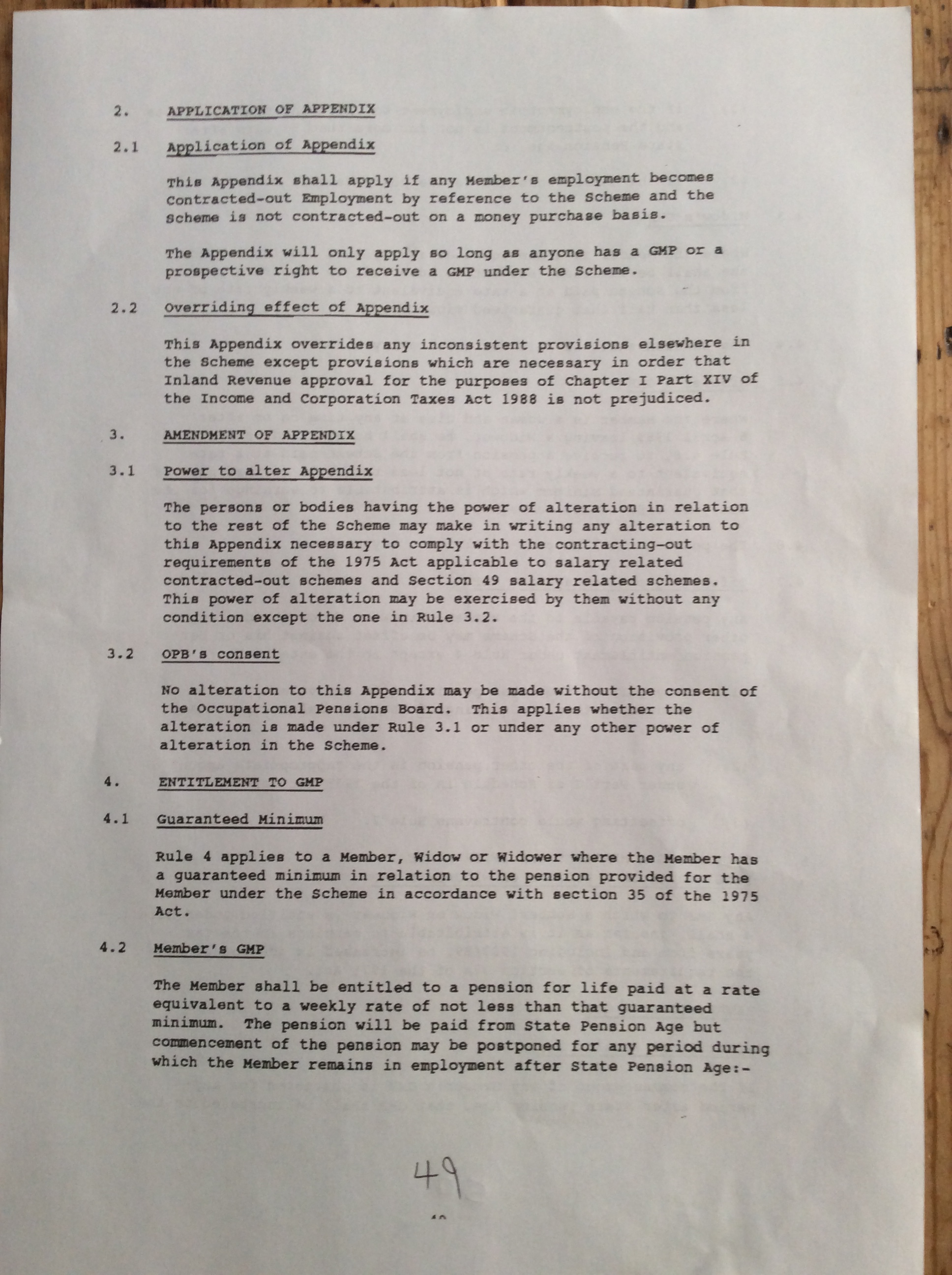
29th deed of variation 15/1/91 page 49
0 -
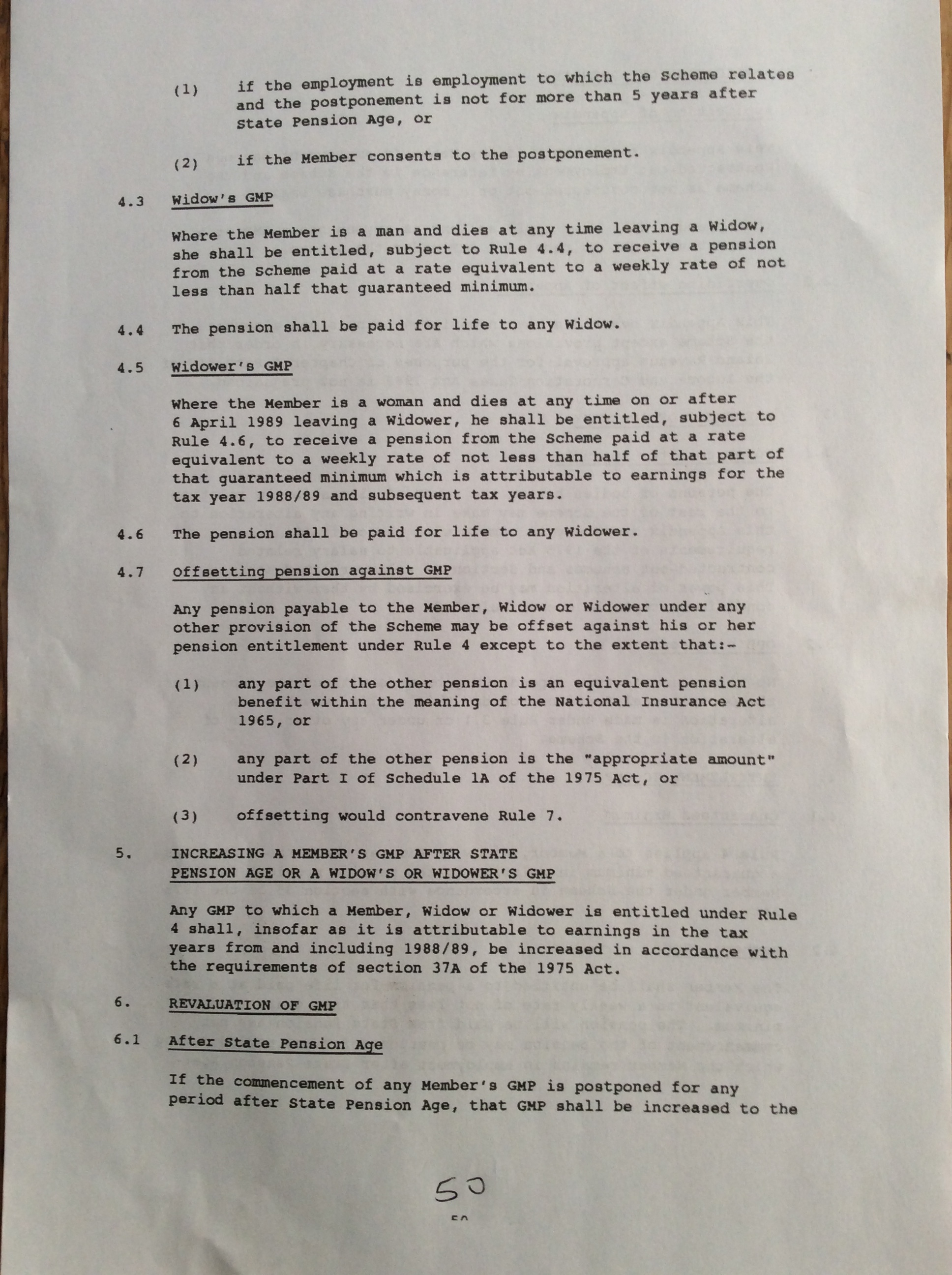
29th deed of variation 15/1/91 page 50
0 -
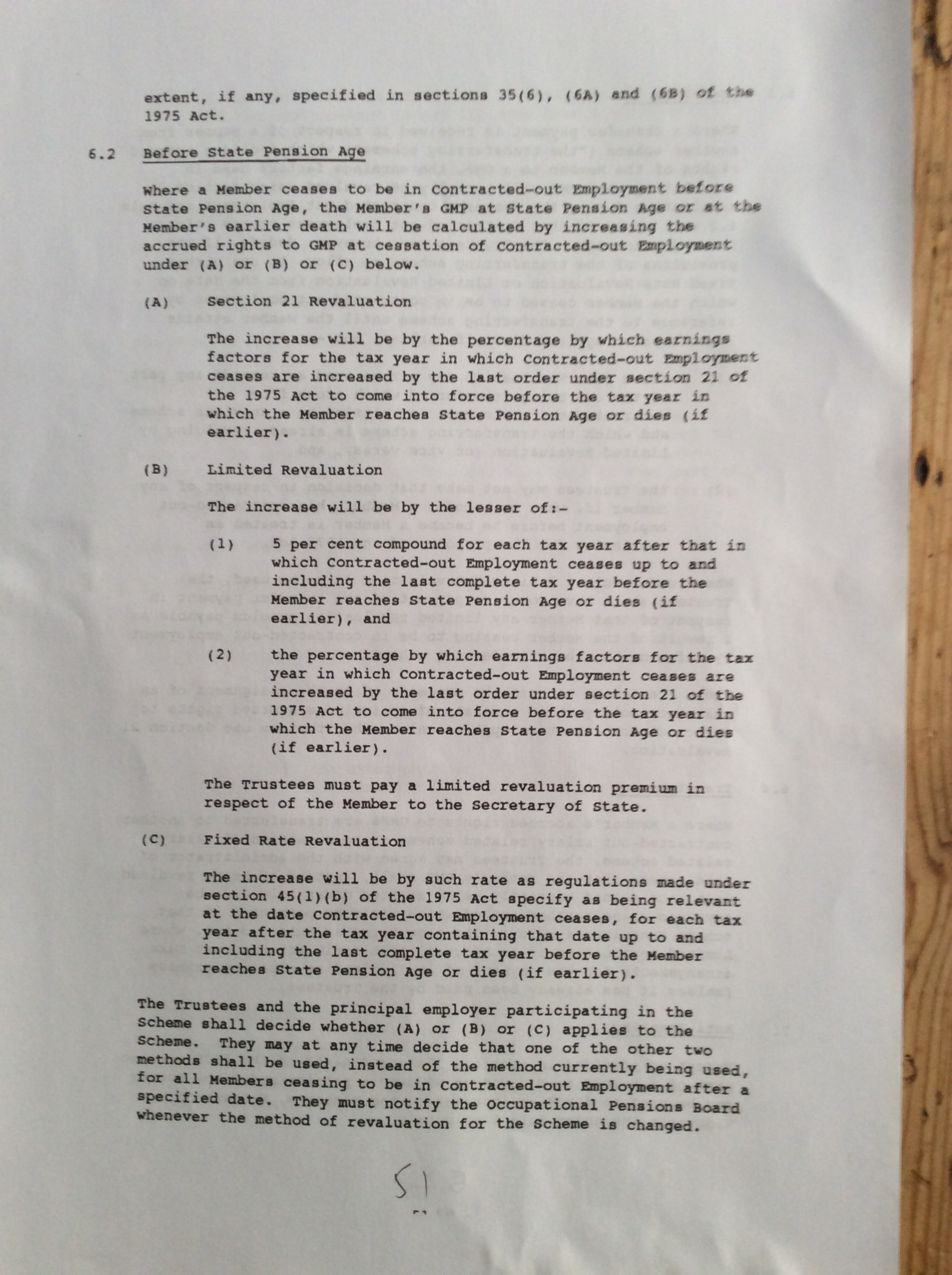
29th deed of variation 15/1/91 page 51
0









Confirm your email address to Create Threads and Reply

Categories
- All Categories
- 354.8K Banking & Borrowing
- 254.5K Reduce Debt & Boost Income
- 455.6K Spending & Discounts
- 247.6K Work, Benefits & Business
- 604.6K Mortgages, Homes & Bills
- 178.6K Life & Family
- 262.2K Travel & Transport
- 1.5M Hobbies & Leisure
- 16.1K Discuss & Feedback
- 37.7K Read-Only Boards