We’d like to remind Forumites to please avoid political debate on the Forum.
This is to keep it a safe and useful space for MoneySaving discussions. Threads that are – or become – political in nature may be removed in line with the Forum’s rules. Thank you for your understanding.
EV Discussion thread
Comments
-
Totally agree that a tax change is needed. You (and Nick, and my 'now BEV' friend), have shown what is possible. Yet the real world fuel data is horrendous. So, those that buy a PHEV because they want a PHEV (v's an ICEV) can make it work, but those that get one for other reasons, reveal just how poorly they perform compared to their official rating. Simply put, people who don't really want/need a PHEV, shouldn't be getting PHEV's. [Though that does then make me ponder, if they can then go on to provide a SH PHEV market to those that do want one, and intend to use it 'properly'?]
A new study on PHEV's in Europe has recently come out, and the discrepancy is horrific ~400%, v's ~19% for ICEV's against their fuel consumption ratings.
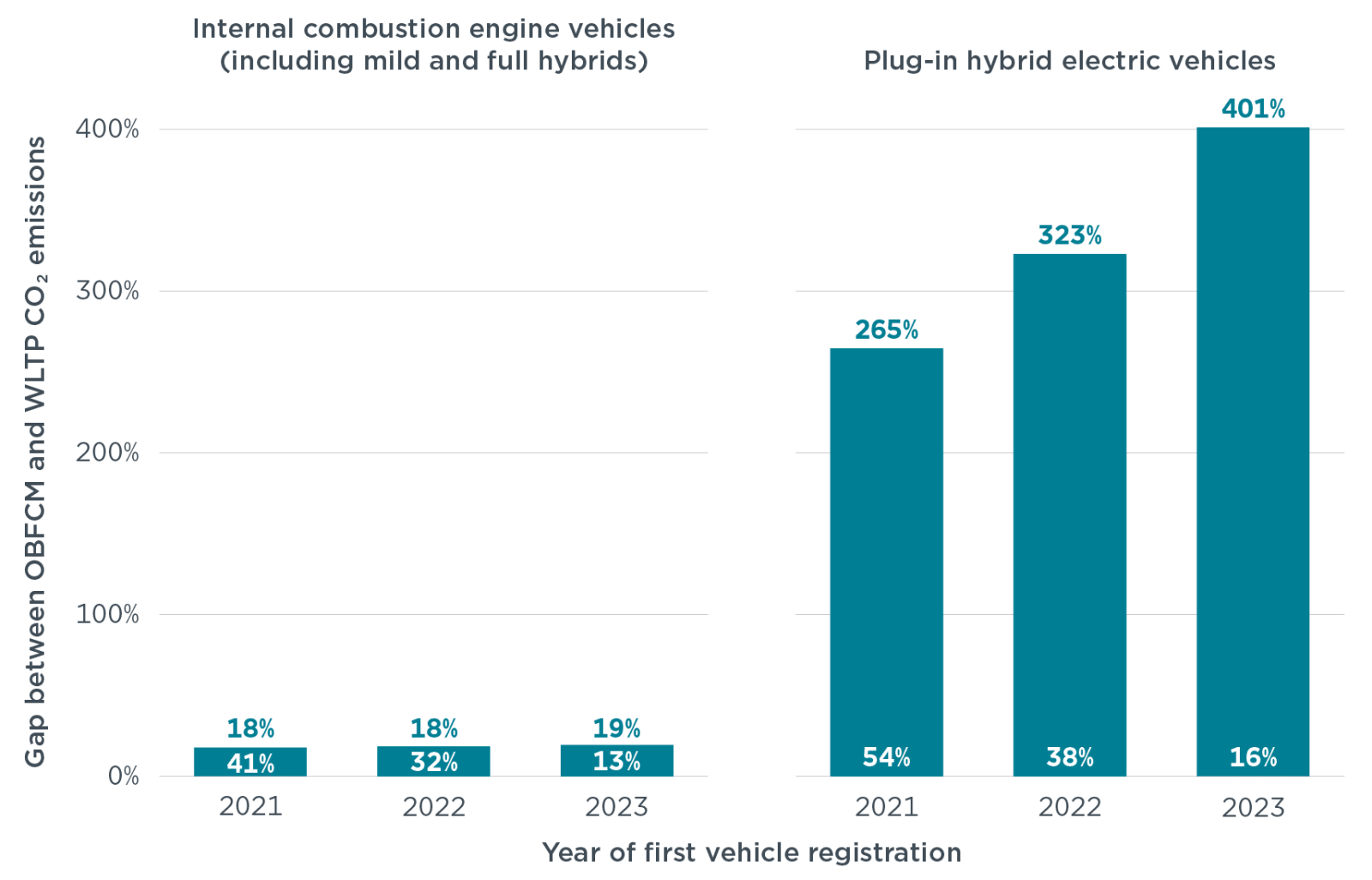
Press Release - Plug-in hybrids in Europe emit five times more than officially reported
Short report with link to full report - On the way to ‘real-world’ CO2 values? Evidence from 2021–2023 on-board fuel consumption monitoring data in the European passenger car market
Mart. Cardiff. 8.72 kWp PV systems (2.12 SSW 4.6 ESE & 2.0 WNW). 28kWh battery storage. Two A2A units for cleaner heating. Two BEV's for cleaner driving.
For general PV advice please see the PV FAQ thread on the Green & Ethical Board.1 -
I don’t understand why organisations like ICCT and T&E attack PHEVs as a technology when the technology isn’t the issue (as Nick has demonstrated). The problem is the tax (BIK) treatment which encourages PHEV “ownership” rather than electric usage.
A different system of assumptions need to be made if the WLTP cannot be achieved. Real life consumptions figures for a builder’s pick up or van will never be anywhere near WLTP when the test doesn’t include the crew sitting in the cab with the engine running to keep warm. The test cycle is unrealistic. WLTP tests for ICE cars have improved but are still about 20% out of and range/consumption figures for BEVs also fall a long way short of WLTP ranges.
From the ICCT:
Policymakers could consider collecting real-world energy consumption data from BEVs using on-board fuel and energy consumption monitoring devices. The simulated real-world energy consumption in this study is 29% to 44% higher than the type-approval value. For verifying the representativeness of BEV type-approval values, collecting reliable real-world energy consumption is essential. It is also a prerequisite for providing consumers with comprehensive information, determining life-cycle emissions, and assessing the impact of electric vehicle energy consumption limits. These analyses could be performed by the European Commission as defined in the CO2 standards for cars and vans.
Northern Lincolnshire. 7.8 kWp system, (4.2 kWwest facing panels , 3.6 kWeast facing), Solis inverters installed 2018, 5kW SSE facing system (shaded in afternoon) added in 2025 with Tesla PW3 battery, Mitsubishi SRK35ZS-S and SRK20ZS-S Wall Mounted A2A Heat Pumps, ex Nissan Leaf owner.0 -
I had to replace the tyres on my Mokka-E after 24,000 miles. Before that I had a Yaris Hybrid and those tyres lasted about twice as long. The cost of a new set of tyres for my Mokka-E was roughly the same as I had paid for the electricity to drive the 24,000 miles.
Reed3 -
I have been out today. Twice I was the front of the queue at traffic lights on a dual carriageway and both times EVs pulled up alongside me and both times they set off like a bat out of hell. Is the increased tyre wear that ensues down to EV manufacturers making this performance available or is it down to drivers exploiting it?
Northern Lincolnshire. 7.8 kWp system, (4.2 kWwest facing panels , 3.6 kWeast facing), Solis inverters installed 2018, 5kW SSE facing system (shaded in afternoon) added in 2025 with Tesla PW3 battery, Mitsubishi SRK35ZS-S and SRK20ZS-S Wall Mounted A2A Heat Pumps, ex Nissan Leaf owner.1 -
I guess that depends whether your generalising the bat out of hell as representative of all EV drivers. Whether you’re comparing the bat out of hell to you personally or the average ICE driver? If the bat out of hell have been a BMW driver would you have perhaps have expected the behaviour?
I'm a Forum Ambassador on the housing, mortgages & student money saving boards. I volunteer to help get your forum questions answered and keep the forum running smoothly. Forum Ambassadors are not moderators and don't read every post. If you spot an illegal or inappropriate post then please report it to forumteam@moneysavingexpert.com (it's not part of my role to deal with this). Any views are mine and not the official line of MoneySavingExpert.com.0 -
No, I was not assuming all EV drivers set off like that and I accept that tyre mileage will vary significantly from driver to driver. To have set off like that I would have had to hold the car on the handbrake, keeping the revs steady at about 4500 rpm then dropping the clutch as I released the handbrake. Even then a 110 bhp car would have struggled to get the car off the line like the EVs did. The instant torque and initial acceleration of an EV up to about 30mph will embarrass a supercar and if used there will be a cost in terms of tyre wear. Not every EV is driven like that of course but some EV drivers do find it fun to do so.
Edit: I do, generally, try to drive economically but that doesn’t necessarily mean slowly. It means avoiding hard acceleration, short shifting and avoiding braking by anticipation. If I see red lights ahead I will lift off timing my run to coincide with the traffic in front clearing so I maintain my momentum. rather than driving up to them and braking hard. I do usually choose the lane at traffic lights that will allow me to make the best progress and I am respectful of other drivers by not impeding their progress.
As a bit of background, I have, in the past, owned a TVR, Vauxhall VX220 and a Lotus Elise as well as several MX5s. I have stopped doing track days now and confine my “track”activity to Gran Turismo on my Play Station. I don’t believe in racing on the road.
Northern Lincolnshire. 7.8 kWp system, (4.2 kWwest facing panels , 3.6 kWeast facing), Solis inverters installed 2018, 5kW SSE facing system (shaded in afternoon) added in 2025 with Tesla PW3 battery, Mitsubishi SRK35ZS-S and SRK20ZS-S Wall Mounted A2A Heat Pumps, ex Nissan Leaf owner.0 -
Since driving an EV, I brake slower to maximise the regeneration and because I enjoy the one pedal driving effect. I do also accelerate more to get into gaps in traffic etc, mainly because the car can, whereas the previous [nissan juke] couldn’t. I’m too old to accelerate off at traffic lights, not that I ever did.
I'm a Forum Ambassador on the housing, mortgages & student money saving boards. I volunteer to help get your forum questions answered and keep the forum running smoothly. Forum Ambassadors are not moderators and don't read every post. If you spot an illegal or inappropriate post then please report it to forumteam@moneysavingexpert.com (it's not part of my role to deal with this). Any views are mine and not the official line of MoneySavingExpert.com.0 -
My first 2021 Model 3 Performance got close to 30K on it's original tyres & would have probably got there if I'd run them down to 1.6mm. The BMW 435d xDrive that came before it needed new rear tyres at around 20K & front ones at 26K. The BMW was about 150kg lighter than the Tesla. Both cars were subjected to the same 120 mile daily commute.
4kWp (black/black) - Sofar Inverter - SSE(141°) - 30° pitch - North LincsInstalled June 2013 - PVGIS = 3400Sunsynk Ecco Inverter & Pylontech 5x US2000, 3x US3000, 3x US5000 Batteries - 37kWh0 -
When you first get an EV the performance is intoxicating & you can't get enough of it. After you've owned one for a while & indulged all you family & friends in the 0-100 experience (kph of course), you eventually settle down & start to drive it normally. You also realise how much those traffic light drag races deplete the range!
4kWp (black/black) - Sofar Inverter - SSE(141°) - 30° pitch - North LincsInstalled June 2013 - PVGIS = 3400Sunsynk Ecco Inverter & Pylontech 5x US2000, 3x US3000, 3x US5000 Batteries - 37kWh0 -
I have found (as a passenger) they are also quite good appetite suppressants.
Northern Lincolnshire. 7.8 kWp system, (4.2 kWwest facing panels , 3.6 kWeast facing), Solis inverters installed 2018, 5kW SSE facing system (shaded in afternoon) added in 2025 with Tesla PW3 battery, Mitsubishi SRK35ZS-S and SRK20ZS-S Wall Mounted A2A Heat Pumps, ex Nissan Leaf owner.0











Confirm your email address to Create Threads and Reply

Categories
- All Categories
- 355.6K Banking & Borrowing
- 254.8K Reduce Debt & Boost Income
- 456.1K Spending & Discounts
- 248.2K Work, Benefits & Business
- 605.7K Mortgages, Homes & Bills
- 179K Life & Family
- 263.5K Travel & Transport
- 1.5M Hobbies & Leisure
- 16.1K Discuss & Feedback
- 37.7K Read-Only Boards