We’d like to remind Forumites to please avoid political debate on the Forum.
This is to keep it a safe and useful space for MoneySaving discussions. Threads that are – or become – political in nature may be removed in line with the Forum’s rules. Thank you for your understanding.
EV Discussion thread
Comments
-
The second to last time I spent trying to charge my EV, I spent the first 20 minutes trying to download the necessary app, give it some money and persuade it to recognise the charger I was standing next to. I then spent the next 20 minutes trying and failing to get the charger to deliver a charge. In the end we found that the whole bank of chargers was out of action and had been for some time. So that was 40 minutes completely wasted. If I keep encountering complete time-wasting failures like this then my average EV charging time will never come close to the time required to fuel an ICE car.
Reed1 -
There's a large Tesla charging plaza at the M5 services in Exeter. Most sensible routes to Fowey will take you past it. Top off there and you'll get to Fowey on half charge or better.
I understand it's relatively cheap to charge a Tesla at a supercharger, although not having a Tesla I can't speak from experience.
apparently it’s 21 miles to the NW at St Columb, a 30-35 minute drive.
AKA "hamburger hill", so called as the A30 bypass goes up a fairly steep stretch as it passes the retail park (where the supercharger is) and one of the first outlets to put up a prominent sign was McDonald's 🙂
I asked Google if there were any rapid chargers in Fowey and Google said No, the nearest being 8 miles away.
Bodmin and St Austell both have fast chargers from about 65p/kWh. Bodmin has a couple of multi-charger plazas where you'd be very unlucky to find a queue.
Our holiday cottage doesn’t have a petrol pump (nor does it have a charger)
It does have electricity, though? So you could granny charge? That's what we typically do when visiting west Cornwall. An overnight granny charge will add 100 miles or more.
(We do a similar route 4-5 times a year as my parents live down there. Our e-UP! only has a 100-120 mile range. We generally arrive in Exeter with a couple of miles in hand, charge to 85-90% then head off again. Depending on weather and traffic that'll often get us to our destination, but if not there are half a dozen or more spots along the A30 in Cornwall where we can get a top-up. Jamaica Inn is one of them.)
N. Hampshire, he/him. Octopus Intelligent Go elec / Fuse gas / Vodafone BB / iD mobile. Kirk Hill Co-op member.Ofgem cap table, Ofgem cap explainer. Economy 7 cap explainer. Gas vs E7 vs peak elec heating costs, Best kettle!
2.72kWp PV facing SSW installed Jan 2012. 11 x 247w panels, 3.6kw inverter. 37 MWh generated, long-term average 2.6 Os.1 -
I think the quickest at the moment is the Xpeng G6. It can supposedly charge from 10% to 80% in 12 minutes, which it might get close to on a 350kW Ionity charger. Still not as quick as filling an ICE car.
I have one on order but my decision was not based on charging speed as 99% of charging is at home.
2 -
The point is that EVs charge whilst you're doing other things, like having a toilet and refreshment break, or whilst you are sleeping, or when you are in the gym, or the shops…
I hear quite a few moans about EVs (800V on 350+kW chargers, not giving drivers enough time to do up their flies, let alone get a coffee, before the app is telling them to vacate the bay.
2 -
A standard filling station petrol pump will dispense petrol at 35-50 litres per minute, that’s 385 to 550 miles of range added in a minute for a car that does 50mpg. The beauty of that is that the rate of flow is the same from when the tank is empty to when the pump clicks off unlike an EV charger that can only sustain a high rate of charging for a few minutes.
According to a YouTube video the XPeng G6 is the fastest charging car tested. It is quoted as being able to charge at 280-451kW given the right charger. 451watts adds roughly 7.5kWh in a minute or around 22.5 miles of range at 3 miles per kWh. That might sound impressive but the best fire out petrol pumps are 50 times faster at adding range. The YouTube video of the test which I haven’t watched apparently demonstrates that “this allows the car to go from 10% (or 20%) to 80% in just 12 to 16 minutes”. Let’s assume the 12 minutes is from 20-80%. The battery capacity is 87.5kWh so the car adds 52.5 kWh in 12 minutes or 4.375kWh per minute or around 13 miles of range a minute - that about 30 times slower than the lower end of the petrol pump range. (Fleet News quotes a real world range for the Performance version of 260 miles or 156 miles from 60% of the battery XPENG G6 AWD Performance price and specifications | Ref: 3276)
It would appear therefore that the fastest charging EV available is actually 20 to 30 times slower at adding range than a petrol pump.
Northern Lincolnshire. 7.8 kWp system, (4.2 kWwest facing panels , 3.6 kWeast facing), Solis inverters installed 2018, 5kW SSE facing system (shaded in afternoon) added in 2025 with Tesla PW3 battery, Mitsubishi SRK35ZS-S and SRK20ZS-S Wall Mounted A2A Heat Pumps, ex Nissan Leaf owner.0 -
It seems a bit odd to me all this quibbling over a few minutes difference between filling an ICE and charging an EV. You could argue that because I charge 99% of the time at home overnight, I save many more minutes by never having to stop at a petrol station. But at the end of the day it’s most likely negligible and not worth worrying about for those that can mostly charge at home.
I suppose it only becomes a potential issue for someone doing most of their charging away from home but then they’re probably not saving much money compared to ICE/petrol anyway and have other reasons for wanting an EV.
2 -
350 miles is a very useful range and as much as most people need. It probably, though, is a summer range in ideal conditions. Worst case scenario (motorway speeds, winter temperatures and wet roads or strong winds) might be nearer 230-250 miles with the same car. Would you want to test the lower limit if battery capacity in the middle of winter? On my 390 mile December 2022 winter trip at -7C I averaged 48mpg in my Golf - that’s a theoretical range of 528 miles with the 50litre tank. Or say 475 for a normal fill up leaving a few miles in reserve. I don’t have figures for the Golf PHEV but I’d guess it might be similar. I reckon I’d have more peace of mind for a 350 mile trip in the Golf and what’s more the cabin heating comes without any impact on range.
Northern Lincolnshire. 7.8 kWp system, (4.2 kWwest facing panels , 3.6 kWeast facing), Solis inverters installed 2018, 5kW SSE facing system (shaded in afternoon) added in 2025 with Tesla PW3 battery, Mitsubishi SRK35ZS-S and SRK20ZS-S Wall Mounted A2A Heat Pumps, ex Nissan Leaf owner.0 -
Hi Grumpy, sorry it took so long for my memory to jog me, but regarding this line you wrote:
344 miles in total is not far off the mileage range quoted when we purchased the car (370 or 380 or something like that IIRC).
Thinking back, do I recall correctly that you went for the AWD, in order to get the longer range battery?
If so, then the TM3 (Highland model) is now available in RWD long range, with the WLTP range now at 466 miles, v's the ~380 mile range, you mention for the original AWD LR model (410 miles for the Highland AWD LR).
Given you may have matched the WLTP range (allowing for the below zero range left in the Tesla), then that's a decent step up in the years since you bought. Augurs well for the future if you ever decide to change.
I think the WLTP range for my Y is ~330 miles, and have achieved ~295miles all motorway at an average of about 75mph. So not far off, assuming ~25 miles of range after zero, but as I mentioned before, never had the guts to test that. Probably 10% or more efficiency improvement at 65mph.
Mart. Cardiff. 8.72 kWp PV systems (2.12 SSW 4.6 ESE & 2.0 WNW). 28kWh battery storage. Two A2A units for cleaner heating. Two BEV's for cleaner driving.
For general PV advice please see the PV FAQ thread on the Green & Ethical Board.0 -
The latest Tesla Model 3 RWD Long Range, now labelled Premium has an NMC battery which you should only charge to 100% right before embarking on a long road trip to prevent prolonged degradation from high voltage stress. If charging to 80% the available range drops to 373 miles (based on WLTP figures.) The NMC battery, though, suffers less range loss in winter, than LFP batteried cars. I wonder how many LR owners routinely stick to 80% battery charging.
The RWD (Standard) has an LFP battery which Tesla recommends be charged to 100% and a range of 332 miles and is quite a bargain at £37,990. If you are happy using public chargers it is a good buy. Historically though the Long Range out sells the Standard Range 60:40 so it does suggest that drivers prefer to pay a significant premium to reduce or avoid public charging: surprising, really, considering how easy it is to charge a Tesla. Personally, I would still go for the Long Range.
Northern Lincolnshire. 7.8 kWp system, (4.2 kWwest facing panels , 3.6 kWeast facing), Solis inverters installed 2018, 5kW SSE facing system (shaded in afternoon) added in 2025 with Tesla PW3 battery, Mitsubishi SRK35ZS-S and SRK20ZS-S Wall Mounted A2A Heat Pumps, ex Nissan Leaf owner.0 -
Yes, I have the TM3LR.
I agree it is pleasing that the battery range / efficiency is improving so that the newer cars have longer ranges still.
I have to be honest, my car is three years old at the end of this month and still as good as new in every way so there is no desire to change. I have just gone over 32k miles this week. In fact, I found in the last few weeks after the latest software update there is a graph that gives total energy over total miles. An average of 210 Wh/mile is pretty good I think.
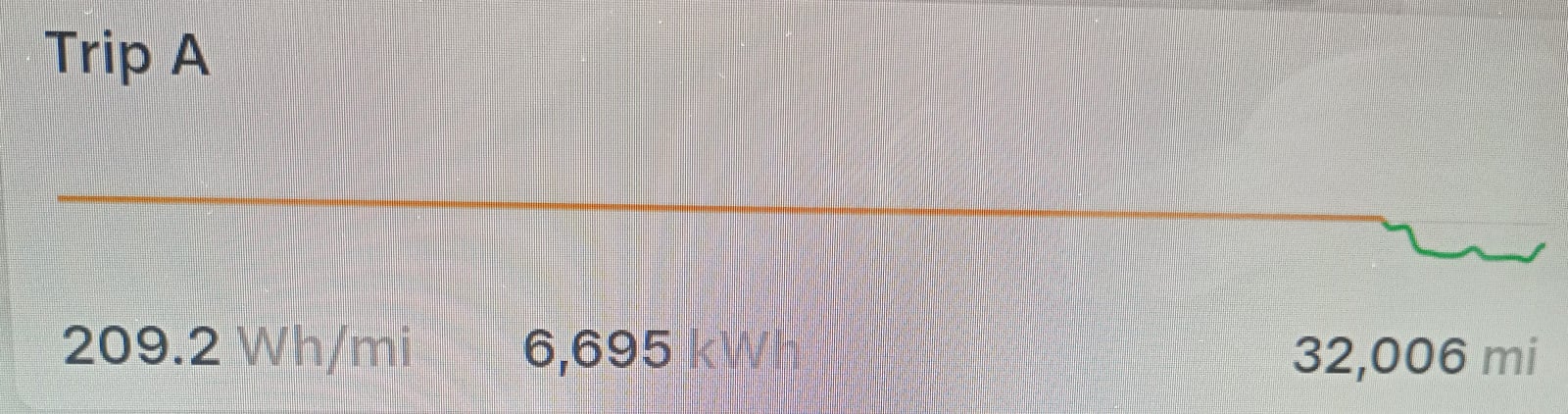
If I did change, I'd like more "sports" seats which I think the latest TM3/Y has and I have also started to notice more wind noise than I recall from when the car was new.
3










Confirm your email address to Create Threads and Reply

Categories
- All Categories
- 355.6K Banking & Borrowing
- 254.8K Reduce Debt & Boost Income
- 456.1K Spending & Discounts
- 248.2K Work, Benefits & Business
- 605.7K Mortgages, Homes & Bills
- 179K Life & Family
- 263.5K Travel & Transport
- 1.5M Hobbies & Leisure
- 16.1K Discuss & Feedback
- 37.7K Read-Only Boards