We’d like to remind Forumites to please avoid political debate on the Forum.
This is to keep it a safe and useful space for MoneySaving discussions. Threads that are – or become – political in nature may be removed in line with the Forum’s rules. Thank you for your understanding.
📨 Have you signed up to the Forum's new Email Digest yet? Get a selection of trending threads sent straight to your inbox daily, weekly or monthly!
The Forum now has a brand new text editor, adding a bunch of handy features to use when creating posts. Read more in our how-to guide
Timing the market
Comments
-
You could be right re the passive funds causing the large-cap growth bubble. If base rates rise and large-cap growth valuations remain elevated, it might then be the most likely culprit.NedS said:Prism said:
I agree at the index level. I think there was a smallish window after 2008 when quality growth investing was the place to be. Around that time a few passive funds launched to take advantage too. That outperformance has dropped away a little though. The world quality index and passive funds are still pretty much top of the pile over all time periods but not by much. It does come at a small price premium though so rising interest rates may well level things out. The historical out performance of funds like Fundsmith has come from stock picking.BritishInvestor said:
"Fundsmith with its obsession of cash producing stalwarts"Prism said:
There may be some fund managers that still try to compete in this area with small agile funds and a trading rather than investing stance but I don't know any.In 2021, it's quite tough (to put it politely) to find inefficiencies if you're an active fund manager, for a number of reasons:
1. Competition: The resources available to fund managers in terms of brainpower, computer capacity, historical data (quality and quantity) is far, far behind the quant-style hedge funds, and I'd assume a fair way behind investment banking prop desks (I don't know how many of these are still in existence to be fair). The best talent (certainly in the City (London)) tends to gravitate to IBs or hedge funds.
2. Scalability: Inefficiencies tend to be limited in scale, with more volume tending to move the market, therefore, eliminating the edge. A large fund run by an active fund manager (with effectively one strategy) is unlikely to be able to exploit inefficiencies at this scale.
3. Reaction time: Hedge fund computers react in near real-time to remove the inefficiency before Mr active fund manager has finished his cornflakes
Most completely agree that market timing is pointless and wouldn't compare themselves quants or traders. It can take several weeks if not a few months to build up a position in a new holding so any inefficiencies they see must be long multi year ones. The most effective fund houses in this area seem to be the ones that do their own analysis and completely ignore sell side data or others opinions. If you reduce the importance of the current share price then moving the market and reaction time become less of a concern. Due to the work required to do in house analysis this tends to limit the number of holdings of those funds making them more concentrated.
This theoretically indicates a higher risk due to less diversification but this seems pretty rare to find an example. One is JEO which had a 17% top holding drop to zero (Wirecard) and yet the performance has still kept pretty close to the index over the last 5 years and easily beats it over 10 years. I find it quite interesting that a fund can shrug off a permanent 17% loss in capital.
My thoughts in general are that some fund managers, and their teams, are pretty good at this in spite of the huge sums at money thrown at their hedge fund competitors. Most of them seem to be relatively small teams who try and do something a bit different, whether that be Scottish Mortgage with their ideas about companies in 10-20 years, Fundsmith with its obsession of cash producing stalwarts or the large variety of UK small cap funds working in under researched areas.
But as we've discussed previously, it's debatable whether there's any alpha there.
One of the problems we have here is that if someone truely believes that growth investing is the best place to be they are somewhat limited in their choices of passive funds - there are basically none. So if, rightly or wrongly, you want to follow a growth strategy then you end up looking at active funds. Morningstar classes a few momentum funds as growth but that isn't correct. Momentum is simply what has done well recently and therefore is currently full of oil companies and banks to go along with stuff like Tesla and Apple.Passive index trackers essentially reward (and perpetuate) momentum and growth at the expense of value. The better a stock share price does, the more the index will buy of it, and so on (hence why the 10 biggest companies in the world constitute something like 20% of global capitalisation)Value investing works on the basis of buy low, sell high, but if a share is undervalued, the index won't buy more of it (relative to growth stocks) so it's more likely to remain cheap. Buy low, sell low, doesn't work so well, so there is little incentive for the company to invest, hence it is more likely to focus on adding shareholder value by share buybacks and dividend distribution - after all where is the value in investing in the business if the market isn't going to reward that investment by way of a higher share price. The rise in popularity of passive index trackers largely explains why the FTSE100 is undervalued and full of cash generative dividend paying / share buyback companies. As long as the bull market run continues, it's difficult to see how that will change.
But why is the bubble pretty much confined to the US when there are tracker funds elsewhere - more flow in that direction?0 -
For that to be the case, his outperformance should not be explainable by simple rules/factor attribution. However, his strategy seems reasonably straightforward to emulate.BritishInvestor said:Prism said:
I agree at the index level. I think there was a smallish window after 2008 when quality growth investing was the place to be. Around that time a few passive funds launched to take advantage too. That outperformance has dropped away a little though. The world quality index and passive funds are still pretty much top of the pile over all time periods but not by much. It does come at a small price premium though so rising interest rates may well level things out. The historical out performance of funds like Fundsmith has come from stock picking.BritishInvestor said:
"Fundsmith with its obsession of cash producing stalwarts"Prism said:
There may be some fund managers that still try to compete in this area with small agile funds and a trading rather than investing stance but I don't know any.In 2021, it's quite tough (to put it politely) to find inefficiencies if you're an active fund manager, for a number of reasons:
1. Competition: The resources available to fund managers in terms of brainpower, computer capacity, historical data (quality and quantity) is far, far behind the quant-style hedge funds, and I'd assume a fair way behind investment banking prop desks (I don't know how many of these are still in existence to be fair). The best talent (certainly in the City (London)) tends to gravitate to IBs or hedge funds.
2. Scalability: Inefficiencies tend to be limited in scale, with more volume tending to move the market, therefore, eliminating the edge. A large fund run by an active fund manager (with effectively one strategy) is unlikely to be able to exploit inefficiencies at this scale.
3. Reaction time: Hedge fund computers react in near real-time to remove the inefficiency before Mr active fund manager has finished his cornflakes
Most completely agree that market timing is pointless and wouldn't compare themselves quants or traders. It can take several weeks if not a few months to build up a position in a new holding so any inefficiencies they see must be long multi year ones. The most effective fund houses in this area seem to be the ones that do their own analysis and completely ignore sell side data or others opinions. If you reduce the importance of the current share price then moving the market and reaction time become less of a concern. Due to the work required to do in house analysis this tends to limit the number of holdings of those funds making them more concentrated.
This theoretically indicates a higher risk due to less diversification but this seems pretty rare to find an example. One is JEO which had a 17% top holding drop to zero (Wirecard) and yet the performance has still kept pretty close to the index over the last 5 years and easily beats it over 10 years. I find it quite interesting that a fund can shrug off a permanent 17% loss in capital.
My thoughts in general are that some fund managers, and their teams, are pretty good at this in spite of the huge sums at money thrown at their hedge fund competitors. Most of them seem to be relatively small teams who try and do something a bit different, whether that be Scottish Mortgage with their ideas about companies in 10-20 years, Fundsmith with its obsession of cash producing stalwarts or the large variety of UK small cap funds working in under researched areas.
But as we've discussed previously, it's debatable whether there's any alpha there.
One of the problems we have here is that if someone truely believes that growth investing is the best place to be they are somewhat limited in their choices of passive funds - there are basically none. So if, rightly or wrongly, you want to follow a growth strategy then you end up looking at active funds. Morningstar classes a few momentum funds as growth but that isn't correct. Momentum is simply what has done well recently and therefore is currently full of oil companies and banks to go along with stuff like Tesla and Apple.
"The historical out performance of funds like Fundsmith has come from stock picking."
For that to be the case, his outperformance should not be explainable by simple rules/factor attribution. However, his strategy seems reasonably straightforward to emulate.
"One of the problems we have here is that if someone truely believes that growth investing is the best place to be they are somewhat limited in their choices of passive funds - there are basically none."
I suspect the reason there aren't that many growth style factor funds is that history tells us that value tends to outperform over the longer term, so the demand might be limited.
Why should it not be explainable? The skill may be in knowing which rules and factors to use. And from the graph the emulation appeared to give exactly the same performance as Fundsmith . If the performance is identical why not use Fundsmith and avoid the effort? It would be a bit more impressive if it had significantly outperformed Fundsmith and had not been created with the benefit of hindsight.
I suspect the reason there aren't that many growth style factor funds is that history tells us that value tends to outperform over the longer term, so the demand might be limited.
Limited demand has not stopped ETF fund managers coming up with some remarkably obscure products, Kazakhstan Equity, 3D printing, Columbia Municipal Income etc etc. Surely a Global Growth ETF should be a pretty obvious opportunity for every fund manager.
If people believed value tends to outperform growth wouldn't value investments outweigh growth ones in the major indexes? According to Morningstar the MSCI World Index is 25% value, 42% blend, 34% growth. Or do you know better than the market?1 -
I guess because the US represents 55-60% of global capitalisation, and 8 of the top 10 companies by capitalisation in a global index tracker are US companies. The more money that flows into global equity index trackers, the more money flows into these mega-cap US companies.BritishInvestor said:
You could be right re the passive funds causing the large-cap growth bubble. If base rates rise and large-cap growth valuations remain elevated, it might then be the most likely culprit.NedS said:Prism said:
I agree at the index level. I think there was a smallish window after 2008 when quality growth investing was the place to be. Around that time a few passive funds launched to take advantage too. That outperformance has dropped away a little though. The world quality index and passive funds are still pretty much top of the pile over all time periods but not by much. It does come at a small price premium though so rising interest rates may well level things out. The historical out performance of funds like Fundsmith has come from stock picking.BritishInvestor said:
"Fundsmith with its obsession of cash producing stalwarts"Prism said:
There may be some fund managers that still try to compete in this area with small agile funds and a trading rather than investing stance but I don't know any.In 2021, it's quite tough (to put it politely) to find inefficiencies if you're an active fund manager, for a number of reasons:
1. Competition: The resources available to fund managers in terms of brainpower, computer capacity, historical data (quality and quantity) is far, far behind the quant-style hedge funds, and I'd assume a fair way behind investment banking prop desks (I don't know how many of these are still in existence to be fair). The best talent (certainly in the City (London)) tends to gravitate to IBs or hedge funds.
2. Scalability: Inefficiencies tend to be limited in scale, with more volume tending to move the market, therefore, eliminating the edge. A large fund run by an active fund manager (with effectively one strategy) is unlikely to be able to exploit inefficiencies at this scale.
3. Reaction time: Hedge fund computers react in near real-time to remove the inefficiency before Mr active fund manager has finished his cornflakes
Most completely agree that market timing is pointless and wouldn't compare themselves quants or traders. It can take several weeks if not a few months to build up a position in a new holding so any inefficiencies they see must be long multi year ones. The most effective fund houses in this area seem to be the ones that do their own analysis and completely ignore sell side data or others opinions. If you reduce the importance of the current share price then moving the market and reaction time become less of a concern. Due to the work required to do in house analysis this tends to limit the number of holdings of those funds making them more concentrated.
This theoretically indicates a higher risk due to less diversification but this seems pretty rare to find an example. One is JEO which had a 17% top holding drop to zero (Wirecard) and yet the performance has still kept pretty close to the index over the last 5 years and easily beats it over 10 years. I find it quite interesting that a fund can shrug off a permanent 17% loss in capital.
My thoughts in general are that some fund managers, and their teams, are pretty good at this in spite of the huge sums at money thrown at their hedge fund competitors. Most of them seem to be relatively small teams who try and do something a bit different, whether that be Scottish Mortgage with their ideas about companies in 10-20 years, Fundsmith with its obsession of cash producing stalwarts or the large variety of UK small cap funds working in under researched areas.
But as we've discussed previously, it's debatable whether there's any alpha there.
One of the problems we have here is that if someone truely believes that growth investing is the best place to be they are somewhat limited in their choices of passive funds - there are basically none. So if, rightly or wrongly, you want to follow a growth strategy then you end up looking at active funds. Morningstar classes a few momentum funds as growth but that isn't correct. Momentum is simply what has done well recently and therefore is currently full of oil companies and banks to go along with stuff like Tesla and Apple.Passive index trackers essentially reward (and perpetuate) momentum and growth at the expense of value. The better a stock share price does, the more the index will buy of it, and so on (hence why the 10 biggest companies in the world constitute something like 20% of global capitalisation)Value investing works on the basis of buy low, sell high, but if a share is undervalued, the index won't buy more of it (relative to growth stocks) so it's more likely to remain cheap. Buy low, sell low, doesn't work so well, so there is little incentive for the company to invest, hence it is more likely to focus on adding shareholder value by share buybacks and dividend distribution - after all where is the value in investing in the business if the market isn't going to reward that investment by way of a higher share price. The rise in popularity of passive index trackers largely explains why the FTSE100 is undervalued and full of cash generative dividend paying / share buyback companies. As long as the bull market run continues, it's difficult to see how that will change.
But why is the bubble pretty much confined to the US when there are tracker funds elsewhere - more flow in that direction?
I am a Forum Ambassador and I support the Forum Team on the Benefits & tax credits, Heat pumps and Green & Ethical MoneySaving forums. If you need any help on those boards, do let me know. Please note that Ambassadors are not moderators. Any post you spot in breach of the Forum Rules should be reported via the report button, or by emailing forumteam@moneysavingexpert.com. All views are my own & not the official line of Money Saving Expert.Our green credentials: 12kW Samsung ASHP for heating, 7.2kWp Solar (South facing), Tesla Powerwall 3 (13.5kWh), Net exporter1 -
"The skill may be in knowing which rules and factors to use."Linton said:
For that to be the case, his outperformance should not be explainable by simple rules/factor attribution. However, his strategy seems reasonably straightforward to emulate.BritishInvestor said:Prism said:
I agree at the index level. I think there was a smallish window after 2008 when quality growth investing was the place to be. Around that time a few passive funds launched to take advantage too. That outperformance has dropped away a little though. The world quality index and passive funds are still pretty much top of the pile over all time periods but not by much. It does come at a small price premium though so rising interest rates may well level things out. The historical out performance of funds like Fundsmith has come from stock picking.BritishInvestor said:
"Fundsmith with its obsession of cash producing stalwarts"Prism said:
There may be some fund managers that still try to compete in this area with small agile funds and a trading rather than investing stance but I don't know any.In 2021, it's quite tough (to put it politely) to find inefficiencies if you're an active fund manager, for a number of reasons:
1. Competition: The resources available to fund managers in terms of brainpower, computer capacity, historical data (quality and quantity) is far, far behind the quant-style hedge funds, and I'd assume a fair way behind investment banking prop desks (I don't know how many of these are still in existence to be fair). The best talent (certainly in the City (London)) tends to gravitate to IBs or hedge funds.
2. Scalability: Inefficiencies tend to be limited in scale, with more volume tending to move the market, therefore, eliminating the edge. A large fund run by an active fund manager (with effectively one strategy) is unlikely to be able to exploit inefficiencies at this scale.
3. Reaction time: Hedge fund computers react in near real-time to remove the inefficiency before Mr active fund manager has finished his cornflakes
Most completely agree that market timing is pointless and wouldn't compare themselves quants or traders. It can take several weeks if not a few months to build up a position in a new holding so any inefficiencies they see must be long multi year ones. The most effective fund houses in this area seem to be the ones that do their own analysis and completely ignore sell side data or others opinions. If you reduce the importance of the current share price then moving the market and reaction time become less of a concern. Due to the work required to do in house analysis this tends to limit the number of holdings of those funds making them more concentrated.
This theoretically indicates a higher risk due to less diversification but this seems pretty rare to find an example. One is JEO which had a 17% top holding drop to zero (Wirecard) and yet the performance has still kept pretty close to the index over the last 5 years and easily beats it over 10 years. I find it quite interesting that a fund can shrug off a permanent 17% loss in capital.
My thoughts in general are that some fund managers, and their teams, are pretty good at this in spite of the huge sums at money thrown at their hedge fund competitors. Most of them seem to be relatively small teams who try and do something a bit different, whether that be Scottish Mortgage with their ideas about companies in 10-20 years, Fundsmith with its obsession of cash producing stalwarts or the large variety of UK small cap funds working in under researched areas.
But as we've discussed previously, it's debatable whether there's any alpha there.
One of the problems we have here is that if someone truely believes that growth investing is the best place to be they are somewhat limited in their choices of passive funds - there are basically none. So if, rightly or wrongly, you want to follow a growth strategy then you end up looking at active funds. Morningstar classes a few momentum funds as growth but that isn't correct. Momentum is simply what has done well recently and therefore is currently full of oil companies and banks to go along with stuff like Tesla and Apple.
"The historical out performance of funds like Fundsmith has come from stock picking."
For that to be the case, his outperformance should not be explainable by simple rules/factor attribution. However, his strategy seems reasonably straightforward to emulate.
"One of the problems we have here is that if someone truely believes that growth investing is the best place to be they are somewhat limited in their choices of passive funds - there are basically none."
I suspect the reason there aren't that many growth style factor funds is that history tells us that value tends to outperform over the longer term, so the demand might be limited.
Why should it not be explainable? The skill may be in knowing which rules and factors to use. And from the graph the emulation appeared to give exactly the same performance as Fundsmith . If the performance is identical why not use Fundsmith and avoid the effort? It would be a bit more impressive if it had significantly outperformed Fundsmith and had not been created with the benefit of hindsight.
I suspect the reason there aren't that many growth style factor funds is that history tells us that value tends to outperform over the longer term, so the demand might be limited.
Limited demand has not stopped ETF fund managers coming up with some remarkably obscure products, Kazakhstan Equity, 3D printing, Columbia Municipal Income etc etc. Surely a Global Growth ETF should be a pretty obvious opportunity for every fund manager.
If people believed value tends to outperform growth wouldn't value investments outweigh growth ones in the major indexes? According to Morningstar the MSCI World Index is 25% value, 42% blend, 34% growth. Or do you know better than the market?
If someone were able to do this, they would be one of the richest people in the world (I'm not exaggerating ). Look at the best hedge funds and their difference in returns between short term trading and longer-term strategies.
"If the performance is identical why not use Fundsmith and avoid the effort"
I think we might be arguing two different things. My main point is that it's unlikely you will fund genuine outperformance in the retail space. As to whether you should buy a certain fund or not, that's a different question, but I can't really think of a retirement objective that would be best fulfilled by strategies that history shows underperform over the longer term.
"If people believed value tends to outperform growth wouldn't value investments outweigh growth ones in the major indexes?"
I'm not sure I understand your point on this one? Value has historically outperformed growth (that's not to say it will in the future)., but what the market does in the short term (a decade is a relatively short term) doesn't always reflect long term trends. What rules MSCI use to construct their indices would also impact the makeup.0 -
Yep, potentially, we will find out at some point I'm sure.NedS said:
I guess because the US represents 55-60% of global capitalisation, and 8 of the top 10 companies by capitalisation in a global index tracker are US companies. The more money that flows into global equity index trackers, the more money flows into these mega-cap US companies.BritishInvestor said:
You could be right re the passive funds causing the large-cap growth bubble. If base rates rise and large-cap growth valuations remain elevated, it might then be the most likely culprit.NedS said:Prism said:
I agree at the index level. I think there was a smallish window after 2008 when quality growth investing was the place to be. Around that time a few passive funds launched to take advantage too. That outperformance has dropped away a little though. The world quality index and passive funds are still pretty much top of the pile over all time periods but not by much. It does come at a small price premium though so rising interest rates may well level things out. The historical out performance of funds like Fundsmith has come from stock picking.BritishInvestor said:
"Fundsmith with its obsession of cash producing stalwarts"Prism said:
There may be some fund managers that still try to compete in this area with small agile funds and a trading rather than investing stance but I don't know any.In 2021, it's quite tough (to put it politely) to find inefficiencies if you're an active fund manager, for a number of reasons:
1. Competition: The resources available to fund managers in terms of brainpower, computer capacity, historical data (quality and quantity) is far, far behind the quant-style hedge funds, and I'd assume a fair way behind investment banking prop desks (I don't know how many of these are still in existence to be fair). The best talent (certainly in the City (London)) tends to gravitate to IBs or hedge funds.
2. Scalability: Inefficiencies tend to be limited in scale, with more volume tending to move the market, therefore, eliminating the edge. A large fund run by an active fund manager (with effectively one strategy) is unlikely to be able to exploit inefficiencies at this scale.
3. Reaction time: Hedge fund computers react in near real-time to remove the inefficiency before Mr active fund manager has finished his cornflakes
Most completely agree that market timing is pointless and wouldn't compare themselves quants or traders. It can take several weeks if not a few months to build up a position in a new holding so any inefficiencies they see must be long multi year ones. The most effective fund houses in this area seem to be the ones that do their own analysis and completely ignore sell side data or others opinions. If you reduce the importance of the current share price then moving the market and reaction time become less of a concern. Due to the work required to do in house analysis this tends to limit the number of holdings of those funds making them more concentrated.
This theoretically indicates a higher risk due to less diversification but this seems pretty rare to find an example. One is JEO which had a 17% top holding drop to zero (Wirecard) and yet the performance has still kept pretty close to the index over the last 5 years and easily beats it over 10 years. I find it quite interesting that a fund can shrug off a permanent 17% loss in capital.
My thoughts in general are that some fund managers, and their teams, are pretty good at this in spite of the huge sums at money thrown at their hedge fund competitors. Most of them seem to be relatively small teams who try and do something a bit different, whether that be Scottish Mortgage with their ideas about companies in 10-20 years, Fundsmith with its obsession of cash producing stalwarts or the large variety of UK small cap funds working in under researched areas.
But as we've discussed previously, it's debatable whether there's any alpha there.
One of the problems we have here is that if someone truely believes that growth investing is the best place to be they are somewhat limited in their choices of passive funds - there are basically none. So if, rightly or wrongly, you want to follow a growth strategy then you end up looking at active funds. Morningstar classes a few momentum funds as growth but that isn't correct. Momentum is simply what has done well recently and therefore is currently full of oil companies and banks to go along with stuff like Tesla and Apple.Passive index trackers essentially reward (and perpetuate) momentum and growth at the expense of value. The better a stock share price does, the more the index will buy of it, and so on (hence why the 10 biggest companies in the world constitute something like 20% of global capitalisation)Value investing works on the basis of buy low, sell high, but if a share is undervalued, the index won't buy more of it (relative to growth stocks) so it's more likely to remain cheap. Buy low, sell low, doesn't work so well, so there is little incentive for the company to invest, hence it is more likely to focus on adding shareholder value by share buybacks and dividend distribution - after all where is the value in investing in the business if the market isn't going to reward that investment by way of a higher share price. The rise in popularity of passive index trackers largely explains why the FTSE100 is undervalued and full of cash generative dividend paying / share buyback companies. As long as the bull market run continues, it's difficult to see how that will change.
But why is the bubble pretty much confined to the US when there are tracker funds elsewhere - more flow in that direction?0 -
Sure, but those are indexes not funds. You can get a couple of ETFs which use a quality screen but I know of nothing that tracks MCSI growth. The other example given of selecting 25 individual quality screened stocks seems to be a load of hassle to select which stocks and then pay for all of the dealings. Besides, I can think of 25 quality stocks that have had much lower performance than the index. I don't believe choosing any old ones helps.BritishInvestor said:
The majority of the funds I use have some sort of leaning to high quality resilient companies with high cash returns. No market timing or particular focus on price or value. If there were index funds that represented what I wanted to do I would certainly consider it.0 -
Say my view that being underweight US was good and being overweight small cap was good turns out to be correct. You will then say I showed no skill or ability because anyone else could have done the same? Except, they didn't and I did."The skill may be in knowing which rules and factors to use."
If someone were able to do this, they would be one of the richest people in the world (I'm not exaggerating).
Regrettably, your view does not seem logical, for it's deciding in advance, not with hindsight, that is the challenge. Someone has to make the decisions about which factors, weightings or whatever to use, before the future unfolds.
Meanwhile, customers who wanted a global fund and chose Fundsmith to get the expertise of its manager have reason to be happy, for he seems to have made good choices vs just being an index tracker operator. The active tracker buyers got what they paid for, at a minimum: an active choice to differ from the global index.
I suspect that those involved with Fundsmith are quite happy with their rewards, which seem likely to be very substantial, from sticking to the game where they seem to have demonstrated some ability in their field, even if you want to dismiss performance and just call it marketing.
Even if you do make good choices, it can take time to show results. Though I did happen upon this person who made a few hundred thousand Canadian Dollars from leveraged trading of a two hundred Dollar initial investment in a few hours...*
* a hint for others: notice his stake was only 200. He could afford to lose that. Don't go in with 100k and try to double it unless you too can afford the loss. He got the publicity because he was extremely unusual. Also, if using spread betting for leverage, remember that around 85% lose. And that's not inherently a bad thing if using it for hedging, because you want the hedge to fail to be needed, hence the loss showing up there and the gain elsewhere.1 -
BritishInvestor said:"If the performance is identical why not use Fundsmith and avoid the effort"
I think we might be arguing two different things. My main point is that it's unlikely you will fund genuine outperformance in the retail space. As to whether you should buy a certain fund or not, that's a different question, but I can't really think of a retirement objective that would be best fulfilled by strategies that history shows underperform over the longer term.Maybe I've not been looking in the right places but I have struggled to find any good data to show that quality (as we understand it in modern times) underperforms the market over the longer term? It's easy to find plenty of data that shows value doing better but with higher volatility.For example, the below 5 year old image (to remove some recent quality overperformance) from the MSCI factor factsheet using data going back the previous 40 years suggests that quality has provided a higher return with lower volatility than going passive with a world index. Of course with Fundsmith that extra 1% return goes back to Terry with his high OCF and it's hard to stick with any factor investment in periods when it's totally out of favour and many tend to close down or get merged into something else with better short/medium term prospects so holding a world index might be an easier ownership path.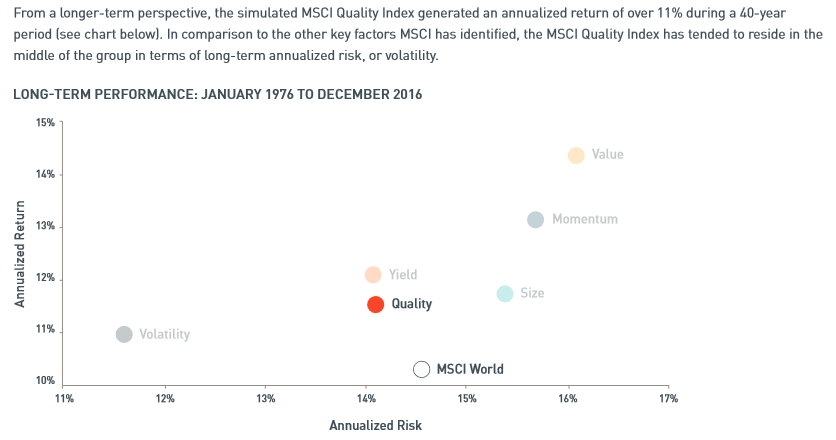 2
2 -
jamesd said:
Say my view that being underweight US was good and being overweight small cap was good turns out to be correct. You will then say I showed no skill or ability because anyone else could have done the same? Except, they didn't and I did."The skill may be in knowing which rules and factors to use."
If someone were able to do this, they would be one of the richest people in the world (I'm not exaggerating).
Regrettably, your view does not seem logical, for it's deciding in advance, not with hindsight, that is the challenge. Someone has to make the decisions about which factors, weightings or whatever to use, before the future unfolds.
Meanwhile, customers who wanted a global fund and chose Fundsmith to get the expertise of its manager have reason to be happy, for he seems to have made good choices vs just being an index tracker operator. The active tracker buyers got what they paid for, at a minimum: an active choice to differ from the global index.
I suspect that those involved with Fundsmith are quite happy with their rewards, which seem likely to be very substantial, from sticking to the game where they seem to have demonstrated some ability in their field, even if you want to dismiss performance and just call it marketing.
Even if you do make good choices, it can take time to show results. Though I did happen upon this person who made a few hundred thousand Canadian Dollars from leveraged trading of a two hundred Dollar initial investment in a few hours...*
* a hint for others: notice his stake was only 200. He could afford to lose that. Don't go in with 100k and try to double it unless you too can afford the loss. He got the publicity because he was extremely unusual. Also, if using spread betting for leverage, remember that around 85% lose. And that's not inherently a bad thing if using it for hedging, because you want the hedge to fail to be needed, hence the loss showing up there and the gain elsewhere.
"Regrettably, your view does not seem logical, for it's deciding in advance, not with hindsight, that is the challenge. Someone has to make the decisions about which factors, weightings or whatever to use, before the future unfolds."
That's what I said - maybe I didn't make myself clear enough.
0 -
it would be useful to strip out the last decade (not just 5 years) to see how quality has performed. Would be interesting to see the correlation of large cap growth and quality over the last decade.Alexland said:BritishInvestor said:"If the performance is identical why not use Fundsmith and avoid the effort"
I think we might be arguing two different things. My main point is that it's unlikely you will fund genuine outperformance in the retail space. As to whether you should buy a certain fund or not, that's a different question, but I can't really think of a retirement objective that would be best fulfilled by strategies that history shows underperform over the longer term.Maybe I've not been looking in the right places but I have struggled to find any good data to show that quality (as we understand it in modern times) underperforms the market over the longer term? It's easy to find plenty of data that shows value doing better but with higher volatility.For example, the below 5 year old image (to remove some recent quality overperformance) from the MSCI factor factsheet using data going back the previous 40 years suggests that quality has provided a higher return with lower volatility than going passive with a world index. Of course with Fundsmith that extra 1% return goes back to Terry with his high OCF and it's hard to stick with any factor investment in periods when it's totally out of favour and many tend to close down or get merged into something else with better short/medium term prospects so holding a world index might be an easier ownership path.
Re fundsmith, I'm thinking more of the large-cap growth style.0












Confirm your email address to Create Threads and Reply

Categories
- All Categories
- 354.4K Banking & Borrowing
- 254.4K Reduce Debt & Boost Income
- 455.4K Spending & Discounts
- 247.3K Work, Benefits & Business
- 604K Mortgages, Homes & Bills
- 178.4K Life & Family
- 261.5K Travel & Transport
- 1.5M Hobbies & Leisure
- 16K Discuss & Feedback
- 37.7K Read-Only Boards