We’d like to remind Forumites to please avoid political debate on the Forum.
This is to keep it a safe and useful space for MoneySaving discussions. Threads that are – or become – political in nature may be removed in line with the Forum’s rules. Thank you for your understanding.
📨 Have you signed up to the Forum's new Email Digest yet? Get a selection of trending threads sent straight to your inbox daily, weekly or monthly!
The Forum now has a brand new text editor, adding a bunch of handy features to use when creating posts. Read more in our how-to guide
Timing the market
Comments
-
Free cash flow yield is an important fundamental metric. Source and application of funds statement is a key page in a company's annual accounts. Far more difficult to hide transgressions there. Than manipulating the presentation of the Profit and Loss account to improve the published EPS. Finance directors are masters of financial engineering.BritishInvestor said:
"Fundsmith with its obsession of cash producing stalwarts"Prism said:
There may be some fund managers that still try to compete in this area with small agile funds and a trading rather than investing stance but I don't know any.In 2021, it's quite tough (to put it politely) to find inefficiencies if you're an active fund manager, for a number of reasons:
1. Competition: The resources available to fund managers in terms of brainpower, computer capacity, historical data (quality and quantity) is far, far behind the quant-style hedge funds, and I'd assume a fair way behind investment banking prop desks (I don't know how many of these are still in existence to be fair). The best talent (certainly in the City (London)) tends to gravitate to IBs or hedge funds.
2. Scalability: Inefficiencies tend to be limited in scale, with more volume tending to move the market, therefore, eliminating the edge. A large fund run by an active fund manager (with effectively one strategy) is unlikely to be able to exploit inefficiencies at this scale.
3. Reaction time: Hedge fund computers react in near real-time to remove the inefficiency before Mr active fund manager has finished his cornflakes
Most completely agree that market timing is pointless and wouldn't compare themselves quants or traders. It can take several weeks if not a few months to build up a position in a new holding so any inefficiencies they see must be long multi year ones. The most effective fund houses in this area seem to be the ones that do their own analysis and completely ignore sell side data or others opinions. If you reduce the importance of the current share price then moving the market and reaction time become less of a concern. Due to the work required to do in house analysis this tends to limit the number of holdings of those funds making them more concentrated.
This theoretically indicates a higher risk due to less diversification but this seems pretty rare to find an example. One is JEO which had a 17% top holding drop to zero (Wirecard) and yet the performance has still kept pretty close to the index over the last 5 years and easily beats it over 10 years. I find it quite interesting that a fund can shrug off a permanent 17% loss in capital.
My thoughts in general are that some fund managers, and their teams, are pretty good at this in spite of the huge sums at money thrown at their hedge fund competitors. Most of them seem to be relatively small teams who try and do something a bit different, whether that be Scottish Mortgage with their ideas about companies in 10-20 years, Fundsmith with its obsession of cash producing stalwarts or the large variety of UK small cap funds working in under researched areas.
But as we've discussed previously, it's debatable whether there's any alpha there.2 -
BritishInvestor said:Linton said:BritishInvestor said:
Thank youLinton said:
My strategy is high diversification. So for the latest version of the 100% equity portfolio alongside income and Wealth Preservation portfolios:BritishInvestor said:
I think maybe an example of an offering that reduces equity volatility would be useful - I don't necessarily disagree with your reply so interested what you had in mind.Linton said:
Reducing equity volatility whilst generating a medium term return at least 1% above inflation is precisely my objective. Achieving this is the optimal outcome.BritishInvestor said:Prism said:
In overall performance terms I guess that is what active management is mainly about - that the market is mispriced. Actually maybe its fairer to say that the stocks that they select are mispriced. Now whether that is a short term mispricing (value investor) or a long term mispricing (growth investor) its still the same idea, that those stocks will perform better than the market expects them too over some time period.BritishInvestor said:
I'm not clear how you undertake successful due diligence. I once raised a Roger Moore style eyebrow when a portfolio building firm said that part of their due diligence was looking a fund manager in the eye! I'm not also not clear how you avoid the companies that won't be winners - that implies a market mispricing unless I'm misunderstanding what you are saying?
Of course most active investment managers will not focus totally on raw performance. So providing lower than market returns with lower volatility is a perfectly acceptable compromise. I am always wary of any fund that attempts to hit a particular benchmark but for example beating inflation over a particular period might be all you need.
For all of those scenarios the manager needs to believe that to some degree the market is wrong and/or they are better than the market or in some cases doing things so differently that the market doesn't really matter. Then all you need to do is select those managers
"So providing lower than market returns with lower volatility is a perfectly acceptable compromise."
I struggle to understand why this would be optimal within a given asset class. So typically, high quality/low duration bonds dampen equity volatility. Can it be more efficient to try and damp within the asset class itself? Not sure about that.
The reason is that in retirement the medium term timeframe is the most important for investment. Short term doesnt matter since cash works fine. The very long term is irrelevent as most people wont live long enough to really gain the benefits. Under current circumstances high quality/low duration bonds provide zero return, medium term and long duration ones carry serious risk with their capital values and inflation can become a major concern. Apart from a few niche investments there is nothing appropriate to invest in other than equity.
- US allocation 40%
- Large companies (as classified by Morningstar) 50%. 50% small/medium.
- Total of top 10 underlying holdings is <10% of portfolio.
- Funds chosen to avoid excessive dependence on particular industry sectors, particularly tech.
- I check Value vs Growth but cant do much about it as there are very few funds with a high Value component around at the moment.
Backtesting performance shows 117% return over 5 years compared with MSCI World's 90% but over the past year it has returned 26% to the MSCI Worlds 27% perhaps due to the relaively low holding in tech giants. However this tells us nothing about the next 5 years. We will see. In any case high performance is a secondary concern to appropriate allocations and those numbers are way above the requirement.
I'd wonder how close you could get to that implementation with a passive approach vs what you currently have
So for example, for equities
tilting towards small
https://www.msci.com/documents/10199/a67b0d43-0289-4bce-8499-0c102eaa8399
tilting away from US
https://www.msci.com/documents/10199/c0db0a48-01f2-4ba9-ad01-226fd5678111
https://www.msci.com/documents/10199/db217f4c-cc8c-4e21-9fac-60eb6a47faf0
(and others)
Wealth preservation trusts are an interesting one. The (popular) one I picked at random fell ~12% in late 2008 whereas a global bond benchmark fell by around 2%. Maybe that was an outlier.
Comparing the global small comnpanies index returns over the past 5 years with all the Small Company funds I have held in that timeframe.... 5 years is as far as I can go back with a MSCI Global small cap ETF:
SPDF MSCI Global Small Cap - 70.9%
Bailiie Gifford Japan Small Cap - 84.8%
Marlborough Special Situations - 93.8%
Theadneedle European Smaller Companies - 115.8%
Matthews Asia Small Companies - 128%
Artemis US Smaller Companies - 133.5%
Liontrust UK Smaller Companies - 136%
ASI European Smaller Comanies - 145%
So every single active fund across all geographies in the list outperformed the Global Small Cap Index Fund. Perhaps I am a briliant fund picker or rather more likely Global Index funds are not the best way to invest in Small Companies.
On WP Funds see the following fraphs, with dividends re-invested:
I use CGT (Capital Gearing Trust) [B] and Troy Trojan [A]. CGT dates from before the tech boom/bust, Troy Trojan from 2004: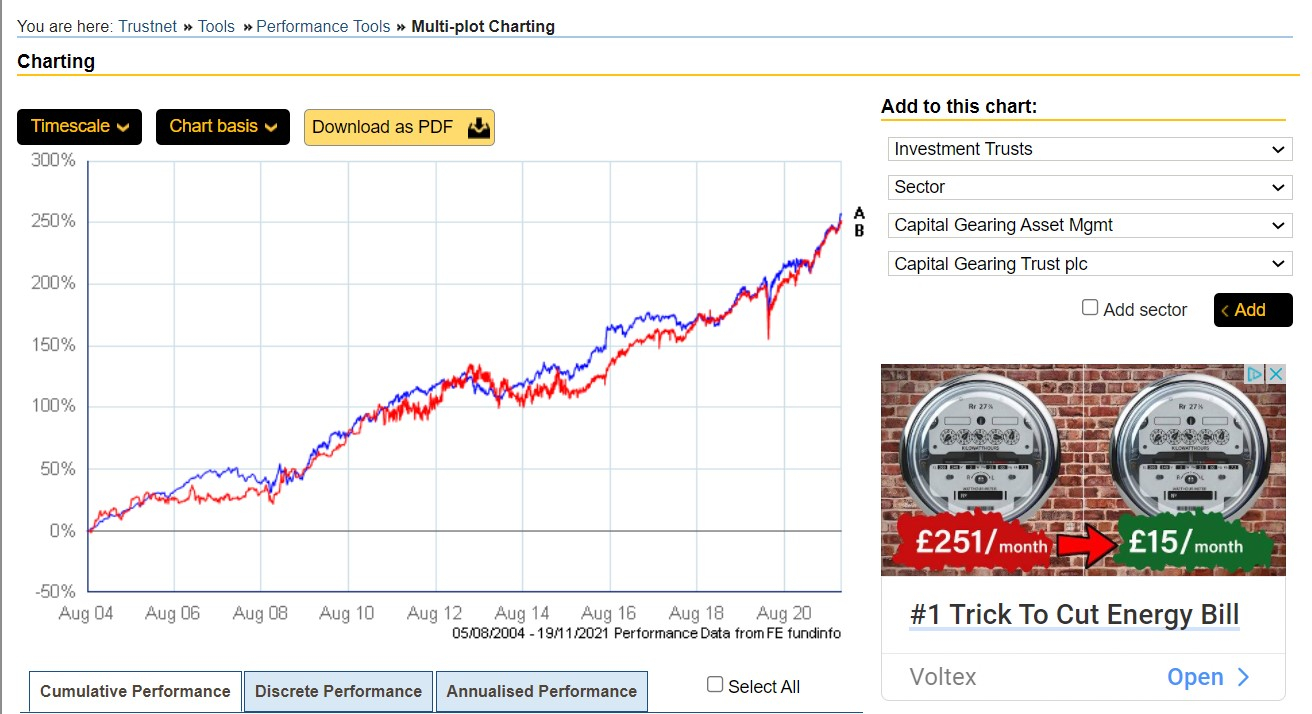
CGT [A] and FTSE World Index [B]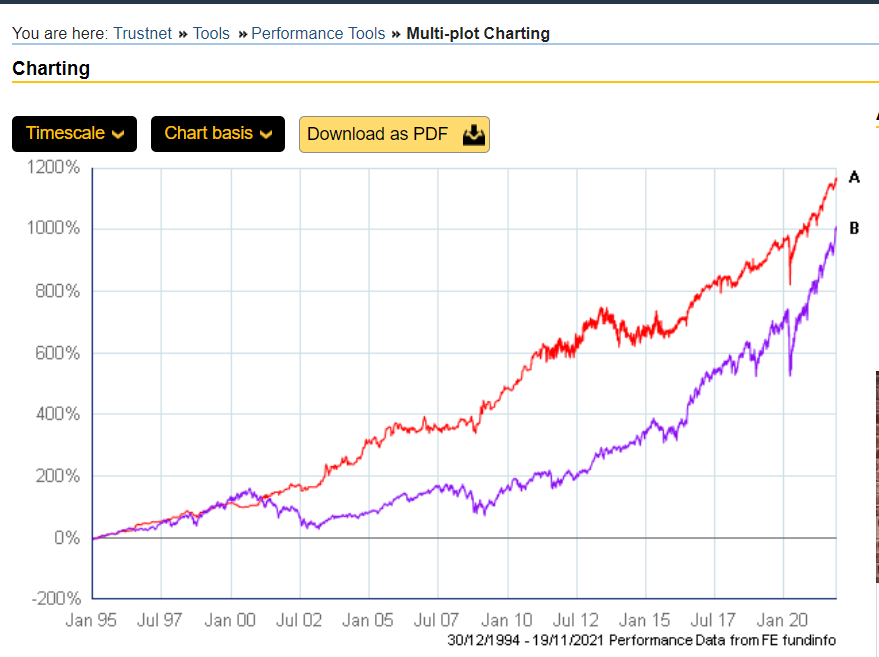
"Perhaps I am a briliant fund picker or rather more likely Global Index funds are not the best way to invest in Small Companies."
I might be missing something obvious here, but looking at one of the funds, there's a big tilt to growth, so I'm not really sure it's a valid comparison.
PE ratio of 15
https://www.morningstar.co.uk/uk/etf/snapshot/snapshot.aspx?id=0P00011EX4&tab=3&InvestmentType=FE
PE ratio of 31
https://www.morningstar.co.uk/uk/funds/snapshot/snapshot.aspx?id=F00000P8DK&tab=3
You can see here the "outperformance" on the benchmarks
https://www.msci.com/documents/10199/71483ec6-c345-4551-b6ff-ee2b48f8d632
"I use CGT (Capital Gearing Trust) "
If you look at how it performed from 11th September 2008 (I still remember that weekend) to 10th November, you can see the falls.
If the MSCII World Small Cap Index is not a fair cimparison with my set of smaller companies funds perhaps you can suggest another one? Which is really my point - if an appropriate passive fund doesnt exist the pro passive arguments are irrelevent.
From the 11th September 2008 to the 10th November 2008 CGT dropped by about 10%. By January 2009 it had more than recovered, If you want stabillity over a 4 month period you really need to be in cash especially at the moment. CGT and other WP funds are more appropriate for a short.medium term time frame, say 3-12 years.1 -
What is this "alpha" you are failing to find? A fund's performance will depend on its underlying investments. There isnt some magic gold dust that a fund manager can add. Normally alpha is the variation from the Index. What index fund is appropriate for Fundsmith? If there is one we can make a comparison, if there isn't then alpha is irrelevent.BritishInvestor said:
"Fundsmith with its obsession of cash producing stalwarts"Prism said:
There may be some fund managers that still try to compete in this area with small agile funds and a trading rather than investing stance but I don't know any.In 2021, it's quite tough (to put it politely) to find inefficiencies if you're an active fund manager, for a number of reasons:
1. Competition: The resources available to fund managers in terms of brainpower, computer capacity, historical data (quality and quantity) is far, far behind the quant-style hedge funds, and I'd assume a fair way behind investment banking prop desks (I don't know how many of these are still in existence to be fair). The best talent (certainly in the City (London)) tends to gravitate to IBs or hedge funds.
2. Scalability: Inefficiencies tend to be limited in scale, with more volume tending to move the market, therefore, eliminating the edge. A large fund run by an active fund manager (with effectively one strategy) is unlikely to be able to exploit inefficiencies at this scale.
3. Reaction time: Hedge fund computers react in near real-time to remove the inefficiency before Mr active fund manager has finished his cornflakes
Most completely agree that market timing is pointless and wouldn't compare themselves quants or traders. It can take several weeks if not a few months to build up a position in a new holding so any inefficiencies they see must be long multi year ones. The most effective fund houses in this area seem to be the ones that do their own analysis and completely ignore sell side data or others opinions. If you reduce the importance of the current share price then moving the market and reaction time become less of a concern. Due to the work required to do in house analysis this tends to limit the number of holdings of those funds making them more concentrated.
This theoretically indicates a higher risk due to less diversification but this seems pretty rare to find an example. One is JEO which had a 17% top holding drop to zero (Wirecard) and yet the performance has still kept pretty close to the index over the last 5 years and easily beats it over 10 years. I find it quite interesting that a fund can shrug off a permanent 17% loss in capital.
My thoughts in general are that some fund managers, and their teams, are pretty good at this in spite of the huge sums at money thrown at their hedge fund competitors. Most of them seem to be relatively small teams who try and do something a bit different, whether that be Scottish Mortgage with their ideas about companies in 10-20 years, Fundsmith with its obsession of cash producing stalwarts or the large variety of UK small cap funds working in under researched areas.
But as we've discussed previously, it's debatable whether there's any alpha there.
I dont hold fundsmith as it doesnt help in creating a protfolio based on allocations - it is difficult to see what a findsmith shaped hole would look like.0 -
Absolutely. Fundsmith doesn't work at all if you want any control of regional or sector allocations. Much like any active global fund the allocations move around over time. It can be used as a size allocation if that is desired as it can be pretty much guaranteed to be stuck firmly in the large/mega cap space.Linton said:
I dont hold fundsmith as it doesnt help in creating a protfolio based on allocations - it is difficult to see what a findsmith shaped hole would look like.
The same is true with the wealth preservation funds though too. They change allocations over time and you kind of have to keep that part of the portfolio separate.0 -
Source and application of funds statement is a key page in a company's annual accounts. Far more difficult to hide transgressions there
Agreed. Queens Moat and Polly Peck were but two where a quick perusal of these would have had significant alarm bells ringing.....years before they actually went bust.
0 -
Prism said:
I agree at the index level. I think there was a smallish window after 2008 when quality growth investing was the place to be. Around that time a few passive funds launched to take advantage too. That outperformance has dropped away a little though. The world quality index and passive funds are still pretty much top of the pile over all time periods but not by much. It does come at a small price premium though so rising interest rates may well level things out. The historical out performance of funds like Fundsmith has come from stock picking.BritishInvestor said:
"Fundsmith with its obsession of cash producing stalwarts"Prism said:
There may be some fund managers that still try to compete in this area with small agile funds and a trading rather than investing stance but I don't know any.In 2021, it's quite tough (to put it politely) to find inefficiencies if you're an active fund manager, for a number of reasons:
1. Competition: The resources available to fund managers in terms of brainpower, computer capacity, historical data (quality and quantity) is far, far behind the quant-style hedge funds, and I'd assume a fair way behind investment banking prop desks (I don't know how many of these are still in existence to be fair). The best talent (certainly in the City (London)) tends to gravitate to IBs or hedge funds.
2. Scalability: Inefficiencies tend to be limited in scale, with more volume tending to move the market, therefore, eliminating the edge. A large fund run by an active fund manager (with effectively one strategy) is unlikely to be able to exploit inefficiencies at this scale.
3. Reaction time: Hedge fund computers react in near real-time to remove the inefficiency before Mr active fund manager has finished his cornflakes
Most completely agree that market timing is pointless and wouldn't compare themselves quants or traders. It can take several weeks if not a few months to build up a position in a new holding so any inefficiencies they see must be long multi year ones. The most effective fund houses in this area seem to be the ones that do their own analysis and completely ignore sell side data or others opinions. If you reduce the importance of the current share price then moving the market and reaction time become less of a concern. Due to the work required to do in house analysis this tends to limit the number of holdings of those funds making them more concentrated.
This theoretically indicates a higher risk due to less diversification but this seems pretty rare to find an example. One is JEO which had a 17% top holding drop to zero (Wirecard) and yet the performance has still kept pretty close to the index over the last 5 years and easily beats it over 10 years. I find it quite interesting that a fund can shrug off a permanent 17% loss in capital.
My thoughts in general are that some fund managers, and their teams, are pretty good at this in spite of the huge sums at money thrown at their hedge fund competitors. Most of them seem to be relatively small teams who try and do something a bit different, whether that be Scottish Mortgage with their ideas about companies in 10-20 years, Fundsmith with its obsession of cash producing stalwarts or the large variety of UK small cap funds working in under researched areas.
But as we've discussed previously, it's debatable whether there's any alpha there.
One of the problems we have here is that if someone truely believes that growth investing is the best place to be they are somewhat limited in their choices of passive funds - there are basically none. So if, rightly or wrongly, you want to follow a growth strategy then you end up looking at active funds. Morningstar classes a few momentum funds as growth but that isn't correct. Momentum is simply what has done well recently and therefore is currently full of oil companies and banks to go along with stuff like Tesla and Apple.Passive index trackers essentially reward (and perpetuate) momentum and growth at the expense of value. The better a stock share price does, the more the index will buy of it, and so on (hence why the 10 biggest companies in the world constitute something like 20% of global capitalisation)Value investing works on the basis of buy low, sell high, but if a share is undervalued, the index won't buy more of it (relative to growth stocks) so it's more likely to remain cheap. Buy low, sell low, doesn't work so well, so there is little incentive for the company to invest, hence it is more likely to focus on adding shareholder value by share buybacks and dividend distribution - after all where is the value in investing in the business if the market isn't going to reward that investment by way of a higher share price. The rise in popularity of passive index trackers largely explains why the FTSE100 is undervalued and full of cash generative dividend paying / share buyback companies. As long as the bull market run continues, it's difficult to see how that will change.
I am a Forum Ambassador and I support the Forum Team on the Benefits & tax credits, Heat pumps and Green & Ethical MoneySaving forums. If you need any help on those boards, do let me know. Please note that Ambassadors are not moderators. Any post you spot in breach of the Forum Rules should be reported via the report button, or by emailing forumteam@moneysavingexpert.com. All views are my own & not the official line of Money Saving Expert.Our green credentials: 12kW Samsung ASHP for heating, 7.2kWp Solar (South facing), Tesla Powerwall 3 (13.5kWh), Net exporter0 -
Polly Peck collapsed due to a well hidden and complex fraud. Dented confidence in the the value of what at face value appeared to be healthy annual audited accounts. As a consequence the Cadbury Report recommended fundamental changes to Corporate Governance for UK listed companies. The code has changed over the years but the cornerstones of practice have remained in place. A reason that the London stock markets are so well regarded globally.MarkCarnage said:Source and application of funds statement is a key page in a company's annual accounts. Far more difficult to hide transgressions thereAgreed. Queens Moat and Polly Peck were but two where a quick perusal of these would have had significant alarm bells ringing.....years before they actually went bust.
0 -
Prism said:
I agree at the index level. I think there was a smallish window after 2008 when quality growth investing was the place to be. Around that time a few passive funds launched to take advantage too. That outperformance has dropped away a little though. The world quality index and passive funds are still pretty much top of the pile over all time periods but not by much. It does come at a small price premium though so rising interest rates may well level things out. The historical out performance of funds like Fundsmith has come from stock picking.BritishInvestor said:
"Fundsmith with its obsession of cash producing stalwarts"Prism said:
There may be some fund managers that still try to compete in this area with small agile funds and a trading rather than investing stance but I don't know any.In 2021, it's quite tough (to put it politely) to find inefficiencies if you're an active fund manager, for a number of reasons:
1. Competition: The resources available to fund managers in terms of brainpower, computer capacity, historical data (quality and quantity) is far, far behind the quant-style hedge funds, and I'd assume a fair way behind investment banking prop desks (I don't know how many of these are still in existence to be fair). The best talent (certainly in the City (London)) tends to gravitate to IBs or hedge funds.
2. Scalability: Inefficiencies tend to be limited in scale, with more volume tending to move the market, therefore, eliminating the edge. A large fund run by an active fund manager (with effectively one strategy) is unlikely to be able to exploit inefficiencies at this scale.
3. Reaction time: Hedge fund computers react in near real-time to remove the inefficiency before Mr active fund manager has finished his cornflakes
Most completely agree that market timing is pointless and wouldn't compare themselves quants or traders. It can take several weeks if not a few months to build up a position in a new holding so any inefficiencies they see must be long multi year ones. The most effective fund houses in this area seem to be the ones that do their own analysis and completely ignore sell side data or others opinions. If you reduce the importance of the current share price then moving the market and reaction time become less of a concern. Due to the work required to do in house analysis this tends to limit the number of holdings of those funds making them more concentrated.
This theoretically indicates a higher risk due to less diversification but this seems pretty rare to find an example. One is JEO which had a 17% top holding drop to zero (Wirecard) and yet the performance has still kept pretty close to the index over the last 5 years and easily beats it over 10 years. I find it quite interesting that a fund can shrug off a permanent 17% loss in capital.
My thoughts in general are that some fund managers, and their teams, are pretty good at this in spite of the huge sums at money thrown at their hedge fund competitors. Most of them seem to be relatively small teams who try and do something a bit different, whether that be Scottish Mortgage with their ideas about companies in 10-20 years, Fundsmith with its obsession of cash producing stalwarts or the large variety of UK small cap funds working in under researched areas.
But as we've discussed previously, it's debatable whether there's any alpha there.
One of the problems we have here is that if someone truely believes that growth investing is the best place to be they are somewhat limited in their choices of passive funds - there are basically none. So if, rightly or wrongly, you want to follow a growth strategy then you end up looking at active funds. Morningstar classes a few momentum funds as growth but that isn't correct. Momentum is simply what has done well recently and therefore is currently full of oil companies and banks to go along with stuff like Tesla and Apple.
"The historical out performance of funds like Fundsmith has come from stock picking."
For that to be the case, his outperformance should not be explainable by simple rules/factor attribution. However, his strategy seems reasonably straightforward to emulate.
"One of the problems we have here is that if someone truely believes that growth investing is the best place to be they are somewhat limited in their choices of passive funds - there are basically none."
I suspect the reason there aren't that many growth style factor funds is that history tells us that value tends to outperform over the longer term, so the demand might be limited.
0 -
Linton said:BritishInvestor said:Linton said:BritishInvestor said:
Thank youLinton said:
My strategy is high diversification. So for the latest version of the 100% equity portfolio alongside income and Wealth Preservation portfolios:BritishInvestor said:
I think maybe an example of an offering that reduces equity volatility would be useful - I don't necessarily disagree with your reply so interested what you had in mind.Linton said:
Reducing equity volatility whilst generating a medium term return at least 1% above inflation is precisely my objective. Achieving this is the optimal outcome.BritishInvestor said:Prism said:
In overall performance terms I guess that is what active management is mainly about - that the market is mispriced. Actually maybe its fairer to say that the stocks that they select are mispriced. Now whether that is a short term mispricing (value investor) or a long term mispricing (growth investor) its still the same idea, that those stocks will perform better than the market expects them too over some time period.BritishInvestor said:
I'm not clear how you undertake successful due diligence. I once raised a Roger Moore style eyebrow when a portfolio building firm said that part of their due diligence was looking a fund manager in the eye! I'm not also not clear how you avoid the companies that won't be winners - that implies a market mispricing unless I'm misunderstanding what you are saying?
Of course most active investment managers will not focus totally on raw performance. So providing lower than market returns with lower volatility is a perfectly acceptable compromise. I am always wary of any fund that attempts to hit a particular benchmark but for example beating inflation over a particular period might be all you need.
For all of those scenarios the manager needs to believe that to some degree the market is wrong and/or they are better than the market or in some cases doing things so differently that the market doesn't really matter. Then all you need to do is select those managers
"So providing lower than market returns with lower volatility is a perfectly acceptable compromise."
I struggle to understand why this would be optimal within a given asset class. So typically, high quality/low duration bonds dampen equity volatility. Can it be more efficient to try and damp within the asset class itself? Not sure about that.
The reason is that in retirement the medium term timeframe is the most important for investment. Short term doesnt matter since cash works fine. The very long term is irrelevent as most people wont live long enough to really gain the benefits. Under current circumstances high quality/low duration bonds provide zero return, medium term and long duration ones carry serious risk with their capital values and inflation can become a major concern. Apart from a few niche investments there is nothing appropriate to invest in other than equity.
- US allocation 40%
- Large companies (as classified by Morningstar) 50%. 50% small/medium.
- Total of top 10 underlying holdings is <10% of portfolio.
- Funds chosen to avoid excessive dependence on particular industry sectors, particularly tech.
- I check Value vs Growth but cant do much about it as there are very few funds with a high Value component around at the moment.
Backtesting performance shows 117% return over 5 years compared with MSCI World's 90% but over the past year it has returned 26% to the MSCI Worlds 27% perhaps due to the relaively low holding in tech giants. However this tells us nothing about the next 5 years. We will see. In any case high performance is a secondary concern to appropriate allocations and those numbers are way above the requirement.
I'd wonder how close you could get to that implementation with a passive approach vs what you currently have
So for example, for equities
tilting towards small
https://www.msci.com/documents/10199/a67b0d43-0289-4bce-8499-0c102eaa8399
tilting away from US
https://www.msci.com/documents/10199/c0db0a48-01f2-4ba9-ad01-226fd5678111
https://www.msci.com/documents/10199/db217f4c-cc8c-4e21-9fac-60eb6a47faf0
(and others)
Wealth preservation trusts are an interesting one. The (popular) one I picked at random fell ~12% in late 2008 whereas a global bond benchmark fell by around 2%. Maybe that was an outlier.
Comparing the global small comnpanies index returns over the past 5 years with all the Small Company funds I have held in that timeframe.... 5 years is as far as I can go back with a MSCI Global small cap ETF:
SPDF MSCI Global Small Cap - 70.9%
Bailiie Gifford Japan Small Cap - 84.8%
Marlborough Special Situations - 93.8%
Theadneedle European Smaller Companies - 115.8%
Matthews Asia Small Companies - 128%
Artemis US Smaller Companies - 133.5%
Liontrust UK Smaller Companies - 136%
ASI European Smaller Comanies - 145%
So every single active fund across all geographies in the list outperformed the Global Small Cap Index Fund. Perhaps I am a briliant fund picker or rather more likely Global Index funds are not the best way to invest in Small Companies.
On WP Funds see the following fraphs, with dividends re-invested:
I use CGT (Capital Gearing Trust) [B] and Troy Trojan [A]. CGT dates from before the tech boom/bust, Troy Trojan from 2004:
CGT [A] and FTSE World Index [B]
"Perhaps I am a briliant fund picker or rather more likely Global Index funds are not the best way to invest in Small Companies."
I might be missing something obvious here, but looking at one of the funds, there's a big tilt to growth, so I'm not really sure it's a valid comparison.
PE ratio of 15
https://www.morningstar.co.uk/uk/etf/snapshot/snapshot.aspx?id=0P00011EX4&tab=3&InvestmentType=FE
PE ratio of 31
https://www.morningstar.co.uk/uk/funds/snapshot/snapshot.aspx?id=F00000P8DK&tab=3
You can see here the "outperformance" on the benchmarks
https://www.msci.com/documents/10199/71483ec6-c345-4551-b6ff-ee2b48f8d632
"I use CGT (Capital Gearing Trust) "
If you look at how it performed from 11th September 2008 (I still remember that weekend) to 10th November, you can see the falls.
If the MSCII World Small Cap Index is not a fair cimparison with my set of smaller companies funds perhaps you can suggest another one? Which is really my point - if an appropriate passive fund doesnt exist the pro passive arguments are irrelevent.
From the 11th September 2008 to the 10th November 2008 CGT dropped by about 10%. By January 2009 it had more than recovered, If you want stabillity over a 4 month period you really need to be in cash especially at the moment. CGT and other WP funds are more appropriate for a short.medium term time frame, say 3-12 years.
"If the MSCII World Small Cap Index is not a fair cimparison with my set of smaller companies funds perhaps you can suggest another one?"
I'd start with something that had a growth tilt (assuming the remainder of your holdings were also invested in the same way). Alternatively, look over a multi-decade period, which would dampen down the recent mad growth periods and give a more representative answer. Five years of tailwinds isn't really telling you much unfortunately.
"Which is really my point - if an appropriate passive fund doesnt exist the pro passive arguments are irrelevant."
I think you'd have to ask yourself why there isn't much coverage. If we hadn't had the last crazy decade, where the gap between value and growth is near unprecedented levels, I think it's unlikely there would be as many people investing in growth style funds.
"From the 11th September 2008 to the 10th November 2008 CGT dropped by about 10%. "
Yep, and I'd therefore struggle to see where it fits into a portfolio.
"CGT and other WP funds are more appropriate for a short.medium term time frame, say 3-12 years."
I'm not clear what they provide over a "conventional" equity/bond portfolio (which would no doubt have additional "demands" on the retirement pot over longer timescales than 3-12 years)0 -
"There isnt some magic gold dust that a fund manager can add."Linton said:
What is this "alpha" you are failing to find? A fund's performance will depend on its underlying investments. There isnt some magic gold dust that a fund manager can add. Normally alpha is the variation from the Index. What index fund is appropriate for Fundsmith? If there is one we can make a comparison, if there isn't then alpha is irrelevent.BritishInvestor said:
"Fundsmith with its obsession of cash producing stalwarts"Prism said:
There may be some fund managers that still try to compete in this area with small agile funds and a trading rather than investing stance but I don't know any.In 2021, it's quite tough (to put it politely) to find inefficiencies if you're an active fund manager, for a number of reasons:
1. Competition: The resources available to fund managers in terms of brainpower, computer capacity, historical data (quality and quantity) is far, far behind the quant-style hedge funds, and I'd assume a fair way behind investment banking prop desks (I don't know how many of these are still in existence to be fair). The best talent (certainly in the City (London)) tends to gravitate to IBs or hedge funds.
2. Scalability: Inefficiencies tend to be limited in scale, with more volume tending to move the market, therefore, eliminating the edge. A large fund run by an active fund manager (with effectively one strategy) is unlikely to be able to exploit inefficiencies at this scale.
3. Reaction time: Hedge fund computers react in near real-time to remove the inefficiency before Mr active fund manager has finished his cornflakes
Most completely agree that market timing is pointless and wouldn't compare themselves quants or traders. It can take several weeks if not a few months to build up a position in a new holding so any inefficiencies they see must be long multi year ones. The most effective fund houses in this area seem to be the ones that do their own analysis and completely ignore sell side data or others opinions. If you reduce the importance of the current share price then moving the market and reaction time become less of a concern. Due to the work required to do in house analysis this tends to limit the number of holdings of those funds making them more concentrated.
This theoretically indicates a higher risk due to less diversification but this seems pretty rare to find an example. One is JEO which had a 17% top holding drop to zero (Wirecard) and yet the performance has still kept pretty close to the index over the last 5 years and easily beats it over 10 years. I find it quite interesting that a fund can shrug off a permanent 17% loss in capital.
My thoughts in general are that some fund managers, and their teams, are pretty good at this in spite of the huge sums at money thrown at their hedge fund competitors. Most of them seem to be relatively small teams who try and do something a bit different, whether that be Scottish Mortgage with their ideas about companies in 10-20 years, Fundsmith with its obsession of cash producing stalwarts or the large variety of UK small cap funds working in under researched areas.
But as we've discussed previously, it's debatable whether there's any alpha there.
I dont hold fundsmith as it doesnt help in creating a protfolio based on allocations - it is difficult to see what a findsmith shaped hole would look like.
Agreed
"Normally alpha is the variation from the Index"
I use alpha as a proxy for performance that is unexplainable by rudimentary performance attribution analysis (which I accept is slightly different from the "official" definition)
https://en.wikipedia.org/wiki/Alpha_(finance)
https://en.wikipedia.org/wiki/Fama–French_three-factor_model
"The traditional asset pricing model, known formally as the capital asset pricing model (CAPM) uses only one variable to describe the returns of a portfolio or stock with the returns of the market as a whole. In contrast, the Fama–French model uses three variables. Fama and French started with the observation that two classes of stocks have tended to do better than the market as a whole: (i) small caps and (ii) stocks with a high book-to-market ratio (B/P, customarily called value stocks, contrasted with growth stocks)."
"The Fama–French three-factor model explains over 90% of the diversified portfolios returns, compared with the average 70% given by the CAPM (within sample)."
"What index fund is appropriate for Fundsmith?"
Fundsmith has ~30 holdings - I'm not sure how there possibly could be an index fund to compare against, but in terms of factor tilts/benchmarks, this might be a reasonable start.
https://www.msci.com/documents/10199/344aa133-d8fa-4a15-b091-20a8fd024b65
https://www.msci.com/documents/10199/bcb64e9b-267c-4bc7-b810-fdc0a99ec41d
0













Confirm your email address to Create Threads and Reply

Categories
- All Categories
- 354.4K Banking & Borrowing
- 254.4K Reduce Debt & Boost Income
- 455.4K Spending & Discounts
- 247.3K Work, Benefits & Business
- 604K Mortgages, Homes & Bills
- 178.4K Life & Family
- 261.5K Travel & Transport
- 1.5M Hobbies & Leisure
- 16K Discuss & Feedback
- 37.7K Read-Only Boards