We’d like to remind Forumites to please avoid political debate on the Forum.
This is to keep it a safe and useful space for MoneySaving discussions. Threads that are – or become – political in nature may be removed in line with the Forum’s rules. Thank you for your understanding.
📨 Have you signed up to the Forum's new Email Digest yet? Get a selection of trending threads sent straight to your inbox daily, weekly or monthly!
The Forum now has a brand new text editor, adding a bunch of handy features to use when creating posts. Read more in our how-to guide
Timing the market
Comments
-
Gain made by delaying investment since 9 November 2021: 8.0%Average return made by delaying investment for 191 days: 5.3% loss(based on data from the Investment Association 40-85% Shares sector since 1973)Chance of the market going down over 191 days in that historic period: 3 in 10Congratulations on successfully beating the odds and picking up pennies in front of a steamroller.Of course, it's only a success if you can time the bottom as well.
1 -
Some shares will fall, some shares will rise, some shares will remain unchanged. Markets are simply the net weighted movement of the stocks contained in. Looking inside the tin is where the real action is.....fancible said:OP here. Looks like my hunch re a market correction was correct and in this case sitting on the sidelines waiting for it to has probably payed off for me. I could equally of course have missed the boat, but those are the choices every individual needs to take. Now to time the bottom! I still think there are further falls ahead, but who knows 🤷1 -
Exactly right. I am referring specifically to SMT which I was considering investing in as per my opening comment and has almost halved in the last 6 months. RICA which I began drip feeding into from Jan has basically held steady.Thrugelmir said:
Some shares will fall, some shares will rise, some shares will remain unchanged. Markets are simply the net weighted movement of the stocks contained in. Looking inside the tin is where the real action is.....fancible said:OP here. Looks like my hunch re a market correction was correct and in this case sitting on the sidelines waiting for it to has probably payed off for me. I could equally of course have missed the boat, but those are the choices every individual needs to take. Now to time the bottom! I still think there are further falls ahead, but who knows 🤷
As I said this has worked for me (maybe more by luck than anything else), but for longer term time investing, time in the market probably still wins...0 -
If you were going to invest in SMT 6 months ago, and have held off until now and the price has almost halved, surely now would be a good time to invest rather trying to time the exact bottom. Even if it does fall further surely you are happy with the current price compared to what you were considering paying 6 months ago.fancible said:
Exactly right. I am referring specifically to SMT which I was considering investing in as per my opening comment and has almost halved in the last 6 months. RICA which I began drip feeding into from Jan has basically held steady.Thrugelmir said:
Some shares will fall, some shares will rise, some shares will remain unchanged. Markets are simply the net weighted movement of the stocks contained in. Looking inside the tin is where the real action is.....fancible said:OP here. Looks like my hunch re a market correction was correct and in this case sitting on the sidelines waiting for it to has probably payed off for me. I could equally of course have missed the boat, but those are the choices every individual needs to take. Now to time the bottom! I still think there are further falls ahead, but who knows 🤷
As I said this has worked for me (maybe more by luck than anything else), but for longer term time investing, time in the market probably still wins...0 -
Yes I have invested quite a bit recently and am going to phase more in over the next few months. It's just me being greedy and wanting to invest the remainder at the bottom rather than on the way down, but even at current prices it seems to a good long term buy.Audaxer said:
If you were going to invest in SMT 6 months ago, and have held off until now and the price has almost halved, surely now would be a good time to invest rather trying to time the exact bottom. Even if it does fall further surely you are happy with the current price compared to what you were considering paying 6 months ago.fancible said:
Exactly right. I am referring specifically to SMT which I was considering investing in as per my opening comment and has almost halved in the last 6 months. RICA which I began drip feeding into from Jan has basically held steady.Thrugelmir said:
Some shares will fall, some shares will rise, some shares will remain unchanged. Markets are simply the net weighted movement of the stocks contained in. Looking inside the tin is where the real action is.....fancible said:OP here. Looks like my hunch re a market correction was correct and in this case sitting on the sidelines waiting for it to has probably payed off for me. I could equally of course have missed the boat, but those are the choices every individual needs to take. Now to time the bottom! I still think there are further falls ahead, but who knows 🤷
As I said this has worked for me (maybe more by luck than anything else), but for longer term time investing, time in the market probably still wins...0 -
Do you have an update for the funds vs the small cap index to see how the recent market events have impacted relative performance?BritishInvestor said:Linton said:BritishInvestor said:
Thank youLinton said:
My strategy is high diversification. So for the latest version of the 100% equity portfolio alongside income and Wealth Preservation portfolios:BritishInvestor said:
I think maybe an example of an offering that reduces equity volatility would be useful - I don't necessarily disagree with your reply so interested what you had in mind.Linton said:
Reducing equity volatility whilst generating a medium term return at least 1% above inflation is precisely my objective. Achieving this is the optimal outcome.BritishInvestor said:Prism said:
In overall performance terms I guess that is what active management is mainly about - that the market is mispriced. Actually maybe its fairer to say that the stocks that they select are mispriced. Now whether that is a short term mispricing (value investor) or a long term mispricing (growth investor) its still the same idea, that those stocks will perform better than the market expects them too over some time period.BritishInvestor said:
I'm not clear how you undertake successful due diligence. I once raised a Roger Moore style eyebrow when a portfolio building firm said that part of their due diligence was looking a fund manager in the eye! I'm not also not clear how you avoid the companies that won't be winners - that implies a market mispricing unless I'm misunderstanding what you are saying?
Of course most active investment managers will not focus totally on raw performance. So providing lower than market returns with lower volatility is a perfectly acceptable compromise. I am always wary of any fund that attempts to hit a particular benchmark but for example beating inflation over a particular period might be all you need.
For all of those scenarios the manager needs to believe that to some degree the market is wrong and/or they are better than the market or in some cases doing things so differently that the market doesn't really matter. Then all you need to do is select those managers
"So providing lower than market returns with lower volatility is a perfectly acceptable compromise."
I struggle to understand why this would be optimal within a given asset class. So typically, high quality/low duration bonds dampen equity volatility. Can it be more efficient to try and damp within the asset class itself? Not sure about that.
The reason is that in retirement the medium term timeframe is the most important for investment. Short term doesnt matter since cash works fine. The very long term is irrelevent as most people wont live long enough to really gain the benefits. Under current circumstances high quality/low duration bonds provide zero return, medium term and long duration ones carry serious risk with their capital values and inflation can become a major concern. Apart from a few niche investments there is nothing appropriate to invest in other than equity.
- US allocation 40%
- Large companies (as classified by Morningstar) 50%. 50% small/medium.
- Total of top 10 underlying holdings is <10% of portfolio.
- Funds chosen to avoid excessive dependence on particular industry sectors, particularly tech.
- I check Value vs Growth but cant do much about it as there are very few funds with a high Value component around at the moment.
Backtesting performance shows 117% return over 5 years compared with MSCI World's 90% but over the past year it has returned 26% to the MSCI Worlds 27% perhaps due to the relaively low holding in tech giants. However this tells us nothing about the next 5 years. We will see. In any case high performance is a secondary concern to appropriate allocations and those numbers are way above the requirement.
I'd wonder how close you could get to that implementation with a passive approach vs what you currently have
So for example, for equities
tilting towards small
https://www.msci.com/documents/10199/a67b0d43-0289-4bce-8499-0c102eaa8399
tilting away from US
https://www.msci.com/documents/10199/c0db0a48-01f2-4ba9-ad01-226fd5678111
https://www.msci.com/documents/10199/db217f4c-cc8c-4e21-9fac-60eb6a47faf0
(and others)
Wealth preservation trusts are an interesting one. The (popular) one I picked at random fell ~12% in late 2008 whereas a global bond benchmark fell by around 2%. Maybe that was an outlier.
Comparing the global small comnpanies index returns over the past 5 years with all the Small Company funds I have held in that timeframe.... 5 years is as far as I can go back with a MSCI Global small cap ETF:
SPDF MSCI Global Small Cap - 70.9%
Bailiie Gifford Japan Small Cap - 84.8%
Marlborough Special Situations - 93.8%
Theadneedle European Smaller Companies - 115.8%
Matthews Asia Small Companies - 128%
Artemis US Smaller Companies - 133.5%
Liontrust UK Smaller Companies - 136%
ASI European Smaller Comanies - 145%
So every single active fund across all geographies in the list outperformed the Global Small Cap Index Fund. Perhaps I am a briliant fund picker or rather more likely Global Index funds are not the best way to invest in Small Companies.
On WP Funds see the following fraphs, with dividends re-invested:
I use CGT (Capital Gearing Trust) [B] and Troy Trojan [A]. CGT dates from before the tech boom/bust, Troy Trojan from 2004: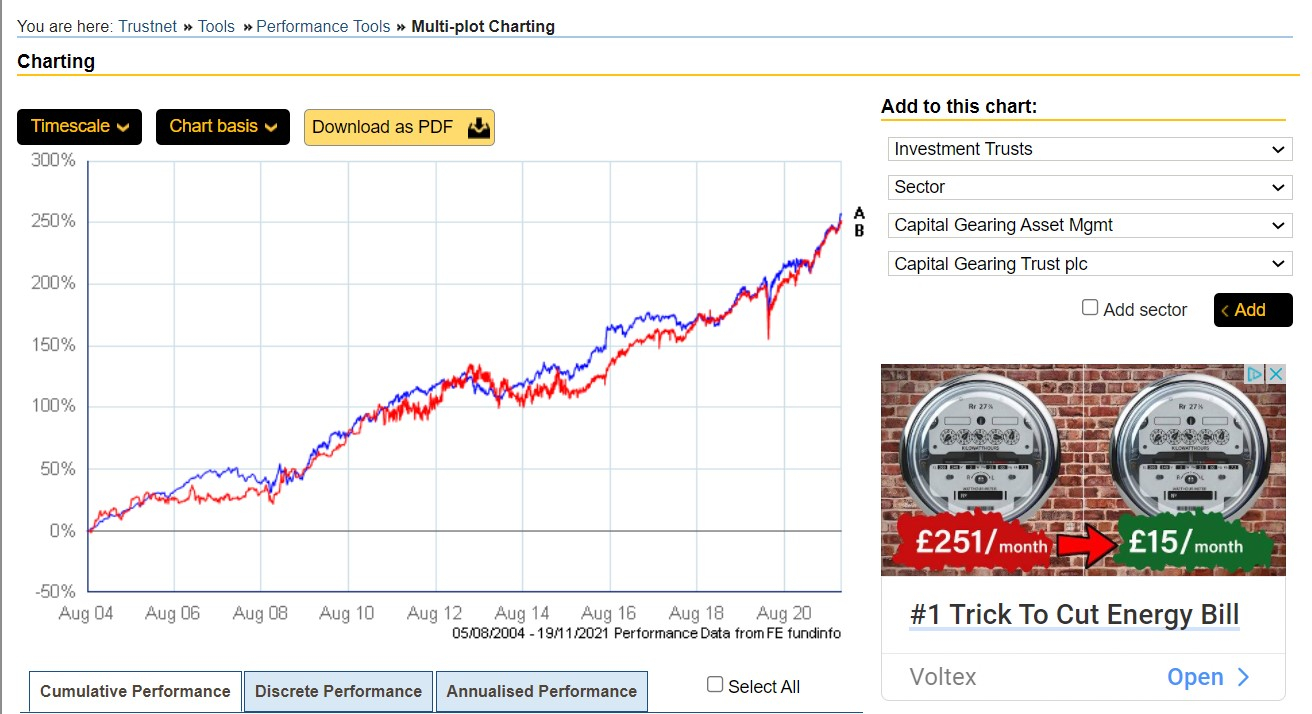
CGT [A] and FTSE World Index [B]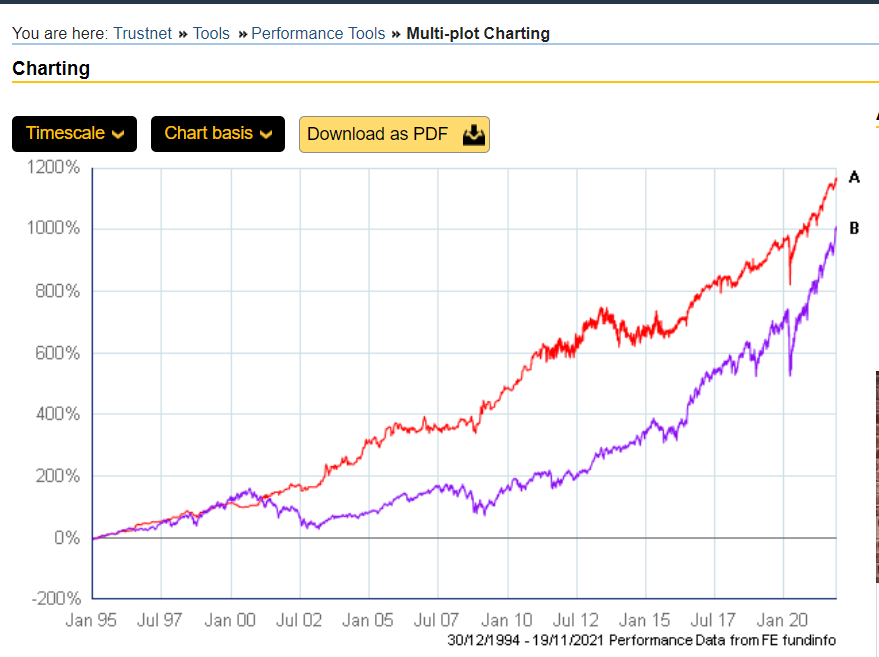
"Perhaps I am a briliant fund picker or rather more likely Global Index funds are not the best way to invest in Small Companies."
I might be missing something obvious here, but looking at one of the funds, there's a big tilt to growth, so I'm not really sure it's a valid comparison.
PE ratio of 15
https://www.morningstar.co.uk/uk/etf/snapshot/snapshot.aspx?id=0P00011EX4&tab=3&InvestmentType=FE
PE ratio of 31
https://www.morningstar.co.uk/uk/funds/snapshot/snapshot.aspx?id=F00000P8DK&tab=3
You can see here the "outperformance" on the benchmarks
https://www.msci.com/documents/10199/71483ec6-c345-4551-b6ff-ee2b48f8d632
"I use CGT (Capital Gearing Trust) "
If you look at how it performed from 11th September 2008 (I still remember that weekend) to 10th November, you can see the falls.BritishInvestor said:Linton said:BritishInvestor said:
Thank youLinton said:
My strategy is high diversification. So for the latest version of the 100% equity portfolio alongside income and Wealth Preservation portfolios:BritishInvestor said:
I think maybe an example of an offering that reduces equity volatility would be useful - I don't necessarily disagree with your reply so interested what you had in mind.Linton said:
Reducing equity volatility whilst generating a medium term return at least 1% above inflation is precisely my objective. Achieving this is the optimal outcome.BritishInvestor said:Prism said:
In overall performance terms I guess that is what active management is mainly about - that the market is mispriced. Actually maybe its fairer to say that the stocks that they select are mispriced. Now whether that is a short term mispricing (value investor) or a long term mispricing (growth investor) its still the same idea, that those stocks will perform better than the market expects them too over some time period.BritishInvestor said:
I'm not clear how you undertake successful due diligence. I once raised a Roger Moore style eyebrow when a portfolio building firm said that part of their due diligence was looking a fund manager in the eye! I'm not also not clear how you avoid the companies that won't be winners - that implies a market mispricing unless I'm misunderstanding what you are saying?
Of course most active investment managers will not focus totally on raw performance. So providing lower than market returns with lower volatility is a perfectly acceptable compromise. I am always wary of any fund that attempts to hit a particular benchmark but for example beating inflation over a particular period might be all you need.
For all of those scenarios the manager needs to believe that to some degree the market is wrong and/or they are better than the market or in some cases doing things so differently that the market doesn't really matter. Then all you need to do is select those managers
"So providing lower than market returns with lower volatility is a perfectly acceptable compromise."
I struggle to understand why this would be optimal within a given asset class. So typically, high quality/low duration bonds dampen equity volatility. Can it be more efficient to try and damp within the asset class itself? Not sure about that.
The reason is that in retirement the medium term timeframe is the most important for investment. Short term doesnt matter since cash works fine. The very long term is irrelevent as most people wont live long enough to really gain the benefits. Under current circumstances high quality/low duration bonds provide zero return, medium term and long duration ones carry serious risk with their capital values and inflation can become a major concern. Apart from a few niche investments there is nothing appropriate to invest in other than equity.
- US allocation 40%
- Large companies (as classified by Morningstar) 50%. 50% small/medium.
- Total of top 10 underlying holdings is <10% of portfolio.
- Funds chosen to avoid excessive dependence on particular industry sectors, particularly tech.
- I check Value vs Growth but cant do much about it as there are very few funds with a high Value component around at the moment.
Backtesting performance shows 117% return over 5 years compared with MSCI World's 90% but over the past year it has returned 26% to the MSCI Worlds 27% perhaps due to the relaively low holding in tech giants. However this tells us nothing about the next 5 years. We will see. In any case high performance is a secondary concern to appropriate allocations and those numbers are way above the requirement.
I'd wonder how close you could get to that implementation with a passive approach vs what you currently have
So for example, for equities
tilting towards small
https://www.msci.com/documents/10199/a67b0d43-0289-4bce-8499-0c102eaa8399
tilting away from US
https://www.msci.com/documents/10199/c0db0a48-01f2-4ba9-ad01-226fd5678111
https://www.msci.com/documents/10199/db217f4c-cc8c-4e21-9fac-60eb6a47faf0
(and others)
Wealth preservation trusts are an interesting one. The (popular) one I picked at random fell ~12% in late 2008 whereas a global bond benchmark fell by around 2%. Maybe that was an outlier.
Comparing the global small comnpanies index returns over the past 5 years with all the Small Company funds I have held in that timeframe.... 5 years is as far as I can go back with a MSCI Global small cap ETF:
SPDF MSCI Global Small Cap - 70.9%
Bailiie Gifford Japan Small Cap - 84.8%
Marlborough Special Situations - 93.8%
Theadneedle European Smaller Companies - 115.8%
Matthews Asia Small Companies - 128%
Artemis US Smaller Companies - 133.5%
Liontrust UK Smaller Companies - 136%
ASI European Smaller Comanies - 145%
So every single active fund across all geographies in the list outperformed the Global Small Cap Index Fund. Perhaps I am a briliant fund picker or rather more likely Global Index funds are not the best way to invest in Small Companies.
On WP Funds see the following fraphs, with dividends re-invested:
I use CGT (Capital Gearing Trust) [B] and Troy Trojan [A]. CGT dates from before the tech boom/bust, Troy Trojan from 2004:
CGT [A] and FTSE World Index [B]
"Perhaps I am a briliant fund picker or rather more likely Global Index funds are not the best way to invest in Small Companies."
I might be missing something obvious here, but looking at one of the funds, there's a big tilt to growth, so I'm not really sure it's a valid comparison.
PE ratio of 15
https://www.morningstar.co.uk/uk/etf/snapshot/snapshot.aspx?id=0P00011EX4&tab=3&InvestmentType=FE
PE ratio of 31
https://www.morningstar.co.uk/uk/funds/snapshot/snapshot.aspx?id=F00000P8DK&tab=3
You can see here the "outperformance" on the benchmarks
https://www.msci.com/documents/10199/71483ec6-c345-4551-b6ff-ee2b48f8d632
"I use CGT (Capital Gearing Trust) "
If you look at how it performed from 11th September 2008 (I still remember that weekend) to 10th November, you can see the falls.
0















Confirm your email address to Create Threads and Reply

Categories
- All Categories
- 354.4K Banking & Borrowing
- 254.4K Reduce Debt & Boost Income
- 455.4K Spending & Discounts
- 247.3K Work, Benefits & Business
- 604K Mortgages, Homes & Bills
- 178.4K Life & Family
- 261.5K Travel & Transport
- 1.5M Hobbies & Leisure
- 16K Discuss & Feedback
- 37.7K Read-Only Boards