We’d like to remind Forumites to please avoid political debate on the Forum.
This is to keep it a safe and useful space for MoneySaving discussions. Threads that are – or become – political in nature may be removed in line with the Forum’s rules. Thank you for your understanding.
The MSE Forum Team would like to wish you all a Merry Christmas. However, we know this time of year can be difficult for some. If you're struggling during the festive period, here's a list of organisations that might be able to help
📨 Have you signed up to the Forum's new Email Digest yet? Get a selection of trending threads sent straight to your inbox daily, weekly or monthly!
Has MSE helped you to save or reclaim money this year? Share your 2025 MoneySaving success stories!
Assistance with improving my pension fund choices
Comments
-
The help I've had so far has been great, I hope what I said didn't come across otherwise.Albermarle said:Isn't staying in investments someone else picked for me just as bad as trying to work out my own strategy (with advice of course)?
If you want personal detailed financial advice about your investments you have to go to an IFA and pay for it .
What you will get here is free/voluntary informed ( hopefully) guidance and opinion .
I think you have already received a lot of this already ( nearly 60 posts in total ) .
Alot of the first chunk of discussion has been around understanding what I have to work with. It took a while to get to grips with the type of funds I have available and their limitations (being quite a limited set of pension funds in structures some people weren't that familiar with).
Ive done alot of work to unpick the funds Im currently in and try to discover what is contained within some other funds I have to choose from. The multi-asset fund I'm in is a right hodge podge of stuff. I haven't really got to grips with that one yet because Ive been focussing on the equities bit. But there are equities buried in the multi-asset fund too, alot less transparantly (it doesn't tell you the geographical mix). I'm going to need to unpick all this as well.
Now I actually need to go and create a strategy (working on it), and then start making actual changes to my funds themselves.0 -
I’m in a similar situation as yourself with my workplace pension with Aegon and have been looking at my options (30 y/o looking to go into 100% equities).I don’t particularly like many funds that are on offer, and actually find the fact sheets that Aegon provide aren’t that great ( E.g. A global equity fund tells you the geographic split in investments but not how many holdings.. is it a concentrated fund of 50 stocks or an index tracker with 2000+?!).
Im not sure if you are aware but you can actually partial transfer your pension to another provider each month. Some providers only allow full transfers but both Vanguard SIPP (0.15) and AJ Bell SIPP (0.25) accept partial transfers. With my employer, I pay 0.45% for management fees so by doing this, it’s an easy win without even worrying about the investments. With my timeframe and monthly investment amounts it looks like I can save £70,000+ over the 30+ year investment horizon by simply transferring to a cheaper provider. Providing you leave a nominal amount in your workplace fund so it doesn’t close down, you can repeat the process each month.Also by doing this it gives you access to a host of other investment funds which may suit what you are looking for (I.e A multi asset fund with an allocation split you prefer without having to worry about multiple investment funds).
Something to consider at least!1 -
@DanJ90 I wasn't aware of that no. Its an interesting (but more complex) option. So you still get the contributions paid into the same scheme but then you regularly transfer it out to an alternative? That is alot of ongoing work.
I don't know how much management fee I pay (if any?), I haven't seen that anywhere. I assumed the stated fund fees were the management fees, is there likely to be another management fee on top taken by Aegon or my employer?0 -
Hi me again...
I have been reading some of the links people have provided to help me come up with my strategy.
I have followed the following process:- Evaluated my current investment funds which were initially set up by my company and pension provider, to try and understand what is going on in them. The insight here has helped massively with this activity.
- Taken on board the thoughts people have voiced here, and the information in the links people provided me, to come up with a more balanced, and simpler, portfolio.
- Figuring out how to transition between my existing investments and the new strategy, as I already have a lot of money invested in existing funds through my pension provider, and the funds available to me are limited in some ways. I will not be able to only have one or two funds to accomplish my strategy - it will have to be a composite approach at least a little.
My existing portfolio
I've done alot work to understand what I currently have (helped alot by the responses here, so thank you all). This was tricky because the funds I'm currently in are a bit of a hodge-podge, and I didn't know what different terms meant. Here is a chart showing what I currently have: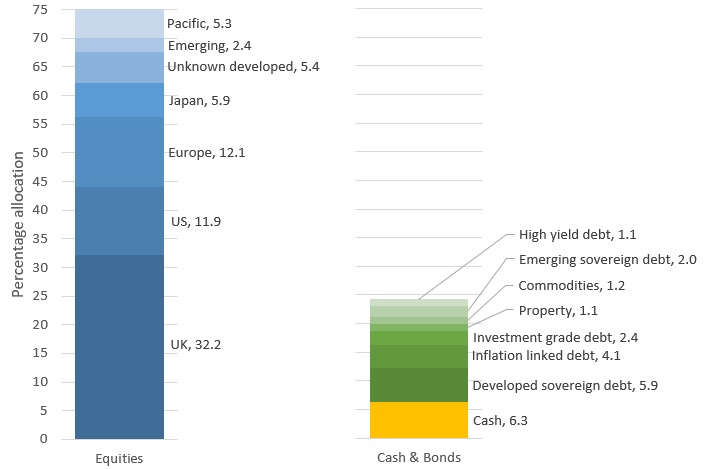
With thanks to the opinions expressed here, and my own reading and thoughts, here are the issues I think there are with it:- Its too UK heavy in the equities part, and therefore also too light for US/North American equities.
- The majority of these equities are within a single fund, the Blackrock 50/50 Global Equity Index. The over-reliance on UK equities appears to be the reason why this fund has not done as well over the past five to ten years compared to other funds with a lower UK proportion.
- It has too much cash. I'm at least 25 years away from retirement and I don't think having 6% in cash is adding anything? Its not enough to fall back on should the worst happen and it's deflating.
- The small amounts of money in property, commodities, high yield debt and emerging sovereign debt won't be having much impact. If these components mooned, I'm only in them for a small amount, and if they crashed, well same, little impact. Is there any point having these really? Why not just have a mix of UK Government and developed corporate bonds here instead and keep things simple?
- The cash and bonds (and some equities) are contained within a single multi-asset fund which has not performed very well over the past five years. Other bond funds more focused on the UK Government bonds and corporate bonds have done better, without an increase in the risk grading.
- I have not been able to find out how the bonds are split geographically in the multi-asset fund.
My proposed changes:
I am proposing to retain a 70/30 split between equities and bonds.
For equities, I am proposing to gradually transition from my current mix to the following:- UK equities 10% (using more passive index funds)
- Developed world ex-UK equities 50% (using more passive index funds)
- Emerging equities 10% (unsure yet on how active or passive this one should be)
I haven't yet decided on which fund to use for the emerging equities. There are a few I can choose from and I need to read up on them further. I'm not sure if 10% is a little too high, but any lower will probably have minimal impact and not be worth it.
For bonds, I am proposing:- To drop the cash completely - I don't think it is adding much safety net anyway and I'm 25 years from retirement still.
- To increase my holding of UK index linked bonds. This will in part make up for my reduction in UK equities. I'm thinking 10-15% in a direct UK Government bonds fund.
- To increase the holding in Sterling Corporate bonds via a dedicated fund, again possibly 10-15%.
- To investigate any funds for emerging markets bonds, but I don't think I have much choice of funds here. 5% maybe in this.
- I also don't appear to have any funds which would allow me to invest in US bonds or bonds for other developed governments outside of the UK. If I wanted this I'd have to retain a multi-asset fund but it doesn't seem worth it for the small amount.
Transitioning:
I have £82k invested in the existing funds which were chosen for me as part of my pension scheme, so I will need to transition between the current investments and the new ones.
I am conscious that a faster transition would get me to a more balanced portfolio quicker, but may come with some risk of exposure to short term movements in the underlying funds.
I do not know whether I am limited in terms of how many changes I can make to my portfolio over a period of time, or whether there is any cost to making changes. I will have to check this out.
How fast should I be transitioning between the old and new funds, is more regular and smaller changes better than less frequent and larger ones?
Thank you.
I know this is a long thread already, but I'd love to hear any opinions on my strategy above. Is this what a strategy is meant to look like?
0 -
Yep you let your workplace keep paying into the workplace pension then you transfer out each month leaving a small amount in to keep the account open. It’s not complex as such. For example, Vanguard you simply login and select transfer to SIPP, follow the online form, select the amount and submit. Both VG and Aegon use the electronic Origo payment system so it’s a smooth process - just takes a few weeks.
It is more of a hassle than leaving it as-is, but if your investment horizon is long term then the savings in fees alone is worth it to me (70K for my potential savings is just over two years of retirement spends for our plan).
You will pay a management fee per annum (like I say, ours is 0.45% with Aegon so yours will likely be similar) and then an OCF on each fund (Blackrock world ex-UK might be 0.14% for example) - so in this instance you would be paying 0.59% in total fees per year if that makes sense. Might be worth finding out what you pay as if it is higher then it may well be worth looking at moving it all.Just my opinion though! Good luck with whatever you decide.0 -
I cant see anything in my account or on any documentation that refers to any additional fees. As far as I can tell I pay an annual management charge and an additional annual expenses fee for each fund, which both vary depending on the fund.
My fees are currently 0.11% for the 50/50 global equity fund and 0.27% for the multi asset fund.0 -
To be absolutely sure what you are paying now , you will probably have to call Aegon.
These big pension companies all have different charging sructures. Some have one fee for the pension and the standard funds have no extra charge . Some only charge for the funds and no management fee for the pension . Then there are discounts for size of pot / what the employer has negotiated for you .
Then some of them charge more like a SIPP , with a separate pension/platform charge + funds charge .
Depending on which system is used the charges for the same fund can be different .
If you then transfer out to a seperate SIPP ( monthly seems a bit excessive, but lets say once a year ) the platform charge is one charge , if you then pick an expensive fund then you might well be paying more than you are now. So you have to tread carefully.0 -
You are in a minority in being in a workplace scheme that allows partial payments out, most schemes are mot set up to allow this.DanJ90 said:Yep you let your workplace keep paying into the workplace pension then you transfer out each month leaving a small amount in to keep the account open. It’s not complex as such. For example, Vanguard you simply login and select transfer to SIPP, follow the online form, select the amount and submit. Both VG and Aegon use the electronic Origo payment system so it’s a smooth process - just takes a few weeks.
It is more of a hassle than leaving it as-is, but if your investment horizon is long term then the savings in fees alone is worth it to me (70K for my potential savings is just over two years of retirement spends for our plan).
You will pay a management fee per annum (like I say, ours is 0.45% with Aegon so yours will likely be similar) and then an OCF on each fund (Blackrock world ex-UK might be 0.14% for example) - so in this instance you would be paying 0.59% in total fees per year if that makes sense. Might be worth finding out what you pay as if it is higher then it may well be worth looking at moving it all.Just my opinion though! Good luck with whatever you decide.0 -
danlightbulb said:
Hi. Yes you're right I do have a couple of global funds to choose like the ones you've shown. But to get a UK allocation I would also have to invest in a UK specific fund as well or design a mix with my existing 50/50 UK/global fund to drag down the percentage of UK.AnotherJoe said:danlightbulb said:@AnotherJoe
Ive examined all 83 funds I can select from, and what I have said above (which the chaps above have confirmed) is true.
All the x%/y% labelled funds refer to the uk/global mix.
I cant select any specific sector funds except for gold. There isnt one for health for example.
I do have options to select more active funds vs passive funds and ive noticed the performance is no better, and that many articles suggest active funds are not worth the premium, so Im happy to stick to passive.
Almost all of the funds with UK stocks in them have a relatively high proportion, between 40 to 70% UK. There are a couple with only a low UK percentage but these have very high US percentage. I can choose from some regional funds (or ex-Uk funds) but would then have to specify my own proportions to get the mix I want.
Currently Im 35% UK equities, that was chosen for me when the scheme was set up.Thats a shocker OP. BUt you did have some global funds you could choose right?* Aegon Blackrock World (ex-UK) Equity Index (BLK)
* Aegon HSBC Islamic Global Equity Index (BLK)Go with those or similar.Anything thats 30% (Or higher) UK is likely to be poor and why be concerned about US being 60% when you are happy to have half that (30% in the UK) when the UK is 5% global and this thats 5x overrepresented whereas US is maybe only 1.5x overrepresented.I wouldnt fuss too much about the exact UK allocation. You'll get some with a global fund.
Just to clarify though - you're not suggesting I move the whole investment from the current 50/50 fund into one of the above? That would seem like a dangerous thing to do in one hit? Those two above funds are both badged as high risk funds.
First, those badges are somewhat arbitrary. Second i woudl say given the underperformance you've suffered with your current funds, those are the high risk ones, not the new ones. Your existing funds are long term high risk to your wealth.
So it leads me then onto how I proceed?- Given that there are no funds directly available that have the right mix, and very few multi asset funds - do I need to specify my own mix across worldwide regions and then invest in several region specific funds?
- Or do I use a combination of say a 50/50 fund and an ex-UK fund to get the mix roughly where it needs to be first, and maybe fine tune it with specific regional funds later?
- Do I make this change in one hit or incrementally (i.e by moving say 5% per month or per quarter) so as to lower the risk of buying/selling at the top/bottom?
It feels to me that I should incrementally adjust my fund mixes over time rather than in one go, to de-risk the changes?
I.e maybe the first thing I do is start moving small amounts from my current 50%UK/50%Global fund into a single other ex-UK fund until I get the proportions broadly better. Then fine tune later into more specific regional funds as needed. I could do the equities side of thing first, and the bonds side of things later or simultaneously?I disagree with that.Thought experiment. You have some not very good funds, and some better funds and a poor overall mix Should you delay moving into the good funds and spend longer with the not very good ones and the poorer mix, basically on the reasoning that ... err, nope I"m stumped.Maybe you think the not very good funds will suddenly get good? or that its better to have a poor mix for longer??? Well if you think that why move at all?Or look at it from another direction. Suppose you'd started out with your new much better mix. so you'd be 100% in that right now.So, why not go into that better mix in one go? Its only putting you where you would/should have been already. And you'd have no anguish about being in it.Its just fear of the unknown.Switch 100% in one go and then dont look back.
0 -
I was thinking about making the first significant change today - moving 30% from the existing fund to the new fund to get the mix broadly in the right place as discussed above.
Then I looked again at the current performance of the two funds and read some articles. Am I too late to this party? There are strong suggestions that US equities are overvalued at the moment and UK is possibly undervalued (although this isn't so clear).
We've seen massive growth in the US equity funds over the past ten years. If my mix had been right ten years ago, I'd have benefited but is now the right time to be making the change? I know that things can go either way but when indicators are suggesting I could be moving funds at a significant peak, this is a big risk isn't it? But then so is staying where I am now.
I agree with everything said so far in the thread, but the problem is Im now already invested in a fund and moving (even if for the right reasons) could go wrong.
0











Confirm your email address to Create Threads and Reply

Categories
- All Categories
- 352.9K Banking & Borrowing
- 253.9K Reduce Debt & Boost Income
- 454.7K Spending & Discounts
- 246K Work, Benefits & Business
- 602.1K Mortgages, Homes & Bills
- 177.8K Life & Family
- 259.9K Travel & Transport
- 1.5M Hobbies & Leisure
- 16K Discuss & Feedback
- 37.7K Read-Only Boards