We’d like to remind Forumites to please avoid political debate on the Forum.
This is to keep it a safe and useful space for MoneySaving discussions. Threads that are – or become – political in nature may be removed in line with the Forum’s rules. Thank you for your understanding.
Cost of adding batteries to existing PV system.
Comments
-
Why is this insanely expensive
I think you've spent too long looking at secondhand equipment.
That's not insanely expensive, that's what that model costs if you buy one new from a reputable retailer with warranty and support.
See eg.
https://midsummerwholesale.co.uk/buy/solax/solax-x1-g4-fit-5
N. Hampshire, he/him. Octopus Intelligent Go elec / Fuse gas / Vodafone BB / iD mobile. Kirk Hill Co-op member.Economy 7 cap explainer. Gas vs E7 vs peak elec heating costs, Ecoflow Stream, Best kettle :-)
2.72kWp PV facing SSW installed Jan 2012. 11 x 247w panels, 3.6kw inverter. 37 MWh generated, long-term average 2.6 Os.1 -
It's also a high voltage (HV) model for HV* batteries (like the Solax HV battery range), not the nominally 48v batteries you are looking at. Not sure if that is the reason it's more expensive than other 5kW inverters.
*Spec sheet says 80-480v
I am a Forum Ambassador and I support the Forum Team on the Benefits & tax credits, Heat pumps and Green & Ethical MoneySaving forums. If you need any help on those boards, do let me know. Please note that Ambassadors are not moderators. Any post you spot in breach of the Forum Rules should be reported via the report button, or by emailing forumteam@moneysavingexpert.com. All views are my own & not the official line of Money Saving Expert.1 -
Blimey! And here's me thinking the batteries were the costly part…
I'd only entertain this as being worthwhile if going second hand. Eg:
Doesn't this do the same thing? £270 and warranted.
https://www.ebay.co.uk/itm/135019335146?
0 -
Doesn't this do the same thing? £270 and warranted.
That would be a better choice for you as it's a 48V system, rather than needing special high-voltage batteries that the Solax requires.
I've bought bits from South West Renewables before and I've not had any problems.
However, that's a bare unit - it doesn't come with brackets, connectors, covers etc. so it's a good choice if you want to replace an existing unit like-for-like but involves a fair bit of work or additional expenses if you're not.
This one includes more of the ancillaries:
https://www.ebay.co.uk/itm/134274963657
Note also that the 90-day warranty on those used units is rather less than you'd get with a new unit. It's enough to let you get it hooked up and operating, and deals with any DOA problems. (That's only reasonable, I wouldn't expect secondhand electronics to come with multi-year guarantees.)
N. Hampshire, he/him. Octopus Intelligent Go elec / Fuse gas / Vodafone BB / iD mobile. Kirk Hill Co-op member.Economy 7 cap explainer. Gas vs E7 vs peak elec heating costs, Ecoflow Stream, Best kettle :-)
2.72kWp PV facing SSW installed Jan 2012. 11 x 247w panels, 3.6kw inverter. 37 MWh generated, long-term average 2.6 Os.1 -
You really perhaps need to step back a bit from looking at equipment first and decide what for you is sensible and feasible. I think others have touched on this without being too explicit.
I have not put numbers on this, Rather just principles as I see them
Firstly take advice on what size of battery and input/output is sensible for you considering your consumption and what you already generate. It does not make too much sense to go for a big battery with low property consumption unless you include the potential for charging your EV from your battery at times when solar production is low or not at time of use cheap tariff. Similarly the opposite is true having a tiny battery compared to consumption and generation. Take into account matching generation to consumption shifted via the battery primarly to property, some to EV and future position shoukd your need expand.
Systems need to act together in a coordinated way. For that they need monitoring/measuring capability. This is usually done via Current transformers (CT) to measure the current( and thus by calculation the power) coming from and going to the various sources and destinations. If you have insufficient of these then chargers and controllers can struggle to meet your intentions to decide where power is coming from and where you intend it to go too including what to do with any excess generation to meet you needs. As examples say you generate from solar ( like most will be doing at present) powering the property and more. Should you export that, fill the battery, charge the car? Alternatively solar Is ticking along ( no excess ), battery part full, car part full but you want to charge it. Do you manually decide now is the time to do it or wait for the EV charger to use excess periods when the sun comes from behind the clouds or take from ( and deplete the battery? All that can be over complicating matters, especially understanding at an early stage but worth considering g with help from on here. If you have or pick the wrong equipment driven purely on price then that is a potential pitfall.
Next going for independence of buying a package (supply and install) puts the onus on you to meet your needs ( the technical complexities and electrical sizing), the rules approvals and installing( or finding an installer) who will do your bidding, and if you cannot, will set it all up for you. As an example of this you have e posted links to equipment that you wish opinions of from members. That latest Solis comes without cables connectors etc so you will have to decidewhat you need( numbers of CT clamps, isolators, circuit breakers for your consumer unit, power connectors, cabling, maybe comms cabling and source those. All need to match the equipment and power needs, some surprisingly high power compared to nominal spec. You might find an electrician who can do all that for you but that is not always easy. Buying used or refurbished equipment withimited individual warranties comes with it's own risks and more difficult support needs to resolve issues.
Crikey that seems all very difficult and negative! It is not meant to be, it is a possibles as enthusiasts on here testify to and much experience has been built up freely given. Is it the road for you ( a very satisfying challenge) or what might be an easier option by the package. I note that the battery maker Fogstar ( some on here have their batteries) who give great advice and support are certainly not expensive have now partnered with Lux ( several including me have their inverter/chargers) to provide a package. Tesla do too at the other end of the price spectrum ( much more than you would seem to be content to pay, understandably) but something that is worth considering surely?
3 -
Thank you.
Good point - I wasn't sure what 'bare unit' meant.
0 -
Bare Unit - without connectors/covers, comms cables, CT clamps, wall fixings, wifi stick for monitoring.....?
You need to ask (before you buy?) so you can interface with supply, battery etc.
My personal opinion of that inverter is that it is good but I would hope to have one with a bit more power output so that two high power appliances running together do not cause grid purchase when they cannot both be supplied at once such as oven, kettle, washing machine, heaters, immersion shower if you have any of those. This only applies, really, when running solely off batteries. If you have high solar output at the time of use such as we often have in spring and summer peak times that problem does not exist as you could have 3kW from the battery plus solar generation so up to a total of 6kW
1 -
That's all good stuff - thank you, HtA.
You are right about battery size - I just assumed a biggie would be good, but now realise that 5-10kW is likely optimum for me.
Contemplating adding a battery has been literally driven by our recent purchase of a Phev (14kWh). It's pretty easy to keep it topped up in this sunny spell, but tricky when it's more intermittent. The main problem is, the car is used until at least midday Mon-Fri, and until 3pm on two of these days, so all that lovely generation in the mornings/day is currently lost, and by the time the car comes home, there's often not enough sun left to fully recharge it.
A 5kWh battery should nicely capture the bulk of the morning generation, allowing for WMs and all that stuff, and therefore provide a much longer charge on any bright days once the car is home.
Anything that can make a sizeable dent in what would be a petrol-only cost of ~£1k pa is going to be good.
A 3kW inverter should actually be fine, since drawing in excess of this will be a rare event. My PV often goes over 3kW, but any power left over from this in charging the batteries will likely get eaten up by background devices. The car being charged draws 10A tops, and whilst cooking will often have two appliances going at the same time, it really isn't for long enough periods to justify a larger inverter, I don't think - unless one happens to pop up.
Also, the connecting cable betwixt garage and house is 4mm2, so I wouldn't want much more that ~6kW going through that.
It's early days, and I'm trying to get my head around how this will work. It may seem ambitious, but I am looking at a full setup for around £1k, so it will be second-user. I've seen 1-2 year old reputable-make battery packs for around £700, and £300 should get me an AC-C inverter if I keep my eye out. Then it's just fitting, and the setup for this in the garage is pretty ideal - I'll do the physical installation, and the rest should be straightforward for a sparky.
0 -
Worth a punt on a couple of these to get ~10kWh capacity? https://www.ebay.co.uk/itm/206230562430
They have been tested:
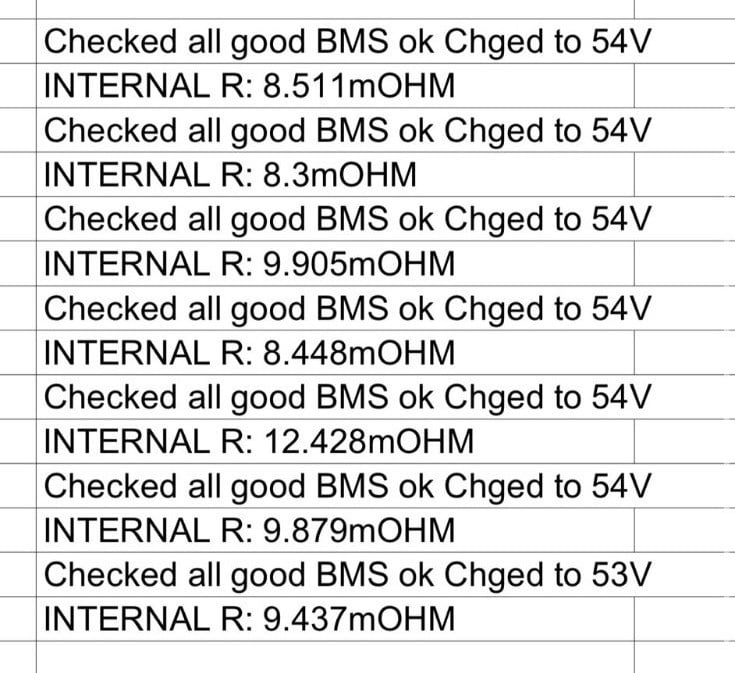
They appear to have only 'COM' ports (apart from the DC power connectors, of course) - is that enough to let them interface with AC-Coupled inverters? (Considering a SOFAR ME3000 SP with it.)
Ta.
0 -
I can't comment on the batteries themselves, but will note the seller has not disclosed the manufacturer and has covered up something (possibly the brand name) on each of them with grey tape.
They appear to have only 'COM' ports (apart from the DC power connectors, of course) - is that enough to let them interface with AC-Coupled inverters? (Considering a SOFAR ME3000 SP with it.)
I have a ME3000P and I don't have any comms connected between my battery and my inverter. I set the voltage and current parameters manually using the "DEFAULT" profile. (It did take a few iterations to get a set of parameters that worked for me.)
N. Hampshire, he/him. Octopus Intelligent Go elec / Fuse gas / Vodafone BB / iD mobile. Kirk Hill Co-op member.Economy 7 cap explainer. Gas vs E7 vs peak elec heating costs, Ecoflow Stream, Best kettle :-)
2.72kWp PV facing SSW installed Jan 2012. 11 x 247w panels, 3.6kw inverter. 37 MWh generated, long-term average 2.6 Os.1








Confirm your email address to Create Threads and Reply

Categories
- All Categories
- 355.7K Banking & Borrowing
- 254.9K Reduce Debt & Boost Income
- 456.1K Spending & Discounts
- 248.3K Work, Benefits & Business
- 605.8K Mortgages, Homes & Bills
- 179K Life & Family
- 263.6K Travel & Transport
- 1.5M Hobbies & Leisure
- 16.1K Discuss & Feedback
- 37.7K Read-Only Boards