We’d like to remind Forumites to please avoid political debate on the Forum.
This is to keep it a safe and useful space for MoneySaving discussions. Threads that are – or become – political in nature may be removed in line with the Forum’s rules. Thank you for your understanding.
Cost of adding batteries to existing PV system.




I'd always shrugged off doing this as the return time would be too long. But I've recently seen some near-new battery setups being sold on FbMarketplace for prices that are hard to ignore - sometimes as little as £1.5k for excess of 10kWh.
The Q is, what would the additional costs be should I jump? Ie, installation, and the charging/controller/inverter? Eg, Tesla uses their 'Backup Gateway'.
Some basic Qs, please - my system uses an 3kW Aurora Power One inverter (replaced once). Can a battery + controller be added to this, or does it need replacing?
I'm on FIT, and this includes a very small sum on assumed return to the grid - this will likely disappear, so I presume I'd need to contact the FIT provider?
If I buy second-hand batteries and controller, what would a PV fellow charge to install this?
Ta.
Some examples I've seen:
https://www.facebook.com/marketplace/item/3131922967018253/?
https://www.facebook.com/marketplace/item/2038598086682974/?
https://www.facebook.com/marketplace/item/2129535164481016/?
https://www.facebook.com/marketplace/item/26761234950167199/?
Comments
-
You can change your Deemed Export to a SEG, which will pay you more, with the right supplier. Probably easier to change the existing inverter to a hybrid one. You can add a gateway if you want off-grid capability, but probably only worth it if your supply is subject to fairly frequent cuts, or you are expecting a Zombie Apocalypse. You need independent earthing arrangements for that, which adds to the cost. You can buy new batteries, with a substantial warranty, from the likes of Fogstar, for not much more, per kWh, than those used ones.
As for installation cost, how long's a piece of string? It very much depends on site specifics.
1 -
Thank you.
Keeping things as simple as possible, I'd rather just keep the existing FIT (highest rate) and lose the other wee export bit.
Ah, the Tesla gateway did mention it would 'island' on a power-outage. No real need for that feature, as supply is reliable.
I was hoping a charge/controller could be added to the existing inverter, especially given that it's a recent replacement. But, if a hybrid inverter is a 'better' system, I'm open to that.
Any thoughts on the linked examples? I don't mean in terms of me chasing one - I'm nowhere near that stage - but does it reflect current options? Ie, a 10+kWh storage system should be quite doable for less than £2k?
0 -
It's easiest to install a standalone system.
I don't get on with Facebook so I've not looked at the links (sorry) but you can buy a brand new kit of inverter and battery for under £2k.
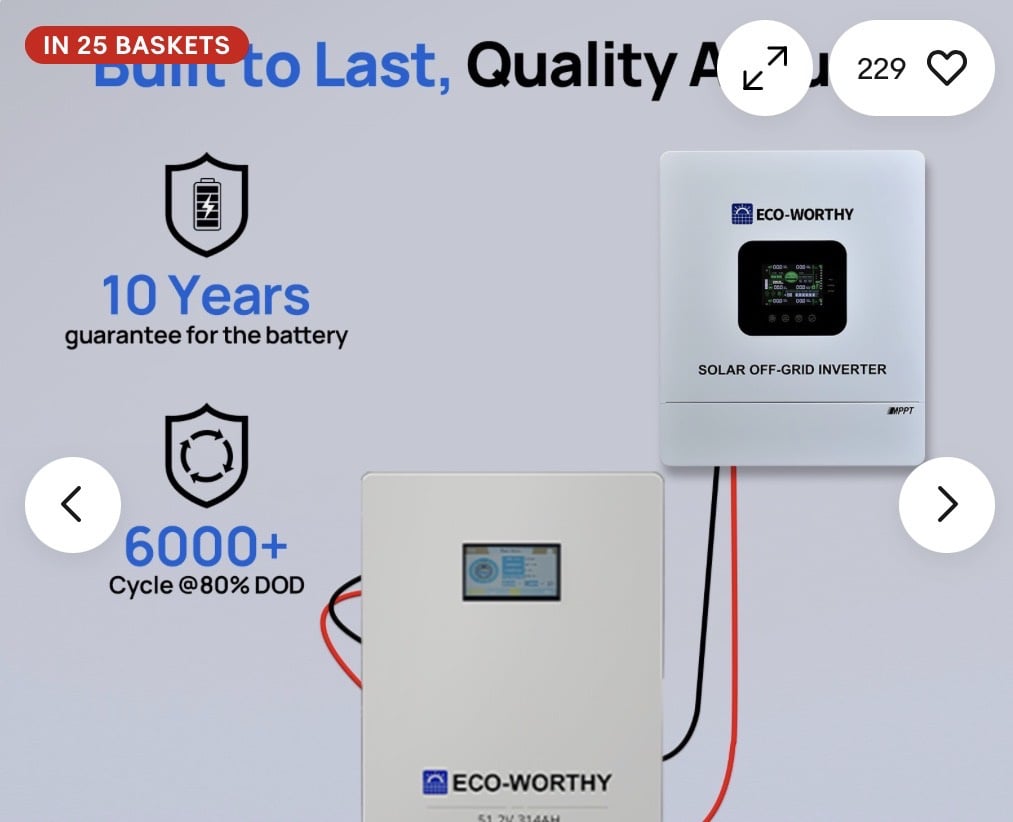
Here's an example:
The Q is, what would the additional costs be should I jump?
To do it legally, you'll need to make an application to the DNO then get an electrician to install everything and file the building regs notifications.
Maybe £500 for the sparky's time and parts?
If you don't want a standalone system but want to modify your existing FIT-qualifying system, you'll need an MCS-certified installer and they'll want to supply their own components. You're probably looking at a minimum of £4k all in, likely closer to £5k.
See this thread for someone else who's doing similar:
N. Hampshire, he/him. Octopus Intelligent Go elec / Fuse gas / Vodafone BB / iD mobile. Kirk Hill Co-op member.Ofgem cap table, Ofgem cap explainer. Economy 7 cap explainer. Gas vs E7 vs peak elec heating costs, Best kettle!
2.72kWp PV facing SSW installed Jan 2012. 11 x 247w panels, 3.6kw inverter. 37 MWh generated, long-term average 2.6 Os.1 -
Wow, that eBay system is cheap! The hybrid inverter charger will take care of everything - inverting from the PVs, filling the battery, and then supplying it to the house as required?
0 -
Does this system actually power the house or do you have to plug your appliances into it? I get the impression that “standalone” means it’s just a very big power pack. That’s ok for off grid applications but a bit inconvenient for day to day domestic use. Nothing wrong with power packs: I have a couple which I have used/can still use to run the boiler and aircon units or an air fryer or free standing induction hob but hooking up lighting circuits or an electric cooker is a lot more difficult.
I wouldn’t want the OP to think this is a grid tied battery which I thought was what he wanted.
Northern Lincolnshire. 7.8 kWp system, (4.2 kWwest facing panels , 3.6 kWeast facing), Solis inverters installed 2018, 5kW SSE facing system (shaded in afternoon) added in 2025 with Tesla PW3 battery, Mitsubishi SRK35ZS-S and SRK20ZS-S Wall Mounted A2A Heat Pumps, ex Nissan Leaf owner.1 -
You are correct, JkenH - mine is grid-tied, and earns FIT as well as providing useful free leccy when the sun is bright enough.
Yes, I'd need a compatible system, one that takes the excess generation that currently goes to the grid, and stores it in batteries instead, to be released when there's household demand - evenings or other heavy loads.
0 -
Possibly my choice of terminology was poor.
I get the impression that “standalone” means it’s just a very big power pack.
The inverter in the picture is a proper Growatt grid-tied inverter. It looks rather like a MIN 6000TL (although Growatt inverters all look similar and I'd want to check exactly what was on offer before ordering).
The battery is on wheels because when you're moving something that weighs >100kg you don't want to lift it unless it's absolutely necessary.
I wouldn’t want the OP to think this is a grid tied battery which I thought was what he wanted.
As above, it definitely looks like a grid-tied inverter to me.
When I said "standalone" I was meaning it would be installed as an AC-coupled battery storage system, entirely separately from the existing FIT-qualifying system. This could be done by most electricians and without messing with the FIT generation meter, for example, and without having to notify your FIT supplier of the change.
If the intention was to replace the Aurora inverter, however, I imagine you'll need a MCS-accredited installer to handle the paperwork, replace the generation meter with a bidirectional one and smooth everything over. This will push you towards buying kit through that MCS installer and means you can't just buy something on eBay, Amazon or FB Marketplace and hope it'll work out.
Whichever approach you take, of you're doing it properly someone (you, or your chosen contractor) will need to get DNO approval.
N. Hampshire, he/him. Octopus Intelligent Go elec / Fuse gas / Vodafone BB / iD mobile. Kirk Hill Co-op member.Ofgem cap table, Ofgem cap explainer. Economy 7 cap explainer. Gas vs E7 vs peak elec heating costs, Best kettle!
2.72kWp PV facing SSW installed Jan 2012. 11 x 247w panels, 3.6kw inverter. 37 MWh generated, long-term average 2.6 Os.2 -
OK, I was looking at this photo which suggested off grid.
 Northern Lincolnshire. 7.8 kWp system, (4.2 kWwest facing panels , 3.6 kWeast facing), Solis inverters installed 2018, 5kW SSE facing system (shaded in afternoon) added in 2025 with Tesla PW3 battery, Mitsubishi SRK35ZS-S and SRK20ZS-S Wall Mounted A2A Heat Pumps, ex Nissan Leaf owner.1
 -
I've now had a chance to look at the FB Marketplace ads. Three of them are for batteries only; you'd need to add a suitable inverter. The GivEnergy system is complete, including inverter, but is (a) used (b) only 5 kWh and (c) GivEnergy, who have just gone bust.
N. Hampshire, he/him. Octopus Intelligent Go elec / Fuse gas / Vodafone BB / iD mobile. Kirk Hill Co-op member.Ofgem cap table, Ofgem cap explainer. Economy 7 cap explainer. Gas vs E7 vs peak elec heating costs, Best kettle!
2.72kWp PV facing SSW installed Jan 2012. 11 x 247w panels, 3.6kw inverter. 37 MWh generated, long-term average 2.6 Os.2 -
Thank again, folks.
QrizB; "When I said "standalone" I was meaning it would be installed as an AC-coupled battery storage system, entirely separately from the existing FIT-qualifying system. This could be done by most electricians and without messing with the FIT generation meter, for example, and without having to notify your FIT supplier of the change."
That sounds interesting. So that would automatically divert excess PV generation to the batteries, and release it ditto on demand? That sounds ideal.
I have no desire to swap the Aurora inverter as it's only a year old. So, a charger/controller that could be wired in as you say sounds just the job. Does this sort of system have a name?
The Fb examples were just a first look to see what appears to be available. Obviously second-hand carries a risk and compromise, but my PV system is at least 15 years old now… I'd just never realised that a battery could be had for ~£1k, and £1.5k with the controller.
(By the way, QrizB, do you know that a write-up in either the Telegraph or Indy referenced you as "knowing your onions" re PV? 😊)
0





Confirm your email address to Create Threads and Reply

Categories
- All Categories
- 355.6K Banking & Borrowing
- 254.8K Reduce Debt & Boost Income
- 456.1K Spending & Discounts
- 248.2K Work, Benefits & Business
- 605.8K Mortgages, Homes & Bills
- 179K Life & Family
- 263.6K Travel & Transport
- 1.5M Hobbies & Leisure
- 16.1K Discuss & Feedback
- 37.7K Read-Only Boards