We’d like to remind Forumites to please avoid political debate on the Forum.
This is to keep it a safe and useful space for MoneySaving discussions. Threads that are – or become – political in nature may be removed in line with the Forum’s rules. Thank you for your understanding.
Cost of adding batteries to existing PV system.
Comments
-
Forensic! Thank you.
I'd assumed that the battery packs came with BMS built in, and these would need to communicate with the inverter for stuff like 'how full I am', and things like that? So, all that is actually needed between the inverter and batteries is the two hefty DC cables? Blimey :-)
0 -
So, all that is actually needed between the inverter and batteries is the two hefty DC cables?
That's all I've got, and it works.
I'm not saying that you can't get slightly better performance (and save having to programme a dozen parameters into the inverter) with comms, but it's not essential.
N. Hampshire, he/him. Octopus Intelligent Go elec / Fuse gas / Vodafone BB / iD mobile. Kirk Hill Co-op member.Ofgem cap table, Ofgem cap explainer. Economy 7 cap explainer. Gas vs E7 vs peak elec heating costs, Best kettle!
2.72kWp PV facing SSW installed Jan 2012. 11 x 247w panels, 3.6kw inverter. 37 MWh generated, long-term average 2.6 Os.1 -
My inverter supports a range of different battery makes and models and connects to my battery via an Ethernet cable. Using comms may not be necessary, but why wouldn't you?
Reed1 -
Foolishly I didn't screenshot it and I don't remember exactly how much this system was:
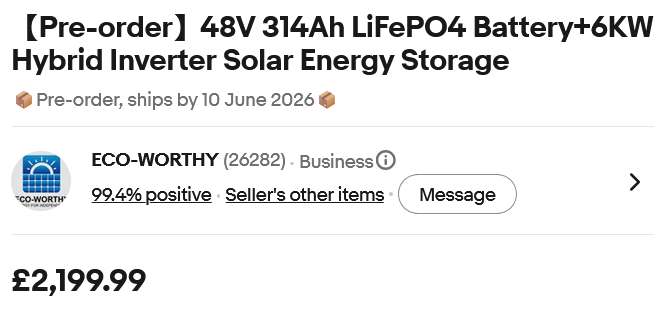
… but you can buy a brand new kit of inverter and battery for under £2k. Here's an example:
I note the same system is now ~£2200 (£2125 after a coupon). Not sure if that's supply-and-demand or just an artefact of Eco-Worthy's promotional pricing; the photo in the listing suggests it should be £1925 but that's not what they've set the price point at!
 N. Hampshire, he/him. Octopus Intelligent Go elec / Fuse gas / Vodafone BB / iD mobile. Kirk Hill Co-op member.Ofgem cap table, Ofgem cap explainer. Economy 7 cap explainer. Gas vs E7 vs peak elec heating costs, Best kettle!
2.72kWp PV facing SSW installed Jan 2012. 11 x 247w panels, 3.6kw inverter. 37 MWh generated, long-term average 2.6 Os.0 -
Now that one battery is working well, I'd like to add the second.
I've seen no instruction to say to first get the two voltages at a close level, but surely that makes sense?
Wishing to understand the charging process; I'm guessing - and readings would appear to suggest - that rate of charge is controlled by the inverter's supplied charging voltage? When it's charging at a decent rate - PVs churning out 2kW-ish - the voltage across the battery goes up by a few volts. When low charge rate, it's much less. That's how it works?
What's the correlation betwixt the 'charging voltage' - volts above battery - and the charging current?
So, if the two batteries differ by only a fraction of a volt, there should be no issue connecting them together? Sparks wont fly...?
Ta. 😜
0 -
Thanks HtA.
They are Alpha-Ess M48112, identical - but they are the 'S' modular series which are intended for series connection for high-voltage commercial installations. I am using it in the 'default' setting on the Sofar, so all the parameters were added manually.
0 -
It sounds like you are considering using these commercial batteries series connected in a domestic environment without full professional knowledge.
You should be aware that extra low voltage DC over 50V becomes progressively more dangerous. Over 100v ( two batteries in series can reach 110v !), that is much more dangerous than 240v AC. This is because AC voltage passes through zero every half cycle allowing muscle to relax slightly- a chance to disconnect yourself - but DC is continuous and muscle control is not regained prolonging shock. I will quote the net from a quick search as I cannot describe it better!
" While regulatory bodies like the UK Health and Safety Executive generally consider direct contact below 50V DC safe, 100V DC crosses into low-voltage territory where electric shock can disrupt heart rhythms, especially in wet conditions. [1, 2, 3, 4, 5]Because DC current is continuous rather than oscillating, it can cause severe muscle tetanus, locking your grip onto the live source and increasing the duration and danger of the shock. [1] "
I suggest do not do it unless you are properly trained and have a similar competent co-worker in attendance. Far better to just limit yourself to one battery and keep the other as a spare!
I have deleted my earlier post as some of it refers to parallel connection and I do not want to mislead.
3 -
I have a 32kWh Fogstar from Bimble
https://www.bimblesolar.com/fogstar-48v-32kwh2026-Heated
I’ve had a sunsynk 8kW inverter installed to run it.This allows me to shift all my electricity to the 8p/kWh cheap rate and save a fortune. Even without selling back to the grid at peak times, break even is 4 years…
2 -
Thanks, but to be clear, I am connecting them in parallel. Using them as 'default' batteries in the Sofar settings, which allows them to be dialled in to the required parameters manually - capacity 224Ah, max voltage 55V etc etc.
My only concern was when connecting them up together for the first time; I'm surprised to not see any reference to this in the Parallel-versions, so whether the BMS can sort this out, I don't know.
What I am planning to do is to connect one pole together, and the other via a resistor and ammeter, the 'resistor' being a 240V filament bulb of around 110ohms. It'll be a slow transfer, but it's only of around one volt before they match.
0 -
Sorry, I did not know you were expecting to connect them in parallel! My earlier deleted post then still stands but I don't know if it can be recovered! Caveat with a bit of modification.
Whereas it is common to connect in parallel the master battery using the battery to battery link will control the individual BMS in each battery to manage charge/discharge sharing and also to ensure individual batteries and through the individual BMSs cells are kept in balance. I do not know if you have or can use that facility in the series versions connected in parallel - and that may be the reason for your question? The manufacturer may be able to advise better.
The series versions rely on a separate unit to provided that overall management function via comms.
I you cannot utilise a master slave set up then that is an issue.
What I would suggest is fully charge each battery in turn so that they are both in an identical known state before connecting together. Nothing wrong with initially adding resistance it will provide some current limitation in case the batteries try to pass excessive current. Yes it will be a very slow transfer 10 ohms could be better.
Without overall BMS management the batteries may well drift apart if one gets more use than the other so it could be worthwhile checking their voltages/SOC individually periodically. Period for this will depend on their use so you will have to find out by trial and error.
If frequent it would be well worth fitting individual DC isolators rather than just a single one between batteries and inverter for convenience with their joining connection then being on the inverter side.
1









Confirm your email address to Create Threads and Reply

Categories
- All Categories
- 355.7K Banking & Borrowing
- 254.9K Reduce Debt & Boost Income
- 456.1K Spending & Discounts
- 248.2K Work, Benefits & Business
- 605.8K Mortgages, Homes & Bills
- 179K Life & Family
- 263.6K Travel & Transport
- 1.5M Hobbies & Leisure
- 16.1K Discuss & Feedback
- 37.7K Read-Only Boards