We’d like to remind Forumites to please avoid political debate on the Forum.
This is to keep it a safe and useful space for MoneySaving discussions. Threads that are – or become – political in nature may be removed in line with the Forum’s rules. Thank you for your understanding.
Outgoing export on Octopus going down
Comments
-
Yes, the cost of sending each kWh is trivial. Other than the purchase price of the electricity itself, how much more do you think it costs for you to receive 1kw down your electricity cable vs 20kw? Nothing right? Because the cables are already there. The transmission cost is barely anything, a couple of pence in losses and a bit of switching. It's the purchase and the profit that make up the bulk of the price.
The electricity costs are averaged over the year. Consumers struggle to deal with 30 minute pricing. Same applies to outgoing as well. If the amount they pay per kwh is going down, then I would expect it's because the price of electricity is going down too. However this clearly isn't the case, since the consumer tariff appears to be the same or has possibly slightly increased, it is difficult to measure.
It makes perfect sense to buy at 15p or 12p otherwise they wouldn't do it. It's an averaged cost, a month ago as I say the wholesale price was around 30-35p morning to evening. Most people who have an export tariff will be paying 30p/unit during the day. So whatever they lose, they gain back. Before I switched to octopus, I fed a ton of data into excel to compare tariffs, the flat rate tariff of another provider which was 19.5p/unit flat rate worked out the same price as my 30/7.5p with my usage data, without including the fact I occasionally charge my car (I don't do a huge amount of driving) which nudged it over.
They also have other incentives to support exporting, such as balancing the grid and meeting quotas and obligations for green energy.
You can just say it makes no sense to be on a flat tariff when agile is 7p and flat tariff is 30p. Until it snows tomorrow and your kids get home from school and you chuck their pe kit in the washing machine and start cooking dinner and suddenly it costs more.
If we could I am sure we would flip flop between whatever was best on a daily, weekly, or monthly basis, but the whole point is that it's all averaged.
Anyway, long story short, if they're paying 12p it's gonna make a lot of people with batteries unhappy that the gap between 7.5p and 12p has shrunk, and it makes me unhappy that the change will cost me £150/yr. I would have thought that purchase price and output price would drop together, thus making little to no difference to me.
0 -
Alicia Silverstone!
0 -
month ago as I say the wholesale price was around 30-35p morning to evening
Can you support that assertion with any sort of evidence? Everything that I've sen suggests your figure is wildly wrong.
1 -
There will be many nights where you are paying 7.5p/kWh for your electricity and it is costing more than this for the supplier. You may even be using electricity in the evening at 30.5p/kWh when your supplier is charged much more. You also want to be paid 15p/kWh for export when that will often be more than your supplier gets paid. It's not unreasonable that these rates have to be adjusted to take into account energy prices, usage patterns and renewable generation forecasts.
6.4kWp (16 * 400Wp REC Alpha) facing ESE + 5kW Huawei inverter + 10kWh Huawei battery. Vaillant Arotherm Pro 7kW heat pump.0 -
Loads of people recieve FiT payments. Mine is ~ 17p and my neighbour's is ~ 75p. Think of those payments as enticements for early adopters, who will bring capital costs down for late adopters.
0 -
… a month ago as I say the wholesale price was around 30-35p morning to evening.
Picking up on this, and on Qyburn's question:
Can you support that assertion with any sort of evidence? Everything that I've sen suggests your figure is wildly wrong.
The Octopus Agile pricing forumla is published by Octopus here. Using the factors for my region - Southern - a wholesalw price of 30p/kWh would result in an Agile price of 63p/kWh outside the evening peak, or 75p/kWh during the peak.
The Energy-Stats website has historical data for Agile prices. The individual half-hourly figures are, I think, available to download and analyse but it's simpler to use the chart of daily highs and lows. For my region that chart is here. Screenshot:
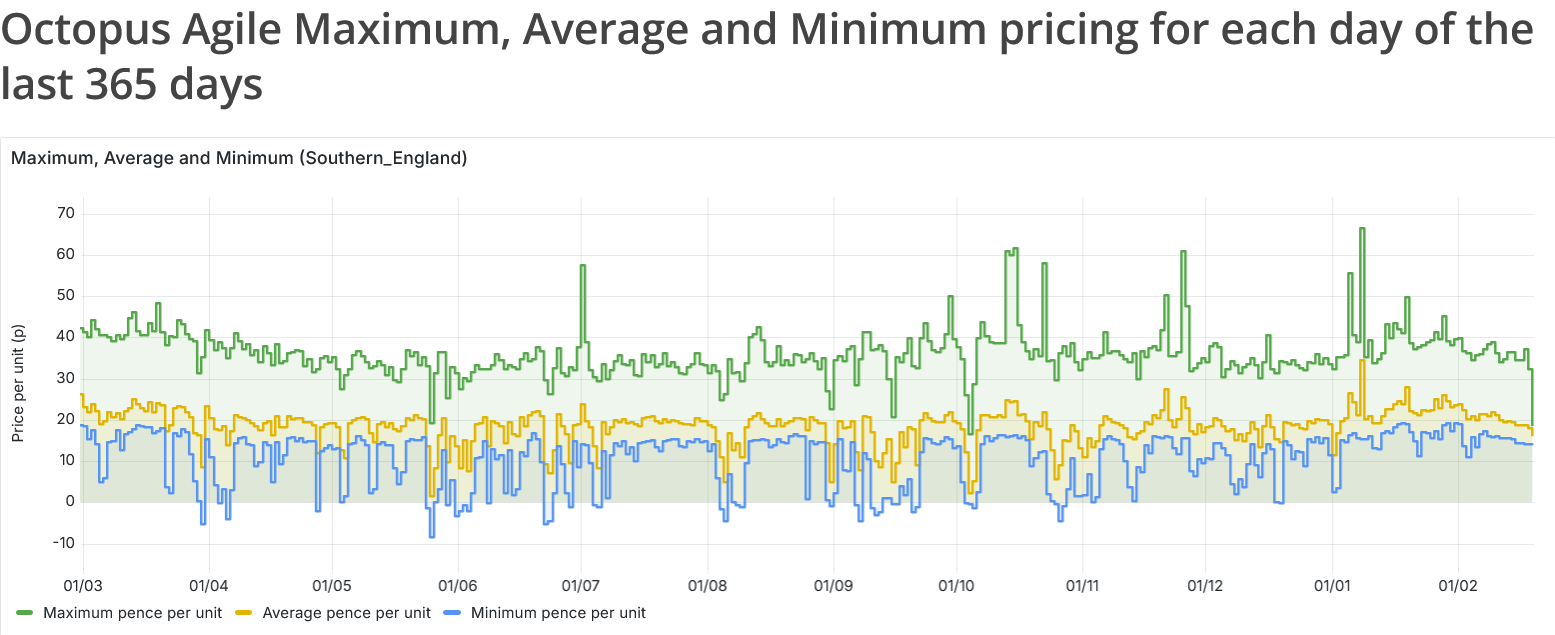
You can see that the maximum half-hourly price in the last year was 66.4p on the 8th of January. Looking back to posts on the "Octopus Agile" thread from around that time, we can see eg. this post where it's observed that "8:30-9:30 and 12-16 more expensive than 18-19".
So let's dig into the CSV data from here. We can see that the 66.4p/kWh occurred in one, single, HH slot at 1630 on that day. That would equate to a wholesale price in that slot of 31.6p/kWh. There was only one other HH slot that day where Agile was above 60p/kWh (wholesale above 28.6p/kWh) and the average for the day was 35p/kWh (wholesale below 17p/kWh).
There is no other occasion shown on the chart for the past 12 months where the highest Agile price for a day was above 63p/kWh, which would be equivalent to 30p/kWh wholesale.
In summary, if there was a time in the last year when "the wholesale price was around 30-35p morning to evening" it isn't evident in the Agile pricing record.
N. Hampshire, he/him. Octopus Intelligent Go elec / Fuse gas / Vodafone BB / iD mobile. Kirk Hill Co-op member.Economy 7 cap explainer. Gas vs E7 vs peak elec heating costs, Ecoflow Stream, Best kettle :-)
2.72kWp PV facing SSW installed Jan 2012. 11 x 247w panels, 3.6kw inverter. 37 MWh generated, long-term average 2.6 Os.0 -
My average price on Agile, for the whole of 2025, was just over 20p/kWh. That was much higher than the year before because my solar panels satisfied my consumption during a lot of the cheap slots but my heat pump would be active during many of the expensive slots (although I did tend to turn the thermostat down when the evening peaks were eye-watering).
1 -
I’m surprised I haven’t seen anyone talking about switching on here.
I’ve had panels (no battery) for the last 3 years and have been with Octopus throughout. I’m currently on a fixed import tariff (no exit fee) which is pretty average but stuck with Octopus due to the the export tariff.
according to the figures on the site, a couple of others (BG and Edf are still offering 15p. I looked into BG and their current fixed import is pretty similar to my current tariff but the higher export would leave me about £70-80 a year better off.Granted the BG tariff is variable so could be dropped even more at any point. EDFs is apparently fixed for 12m but I can’t get their website to give me a quote.
is anyone else thinking of switching?0 -
Some of the higher export rates are only available to people who bought their panels from that supplier.
0 -
British Gas are one of the worst companies I have ever had the misfortune to deal with. They would have to be offering a lot more than 15p for me to even start thinking about it.
0












Confirm your email address to Create Threads and Reply

Categories
- All Categories
- 355.7K Banking & Borrowing
- 254.9K Reduce Debt & Boost Income
- 456.1K Spending & Discounts
- 248.3K Work, Benefits & Business
- 605.9K Mortgages, Homes & Bills
- 179K Life & Family
- 263.7K Travel & Transport
- 1.5M Hobbies & Leisure
- 16.2K Discuss & Feedback
- 37.7K Read-Only Boards