We’d like to remind Forumites to please avoid political debate on the Forum.
This is to keep it a safe and useful space for MoneySaving discussions. Threads that are – or become – political in nature may be removed in line with the Forum’s rules. Thank you for your understanding.
FTSE100 best single year return since 2009.
Comments
-
Whilst recognising that the discussion is about the UK FTSE, Morningstar's article on US funds flow is relevant, they say:
Investors poured nearly $80 billion into long-term US mutual funds and exchange-traded funds in November 2025, the seventh straight month of inflows.
US equity funds bucked a six-month streak of outflows with a minor inflow of $3 billion. Durable trends persisted, with large-blend funds driving inflows, particularly from passive investors, while growth categories led outflows.
https://www.morningstar.com/business/insights/blog/funds/us-fund-flows
FM's of global funds switched from the US to the UK and Europe following the April downturn. One only has to look at the regional allocations of many managed global funds to see that circa 35% is the new 60% US equities allocation. It will be helpful to try and understand what the $80 billion mentioned above comprises, how much was domestic or international and whether it was a swtch from managed funds, to trackers.0 -
chiang_mai said:Whilst recognising that the discussion is about the UK FTSE, Morningstar's article on US funds flow is relevant, they say:
Investors poured nearly $80 billion into long-term US mutual funds and exchange-traded funds in November 2025, the seventh straight month of inflows.
US equity funds bucked a six-month streak of outflows with a minor inflow of $3 billion. Durable trends persisted, with large-blend funds driving inflows, particularly from passive investors, while growth categories led outflows.
https://www.morningstar.com/business/insights/blog/funds/us-fund-flows
FM's of global funds switched from the US to the UK and Europe following the April downturn. One only has to look at the regional allocations of many managed global funds to see that circa 35% is the new 60% US equities allocation. It will be helpful to try and understand what the $80 billion mentioned above comprises, how much was domestic or international and whether it was a swtch from managed funds, to trackers.The use of the terms "mutual fund", "international stocks" (meaning ex-US based on the context) and mention of "rate-cutting expectations" leads me to believe this is based on domestic US data. The article does state "passive inflows dominated" and the example of large-cap value inflows was illustrated by an ETF - this is all to be expected in a country where taxation favours passive, but is probably not too dissimilar elsewhere in the world. The full report appears to be available if you share your "professional email" with them.I'm curious about the 35% is the new 60% bit in bold. This would suggest fund managers are following a similar course to some of us private investors, but going further than I'd have thought. Could you share some example funds where this has occurred please?0 -
Speaking as somebody who spends far too much of his time searching for and assessing funds, and as someone who has long agreed that the US equities allocation deserves to be a much smaller part of a global fund, I have found it difficult in the past to find balanced global equities funds. Whether or not that's because I wasn't looking hard enough or simply didn't see them, I'm unsure. But then, last year I started to see many such funds, the Orbis Balanced and Cautious funds, Ranmore and Prem Miton's Cautious are four funds that spring to mind. I don't know if they were there all along and I simply didn't see them, all I do know is that today it's far easier to fuind global equities funds with a much lower allocation to US equties than I had seen previously..masonic said:The use of the terms "mutual fund", "international stocks" (meaning ex-US based on the context) and mention of "rate-cutting expectations" leads me to believe this is based on domestic US data. The article does state "passive inflows dominated" and the example of large-cap value inflows was illustrated by an ETF - this is all to be expected in a country where taxation favours passive, but is probably not too dissimilar elsewhere in the world. The full report appears to be available if you share your "professional email" with them.I'm curious about the 35% is the new 60% bit in bold. This would suggest fund managers are following a similar course to some of us private investors, but going further than I'd have thought. Could you share some example funds where this has occurred please?1 -
I couldn't access any historic documents for the Orbis multi-asset funds, but for Premier Milton's Cautious fund way back in 2017 it was holding 9.8% US equities within 52.9%, so under 20% of the equities were US (the 2025 figures are 15.4% within 52.9%, so up to almost 30%). So perhaps this isn't a change in portfolio managers' allocations, it would have been really interesting to see a shift from 60% down to much lower allocations. From what I can see in the IA Global sector, there are funds that focus on growth and those that focus on value, which unsurprisingly do not change their spots. Then there are some that are supposedly unconstrained and can allocate anywhere in the world, but do not seem to have reduced their US exposure at this time.chiang_mai said:
Speaking as somebody who spends far too much of his time searching for and assessing funds, and as someone who has long agreed that the US equities allocation deserves to be a much smaller part of a global fund, I have found it difficult in the past to find balanced global equities funds. Whether or not that's because I wasn't looking hard enough or simply didn't see them, I'm unsure. But then, last year I started to see many such funds, the Orbis Balanced and Cautious funds, Ranmore and Prem Miton's Cautious are four funds that spring to mind. I don't know if they were there all along and I simply didn't see them, all I do know is that today it's far easier to fuind global equities funds with a much lower allocation to US equties than I had seen previously..masonic said:The use of the terms "mutual fund", "international stocks" (meaning ex-US based on the context) and mention of "rate-cutting expectations" leads me to believe this is based on domestic US data. The article does state "passive inflows dominated" and the example of large-cap value inflows was illustrated by an ETF - this is all to be expected in a country where taxation favours passive, but is probably not too dissimilar elsewhere in the world. The full report appears to be available if you share your "professional email" with them.I'm curious about the 35% is the new 60% bit in bold. This would suggest fund managers are following a similar course to some of us private investors, but going further than I'd have thought. Could you share some example funds where this has occurred please?1 -
I accept that is true in the case of the PM fund and thank you for confirming. But am I the only one to recall the trend away from US stocks, following the April correction, a move that increased allocations to Europe especially? I will search for news reports of this change in allocation and report back. I am very clear that the recommendations in April were to diversify away from US stocks, a move that saw European inflows. That trend subsequently reversed but not entirely. The net is that many investors remain wary of the US, niot just because of the high valuation of the Tech sector but also because of geo political risk and this sentiment has filtered through to fund composition and geographic allocations.masonic said:
I couldn't access any historic documents for the Orbis multi-asset funds, but for Premier Milton's Cautious fund way back in 2017 it was holding 9.8% US equities within 52.9%, so under 20% of the equities were US (the 2025 figures are 15.4% within 52.9%, so up to almost 30%). So perhaps this isn't a change in portfolio managers' allocations, it would have been really interesting to see a shift from 60% down to much lower allocations. From what I can see in the IA Global sector, there are funds that focus on growth and those that focus on value, which unsurprisingly do not change their spots. Then there are some that are supposedly unconstrained and can allocate anywhere in the world, but do not seem to have reduced their US exposure at this time.1 -
There were lots of reports of investors flooding into European defence stocks. But that's across all market participants (private investors, institutional investors, overseas investors, and UK asset managers). I've not seen that bear out in the allocation of global equity funds, so perhaps the latter group did not participate. It was a very much sentiment/FOMO-driven action, which responsible portfolio managers probably should not have succumbed to. But I would take notice of a more measured shift in allocation based on fundamentals. I'm not that well versed on the darling funds of the global sector, but say Rathbone Global Opportunities or Fundsmith dropped their US allocation, that would be quite something.chiang_mai said:
I accept that is true in the case of the PM fund and thank you for confirming. But am I the only one to recall the trend away from US stocks, following the April correction, a move that increased allocations to Europe especially? I will search for news reports of this change in allocation and report back. I am very clear that the recommendations in April were to diversify away from US stocks, a move that saw European inflows. That trend subsequently reversed but not entirely. The net is that many investors remain wary of the US, niot just because of the high valuation of the Tech sector but also because of geo political risk and this sentiment has filtered through to fund composition and geographic allocations.masonic said:
I couldn't access any historic documents for the Orbis multi-asset funds, but for Premier Milton's Cautious fund way back in 2017 it was holding 9.8% US equities within 52.9%, so under 20% of the equities were US (the 2025 figures are 15.4% within 52.9%, so up to almost 30%). So perhaps this isn't a change in portfolio managers' allocations, it would have been really interesting to see a shift from 60% down to much lower allocations. From what I can see in the IA Global sector, there are funds that focus on growth and those that focus on value, which unsurprisingly do not change their spots. Then there are some that are supposedly unconstrained and can allocate anywhere in the world, but do not seem to have reduced their US exposure at this time.1 -
I never said the vote would increase the value of the world return, just that I believed it would harm my UK trusts/funds and thus changing to more global bias would be better, as turned out to be the case. Since the vote did lead to a record outflow of money from the UK I can't see how any luck was involved there, again decisions made by presumably millions of people for the many billions transferred out. As for the second paragraph I fail to see what it has to do with this discussion.Altior said:Palpably you are claiming that 'best decision I made in 40 years of investing' was due to the Brexit vote. I'm stating that could well be true, but if so it wasn't due to the impact of the Brexit vote on the holdings that you sold out of, or switched into. ie the Brexit vote may be why you changed your positions, but the outcome wasn't contingent on the impact of the vote. Therefore, it was luck.
You might bet the house on red on the roulette wheel due to wearing a red tie that night. That ball landing on red might be the best thing that happened to you, betting on red might have been the best decision you ever made. The colour of your tie might be why you picked red, but the ball didn't land on red due to the colour of the tie you'd selected to wear that day. You'd be just lucky that your red tie was the first one you saw when looking for a tie to wear.1 -
I simply meant you seemed to invest in markets which are less exposed to the US.chiang_mai said:
If it helps at all, I am 75.Veloflyer said:
I'm 61 and perhaps cannot afford a similar risk to you regarding concentration on markets outwith the US to such an extent as I believe this does offer a greater risk than global trackers like VWRP for instance. I do appreciate it may offer greater growth but I am prepared to sacrifice that for lower risk. Each to his own though.
I hear much about the US being over-valued, but my trackers and the S&P are still on the rise and I see nothing at present that demonstrates that it will all come crashing down some time in the near future.
Historic metrics are pretty meaningless. Not even a guide. I have no crystal ball so offer no alternatives to what will happen in the future. AlI I can do is diversify, consider gilts, annuity, cash buffer in case of a crash, read up on what Buffet and others have to say and pray to whichever deity is flavour of the month.
I don't understand your comment about markets concentration, there's none whatsoever in my portfiolio.
Volatility is an historic metric, do you really think that's not a useful metric to understand?
It will be interesting to revisit this topic with you, in say six months.
I don't see much volatility in the price of my tracker funds over the past 15 years or so. Does volatility apply here anyways? I also don't invest in individual stocks or risky markets so perhaps volatility is not much of consideration for me. Pleasingly - and luckily perhaps - they all trended upwards with little volatility and all were heavily US weighted. They continue to do similar.
Will that be the case over the next 6 months? - I have no idea and neither does anyone else, save that I believe putting my faith in the US is not completely barmy and I still believe it has growth potential. It may all implode, but folk have been saying that for years. All I can do against that is mitigate the risk as best I can by diversifying more into global trackers/ROW or by buying IL gilts.0 -
Just so we both have the same understanding of the terminology and framework: The main US equities markets are, for all intents and purposes, the S&P, the Dow, the Nasdaq and the Russell, they are the major US exchanges where US companies are listed. Anyone wanting exposure to US equities must buy stocks or funds that are listed on those exchanges, or the index/indicies that track them.Veloflyer said:
I simply meant you seemed to invest in markets which are less exposed to the US.
I don't see much volatility in the price of my tracker funds over the past 15 years or so. Does volatility apply here anyways? I also don't invest in individual stocks or risky markets so perhaps volatility is not much of consideration for me. Pleasingly - and luckily perhaps - they all trended upwards with little volatility and all were heavily US weighted. They continue to do similar.
Will that be the case over the next 6 months? - I have no idea and neither does anyone else, save that I believe putting my faith in the US is not completely barmy and I still believe it has growth potential. It may all implode, but folk have been saying that for years. All I can do against that is mitigate the risk as best I can by diversifying more into global trackers/ROW or by buying IL gilts.
Trackers track those exchanges/index or segments thereof, an S&P 500 Index Tracker tracks the S&P 500, which in turn lists the 500 largest US companies listed on the exchange. The individual value of each of those companies listings varies, potentially, minute by minute, which means the value of the Index and any thing that tracks it changes also. Those changes represent the volatility, or price movements, of the companies and the overall index. You ask if voltility applies to your tracker, the answer is yes.
The volatility of your tracker fund will tell you how far, historically, the price has moved per day/week/month/year, plus and minus, and how long it has stayed at the new level. If for example the S&P500 fell 10% and it took a month to regain lost ground, volatility measurements will help you to understand that. You may not think that you haven't seen much volatility in your trackers but their value has changed, over time, in line with the index. Comparing the volatility readings help investors compare different trackers and against the performance of managed funds. The bottom line here is that if the S&P500 were to fall by say 20%, the value of any S&P tracker would fall by a similar amount and your tracker would not recover until the S&P recovers.
A potentially useful solution, to help mitigate US markets risk is, as you suggest. A global tracker that contains anywhere from 60% to almost 80% US markets exposure will potentially help dilute the impact of any falls in the US market. By deploying that global tracker you will be investing in other markets around the world, non-US markets such as Europe, the UK Asia, Japan etc.
Lastly, "will that be the case over the next six months", you ask. Physics and history confirm that what goes up, must come down, the higher it goes, the longer it continues going up, doesn't change the ending. The US CAPE is over double its historic average, the only question that remains is, when will it return to norm. You may not think that historic metrics are worth anything but they will tell you what has happened since Day One. If of course you think that this time things are unique and different from anything that has ever happened before in the history of investing, you would be right to disregrd historic metrics.
1 -
talexuser said:
I never said the vote would increase the value of the world return, just that I believed it would harm my UK trusts/funds and thus changing to more global bias would be better, as turned out to be the case. Since the vote did lead to a record outflow of money from the UK I can't see how any luck was involved there, again decisions made by presumably millions of people for the many billions transferred out. As for the second paragraph I fail to see what it has to do with this discussion.Altior said:Palpably you are claiming that 'best decision I made in 40 years of investing' was due to the Brexit vote. I'm stating that could well be true, but if so it wasn't due to the impact of the Brexit vote on the holdings that you sold out of, or switched into. ie the Brexit vote may be why you changed your positions, but the outcome wasn't contingent on the impact of the vote. Therefore, it was luck.
You might bet the house on red on the roulette wheel due to wearing a red tie that night. That ball landing on red might be the best thing that happened to you, betting on red might have been the best decision you ever made. The colour of your tie might be why you picked red, but the ball didn't land on red due to the colour of the tie you'd selected to wear that day. You'd be just lucky that your red tie was the first one you saw when looking for a tie to wear.It's rather disingenuous to keep citing record outflows in 2016 without mentioning they were mostly a reversal of large inflows in 2015, or that there were record inflows in 2017 which were bigger than those outflows. Overall, the net position from 2017 onward was positive until 2022. I wouldn't call £8.8bn "many billions", and it is certainly smaller than the £18.8bn outflows in 2022 or the £22bn outflows in 2023. The sum of £8.8bn represented just 1.4% of assets under management in these funds at that time. AUM increased £562bn -> £634bn -> £722bn in 2015, 2016 and 2017.IA retail sales data: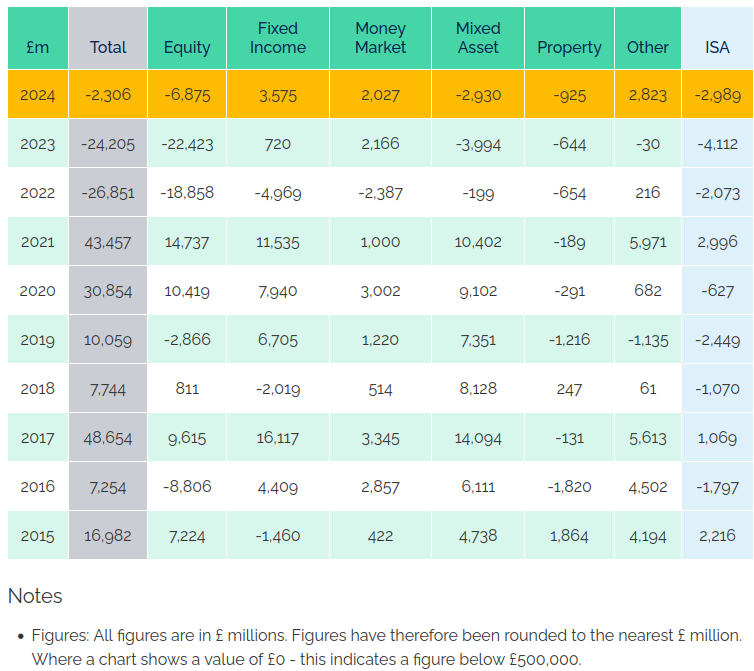 In the context of the FTSE100, and globally, the price trended higher through these years of sales, meaning that there were was demand for the shares. If "presumably millions of people" were involved, then the average amount sold would have been in the low thousands for each person. Probably the action of rebalancing after 20-30% gains were seen in that year across UK retail equity funds in sterling terms, in the greater part due to currency movements. This is supported by the fact that the money ended up mostly in mixed asset and fixed income. While in 2017, things returned to a more typical distribution across asset classes.So by all means continue pushing your forum-rule-breaking, off-topic, political narrative about UK retail fund outflows, but know that it is without substance.7










Confirm your email address to Create Threads and Reply

Categories
- All Categories
- 355.8K Banking & Borrowing
- 254.9K Reduce Debt & Boost Income
- 456.2K Spending & Discounts
- 248.3K Work, Benefits & Business
- 605.9K Mortgages, Homes & Bills
- 179K Life & Family
- 263.7K Travel & Transport
- 1.5M Hobbies & Leisure
- 16.2K Discuss & Feedback
- 37.7K Read-Only Boards