We’d like to remind Forumites to please avoid political debate on the Forum.
This is to keep it a safe and useful space for MoneySaving discussions. Threads that are – or become – political in nature may be removed in line with the Forum’s rules. Thank you for your understanding.
📨 Have you signed up to the Forum's new Email Digest yet? Get a selection of trending threads sent straight to your inbox daily, weekly or monthly!
FTSE100 best single year return since 2009.
Comments
-
It is worth noting that back in 2013 the S&P 500 was much less concentrated with the top 10 companies only accounting for about 8% of the index compared to 40% today. A S&P 500 tracker is nowhere near as much a cross-section of businesses as it was when Buffett made that suggestion.masonic said:Warren Buffett's choice of tracker was no doubt tailored to the target audience, although I'd argue even Americans would benefit from global diversification. His 2013 letter to investors stated "The goal of the non-professional should not be to pick winners - neither he nor his “helpers” can do that - but should rather be to own a cross-section of businesses that in aggregate are bound to do well. A low-cost S&P 500 index fund will achieve this goal."
3 -
But the point was that all three have made gazillions, and that doesn't in itself mean that their views are relevant to those of us at the other end of the spectrum! Having said that, I agree about relative credibility versus commentators, in terms of walking the walk rather than just talking the talk.Veloflyer said:
Buffet has made gazillions - he must be doing something right? I'd give him time of day over many other financial commentators any day of the week.eskbanker said:Not sure I'd place too much reliance on the pronouncements of someone in that position anyway, any more than I'd listen to Jeff Bezos telling me where to shop or Elon Musk giving recommendations about what to drive!1 -
The other thing that gives him a little more credibility than the other billionaires you mentioned is that his answer was quite the opposite of what they would say. And to cover off the point above, I believe the instructions for his wife's trust have not been changed.eskbanker said:
But the point was that all three have made gazillions, and that doesn't in itself mean that their views are relevant to those of us at the other end of the spectrum! Having said that, I agree about relative credibility versus commentators, in terms of walking the walk rather than just talking the talk.Veloflyer said:
Buffet has made gazillions - he must be doing something right? I'd give him time of day over many other financial commentators any day of the week.eskbanker said:Not sure I'd place too much reliance on the pronouncements of someone in that position anyway, any more than I'd listen to Jeff Bezos telling me where to shop or Elon Musk giving recommendations about what to drive!0 -
With all due respect and I say this in the nicest possible way, I suspect you are not yet at the stage where you can afford to have firm opinions about the worth of historic metrics. in investing. Just to give you an idea, below is part of my dashboard showing the types of data I collect and review for change often. By monitoring those metrics I can easily see if my investing profile is changing and becomming out of balance or unnaceptably risky.Veloflyer said:
I guess it depends how much faith you put in historical data to determine the future. My faith in it is so small so as not to signify very much in my decision making - others have a different view.chiang_mai said:
Not really. We've already said that the CAPE adjusted ratio is 39 whislt the long term median is 16. That's historic data that one sees creeping upwards, if one choses to review it. Ditto the volatility readings of Mag 7 stocks will confirm the extent to which they also crept upwards. Even the historic Beta of some trackers is now at 1.0 and this would have been seen to be increasing over time, a sure sign that risk is increasing.
Note: not all the charts carried accross correctly because I had to dissassociate it from my data. I track regions for equities and also for currencies. And the apparent duplication of sector reporting results from a model I have set up which shows the before and after effect of fund changes....you get the idea that it's important to keep an eye on the metrics and observe changes.
Late edit...a related read, just in: https://finance.yahoo.com/news/magnificent-7-stock-market-dominance-140007016.html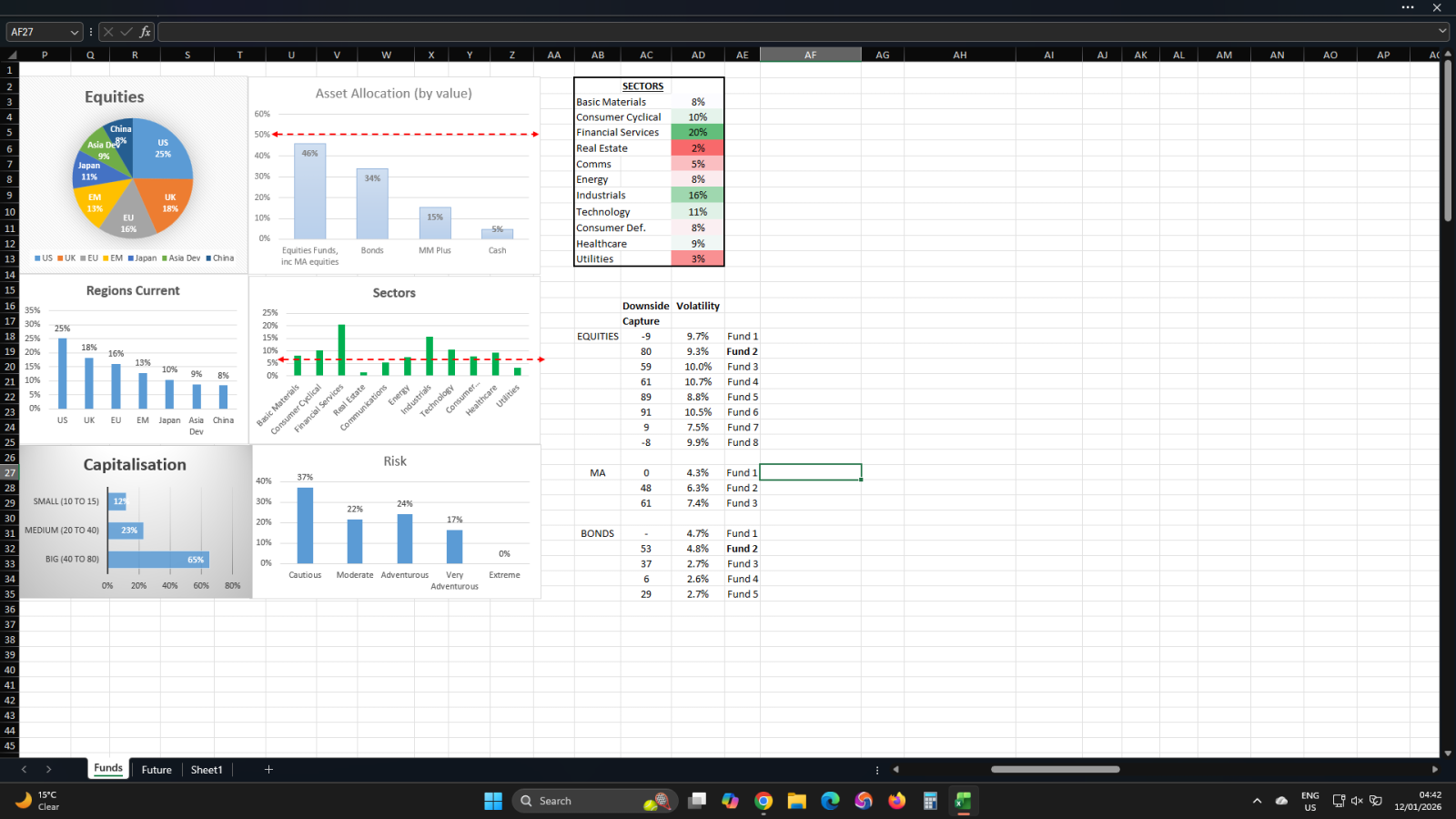
0 -
You could argue that one can only have faith in historical data, and therefore do what is advised to non professional investors and invest in index trackers. To make an individual assessment without any faith in historical data, then you will likely come to a conclusion that differs from the average standard advice of trackers0
-
I would argue that I have constructed my own tracker, which comprises an assortment of managed funds. My tracker has a different tilt to the off the shelf tracker, because the weightings and emphasis of the traditional tracker, don't suit my risk profile and I don't agree they are appropriate for my objectives. Plus, my tracker is managed, it has FM's who negotiate the parts of the obstacle course that I can't see or have the expertise to navigate. My "tracker' operates within predetermined guidelines and is subject to the same balancing routines that a regular tracker is, it just looks different.Cus said:You could argue that one can only have faith in historical data, and therefore do what is advised to non professional investors and invest in index trackers. To make an individual assessment without any faith in historical data, then you will likely come to a conclusion that differs from the average standard advice of trackers
The problem is not the tracker, the problem is the index upon which the tracker is based. My "tracker" doesn't agree that the US market should hold a 60% share, that's a backwards looking metric. My "tracker" is forward looking, just as markets are, it believes the US debt levels are such a huge risk to the US economy that market share of my tracker should be limited to 25%, not 60%. It also believes that Japan should be 10%, not the 3% that traditional trackers employ and that China should be 8% not 3%....and so on.0 -
Surely by that logic, every portfolio could be described as a "tracker", assuming they correlate with an individual's preferred allocation (accepting that the degree of design will vary widely)?chiang_mai said:I would argue that I have constructed my own tracker, which comprises an assortment of managed funds. My tracker has a different tilt to the off the shelf tracker, because the weightings and emphasis of the traditional tracker, don't suit my risk profile and I don't agree they are appropriate for my objectives. Plus, my tracker is managed, it has FM's who negotiate the parts of the obstacle course that I can't see or have the expertise to navigate. My "tracker' operates within predetermined guidelines and is subject to the same balancing routines that a regular tracker is, it just looks different.
The problem is not the tracker, the problem is the index upon which the tracker is based. My "tracker" doesn't agree that the US market should hold a 60% share, that's a backwards looking metric. My "tracker" is forward looking, just as markets are, it believes the US debt levels are such a huge risk to the US economy that market share of my tracker should be limited to 25%, not 60%. It also believes that Japan should be 10%, not the 3% that traditional trackers employ and that China should be 8% not 3%....and so on.2 -
As long as the proportions are held and don't continually vary, and importantly, as long as there's a basis for its construction and weighting, that also do not frequently change. Todays global trackers are nothing more than fixed allocations and ratio's that have a basis for their construction. I question those allocations and ratio's but otherwise there is little difference. I don't think that a fluid portfolio that has no logical basis for its weighting or ratio's would qualify. I suspect most novice (and experienced) retail investors simply want to buy good coverage that has some rationale that underpins its construction and don't have firm views of their own about whether that underpinning is correct or not. Basing that construction on market share is as good as any I suppose but that doesn't mean its right or the only way to construct a tracker. The other part of this is that it's not possible for investors to tinker with the make up of an off the shelf global tracker, which is somewhat beneficial. They can influence weighting by adding other funds in order to tilt the weighting but for most people that might be too much trouble.eskbanker said:
Surely by that logic, every portfolio could be described as a "tracker", assuming they correlate with an individual's preferred allocation (accepting that the degree of design will vary widely)?chiang_mai said:I would argue that I have constructed my own tracker, which comprises an assortment of managed funds. My tracker has a different tilt to the off the shelf tracker, because the weightings and emphasis of the traditional tracker, don't suit my risk profile and I don't agree they are appropriate for my objectives. Plus, my tracker is managed, it has FM's who negotiate the parts of the obstacle course that I can't see or have the expertise to navigate. My "tracker' operates within predetermined guidelines and is subject to the same balancing routines that a regular tracker is, it just looks different.
The problem is not the tracker, the problem is the index upon which the tracker is based. My "tracker" doesn't agree that the US market should hold a 60% share, that's a backwards looking metric. My "tracker" is forward looking, just as markets are, it believes the US debt levels are such a huge risk to the US economy that market share of my tracker should be limited to 25%, not 60%. It also believes that Japan should be 10%, not the 3% that traditional trackers employ and that China should be 8% not 3%....and so on.0 -
The fundamental property of an index tracker is precisely that it hands off responsibility to an external formula, not individual choice.Multi-asset funds and other fund of funds are not index trackers, though they may use index trackers as building blocks.3
-
So if you want a global tracker, you have to take what you're given, unless you elect to construct your own global tracker using regional trackers, in which case it's still a tracker but regional ratio's can be varied. However, if you try to do something similar using managed funds, you may achieve a similar end but it can't be called a tracker.masonic said:The fundamental property of an index tracker is precisely that it hands off responsibility to an external formula, not individual choice.Multi-asset funds and other fund of funds are not index trackers, though they may use index trackers as building blocks.
0












Confirm your email address to Create Threads and Reply

Categories
- All Categories
- 355.8K Banking & Borrowing
- 254.9K Reduce Debt & Boost Income
- 456.2K Spending & Discounts
- 248.3K Work, Benefits & Business
- 605.9K Mortgages, Homes & Bills
- 179K Life & Family
- 263.8K Travel & Transport
- 1.5M Hobbies & Leisure
- 16.2K Discuss & Feedback
- 37.7K Read-Only Boards