We’d like to remind Forumites to please avoid political debate on the Forum.
This is to keep it a safe and useful space for MoneySaving discussions. Threads that are – or become – political in nature may be removed in line with the Forum’s rules. Thank you for your understanding.
Energy news in general
Comments
-
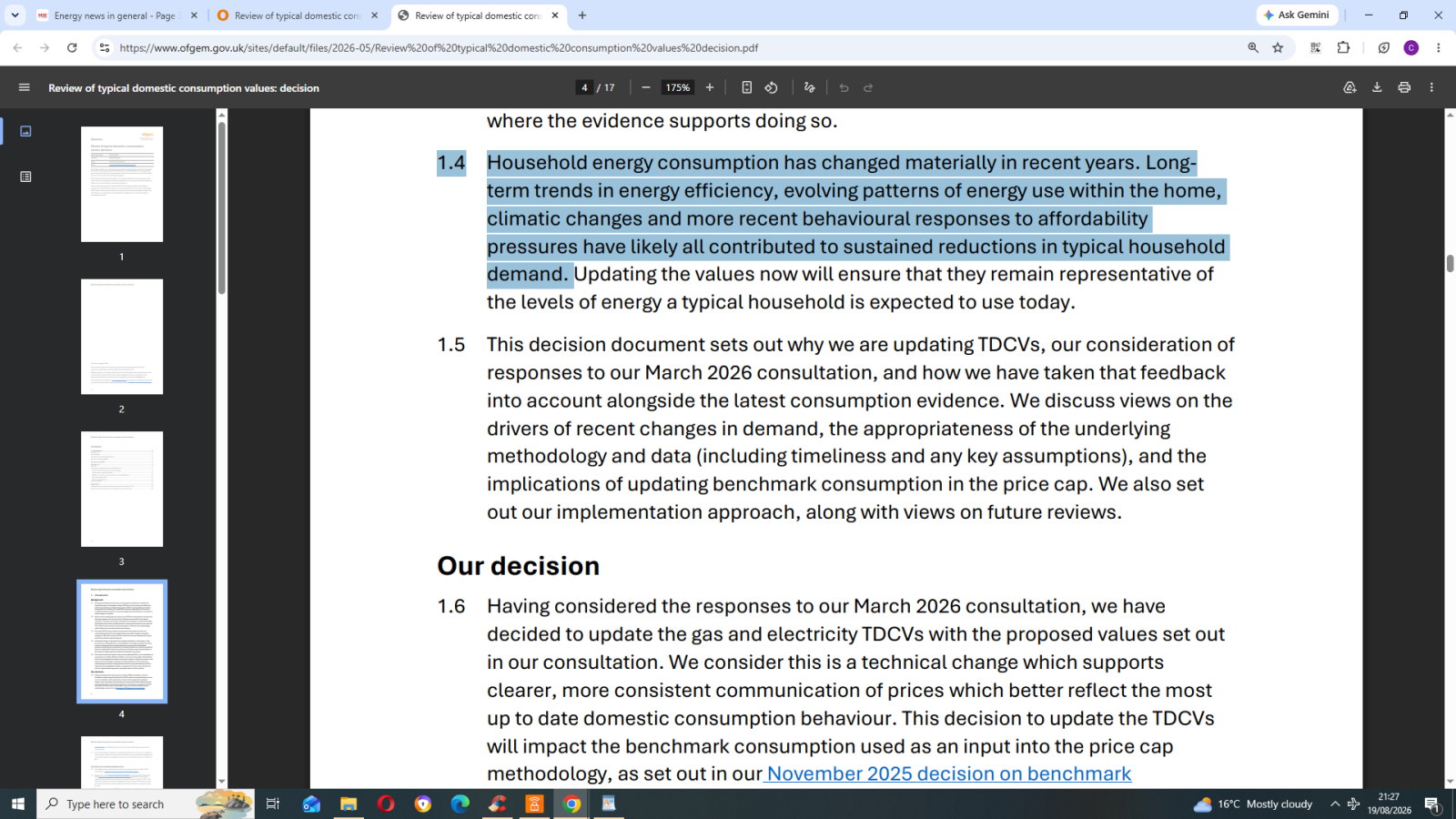
"I wonder if Ofgem have published anything on the reasons for the TDCVs dropping"
 1
1 -
"All of the above" then 😀
I was hoping for a research paper, but that's good enough for this time of night.
N. Hampshire, he/him. Octopus Intelligent Go elec / Fuse gas / Vodafone BB / iD mobile. Kirk Hill Co-op member.Economy 7 cap explainer. Gas vs E7 vs peak elec heating costs, Ecoflow Stream, Best kettle :-)
2.72kWp PV facing SSW installed Jan 2012. 11 x 247w panels, 3.6kw inverter. 37 MWh generated, long-term average 2.6 Os.0 -
This paper discusses the fall in consumption following the 2022 energy price shock and I believe that similar observations might be made about consumer behaviour in 2026.
Losing energy • Resolution Foundation
“In fact, falling energy use this decade can largely be attributed to a two-year period, 2022 to 2023, which accounts for over a third (36 per cent) of the fall in electricity consumption and almost two-fifths (39 per cent) of the fall in gas consumption experienced since 2010.”
Although the paper doesn’t go into detail on the most recent causes of the TDCV reductions it does point out that gas consumption fell a further 17% since the last TDCV review effective October 2023. That is a very rapid reduction.
Another observation about 2022 suggests that (if subsequent trends continue) home energy improvements are unlikely to be a major driver of the 17% reduction in gas consumption.
“In 2022 only 64,000 houses received energy efficiency measures from the government’s flagship insulation scheme ECO, the median energy efficiency score increased by just 1 point (from 66 to 67), the share of boilers that are condensing (and therefore more efficient) rose by 2 percentage points, and only another 0.5 per cent of households installed solar panels. It is hard to believe that changes of this magnitude can drive down median demand as much as happened in 2022.”
Northern Lincolnshire. 7.8 kWp system, (4.2 kWwest facing panels , 3.6 kWeast facing), Solis inverters installed 2018, 5kW SSE facing system (shaded in afternoon) added in 2025 with Tesla PW3 battery, Mitsubishi SRK35ZS-S and SRK20ZS-S Wall Mounted A2A Heat Pumps, ex Nissan Leaf owner.2 -
While it's worrying to think that there may be many more households afraid to turn the heating on at all, perhaps a fair few of the "24C, t-shirt all year" types finally realised it was hitting their pockets a bit too much?
Heated throws and oversized hoodies were the "must have" items, social media was full of the "cool to be cosy" message, hot tubs were being ditched etc. This must surely factor in to the general reduction too?
Barnsley, South Yorkshire
Solar PV 5.25kWp SW facing (14 x 375) installed Mar 22
Lux 3.6kw hybrid inverter and 9.6kw Pylontech batteries
Daikin 8kW ASHP installed Jan 25
Octopus Cosy/Fixed Outgoing1 -
It is interesting looking at this from a statistical point of view as OFGEM look at the median consumer. What a millionaire does in his 500sqm house or what a singleton living in a small flat does are unlikely to impact the median. My quite wealthy next door neighbour ditched his hot tub but still leaves the ground mounted floodlights on. I doubt that hot tub owners constitute the median consumer but they could, of course, have been above the median before ditching the hot tub and below the median afterwards. That could have an impact as the household
that was using 1kWh below the median as now been bumped up to be the median.Weren’t the heated throws a reaction to the 2022 energy crisis? Yes we are consuming less but are these behavioural changes we are adopting just a short term reaction to higher prices and will consumption increase if prices fall again? I have been a lot less careful since I went onto Octopus Go in January and since March have been paying just 4.99p/kWh for the energy to heat my hot water and fill my battery. I haven’t even worried about the cost of aircon (20kWh) as except for a couple of days I have needed to buy any peak rate electricity. With export rates falling I feel less inhibited about self consuming solar.
With more EVs and heat pumps being rolled out we would expect electricity use to be increasing not dectreasing but again EV and heat pumps being users are likely to be way to one side of the median so not impacting the statistic. Possibly rolling out more roof mounted solar panels is shifting the median down as may plug in solar. LED bulbs were probably the biggest factor historically in bringing median electricity use down as everybody bought these but the low hanging fruit has already been picked.
Edit; I suspect the big driver to cut energy consumption was the email from their energy supplier telling them their direct debit was rising and at the same time consumers were told to turn their thermostats down. Hence, my suggestion that rising prices is the biggest driver of the reduced TDCV rather than wide scale improvement to the thermal efficiency of the housing stock.
Northern Lincolnshire. 7.8 kWp system, (4.2 kWwest facing panels , 3.6 kWeast facing), Solis inverters installed 2018, 5kW SSE facing system (shaded in afternoon) added in 2025 with Tesla PW3 battery, Mitsubishi SRK35ZS-S and SRK20ZS-S Wall Mounted A2A Heat Pumps, ex Nissan Leaf owner.0 -
Just saying, before we go casting around too far for explanations for reduced energy usage since 2021: heating degree days
- 2016: 1,960
- 2017: 1,890
- 2018: 1,910
- 2019: 1,895
- 2020: 1,805
- 2021: 1,990
- 2022: 1,620
- 2023: 1,640
- 2024: 1,745
- 2025: 1,595
I think....5 -
I had to google heating degree days - a metric of average difference below 15.5C.
I wouldnt typically be heating at all at 15.5 external - but then i now run a colder house than used to and than many i suspect (16 living room/14 C elsewhere) due to increased unit rate costs.
Given recent power scares like June freq dip being blamed on ac demand - is their an opposing measure of excess temps above a threshold ?
1 -
Just the benefits of that wonderful global warming
1 -
For anyone keeping an eye on domestic energy debt, UK households collectively owe their energy suppliers £6 billion and this is forecast to increase to £7 billion by the end of the year.
With ~25 million households in the UK, that's an average of ~£240 per household increasing to ~£280 per household.
N. Hampshire, he/him. Octopus Intelligent Go elec / Fuse gas / Vodafone BB / iD mobile. Kirk Hill Co-op member.Economy 7 cap explainer. Gas vs E7 vs peak elec heating costs, Ecoflow Stream, Best kettle :-)
2.72kWp PV facing SSW installed Jan 2012. 11 x 247w panels, 3.6kw inverter. 37 MWh generated, long-term average 2.6 Os.0 -
I wonder though what percentage of households actually owe money to their energy company that is considered a "debt". I'd imagine it's probably 5-10% of households who will owe considerably more than £240 each.
If only the energy companies were allowed to quickly put prepayment meters into any property that owed more than say £500, without having to follow procedures that drag on for several years before action can be taken.
Barnsley, South Yorkshire
Solar PV 5.25kWp SW facing (14 x 375) installed Mar 22
Lux 3.6kw hybrid inverter and 9.6kw Pylontech batteries
Daikin 8kW ASHP installed Jan 25
Octopus Cosy/Fixed Outgoing0














Confirm your email address to Create Threads and Reply

Categories
- All Categories
- 355.7K Banking & Borrowing
- 254.9K Reduce Debt & Boost Income
- 456.1K Spending & Discounts
- 248.3K Work, Benefits & Business
- 605.8K Mortgages, Homes & Bills
- 179K Life & Family
- 263.6K Travel & Transport
- 1.5M Hobbies & Leisure
- 16.2K Discuss & Feedback
- 37.7K Read-Only Boards