We’d like to remind Forumites to please avoid political debate on the Forum.
This is to keep it a safe and useful space for MoneySaving discussions. Threads that are – or become – political in nature may be removed in line with the Forum’s rules. Thank you for your understanding.
Energy news in general
Comments
-
Can you quantify at great expense. My understanding is they cost about half as much per kWh as energy from new nuclear stations ?
I think....0 -
Wholesale generation rates - renewables and Hinkley on CfDs, Sizewell on nRAB - are not the be all and end all of our domestic and our businesses energy costs.
Try adding
forecast c£8.x bn balancing costs by 2030.31 (on ave £250 per connection)
including £3.x bn curtailment costs (on ave £100 per connection)
financing for grid development - the 3 TNOs - currently spending as much as £16bn pa - over £500 per user / connection per year
levys like recent RO switch to tax - budget £92 was only 75% - so was £132 pa on ave on electricity bills only.
(as costed per unit - far worse for those off gas grid - using electric heating - than for those with GCH)
But getting back to CfD pricing - even that not cheap anymore
The last auction sold new renewables for mainstream tech - at upto (offshore wind) c£91/MWh - at 2024 indexing - so between 20-25% higher cost per MWh than Ofgem official 2025 UK price tracking for cap at time.
And new deal (to try to lower the CfD rate and further encourage investment) - now ties that margin in for not 15 - but 20 years - with indexing.
Yes you can - like many in DESNZ seem happy to do - put rose tinted blinkers on and argue that raw offshore CfD price is cheaper than nuclear.
The difference is we can bank on nuclear - subject to proper maintenance planning - to produce pretty much its rated power.
No need to build 2.5-3x the theoretical generation capacity to cope with a low ave load factor for wind in the 30-40% range
No need to pay for literally 10s of GW of standby fossil generation to be available to replace it's output when as inherently intermittent - renewables fails to deliver.
Last Jan over 45GW theoretical renewables (wind and grid level solar) delivered just 0.25GW - sub 1% of demand delivered at time of real need - from an investment of what literally must by now be in £100s of billions.
Well pretty soon - you might need kW of electric power on mornings like that to heat your hot water and your home - because if the greens have their way - you certainly wont be burning gas, wood or coal.
0 -
Households could save £200 on energy bills in plan to break link between gas and electricity prices
Households in England, Scotland and Wales could save nearly £200 a year on their energy bills if the government stepped into the market to act as the sole buyer of electricity, according to a thinktank.
The research found that public procurement of electricity, meaning the government would become the “single buyer” of power before it is resold to consumers, could shave billions of pounds from electricity prices.
0 -
The Department for Energy Security and Net Zero would not comment directly on the proposals. “The only way to bring down energy bills for good is with the government’s clean energy mission, which will get the UK off the rollercoaster of fossil fuel prices and on to homegrown power that we control,” a spokesperson said.
Whatever the question the answer from DESNZ is the same:
“The only way to bring down energy bills for good is with the government’s clean energy mission, which will get the UK off the rollercoaster of fossil fuel prices and on to homegrown power that we control,”
Here are some examples from earlier this year:1. Seventh Carbon Budget Announcement (2 June 2026)In an official DESNZ Policy Release on long-term emissions reduction, the department directly highlighted the risk of fossil fuel reliance:
"Families and businesses will continue to reap the benefits of the clean energy transition in the coming decades, as Britain steps up action to get off the fossil fuel rollercoaster.”
2. Major Electricity Pricing Reform Deployment (21 April 2026)During the government’s major market intervention to decouple gas and electricity prices, the framing was used as a headline argument across Whitehall: [1, 2]
- Prime Minister Keir Starmer formally stated in the DESNZ Press Release: "We need to get off the fossil fuel rollercoaster – this will make energy bills more stable and take the pressure off family budgets." [1]
- Industry coverage by The Business Desk and City AM headlined the policy drop as the structural blueprint to end the "fossil fuel rollercoaster." [1, 2]
3. Great British Energy SMR Contract Signing (13 April 2026)Announcing a nuclear partnership with Rolls-Royce, Ed Miliband connected nuclear energy directly to this phrasing in a DESNZ statement:
"Our clean energy mission is the only route to getting off the rollercoaster of fossil fuels and take back control of our energy independence."
4. Personal Social Media Policy Drive (8 April 2026)Promoting new clean energy infrastructure approvals on his official X (formerly Twitter) account, Ed Miliband posted:
"We need as much clean power as possible to get us off the fossil fuel rollercoaster, to give us energy sovereignty and abundance."
5. Renewable Clean Power Auction Drop (10 February 2026)Following a record-breaking clean energy contract allocation, Ed Miliband issued an aggressive statement via DESNZ targeting volatile international petrostates: [1]
"...protecting families, businesses, and our country from the fossil fuel rollercoaster controlled by petrostates and dictators."
6. Official Rejection of Think Tank Costings (13 January 2026)When the Institute of Economic Affairs released a report critical of Net Zero spending, a DESNZ spokesperson formally issued a rebuttal carried by reNews:
"We reject this analysis, which assumes there are no costs associated with staying on the fossil fuel rollercoaster."
Is this mantra pinned up on the wall above every DESNZ desk or do all the staff just have to stand up and recite it every morning?
Northern Lincolnshire. 7.8 kWp system, (4.2 kWwest facing panels , 3.6 kWeast facing), Solis inverters installed 2018, 5kW SSE facing system (shaded in afternoon) added in 2025 with Tesla PW3 battery, Mitsubishi SRK35ZS-S and SRK20ZS-S Wall Mounted A2A Heat Pumps, ex Nissan Leaf owner.2 -
Instead we can stay on the renewables delivery rollercoaster not knowing how much power we can have from
hour to hour
Day to day - well with solar day to night
Week to week
Without that is paying through the nose to have 2 generation systems
1) Nuclear and fossil we can rely on
2) renewables we cannot
And you cannot do that for the same costs as just running 1)
As millions paying electricity bills - especially those using it for conventional heating - know to their cost.
As we ramp up to £3.x bn pa curtailment and £8bn+ pa balancing costs and pay for 3 TNOs to invest c£15bn pa in new grid.
0 -
I am pro renewables, but we dont control it as we not building it via state ownership.
0 -
If you believe UK going to net zero for electricity generation component of total UK contributions - to reduce that components share of UK's total domestic 0.8% share of global emissions is going to make any meaningful difference to near future global warming - then by all means feel free to pay the costs - but dont expect everyone else too.
And I suspect your going to be very disappointed.
UK via it's 95% by 2030 is if anything rushing way ahead of many other nations - and our domestic and business users - paying a heavy price - and those other nations - some with the same Paris accord 2050 commitments (other nations, representing literally billions of earths population do not(*))
(*) Just China, India - in but with different targets - and USA - now not in - represent over 3.3bn currently of world population - of around 8.2 bn - those 3 alone getting near 50x the UK's population.
Even if you do believe - you should want a generation technology we can rely on - to generate power that is capable of consistently matching UK energy demand - both its seasonal and daily / hourly demand profiles - day and night. Grid level solar does neither - in summer or winter.
And that now and in future as we are "forced" out of ICE vehicles and potentially it needs to start soon - forcing c24.5m on gas grid homes and public buildings / businesses also off of GCH and other fossil fuels.
Last gov figures put electricity generation as a small fraction of that 0.8% UK total mix - 10% of mix (gov uk figure) - so just 0.08% global for 100% clean generation. Last year we hit just over 50% so thats maybe c0.04% global savings - after a decade plus of renewable investment at a cost of £10s bn.
The earths population grows around 0.7-0.8% per year - it will grow another c3% by 2030 (UKs 95% by 2030 target plan date) - Around 300-350m new mouths to feed and service - so even if Miliband plan achieved and saved 0.08% - the growing world will add pro rata for that 3.7% additional population to not only replace it but likely far exceed it.
And by median UN forecasts c16-17% by 2050 Paris accord target (2022 8bn 2050 9.5bn = 18.5% growth) . They will all live and consume etc and so add to greenhouse gases.
Even if UK losses it full 0.8% by 2050 - its fighting the impact of the 30% popn growth since 2015 Accord.
And the harm to get there in UK - the £100s bn in capital expenditure costs of renewables and grid to support them - £bns more annually in network balancing and curtailment again adding to our bills. And of course as recent past cap change shown - in past decades literally of green levies - like the £123 pa that was in the average homes electricity bills until Budget change Apr 2026 £30 of which still remains, and £92 shifted into general taxation and no doubt its share of future govt debt and servicing costs.
Every time we make a tiny gain - the planet will be battling against the increase in global population and the emissions of by 2050 around 9.5 billion population - around 2.2 bn / 30% more than in 2015 when Paris accord signed.
2 -
^ That's an interesting story but it's also mostly wrong.
As an example, solar is now the third biggest source of electricity in the US.
N. Hampshire, he/him. Octopus Intelligent Go elec / Fuse gas / Vodafone BB / iD mobile. Kirk Hill Co-op member.Economy 7 cap explainer. Gas vs E7 vs peak elec heating costs, Ecoflow Stream, Best kettle :-)
2.72kWp PV facing SSW installed Jan 2012. 11 x 247w panels, 3.6kw inverter. 37 MWh generated, long-term average 2.6 Os.1 -
Trump has again removed USA from the Paris agreement - signing the order on 20 Jan 2025, for the second time, just as he did late in first term, taking them out officially by Nov 2020.
With Biden admin signing the USA back up just months later in early 2021 (c3 months).
So in fact left - as it requires 12m notice - the USA left it again on 20 Jan 2026.
And has cancelled - and attempted to cancel others (like $7.5bn in Oct in largely democratic states that ended up in courts for months *) - federal funding for green projects - running into $bns since returned to power.
So whatever growth USA did have in green power in recent years under Biden et al - could well be facing a bit of a struggle - even if only temporarily in some cases (*) - for funding.
0 -
A few things there. You seem to be suggesting that nuclear is the answer, not renewables. And obviously, we need to remove FF's asap.
But you seem to be criticising RE for getting 15 - 20yr CfD contracts. But nuclear gets a 35yr CfD contract.
You also stress that those CfD contracts are index linked. Yes they are, during the delivery period (15-20yrs) and also the build out after the contracts are issued, which could be another 2-4yrs (or so). But you didn't mention that due to the long build out term, the nuclear CfD issued in 2015 will be index linked through to the start of generation (perhaps 2030), so ~2015 to 2065.
Yes the latest offshore wind auctions have been at higher prices, there was a large inflationary increase in construction and transportation costs after the gas price spiked post 2022 invasion of Ukraine. This impacts most generation construction costs.
And the costs in the latest auction (round 7) you mention for offshore wind are now at £97.05/MWh. But the 35yr, index linked CfD for nuclear is now at £130.79/MWh.
I'm not sure what the issue with the capacity factor for wind, PV etc is. That is reflected in the CfD contract price, which is paid on energy delivered, not the power rating of the generation source.
You mention standby FF generation for renewables. But nuclear does actually require FF backup. This is due to the enormous amount of power that a single nuclear powerstation, or even a single reactor supplies. If one goes down, unplanned, then back up is needed to cover the shortfall. This doesn't really apply to RE as the power is distributed over 1,000's of generation sources. However, I appreciate that some of the offshore wind farms are also of multi GW scale, so a problem with a grid connection (rather than the loss of a wind turbine) could also be an issue. When half of the French reactors were shutdown, a few years ago, due to concerns over cracks, the UK and German coal generators were running hard to keep France supplied with leccy.
But there are many other issues / problems with nuclear. Such as the sheer cost, and the need to overbuild capacity. Unlike RE, where we can roll out generating capacity with a large wind bias, which generates more in the winter/colder months, when demand is higher, we can't apply such a bias to nuclear.
So to have enough in the winter, we would need to have enormous overcapacity in the non-heating months. France gets away with this, by exporting the excess at low prices. But that's only possible by leaning on the non-nuclear countries. If we all did this, it would fail. Yes you can focus re-fueling into those lower demand months, but at roughly one month in twelve, or two months in twenty four (for the new EPR's), then that still only means, on average, 1/6th of the fleet down. And you can ramp the reactors down, but that means the same costs, just less generation. The contract docs for HPC stated the possibility of a 60% or maybe 70% ramp down (can't remember it was about 10yrs ago I saw them), but the same docs said that no ramping down would be carried out. Presumably because the subsidy is based on generation.
Also, ramping down nuclear generation is effectively curtailment. And whilst curtailment payments have always existed, since wind started to receive the payments, it became a dirty word for some.
So, the only other alternative, to building far more nuclear capacity, and at enormous nuclear costs, would be to build out nuclear capacity to meet UK average annual demand. But that brings us to storage.
Storage isn't new for nuclear. Many of us will remember 'Electric Mountain' Dinorwig being built to handle excess nuclear, when the UK first went down that route. Dinorwig is PHS, pumped hydro storage. And we probably also remember the excellent claymation adverts from Nick Park (Ardman Animation) titled 'Creature Comforts'. These were to advertise 'Heat Electric' and encourage the rollout of storage heaters.
RE needs storage, be it short, medium or long duration energy storage (roughly described as 1-4hrs, 4-10hrs, and over 10hrs respectively). Worst case, we need to fear a dunkelflaute event, which could deliver calm, dull skies, and poor RE generation for a couple of weeks. This could even mean 10-20TWh of storage, probably something along the lines of A-CAES.
But back to nuclear, that would require storage on a vastly greater scale, if we have an averaged fleet, as we would need seasonal storage to shift summer excess, to the winter shortfall. That could mean 100's of TWh's of storage.
And now for where we are. France has the most nuclear as a percentage of generation. But it only plans to build upto 14 new reactors, as the current fleet of nearly 60 reactors age out. Even allowing for the larger capacity of the newer reactors, that would still mean capacity halving, as demand is rising. And let's be honest, 'upto' is doing most of the work there, as France recognises that RE (and storage) is cheaper.
The US has the largest nuclear fleet at nearly 100GW, but this is starting to age out, and the whole fleet over the next couple of decades. They only have a few reactors under construction, having cancelled about half (during construction) as they would never be economical.
So who can possibly build reactors on the scale necessary to make them economic? Well, nobody, as they can't reach economical generation costs (whilst being safe), but China is building them faster than anyone else, and this chart gives a great visual clue to progress:
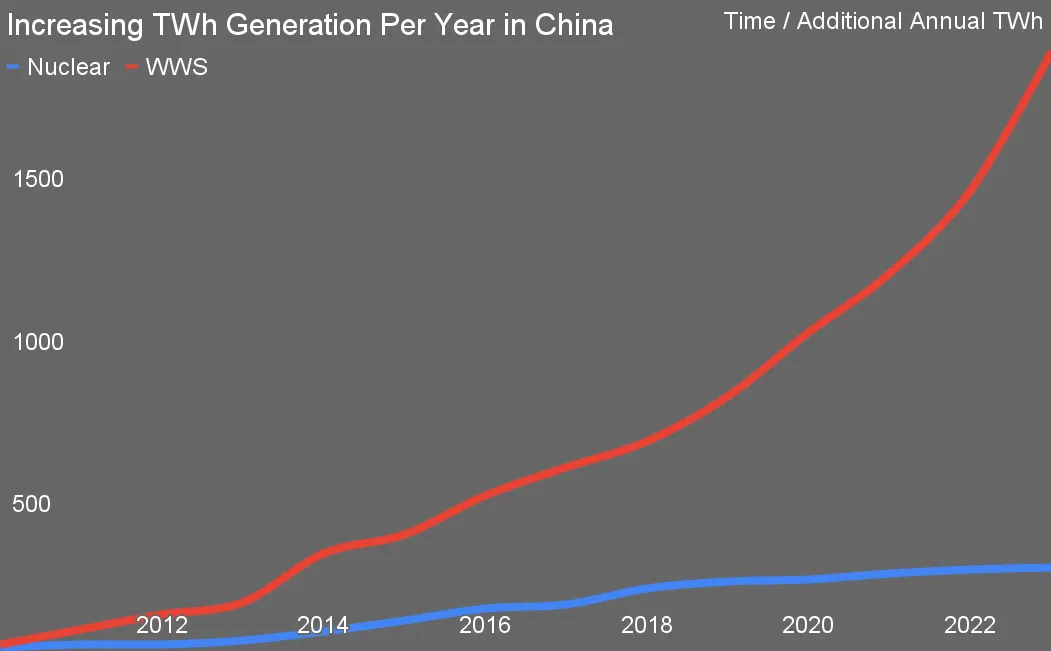
Please note that the chart is generation, not generating capacity. [Edit - Sorry, should have explained that WWS is short for wind, water (hydro) and solar.]
So it's fine to point to the positives of nuclear, and issues with RE, but the bigger picture is important. And even since 2012 when the HPC contract was announced / 2015 when it was issued, an elephant entered the room, and that's cheap storage. Something none of us really saw coming, and the learning curve for battery storage (both cost and energy density (mass and volume)) is mindblowing, averaging at ~20% for every doubling in production.
All that said, personally I can see a role for nuclear providing a small part of the UK's generation, and that solves some of the issues it brings. But sadly not the cost, which if spent on RE (and storage), would deliver far more generation, far sooner, but we can't always get what we want.
Mart. Cardiff. 8.72 kWp PV systems (2.12 SSW 4.6 ESE & 2.0 WNW). 28kWh battery storage. Two A2A units for cleaner heating. Two BEV's for cleaner driving.
For general PV advice please see the PV FAQ thread on the Green & Ethical Board.5










Confirm your email address to Create Threads and Reply

Categories
- All Categories
- 355.7K Banking & Borrowing
- 254.9K Reduce Debt & Boost Income
- 456.1K Spending & Discounts
- 248.3K Work, Benefits & Business
- 605.9K Mortgages, Homes & Bills
- 179K Life & Family
- 263.7K Travel & Transport
- 1.5M Hobbies & Leisure
- 16.2K Discuss & Feedback
- 37.7K Read-Only Boards