We’d like to remind Forumites to please avoid political debate on the Forum.
This is to keep it a safe and useful space for MoneySaving discussions. Threads that are – or become – political in nature may be removed in line with the Forum’s rules. Thank you for your understanding.
POPLA Appeal - ParkingEye PCN 11 minutes "overstay"
Comments
-
zhonguonuren said:This is so disgusting it makes me 😡
I went to the car park for another poster and know exactly what you are saying is true. I cannot imagine any judge will upheld this scam. Follow the regulars advice to get this PCN cancelled and then come back and we can talk about a letter before claim for beach of GDPR.Meanwhile definitely request a copy of the landowner agreement (I doubt you’ll get it but keep asking!). It is useful to you to see if it is compliant plus I am very interested in this piece of land and how it was transferred.Hope it hasn’t put you off visiting Cornwall. All the best ZhongThank you for your support and taking the pictures, those are really useful. I'll definitely get n touch to talk about a claim for breach of GDPR.And my holidays in Cornwall were otherwise really pleasant, will definitely be back!...although I'll be a bit more careful where I park 2
2 -
Unfortunately not, but thank you for the suggestion.Coupon-mad said:Do you have Google Location for that day on your phone? It might surprise you and show you actually arrived minutes later.
1 -
Sorry it took a while, but here's the redrafted appeal to POPLA. Would you mind reviewing and letting me know if I should amend anything please?-----------------------------------I contend that I am not liable for the alleged parking charge and wish to appeal against it on the following grounds:
1. No Consideration/Grace periods - The Operator is not compliant with the BPA Code of Practice
2. No evidence of Landowner Authority - The Operator is put to strict proof of full compliance with the BPA Code of Practice
3. The signs in this car park are not prominent, clear or legible from all parking spaces and there is insufficient notice of the sum of the parking charge itself
4. No evidence of period parked – The Operator is not compliant with the BPA Code of Practice
1. No Consideration/Grace Periods - The Operator is not compliant with the BPA Code of Practice
This matter appears to flow from an allegation of 'overstay' of a mere eleven minutes, despite the fact this is not an overstay at all and is unsupported by the new PAS232 BSI draft about Consideration periods and BPA Code of Practice about Grace periods.
The paid for parking session on the PCN is not established by the photographs provided. Photographs taken show merely the time of entry (12:28) into and exit (16:39) from the car park, but do not establish the time at which the parking ticket was purchased or at which it expired. I purchased parking at 12:37, for a period of 4 hours until 16:37 on that day, as proven by the below pay-by-phone receipt.
With regards to the Consideration period of 9 minutes prior to purchasing parking (between 12:28 and 12:37), the BPA Code of Practice (link) states:
“(13.1) The driver must have the chance to consider the Terms and Conditions before entering into the ‘parking contract’ with you. If, having had that opportunity, the driver decides not to park but chooses to leave the car park, you must provide them with a reasonable consideration period to leave, before the driver can be bound by your parking contract. The amount of time in these instances will vary dependant on site size and type but it must be a minimum of 5 minutes.”
However, the “minimum of 5 minutes” in this article (13.1) and the following article (13.2) are both ambiguous and unfair under the Consumer Rights Act 2015, and therefore unlawful. On the matter of Consideration periods, the BPA Code of Practice is in contradiction to the PAS232 BSI Government Draft that clearly defines the new statutory Code of Practice. The PAS232 BSI Draft (link) states:
“(6) Duration of parking event
COMMENTARY ON CLAUSE 6
As a matter of contract law, drivers need to be given an appropriate opportunity to understand and decide whether to accept the terms and conditions that apply should they choose to park a vehicle on controlled land. In pay-anddisplay premises, drivers need to have time to make the requisite payment before a parking event commences for the purpose of calculating the time a vehicle is parked in relation to the tariff payable. The amount of time needed varies according to the nature and size of the premises, and in car parks open to the public includes the time needed to find and access a vacant parking bay, or to leave the premises should the driver decide not to park, hence the need for a consideration period before the contract between the driver and the parking operator is made and the parking event occurs. It is also a requirement to allow a grace period at the end of the parking event where parking is permitted.”
“(6.2) Consideration period
It is for the parking operator to determine the duration of the consideration period, subject to the requirements set out at Annex A, taking the following factors into account:
a) the time required for a driver to identify and access a parking bay appropriate to their needs;
NOTE 1 For example, a driver seeking a Blue Badge parking bay or a parent and child parking bay, waiting for another vehicle to vacate a bay, returning to the vehicle to check the VRM, queuing at a payment machine, etc.
b) the time required for a driver to identify and read signs that display the parking terms and conditions, or the consequences of choosing to park where public parking is not invited;
c) the time required for a driver to identify and comply with requirements for payment;
NOTE 2 This is particularly important for controlled land where the requirement is to pay and display a permit using on-site machinery, make an exact payment in cash using specific coins, or pay-by-phone or on-line through a process that could take several minutes.
d) the time required for a driver to leave the controlled land if they decide not to accept the terms and conditions;
e) the impact of the layout of the controlled land on 6.2a) to 6.2d);
f) the impact of the number of vehicles accessing the car park on a) to d); and
g) the impact of the volume of traffic within the controlled land on a) to d).”
“Annex A (normative)
Consideration periods
COMMENTARY ON ANNEX A The purpose of this Annex is to distinguish between and set best practice and mandatory minima for the consideration periods that apply to the different circumstances where a parking charge may otherwise arise.
A.1 The minimum consideration periods and grace periods listed in Tables A.1 through A.5 shall apply.
A.2 Parking operators shall obtain the consent of the accredited parking association to which they belong to the consideration periods they intend to apply to individual sites before issuing a parking charge based upon them.
Table A.1
Type of Land - Open to the public: Tariff for parking – no barrier, pay on arrival
Minimum Consideration Period (mins): 10
Parking Event: Yes
Grace Period (mins): 10
Entrance Sign to display: Tariffs apply”
Upon entering the car park (at 12:28 according to the PCN’s photographs), I went through the following steps:
1. Look for signage at the entrance of the car park to make sure it was open to the public; as well as to understand the parking terms, conditions and tariffs before deciding if I wanted to park. There wasn’t sufficient signage at the entrance of the car park.
2. Drive up to a parking attendant inside the car park to ask for information
3. Confirm with the parking attendant that car park was indeed open to the public
4. Discuss the parking terms, conditions and tariffs with the parking attendant. The parking attendant indicated that I could pay by the hour, which in itself was disingenuous, as the minimum payment was 2 hours.
5. Look for a specific parent and child parking bay
6. As there were no specific parent and child parking bay, look for a vacant parking bay that would allow sufficient space for my partner and child to get out of the car; as well as for unloading from the boot and unfolding the pushchair.
7. Reverse park in the selected parking bay
8. Stop the vehicle
9. Check on my child in the backseat and unbuckle their seatbelt
10. Locate the pay-and-display machine
11. Get out of the vehicle and walk to the pay-and-display machine
12. Attempting the inadequate signage by the pay-and-display machine to understand the parking terms, conditions and tariffs
13. Walk back to the vehicle to find some coins to use in the pay-and-display machine
14. Look for coins in the vehicle’s storage spaces, pockets and luggage and eventually realise that I did not have sufficient change
15. Walk back to the pay-and-display machine to figure out alternative modes of payment
16. Read the pay-by-phone credit card payment instructions
17. Collect my mobile phone
18. Turn on the mobile phone and wait for signal
19. Download the paybyphone (link) mobile application
20. Install the application
21. Complete my personal details form on the application
22. Collect my credit card
23. Enter my credit card details on the application
24. Find the parking location reference on the car park signage
25. Enter the parking location reference in the application
26. Decide and enter the parking duration on the application, realising that I could not pay by the hour, despite what the parking attendant had indicated
27. Submit online payment for parking on the application
All those steps resulted in my being able to eventually pay for parking at exactly 12:37 (see the above pay-by-phone receipt), 9 minutes after my vehicle entered the car park (according to the PCN’s photographs). So, within the 10 minutes Consideration period set out by the PAS232 BSI and that the Operator should apply.
With regards to the Grace period of 2 minutes between the end of purchase parking period (16:37, per the above receipt) and the vehicle exiting the car park (at 16:39 according to the PCN’s photographs), the BPA Code of Practice (link) states:
“(13.3) Where a parking location is one where a limited period of parking is permitted, or where drivers contract to park for a defined period and pay for that service in advance (Pay & Display), this would be considered as a parking event and a Grace Period of at least 10 minutes must be added to the end of a parking event before you issue a PCN.”
The PAS232 BSI also states:
“(6.3) Grace period A grace period of no less than 10 minutes shall be allowed by the parking operator in addition to the duration of a parking event. This means that, before a parking charge can be issued by a parking operator, 10 minutes shall be added to the length of a time-limited period of permitted free parking or to the period for which pre-payment has been made where a tariff applies.”
So again, these 2 minutes were well within the 10 minutes Grace period that the Operator should apply.
In their appeal rejection letter, ParkingEye state that their “records show insufficient time was paid for on the date of the parking event.”
It is very clear from the evidence that ParkingEye have failed to uphold the Consideration and Grace periods set out by the PAS232 BSIand the BPA Code of Practice, as the total time in the car park exceeded the paid period by only 11 minutes, a sum of 9 minutes prior to purchasing parking online, and 2 minutes after the parking period had ended.By any stretch of the imagination, these few minutes are well within what an ordinary independent person assessing the facts would consider reasonable. In fact, this case demonstrates significant unreasonableness on the part of this notorious parking Operator who appear to be attempting to get more and more 10/11 minute false 'overstay' allegations past POPLA, ignoring their Trade Body rules from the BPA.
2. No Evidence of Landowner Authority - the Operator is put to strict proof of full compliance with the BPA Code of Practice
As this operator does not have proprietary interest in the land, then I require that they produce an unredacted copy of the contract with the landowner. The contract and any 'site agreement' or 'User Manual' setting out details including exemptions - such as any 'genuine customer' or 'genuine resident' exemptions or any site occupier's 'right of veto' charge cancellation rights - is key evidence to define what this operator is authorised to do and any circumstances where the landowner/firms on site in fact have a right to cancellation of a charge. It cannot be assumed, just because an agent is contracted to merely put some signs up and issue Parking Charge Notices, that the agent is also authorised to make contracts with all or any category of visiting drivers and/or to enforce the charge in court in their own name (legal action regarding land use disputes generally being a matter for a landowner only).
Witness statements are not sound evidence of the above, often being pre-signed, generic documents not even identifying the case in hand or even the site rules. A witness statement might in some cases be accepted by POPLA but in this case I suggest it is unlikely to sufficiently evidence the definition of the services provided by each party to the agreement.
Nor would it define vital information such as charging days/times, any exemption clauses, consideration and grace periods (which I believe may be longer than the bare minimum times set out in the BPA Code of Practice) and basic information such as the land boundary and bays where enforcement applies/does not apply. Not forgetting evidence of the various restrictions which the landowner has authorised can give rise to a charge and of course, how much the landowner authorises this agent to charge (which cannot be assumed to be the sum in small print on a sign because template private parking terms and sums have been known not to match the actual landowner agreement).
Paragraph 7 of the BPA Code of Practice defines the mandatory requirements and I put this operator to strict proof of full compliance:“(7.2) If the operator wishes to take legal action on any outstanding parking charges, they must ensure that they have the written authority of the landowner (or their appointed agent) prior to legal action being taken.”
“(7.3) The written authorisation must also set out:
a) the definition of the land on which you may operate, so that the boundaries of the land can be clearly defined
b) any conditions or restrictions on parking control and enforcement operations, including any restrictions on hours of operation
c) any conditions or restrictions on the types of vehicles that may, or may not, be subject to parking control and enforcement
d) who has the responsibility for putting up and maintaining signs
e) the definition of the services provided by each party to the agreement”
0 -
Continued...
3. The signs in this car park are not prominent, clear or legible from all parking spaces and there is insufficient notice of the sum of the parking charge itself
I note that within the Protection of Freedoms Act (POFA) 2012 it discusses the clarity that needs to be provided to make a motorist aware of the parking charge. Specifically, it requires that the driver is given 'adequate notice' of the charge. POFA 2012 defines 'adequate notice' as follows:
''(3) For the purposes of sub-paragraph (2) 'adequate notice' means notice given by: (a) the display of one or more notices in accordance with any applicable requirements prescribed in regulations under paragraph 12 for, or for purposes including, the purposes of sub-paragraph (2); or (b) where no such requirements apply, the display of one or more notices which: (i) specify the sum as the charge for unauthorised parking; and (ii) are adequate to bring the charge to the notice of drivers who park vehicles on the relevant land''.
Even in circumstances where POFA 2012 does not apply, I believe this to be a reasonable standard to use when making my own assessment, as appellant, of the signage in place at the location. Having considered the signage in place at this particular site against the requirements of Section 19 of the BPA Code of Practice and POFA 2012, I am of the view that the signage at the site - given the minuscule font size, which is illegible in most photographs (see Exhibit A and C) and does not appear at all at the entrance (see Exhibit - is NOT sufficient to bring the parking charge (i.e. the sum
itself) to the attention of the motorist.
- is NOT sufficient to bring the parking charge (i.e. the sum
itself) to the attention of the motorist.
There was no contract nor agreement on the 'parking charge' at all. It is submitted that I did not have a fair opportunity to read about any terms involving this huge charge, which is out of all proportion and not saved by the dissimilar 'ParkingEye Ltd v Beavis' case.
In the Beavis case, which turned on specific facts relating only to the signs at that site and the unique interests and intentions of the landowners, the signs were unusually clear and not a typical example for this notorious industry. The Supreme Court were keen to point out the decision related to that car park and those facts only (see statement link).
In the Beavis case, the £85 charge itself was in the largest font size with a contrasting colour background and the terms were legible, fairly concise and unambiguous. There were 'large lettering' signs at the entrance and all around the car park, according to the Judges.
Here is the 'Beavis case' sign as a comparison to the signs under dispute in this case:
This case, by comparison, does not demonstrate an example of the 'large lettering' and 'prominent signage' that impressed the Supreme Court Judges and swayed them into deciding that in the specific car park in the Beavis case alone, a contract and 'agreement on the charge' existed.
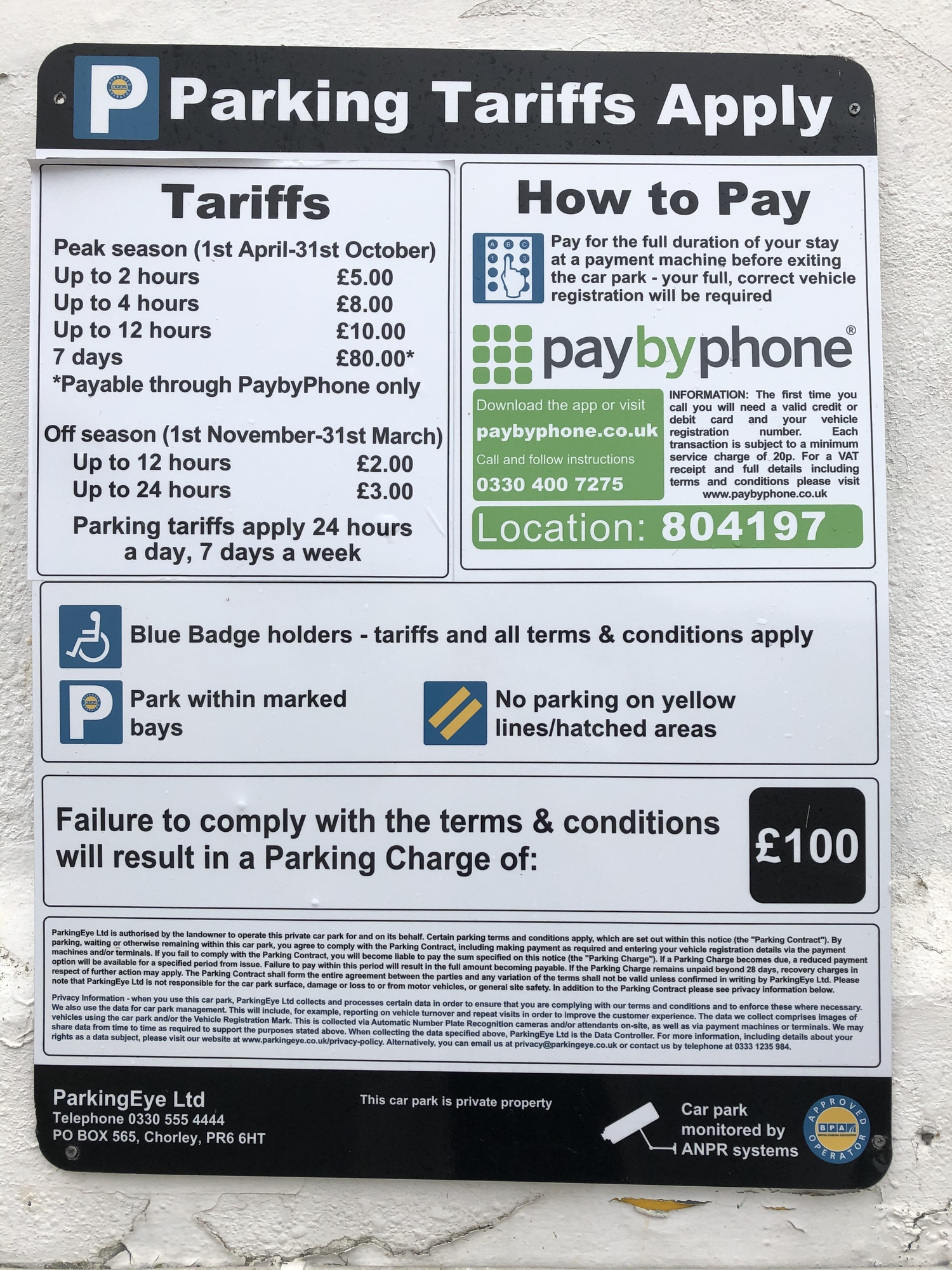
Here, the signs are sporadically placed, indeed obscured and hidden in some areas (see Exhibits A and B below). They are unremarkable, not immediately obvious as parking terms and the wording is mostly illegible, being crowded and cluttered with a lack of white space as a background (see Exhibits C and D below).. It is indisputable that placing letters too close together in order to fit more information into a smaller space can drastically reduce the legibility of a sign, especially one which must be read BEFORE the action of parking and leaving the car.
It is vital to observe, since 'adequate notice of the parking charge' is mandatory under the POFA Schedule 4 and the BPA Code of Practice, that areas of this site are unsigned and there are no full terms displayed - i.e. with the sum of the parking charge itself in large lettering - at the entrance either, so it cannot be assumed that a driver drove past and could read a legible sign, nor parked near one.
This case is more similar to the signage in POPLA decision 5960956830 on 2.6.16, where the Assessor Rochelle Merritt found as fact that signs in a similar size font in a busy car park where other unrelated signs were far larger, was inadequate:
''the signage is not of a good enough size to afford motorists the chance to read and understand the terms and conditions before deciding to remain in the car park. [...] In addition the operators signs would not be clearly visible from a parking space [...] The appellant has raised other grounds for appeal but I have not dealt with these as I have allowed the appeal.''
From the evidence I have seen so far, the terms appear to be displayed inadequately, in letters no more than about half an inch high, approximately (see Exhibit D below) . I put the operator to strict proof as to the size of the wording on their signs and the size of lettering for the most onerous term, the parking charge itself.
The letters seem to be no larger than .40 font size going by this guide (link)
As further evidence that this is inadequate notice, Letter Height Visibility is discussed here (link):
''When designing your sign, consider how you will be using it, as well as how far away the readers you want to impact will be. For example, if you are placing a sales advertisement inside your retail store, your text only needs to be visible to the people in the store. 1-2' letters (or smaller) would work just fine. However, if you are hanging banners and want drivers on a nearby highway to be able to see them, design your letters at 3' or even larger.''
So, a letter height of just half an inch, showing the terms and the 'charge' and placed out of sight from the parking space and buried in far too crowded small print, is woefully inadequate in an outdoor car park.
Under Lord Denning's Red Hand Rule, the charge (being 'out of all proportion' with expectations of drivers in this car park and which is the most onerous of terms) should have been effectively: 'in red letters with a red hand pointing to it' - i.e. VERY clear and prominent with the terms in large lettering, as was found to be the case in the car park in 'Beavis'. A reasonable interpretation of the 'red hand rule' and the 'signage visibility distance' tables above and the BPA Code of Practice, taking all information into account, would require a parking charge and the terms to be displayed far more transparently, on a more prominent sign and in far larger lettering, with fewer words and more 'white space' as background contrast. Indeed in the Consumer Rights Act 2015 there is a 'Requirement for transparency':
“(1) A trader must ensure that a written term of a consumer contract, or a consumer notice in writing, is transparent.”
“(2) A consumer notice is transparent for the purposes of subsection (1) if it is expressed in plain and intelligible language and it is legible.”
The Beavis case signs not being similar to the signs in this appeal at all, I submit that the persuasive case law is in fact 'Vine v London Borough of Waltham Forest [2000] EWCA Civ 106' about a driver not seeing the terms and consequently, she was NOT deemed bound by them.
This judgment is binding case law from the Court of Appeal and supports my argument, not the Operator's case (see Decision here).
This was a victory for the motorist and found that, where terms on a sign are not seen and the area is not clearly marked/signed with prominent terms, the driver has not consented to - and cannot have 'breached' - an unknown contract because there is no contract capable of being established. The driver in that case (who had not seen any signs/lines) had NOT entered into a contract. The recorder made a clear finding of fact that the plaintiff, Miss Vine, did not see a sign because the area was not clearly marked as 'private land' and the signs were obscured/not adjacent to the car and could not have been seen and read from a driver's seat before parking.
So, for this appeal, I put this operator to strict proof of where the car was parked and (from photos taken in the same lighting conditions) how their signs appeared on that date, at that time, from the angle of the driver's perspective. Equally, I require this operator to show how the entrance signs appear from a driver's seat, not stock examples of 'the sign' in isolation/close-up. I submit that full terms simply cannot be read from a car before parking and mere 'stock examples' of close-ups of the (alleged) signage terms will not be sufficient to disprove this. Exhibit A: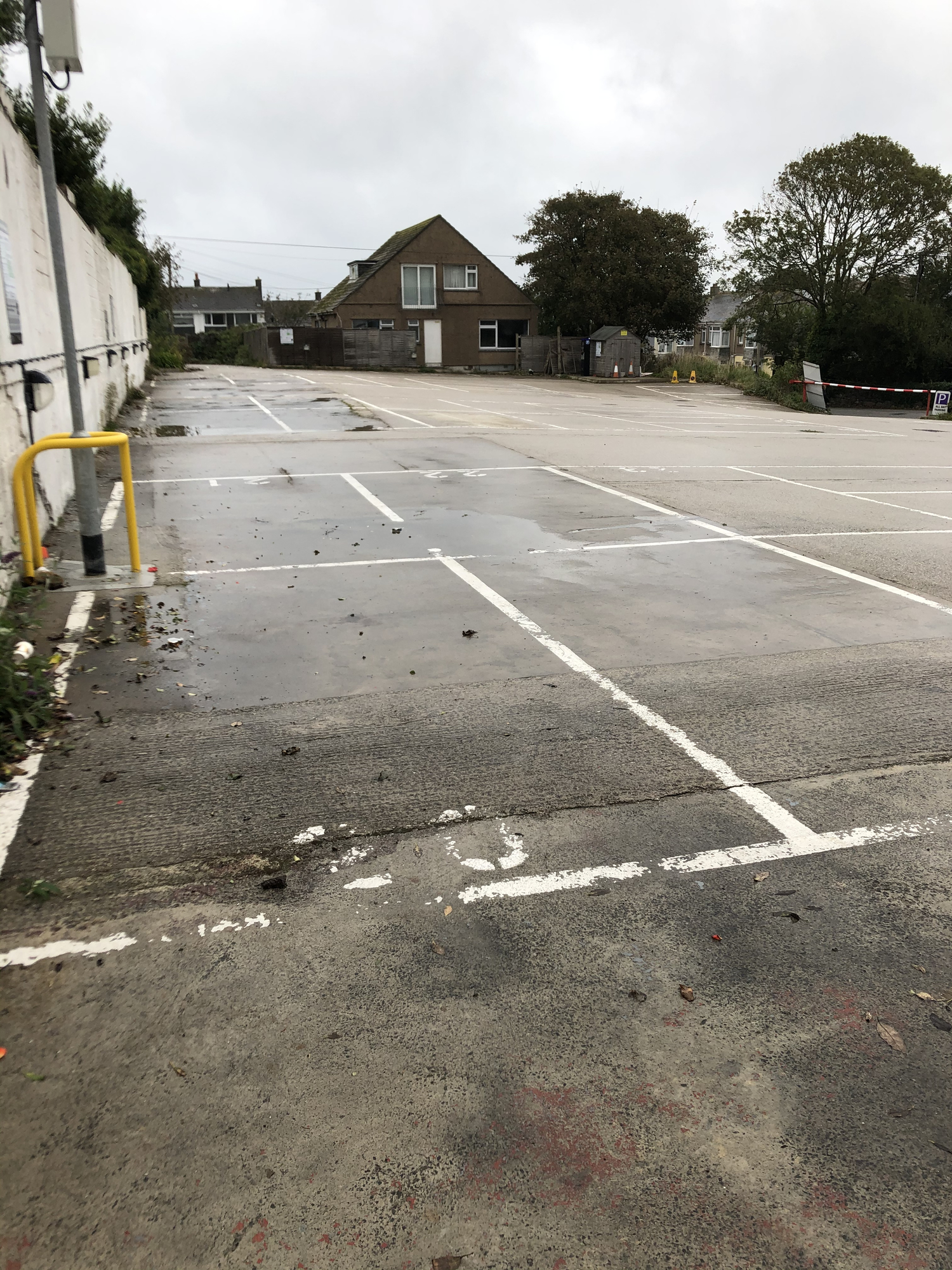 Exhibit B: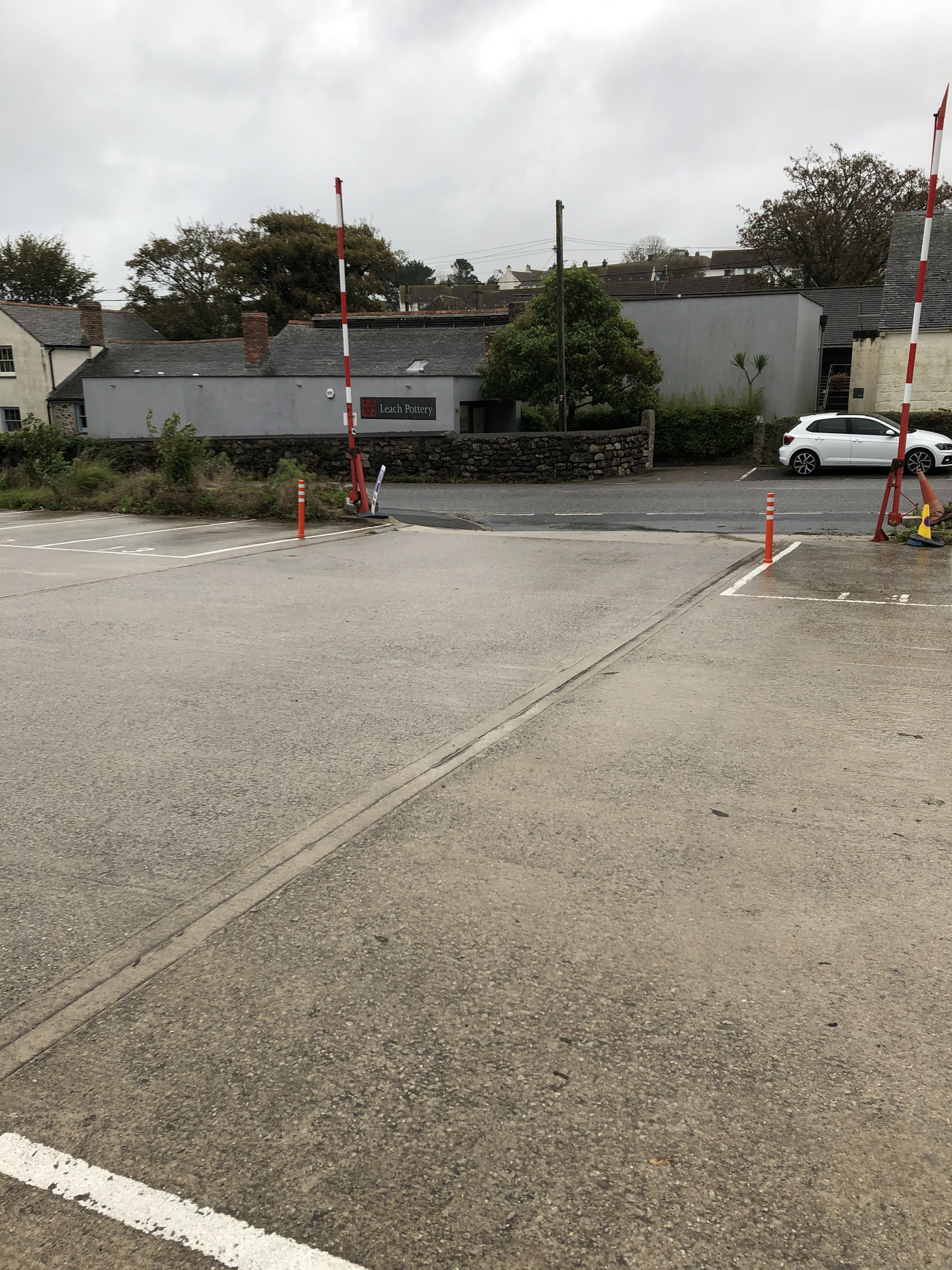
Exhibit C:
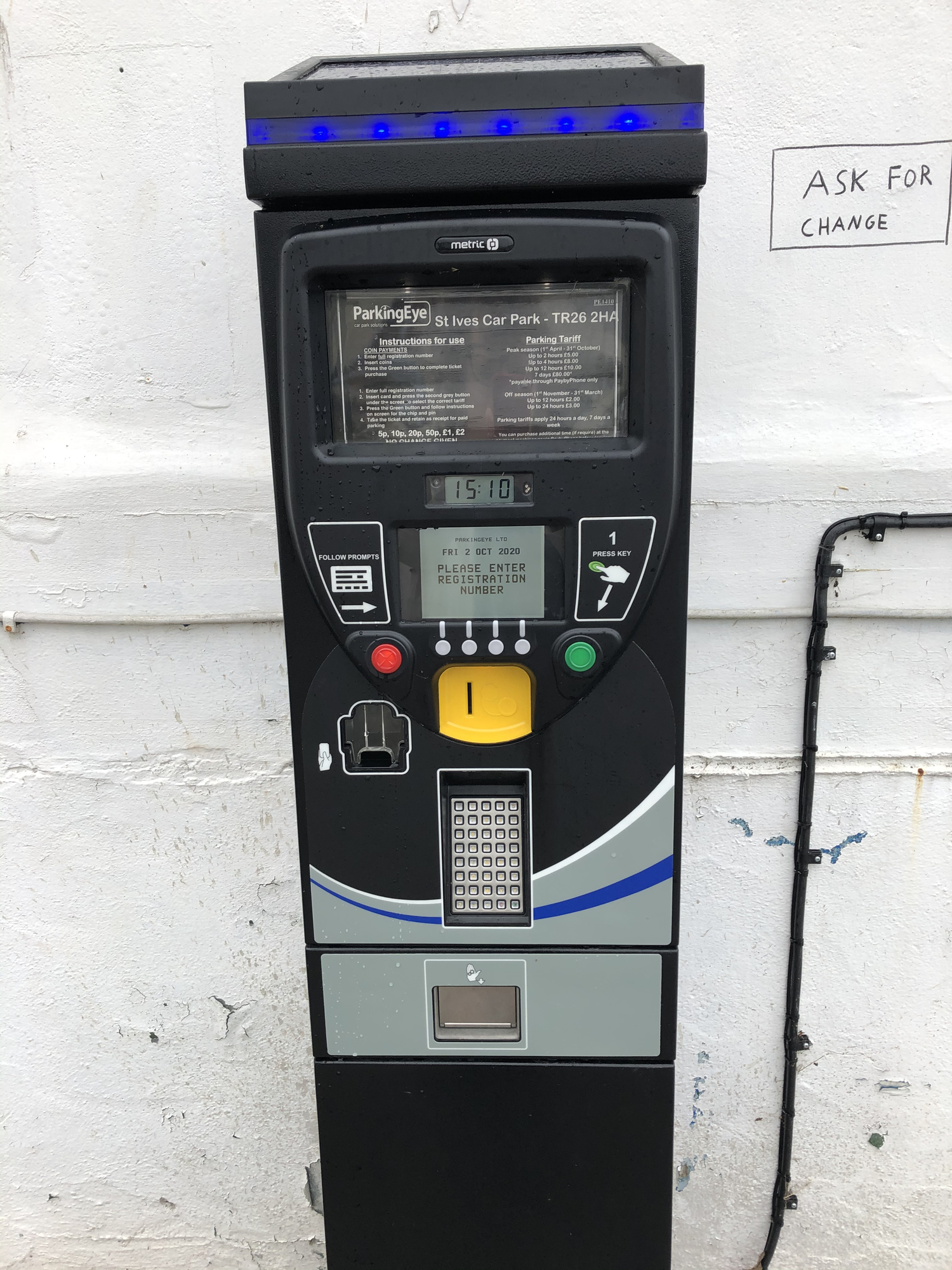
Exhibit D
4. No Evidence of Period Parked – The Operator is not compliant with the BPA Code of Practice
Contrary to the mandatory provisions of the BPA Code of Practice, there is no record to show that the vehicle was parked versus entering and exiting the car park.
Paragraph (29.4) of the BPA Code of Practice states :
“The notice must:
specify the vehicle, the land on which it was parked and the period of parking to which the notice relates”
The ParkingEye Ltd parking charge notice simply claims:
“Time in Car Park: 4 hours 11 minutes
Arrival Time: 23/09/2020 12:28:17
Departure Time: 23/09/2020 16:39:53”
The parking charge notice separately states that the vehicle:
“Entered the St Ives, TR26 2HA car park at 12:28:17 and departed at 16:39:53 on 23 September 2020”
At no stage do ParkingEye Ltd explicitly specify the “period of parking to which the notice relates”, as required by the BPA Code of Practice. I require ParkingEye Ltd to provide evidence to show the vehicle in question was parked on the date/time (for the duration claimed) and at the location stated in the Parking Charge Notice.
For the above reasons, it is respectfully requested that this parking charge request appeal be upheld on every point.
Yours faithfully
0 -
Those T&C in tiny print are horrendous, read this,
https://forums.moneysavingexpert.com/discussion/5972164/parking-eye-signs-oxford-road-reading
You never know how far you can go until you go too far.1 -
Don't include exhibit D. Why show a close up of a sign that POPLA will look and and throw your appeal in the bin?PRIVATE 'PCN'? DON'T PAY BUT DON'T IGNORE IT (except N.Ireland).
CLICK at the top or bottom of any page where it says:
Home»Motoring»Parking Tickets Fines & Parking - read the NEWBIES THREAD3 -
Thank you, this will be helpful if my POPLA appeal is unsuccesful.D_P_Dance said:Those T&C in tiny print are horrendous, read this,
https://forums.moneysavingexpert.com/discussion/5972164/parking-eye-signs-oxford-road-reading
1 -
Coupon-mad said:Don't include exhibit D. Why show a close up of a sign that POPLA will look and and throw your appeal in the bin?Yes, I was wondering about that picture. But if I take that picture out, can I really argue the paragraphs below without providing said evidence? Might Parking Eye not counter by saying that the sign (or at least the Parking Charge - per the Beavis case point) was indeed prominent and provide evidence that it is, perhaps even arguing that I was being disingenuous eluding to provide evidence of the signage itself?
There was no contract nor agreement on the 'parking charge' at all. It is submitted that I did not have a fair opportunity to read about any terms involving this huge charge, which is out of all proportion and not saved by the dissimilar 'ParkingEye Ltd v Beavis' case.
In the Beavis case, which turned on specific facts relating only to the signs at that site and the unique interests and intentions of the landowners, the signs were unusually clear and not a typical example for this notorious industry. The Supreme Court were keen to point out the decision related to that car park and those facts only (see statement link).In the Beavis case, the £85 charge itself was in the largest font size with a contrasting colour background and the terms were legible, fairly concise and unambiguous. There were 'large lettering' signs at the entrance and all around the car park, according to the Judges.
Here is the 'Beavis case' sign as a comparison to the signs under dispute in this case: image
This case, by comparison, does not demonstrate an example of the 'large lettering' and 'prominent signage' that impressed the Supreme Court Judges and swayed them into deciding that in the specific car park in the Beavis case alone, a contract and 'agreement on the charge' existed.
Here, the signs are sporadically placed, indeed obscured and hidden in some areas (see Exhibits A and B below). They are unremarkable, not immediately obvious as parking terms and the wording is mostly illegible, being crowded and cluttered with a lack of white space as a background (see Exhibits C and D below).. It is indisputable that placing letters too close together in order to fit more information into a smaller space can drastically reduce the legibility of a sign, especially one which must be read BEFORE the action of parking and leaving the car.
It is vital to observe, since 'adequate notice of the parking charge' is mandatory under the POFA Schedule 4 and the BPA Code of Practice, that areas of this site are unsigned and there are no full terms displayed - i.e. with the sum of the parking charge itself in large lettering - at the entrance either, so it cannot be assumed that a driver drove past and could read a legible sign, nor parked near one.
This case is more similar to the signage in POPLA decision 5960956830 on 2.6.16, where the Assessor Rochelle Merritt found as fact that signs in a similar size font in a busy car park where other unrelated signs were far larger, was inadequate:
''the signage is not of a good enough size to afford motorists the chance to read and understand the terms and conditions before deciding to remain in the car park. [...] In addition the operators signs would not be clearly visible from a parking space [...] The appellant has raised other grounds for appeal but I have not dealt with these as I have allowed the appeal.''
From the evidence I have seen so far, the terms appear to be displayed inadequately, in letters no more than about half an inch high, approximately (see Exhibit D below) . I put the operator to strict proof as to the size of the wording on their signs and the size of lettering for the most onerous term, the parking charge itself.
The letters seem to be no larger than .40 font size going by this guide (link)
As further evidence that this is inadequate notice, Letter Height Visibility is discussed here (link):''When designing your sign, consider how you will be using it, as well as how far away the readers you want to impact will be. For example, if you are placing a sales advertisement inside your retail store, your text only needs to be visible to the people in the store. 1-2' letters (or smaller) would work just fine. However, if you are hanging banners and want drivers on a nearby highway to be able to see them, design your letters at 3' or even larger.''
So, a letter height of just half an inch, showing the terms and the 'charge' and placed out of sight from the parking space and buried in far too crowded small print, is woefully inadequate in an outdoor car park.
Under Lord Denning's Red Hand Rule, the charge (being 'out of all proportion' with expectations of drivers in this car park and which is the most onerous of terms) should have been effectively: 'in red letters with a red hand pointing to it' - i.e. VERY clear and prominent with the terms in large lettering, as was found to be the case in the car park in 'Beavis'. A reasonable interpretation of the 'red hand rule' and the 'signage visibility distance' tables above and the BPA Code of Practice, taking all information into account, would require a parking charge and the terms to be displayed far more transparently, on a more prominent sign and in far larger lettering, with fewer words and more 'white space' as background contrast. Indeed in the Consumer Rights Act 2015 there is a 'Requirement for transparency':“(1) A trader must ensure that a written term of a consumer contract, or a consumer notice in writing, is transparent.”
“(2) A consumer notice is transparent for the purposes of subsection (1) if it is expressed in plain and intelligible language and it is legible.”
0 -
Where that sign is situated, how prominently displayed it is, how high off the ground it is etc. is anybody's guess.
That photo was taken so close to the sign, in good light conditions. It is not disingenuous of you to refuse to show the signage in such a misleading way. Parking Eye will probably show such photos in their evidence, if it comes to that. But it doesn't matter, your job is to anticipate that and counter such 'evidence' in advance.4 -
You can certainly use your words because your general photos of the car park do not show lots of conspicuous signs!PRIVATE 'PCN'? DON'T PAY BUT DON'T IGNORE IT (except N.Ireland).
CLICK at the top or bottom of any page where it says:
Home»Motoring»Parking Tickets Fines & Parking - read the NEWBIES THREAD3








Confirm your email address to Create Threads and Reply

Categories
- All Categories
- 354.6K Banking & Borrowing
- 254.4K Reduce Debt & Boost Income
- 455.5K Spending & Discounts
- 247.5K Work, Benefits & Business
- 604.3K Mortgages, Homes & Bills
- 178.5K Life & Family
- 261.8K Travel & Transport
- 1.5M Hobbies & Leisure
- 16.1K Discuss & Feedback
- 37.7K Read-Only Boards