We’d like to remind Forumites to please avoid political debate on the Forum.
This is to keep it a safe and useful space for MoneySaving discussions. Threads that are – or become – political in nature may be removed in line with the Forum’s rules. Thank you for your understanding.
Regular Savings Accounts: The Best Currently Available List!
Comments
-
Point taken, perhaps I am being guilty of wishful thinking here. I shall be passing a branch later today anyway so I'll see what they have to say regarding standing orders.TheBanker said:
I think it's a bit ambiguous because the KFD says:Bridlington1 said:
Like @ForumUser7 I just did a transfer of £200 from my Santander account. From what I can see there is no term saying you have to fund the account by standing order, all it says is that you can make payments by standing order.Deposits
There is no minimum monthly deposit. You can save up to a maximum of £200 each month for 12 months by standing order from your Santander current account. Maximum balance you can have in the account at the end of the 12 months is £2,400.
You can make any number of payments via standing order and you don’t have to make a deposit every month. The amount can vary each month, provided the monthly limit isn’t exceeded.
Your month is calculated by the date that you open your Regular eSaver, e.g. you open the Regular eSaver on the 16th of a month, your month will run from 16th of one month to the 15th of the next month.
To make the most of your regular eSaver, you’ll need to set up your standing order to start within the first calendar month after opening. Standing orders are only processed Monday to Friday. If your standing order falls on a weekend or bank holiday your payment will be made on the next working day, if this is the last day of the month your payment won’t reach us until the following month.
If you don’t fund the account from your Santander current account, if you deposit more than £200 in any month or if you hold more than one Regular eSaver account, Santander reserves the right to revert your account into an Everyday Saver.The bold text is their emphasis, not mine.
So it seems to be saying you have to use a Standing Order, but the final paragraph implies you don't (only that the funds have to come from a Santander current account). The second paragraph confuses things further by saying you don't have to make a deposit each month and you can vary the amount - whilst it is possible to amend a Standing Order each month, this isn't how Standing Orders are normally used.
A further complication comes from the point about weekend processing. If you have a Standing Order which happens to fall on a non-working day, you could accidentally fall foul of the £200 monthly limit by depositing £400 in one month (a rolled over standing order from the end of the previous month, plus the current month's standing order) - are they expecting customers to monitor their standing order date closely enough to avoid this happening?
In practice I think you'll be fine but it's not 100% clear cut.
0 -
Seems you posted while i was editing my previous post.TheBanker said:
It's similar wording to the KFD I quoted above. As I said, I think it's ambiguous. The last but one point says you have to fund the account with a standing order, but the 'punishment' for breaking the rules doesn't refer to standing orders, only that the money has to come from a Santander current account and not be more than £200 per month.OceanSound said:
Santander ought to warn customers about this roll over standing orders.TheBanker said:
I think it's a bit ambiguous because the KFD says:Bridlington1 said:
Like @ForumUser7 I just did a transfer of £200 from my Santander account. From what I can see there is no term saying you have to fund the account by standing order, all it says is that you can make payments by standing order.Deposits
There is no minimum monthly deposit. You can save up to a maximum of £200 each month for 12 months by standing order from your Santander current account. Maximum balance you can have in the account at the end of the 12 months is £2,400.
You can make any number of payments via standing order and you don’t have to make a deposit every month. The amount can vary each month, provided the monthly limit isn’t exceeded.
Your month is calculated by the date that you open your Regular eSaver, e.g. you open the Regular eSaver on the 16th of a month, your month will run from 16th of one month to the 15th of the next month.
To make the most of your regular eSaver, you’ll need to set up your standing order to start within the first calendar month after opening. Standing orders are only processed Monday to Friday. If your standing order falls on a weekend or bank holiday your payment will be made on the next working day, if this is the last day of the month your payment won’t reach us until the following month.
If you don’t fund the account from your Santander current account, if you deposit more than £200 in any month or if you hold more than one Regular eSaver account, Santander reserves the right to revert your account into an Everyday Saver.The bold text is their emphasis, not mine.
So it seems to be saying you have to use a Standing Order, but the final paragraph implies you don't (only that the funds have to come from a Santander current account). The second paragraph confuses things further by saying you don't have to make a deposit each month and you can vary the amount - whilst it is possible to amend a Standing Order each month, this isn't how Standing Orders are normally used.
A further complication comes from the point about weekend processing. If you have a Standing Order which happens to fall on a non-working day, you could accidentally fall foul of the £200 monthly limit by depositing £400 in one month (a rolled over standing order from the end of the previous month, plus the current month's standing order) - are they expecting customers to monitor their standing order date closely enough to avoid this happening?
In practice I think you'll be fine but it's not 100% clear cut.
Of course for those of us who are aware of the caveat, it's easily avoidable by starting the standing order (SO) at the beginning of the month right up to the middle of the month (or even around 20th of each month should be fine - as there is no risk of any SO rolling over to the next month).
BTW, Santander website says this:
https://www.santander.co.uk/personal/savings-and-investments/savings/regular-esaverHow it works* You’re a UK resident aged 16 or over* You don't already have a Regular eSaver* You have a Santander current account, excluding 1|2|3 Mini In Trust* Fund the account with a standing order from a Santander current account* If you don’t fund the account from your Santander current account or if you deposit more than £200 in any month, Santander reserve the right to change your account into an Everyday Saver
Notice the last part does not say 'If you don't fund the account from your Santander Current Account, by standing order, or if you deposit more than ......Santander reserve the right to change your account into an Everyday Saver'.
So, funding the RS by SO isn't a requirement.
As I said I think people would be fine in practice, but if Santander did decide to convert an account to an Everyday Saver because the deposits weren't made by Standing Order, I'm not convinced FOS would uphold a complaint. Look at the Co-op refer a friend thread in the Banking section. The Co-op's terms are ambiguous, but the FOS are siding with the bank.
FOS always shout from the roof top that they deal with cases on a case-by-case basis. FOS 'siding with the bank' as you put it may be indicative of underlying issues at FOS.
However, if they were to handle cases on a case-by-case basis (using fairness to decide - as this is how they decide on cases - it's not legal proof) the Co-op terms being ambiguous but the FOS siding with the bank is no indication that they would do so in Santander's case.
FOS would need to look at what it says on the website, on the terms and conditions, the KFD etc and then decide. We wouldn't be able to prejudge that because FOS behaved in such a manner with Co-op they would repeat that behaviour. This is of course assuming that FOS operate in shipshape manner.1 -
Santander ought to warn customers about this roll over standing orders.
Of course for those of us who are aware of the caveat, it's easily avoidable by starting the standing order (SO) at the beginning of the month right up to the middle of the month (or even around 20th of each month should be fine - as there is no risk of any SO rolling over to the next month)...
Don't forget that it's an account opening anniversary month, not a calendar month.
5 -
I am not trying to prejudge how FOS would decide a complaint. To get to that stage, (i) Santander would have actually tried to enforce the 'Standing Order' condition, and (ii) Santander's own complaints team would have to reject any complaint. Then FOS would have to consider all the facts and reach a decision. My reference to the Co-op was simply to highlight that FOS do not automatically side with the customer - I did not mean to imply they would reach the same decision in a complaint about Santander.OceanSound said:
Seems you posted while i was editing my previous post.TheBanker said:
It's similar wording to the KFD I quoted above. As I said, I think it's ambiguous. The last but one point says you have to fund the account with a standing order, but the 'punishment' for breaking the rules doesn't refer to standing orders, only that the money has to come from a Santander current account and not be more than £200 per month.OceanSound said:
Santander ought to warn customers about this roll over standing orders.TheBanker said:
I think it's a bit ambiguous because the KFD says:Bridlington1 said:
Like @ForumUser7 I just did a transfer of £200 from my Santander account. From what I can see there is no term saying you have to fund the account by standing order, all it says is that you can make payments by standing order.Deposits
There is no minimum monthly deposit. You can save up to a maximum of £200 each month for 12 months by standing order from your Santander current account. Maximum balance you can have in the account at the end of the 12 months is £2,400.
You can make any number of payments via standing order and you don’t have to make a deposit every month. The amount can vary each month, provided the monthly limit isn’t exceeded.
Your month is calculated by the date that you open your Regular eSaver, e.g. you open the Regular eSaver on the 16th of a month, your month will run from 16th of one month to the 15th of the next month.
To make the most of your regular eSaver, you’ll need to set up your standing order to start within the first calendar month after opening. Standing orders are only processed Monday to Friday. If your standing order falls on a weekend or bank holiday your payment will be made on the next working day, if this is the last day of the month your payment won’t reach us until the following month.
If you don’t fund the account from your Santander current account, if you deposit more than £200 in any month or if you hold more than one Regular eSaver account, Santander reserves the right to revert your account into an Everyday Saver.The bold text is their emphasis, not mine.
So it seems to be saying you have to use a Standing Order, but the final paragraph implies you don't (only that the funds have to come from a Santander current account). The second paragraph confuses things further by saying you don't have to make a deposit each month and you can vary the amount - whilst it is possible to amend a Standing Order each month, this isn't how Standing Orders are normally used.
A further complication comes from the point about weekend processing. If you have a Standing Order which happens to fall on a non-working day, you could accidentally fall foul of the £200 monthly limit by depositing £400 in one month (a rolled over standing order from the end of the previous month, plus the current month's standing order) - are they expecting customers to monitor their standing order date closely enough to avoid this happening?
In practice I think you'll be fine but it's not 100% clear cut.
Of course for those of us who are aware of the caveat, it's easily avoidable by starting the standing order (SO) at the beginning of the month right up to the middle of the month (or even around 20th of each month should be fine - as there is no risk of any SO rolling over to the next month).
BTW, Santander website says this:
https://www.santander.co.uk/personal/savings-and-investments/savings/regular-esaverHow it works* You’re a UK resident aged 16 or over* You don't already have a Regular eSaver* You have a Santander current account, excluding 1|2|3 Mini In Trust* Fund the account with a standing order from a Santander current account* If you don’t fund the account from your Santander current account or if you deposit more than £200 in any month, Santander reserve the right to change your account into an Everyday Saver
Notice the last part does not say 'If you don't fund the account from your Santander Current Account, by standing order, or if you deposit more than ......Santander reserve the right to change your account into an Everyday Saver'.
So, funding the RS by SO isn't a requirement.
As I said I think people would be fine in practice, but if Santander did decide to convert an account to an Everyday Saver because the deposits weren't made by Standing Order, I'm not convinced FOS would uphold a complaint. Look at the Co-op refer a friend thread in the Banking section. The Co-op's terms are ambiguous, but the FOS are siding with the bank.
FOS always shout from the roof top that they deal with cases on a case-by-case basis. FOS 'siding with the bank' as you put it may be indicative of underlying issues at FOS.
However, if they were to handle cases on a case-by-case basis (using fairness to decide - as this is how they decide on cases - it's not legal proof) the Co-op terms being ambiguous but the FOS siding with the bank is no indication that they would do so in Santander's case.
FOS would need to look at what it says on the website, on the terms and conditions, the KFD etc and then decide. We wouldn't be able to prejudge that because FOS behaved in such a manner with Co-op they would repeat that behaviour. This is of course assuming that FOS operate in shipshape manner.
Personally I would take the easy option and set up a Standing Order, then there's no ambiguity. NB - you could set up the standing order as an annual one, I think, then change the details each month. So it works like a manual payment but they'd see it as a Standing Order.1 -
Oops! I've just funded the new account by transfer and then set up the SO. So far, the initial payment hasn't bounced back, perhaps time will tell.1
-
What date have you selected for the standing order to pay the first payment?Gers said:Oops! I've just funded the new account by transfer and then set up the SO. So far, the initial payment hasn't bounced back, perhaps time will tell.0 -
Good luck with that. Chances are that you may come across a jobsworth staff memeber that'll just say 'No' (these staff always tend to start any sentence with a 'No''), it HAS TO be funded by standing order OR he/she/they will say it dosen't have to be. Then if your account gets changed to an Everyday Saver account for not paying by SO, you'd have to convince Santander complaints that you did speak to Staff member John on such and such a date at in the morning/afternoon/evening. Then staff member john would need to corroborate this. As I say 'Good luck with that'.Bridlington1 said:
Point taken, perhaps I am being guilty of wishful thinking here. I shall be passing a branch later today anyway so I'll see what they have to say regarding standing orders.TheBanker said:
I think it's a bit ambiguous because the KFD says:Bridlington1 said:
Like @ForumUser7 I just did a transfer of £200 from my Santander account. From what I can see there is no term saying you have to fund the account by standing order, all it says is that you can make payments by standing order.Deposits
There is no minimum monthly deposit. You can save up to a maximum of £200 each month for 12 months by standing order from your Santander current account. Maximum balance you can have in the account at the end of the 12 months is £2,400.
You can make any number of payments via standing order and you don’t have to make a deposit every month. The amount can vary each month, provided the monthly limit isn’t exceeded.
Your month is calculated by the date that you open your Regular eSaver, e.g. you open the Regular eSaver on the 16th of a month, your month will run from 16th of one month to the 15th of the next month.
To make the most of your regular eSaver, you’ll need to set up your standing order to start within the first calendar month after opening. Standing orders are only processed Monday to Friday. If your standing order falls on a weekend or bank holiday your payment will be made on the next working day, if this is the last day of the month your payment won’t reach us until the following month.
If you don’t fund the account from your Santander current account, if you deposit more than £200 in any month or if you hold more than one Regular eSaver account, Santander reserves the right to revert your account into an Everyday Saver.The bold text is their emphasis, not mine.
So it seems to be saying you have to use a Standing Order, but the final paragraph implies you don't (only that the funds have to come from a Santander current account). The second paragraph confuses things further by saying you don't have to make a deposit each month and you can vary the amount - whilst it is possible to amend a Standing Order each month, this isn't how Standing Orders are normally used.
A further complication comes from the point about weekend processing. If you have a Standing Order which happens to fall on a non-working day, you could accidentally fall foul of the £200 monthly limit by depositing £400 in one month (a rolled over standing order from the end of the previous month, plus the current month's standing order) - are they expecting customers to monitor their standing order date closely enough to avoid this happening?
In practice I think you'll be fine but it's not 100% clear cut.
huh? terms say "To make the most of your regular eSaver, you’ll need to set up your standing order to start within the first calendar month after opening. ". If you open account today you should be able to select 24th of this month for SO. I believe 24th is not a date that will suffer from the cross-over month effect.10_66 said:Santander ought to warn customers about this roll over standing orders.
Of course for those of us who are aware of the caveat, it's easily avoidable by starting the standing order (SO) at the beginning of the month right up to the middle of the month (or even around 20th of each month should be fine - as there is no risk of any SO rolling over to the next month)...
Don't forget that it's an account opening anniversary month, not a calendar month.
What is the point of doing this? apart from change the amount. You don't want to bring the date forward, as it will fall foul of the only £200 in any month term/condition.TheBanker said:
I am not trying to prejudge how FOS would decide a complaint. To get to that stage, (i) Santander would have actually tried to enforce the 'Standing Order' condition, and (ii) Santander's own complaints team would have to reject any complaint. Then FOS would have to consider all the facts and reach a decision. My reference to the Co-op was simply to highlight that FOS do not automatically side with the customer - I did not mean to imply they would reach the same decision in a complaint about Santander.OceanSound said:
Seems you posted while i was editing my previous post.TheBanker said:
It's similar wording to the KFD I quoted above. As I said, I think it's ambiguous. The last but one point says you have to fund the account with a standing order, but the 'punishment' for breaking the rules doesn't refer to standing orders, only that the money has to come from a Santander current account and not be more than £200 per month.OceanSound said:
Santander ought to warn customers about this roll over standing orders.TheBanker said:
I think it's a bit ambiguous because the KFD says:Bridlington1 said:
Like @ForumUser7 I just did a transfer of £200 from my Santander account. From what I can see there is no term saying you have to fund the account by standing order, all it says is that you can make payments by standing order.Deposits
There is no minimum monthly deposit. You can save up to a maximum of £200 each month for 12 months by standing order from your Santander current account. Maximum balance you can have in the account at the end of the 12 months is £2,400.
You can make any number of payments via standing order and you don’t have to make a deposit every month. The amount can vary each month, provided the monthly limit isn’t exceeded.
Your month is calculated by the date that you open your Regular eSaver, e.g. you open the Regular eSaver on the 16th of a month, your month will run from 16th of one month to the 15th of the next month.
To make the most of your regular eSaver, you’ll need to set up your standing order to start within the first calendar month after opening. Standing orders are only processed Monday to Friday. If your standing order falls on a weekend or bank holiday your payment will be made on the next working day, if this is the last day of the month your payment won’t reach us until the following month.
If you don’t fund the account from your Santander current account, if you deposit more than £200 in any month or if you hold more than one Regular eSaver account, Santander reserves the right to revert your account into an Everyday Saver.The bold text is their emphasis, not mine.
So it seems to be saying you have to use a Standing Order, but the final paragraph implies you don't (only that the funds have to come from a Santander current account). The second paragraph confuses things further by saying you don't have to make a deposit each month and you can vary the amount - whilst it is possible to amend a Standing Order each month, this isn't how Standing Orders are normally used.
A further complication comes from the point about weekend processing. If you have a Standing Order which happens to fall on a non-working day, you could accidentally fall foul of the £200 monthly limit by depositing £400 in one month (a rolled over standing order from the end of the previous month, plus the current month's standing order) - are they expecting customers to monitor their standing order date closely enough to avoid this happening?
In practice I think you'll be fine but it's not 100% clear cut.
Of course for those of us who are aware of the caveat, it's easily avoidable by starting the standing order (SO) at the beginning of the month right up to the middle of the month (or even around 20th of each month should be fine - as there is no risk of any SO rolling over to the next month).
BTW, Santander website says this:
https://www.santander.co.uk/personal/savings-and-investments/savings/regular-esaverHow it works* You’re a UK resident aged 16 or over* You don't already have a Regular eSaver* You have a Santander current account, excluding 1|2|3 Mini In Trust* Fund the account with a standing order from a Santander current account* If you don’t fund the account from your Santander current account or if you deposit more than £200 in any month, Santander reserve the right to change your account into an Everyday Saver
Notice the last part does not say 'If you don't fund the account from your Santander Current Account, by standing order, or if you deposit more than ......Santander reserve the right to change your account into an Everyday Saver'.
So, funding the RS by SO isn't a requirement.
As I said I think people would be fine in practice, but if Santander did decide to convert an account to an Everyday Saver because the deposits weren't made by Standing Order, I'm not convinced FOS would uphold a complaint. Look at the Co-op refer a friend thread in the Banking section. The Co-op's terms are ambiguous, but the FOS are siding with the bank.
FOS always shout from the roof top that they deal with cases on a case-by-case basis. FOS 'siding with the bank' as you put it may be indicative of underlying issues at FOS.
However, if they were to handle cases on a case-by-case basis (using fairness to decide - as this is how they decide on cases - it's not legal proof) the Co-op terms being ambiguous but the FOS siding with the bank is no indication that they would do so in Santander's case.
FOS would need to look at what it says on the website, on the terms and conditions, the KFD etc and then decide. We wouldn't be able to prejudge that because FOS behaved in such a manner with Co-op they would repeat that behaviour. This is of course assuming that FOS operate in shipshape manner.
Personally I would take the easy option and set up a Standing Order, then there's no ambiguity. NB - you could set up the standing order as an annual one, I think, then change the details each month. So it works like a manual payment but they'd see it as a Standing Order.
To be honest, due to the ambiguity (lack of peace of mind - ironic because terms and conditions would otherwise bring us peace of mind), harsh terms and conditions, and pretty ordinary (or less than ordinary) support, not to mention blocking of funds (going into current account) like there's no tomorrow, I'd stay well clear of the Santader Regular e-Saver.
If I did decide to hop on board, I'd probably fund it directly via Santander current account (Not via SO). That's just me. If there is an issue and Santander support dosen't uphold my complaint. I would go direct to Money Claim online and file action. It's about £25 to make a claim. I've had success with this method against Curve card. They changed the terms and didn't give the requisite amount of notice to put it into effect.
I complained to Curve. They didn't uphold my complaint. I then sent a 'letter before action' then made the money claim online. Curve never challenged it. Court decided in my favour, and Curve eventually paid the amount claimed including the fee for money claim online incurred by me.
Where it's something specifically about terms and conditions the above is the safest option. i.e. put your money where your mouth is. Go to FOS and it's luck of the draw if you'd be dealing with a not so well trained adjudicator. They could be googling the answers for all we know. There's huge delays these days too. Yes, you have the option to refer the complaint to an ombudsman if the Adjudicator finds in the businesses favor. But note that adjudicators will try every method under the sun to talk your round to agreeing not to refer.
0 -
OceanSound said:
huh? terms say "To make the most of your regular eSaver, you’ll need to set up your standing order to start within the first calendar month after opening. ". If you open account today you should be able to select 24th of this month for SO. I believe 24th is not a date that will suffer from the cross-over month effect.10_66 said:Santander ought to warn customers about this roll over standing orders.
Of course for those of us who are aware of the caveat, it's easily avoidable by starting the standing order (SO) at the beginning of the month right up to the middle of the month (or even around 20th of each month should be fine - as there is no risk of any SO rolling over to the next month)...
Don't forget that it's an account opening anniversary month, not a calendar month.
"Huh?" See the rest of what they say; I wasn't implying the 20th wouldn't work, I was merely reminding people that it's an anniversary month, not a calendar month.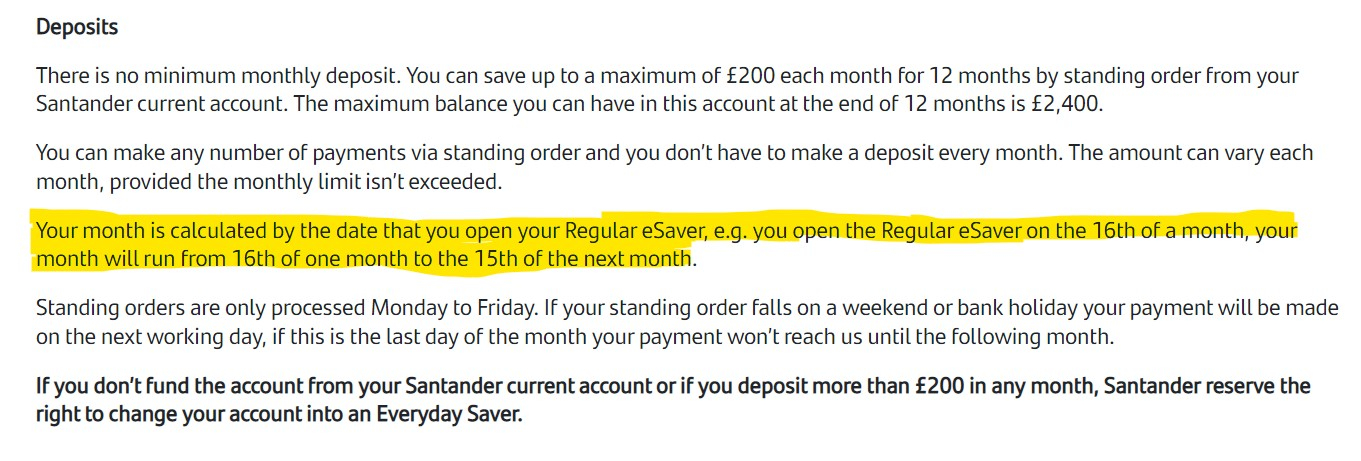
4 -
Re the Santander RS, I'm missing many points here - why bother risking the account being downgraded or closed for the sake of setting up a Standing Order?
Talk of funding directly regardless, visits to a Santander branch to confirm or otherwise ambiguous terms or discussion of the best way to make formal complaints if/when Santander react to the non-existent SO.
For an account that will yield £65 in a year?
Just set up the <expletive> Standing Order.6 -
I've never come across a jobsworth at my local Santander branch and they've always been pretty helpful so I shall still pop in given that I'll be passing the branch today anyway.OceanSound said:
Good luck with that. Chances are that you may come across a jobsworth staff memeber that'll just say 'No' (these staff always tend to start any sentence with a 'No''), it HAS TO be funded by standing order OR he/she/they will say it dosen't have to be. Then if your account gets changed to an Everyday Saver account for not paying by SO, you'd have to convince Santander complaints that you did speak to Staff member John on such and such a date at in the morning/afternoon/evening. Then staff member john would need to corroborate this. As I say 'Good luck with that'.Bridlington1 said:
Point taken, perhaps I am being guilty of wishful thinking here. I shall be passing a branch later today anyway so I'll see what they have to say regarding standing orders.TheBanker said:
I think it's a bit ambiguous because the KFD says:Bridlington1 said:
Like @ForumUser7 I just did a transfer of £200 from my Santander account. From what I can see there is no term saying you have to fund the account by standing order, all it says is that you can make payments by standing order.Deposits
There is no minimum monthly deposit. You can save up to a maximum of £200 each month for 12 months by standing order from your Santander current account. Maximum balance you can have in the account at the end of the 12 months is £2,400.
You can make any number of payments via standing order and you don’t have to make a deposit every month. The amount can vary each month, provided the monthly limit isn’t exceeded.
Your month is calculated by the date that you open your Regular eSaver, e.g. you open the Regular eSaver on the 16th of a month, your month will run from 16th of one month to the 15th of the next month.
To make the most of your regular eSaver, you’ll need to set up your standing order to start within the first calendar month after opening. Standing orders are only processed Monday to Friday. If your standing order falls on a weekend or bank holiday your payment will be made on the next working day, if this is the last day of the month your payment won’t reach us until the following month.
If you don’t fund the account from your Santander current account, if you deposit more than £200 in any month or if you hold more than one Regular eSaver account, Santander reserves the right to revert your account into an Everyday Saver.The bold text is their emphasis, not mine.
So it seems to be saying you have to use a Standing Order, but the final paragraph implies you don't (only that the funds have to come from a Santander current account). The second paragraph confuses things further by saying you don't have to make a deposit each month and you can vary the amount - whilst it is possible to amend a Standing Order each month, this isn't how Standing Orders are normally used.
A further complication comes from the point about weekend processing. If you have a Standing Order which happens to fall on a non-working day, you could accidentally fall foul of the £200 monthly limit by depositing £400 in one month (a rolled over standing order from the end of the previous month, plus the current month's standing order) - are they expecting customers to monitor their standing order date closely enough to avoid this happening?
In practice I think you'll be fine but it's not 100% clear cut.
What do you think @10_66 was reminding us of?OceanSound said:
What is the point of doing this? apart from change the amount. You don't want to bring the date forward, as it will fall foul of the only £200 in any month term/condition.TheBanker said:
I am not trying to prejudge how FOS would decide a complaint. To get to that stage, (i) Santander would have actually tried to enforce the 'Standing Order' condition, and (ii) Santander's own complaints team would have to reject any complaint. Then FOS would have to consider all the facts and reach a decision. My reference to the Co-op was simply to highlight that FOS do not automatically side with the customer - I did not mean to imply they would reach the same decision in a complaint about Santander.OceanSound said:
Seems you posted while i was editing my previous post.TheBanker said:
It's similar wording to the KFD I quoted above. As I said, I think it's ambiguous. The last but one point says you have to fund the account with a standing order, but the 'punishment' for breaking the rules doesn't refer to standing orders, only that the money has to come from a Santander current account and not be more than £200 per month.OceanSound said:
Santander ought to warn customers about this roll over standing orders.TheBanker said:
I think it's a bit ambiguous because the KFD says:Bridlington1 said:
Like @ForumUser7 I just did a transfer of £200 from my Santander account. From what I can see there is no term saying you have to fund the account by standing order, all it says is that you can make payments by standing order.Deposits
There is no minimum monthly deposit. You can save up to a maximum of £200 each month for 12 months by standing order from your Santander current account. Maximum balance you can have in the account at the end of the 12 months is £2,400.
You can make any number of payments via standing order and you don’t have to make a deposit every month. The amount can vary each month, provided the monthly limit isn’t exceeded.
Your month is calculated by the date that you open your Regular eSaver, e.g. you open the Regular eSaver on the 16th of a month, your month will run from 16th of one month to the 15th of the next month.
To make the most of your regular eSaver, you’ll need to set up your standing order to start within the first calendar month after opening. Standing orders are only processed Monday to Friday. If your standing order falls on a weekend or bank holiday your payment will be made on the next working day, if this is the last day of the month your payment won’t reach us until the following month.
If you don’t fund the account from your Santander current account, if you deposit more than £200 in any month or if you hold more than one Regular eSaver account, Santander reserves the right to revert your account into an Everyday Saver.The bold text is their emphasis, not mine.
So it seems to be saying you have to use a Standing Order, but the final paragraph implies you don't (only that the funds have to come from a Santander current account). The second paragraph confuses things further by saying you don't have to make a deposit each month and you can vary the amount - whilst it is possible to amend a Standing Order each month, this isn't how Standing Orders are normally used.
A further complication comes from the point about weekend processing. If you have a Standing Order which happens to fall on a non-working day, you could accidentally fall foul of the £200 monthly limit by depositing £400 in one month (a rolled over standing order from the end of the previous month, plus the current month's standing order) - are they expecting customers to monitor their standing order date closely enough to avoid this happening?
In practice I think you'll be fine but it's not 100% clear cut.
Of course for those of us who are aware of the caveat, it's easily avoidable by starting the standing order (SO) at the beginning of the month right up to the middle of the month (or even around 20th of each month should be fine - as there is no risk of any SO rolling over to the next month).
BTW, Santander website says this:
https://www.santander.co.uk/personal/savings-and-investments/savings/regular-esaverHow it works* You’re a UK resident aged 16 or over* You don't already have a Regular eSaver* You have a Santander current account, excluding 1|2|3 Mini In Trust* Fund the account with a standing order from a Santander current account* If you don’t fund the account from your Santander current account or if you deposit more than £200 in any month, Santander reserve the right to change your account into an Everyday Saver
Notice the last part does not say 'If you don't fund the account from your Santander Current Account, by standing order, or if you deposit more than ......Santander reserve the right to change your account into an Everyday Saver'.
So, funding the RS by SO isn't a requirement.
As I said I think people would be fine in practice, but if Santander did decide to convert an account to an Everyday Saver because the deposits weren't made by Standing Order, I'm not convinced FOS would uphold a complaint. Look at the Co-op refer a friend thread in the Banking section. The Co-op's terms are ambiguous, but the FOS are siding with the bank.
FOS always shout from the roof top that they deal with cases on a case-by-case basis. FOS 'siding with the bank' as you put it may be indicative of underlying issues at FOS.
However, if they were to handle cases on a case-by-case basis (using fairness to decide - as this is how they decide on cases - it's not legal proof) the Co-op terms being ambiguous but the FOS siding with the bank is no indication that they would do so in Santander's case.
FOS would need to look at what it says on the website, on the terms and conditions, the KFD etc and then decide. We wouldn't be able to prejudge that because FOS behaved in such a manner with Co-op they would repeat that behaviour. This is of course assuming that FOS operate in shipshape manner.
Personally I would take the easy option and set up a Standing Order, then there's no ambiguity. NB - you could set up the standing order as an annual one, I think, then change the details each month. So it works like a manual payment but they'd see it as a Standing Order.
With respect I think that's may be a tad extreme. We know from the Ts&Cs that you can fund the account by SO so if you wanted to play it safe then could you not just deposit by SO each month? If Santander blocks accounts that much, then why not just open an account solely for the 5% regular saver and never use it for anything else?OceanSound said:
To be honest, due to the ambiguity (lack of peace of mind - ironic because terms and conditions would otherwise bring us peace of mind), harsh terms and conditions, and pretty ordinary (or less than ordinary) support, not to mention blocking of funds (going into current account) like there's no tomorrow, I'd stay well clear of the Santader Regular e-Saver.
I too prefer not to faff about with SOs but if given the choice between funding a 5% regular saver by SO and not having the account at all I'd pick the former (as is evidenced by my HSBC regular saver).
3











Confirm your email address to Create Threads and Reply

Categories
- All Categories
- 355.5K Banking & Borrowing
- 254.8K Reduce Debt & Boost Income
- 456K Spending & Discounts
- 248.1K Work, Benefits & Business
- 605.5K Mortgages, Homes & Bills
- 178.9K Life & Family
- 263.3K Travel & Transport
- 1.5M Hobbies & Leisure
- 16.1K Discuss & Feedback
- 37.7K Read-Only Boards