We’d like to remind Forumites to please avoid political debate on the Forum.
This is to keep it a safe and useful space for MoneySaving discussions. Threads that are – or become – political in nature may be removed in line with the Forum’s rules. Thank you for your understanding.
PLEASE READ BEFORE POSTING
Hello Forumites! However well-intentioned, for the safety of other users we ask that you refrain from seeking or offering medical advice. This includes recommendations for medicines, procedures or over-the-counter remedies. Posts or threads found to be in breach of this rule will be removed.The Knitters Thread
Comments
-
I think it would be more hassle than it was worth, unless you particularly fell in love with some already knitted yarn. And if you wanted to make something sizeable, it could be tricky to know whether you'd got enough. Turning it into small items would be a safer bet. And you'd want to be very sure it wasn't moth-infested ...FrugalFalafel said:Hi all!
I've seen a few videos recently of people frogging wool items from charity shops to get wool to make new knitted/crocheted items.
Has anyone had any experience with this? Could this be a money saving winner or in practice is it just a lot of faff and not worth it? I would think the fibres would be wavey after being unravelled which would make reworking them harder. And you'd have to not be too picky about the quantity/colour/quality/yarn weights you're looking for etc.
Thanks!
Nicki
I will add a couple of thoughts to that.PipneyJane said:
Hi Nicki @FrugalFalafelFrugalFalafel said:Hi all!
I've seen a few videos recently of people frogging wool items from charity shops to get wool to make new knitted/crocheted items.
Has anyone had any experience with this? Could this be a money saving winner or in practice is it just a lot of faff and not worth it? I would think the fibres would be wavey after being unravelled which would make reworking them harder. And you'd have to not be too picky about the quantity/colour/quality/yarn weights you're looking for etc.
Thanks!
Nicki
The answer to "is it worth the effort" is "it depends". It depends if something is factory made or handmade, which you can only tell by looking at the seams. If factory made, the seams will have been cut and sewn up on an overlocker, with the result that when you unravel, you'll have thousands of short lengths of yarn and that's just not worth the effort.
If it's handmade, then yes, you can resurrect the yarn, but it will need to "forget" the stitches it held or it'll knit up unevenly. (Pure wool definitely has memory. Other fibres vary.) Once unravelled, tie it in big hanks and soak for a few minutes in a bucket of water. Hang up somewhere and let it drip dry, after which it can be balled up to use.
It also depends on what you want to make, the quantity of yarn you've resurrected and the fibre content. You can get a rough idea of fibre content by doing the "Flame Test". Take a short piece of the yarn, hold it over the sink and set fire to it. If it melts, it's acrylic. If it burns quickly, it's cotton. If you struggle to set fire to it, then it's wool.
To work out the weight/ply, there are calculators on line which will tell you how many wraps per inch you'll get when a particular weight of yarn is wrapped around a ruler. Once you know that, and have weighed the yarn you've harvested, you'll be able to workout whether you have enough to make what you want.
Ultimately, only you can answer whether something is worth the effort.- Mohair, and probably anything fluffy - do not attempt this. But then I am slightly averse to mohair these days anyway: it's not easy to knit, and I dread having to wash it. If it goes wrong, unpicking it is not easy because the fibre 'catches' on itself. After a few wears and washes, it does not bear thinking about.
- When you're balling it up, wind it tight. My mother used to wind 'new' wool with two fingers under the wind, so it wasn't too tight, but unpicked wool was done tight - it helps with losing the memory as PipneyJane describes.
- I inherited quantities of wool, including several balls of a nice tweedy DK mix. Unfortunately it was just breaking apart - there were different coloured threads twisted together, but one colour just didn't play nice. I could just pull it apart into short lengths. I wondered if it would be better further into the ball: it wasn't. I took it to my LYS and they said that it was useless: if wool gets too old it loses all its lubricants and just breaks. So it had to go.
- I have it on good authority* that any pre-WW2 yarn is much better quality than post WW2. So if you can be sure it's vintage wool, it's a safer bet than 'modern' fibre.
* At a coffee morning, we were admiring a beautiful cardigan, which initially I thought was 'bought', but the owner said "oh yes, I knitted this just before the war." And when I looked closely I could see that indeed, that k1p1 ribbing was NOT machine, but hand knitted. And the fine cable pattern all over it - exquisite. She went on to say "During the war, the quality of yarn dropped badly, so it wouldn't have lasted if I'd done it later than that." She is 100+, and must have been a teenager. I just hope her family give it a good home when the time comes!
Signature removed for peace of mind6 - Mohair, and probably anything fluffy - do not attempt this. But then I am slightly averse to mohair these days anyway: it's not easy to knit, and I dread having to wash it. If it goes wrong, unpicking it is not easy because the fibre 'catches' on itself. After a few wears and washes, it does not bear thinking about.
-
Thanks Pip! Definitely some things to think about - I hadn't even thought about the machine made items not being in one piece. I think I'll keep my eye out for likely garment and give it a go (I've got a fun slipper boot things on my want-to-make list that should be fairly forgiving!) and thanks for the tip about preparing the fibres. ❤️PipneyJane said:
The answer to "is it worth the effort" is "it depends". It depends if something is factory made or handmade, which you can only tell by looking at the seams. If factory made, the seams will have been cut and sewn up on an overlocker, with the result that when you unravel, you'll have thousands of short lengths of yarn and that's just not worth the effort.
If it's handmade, then yes, you can resurrect the yarn, but it will need to "forget" the stitches it held or it'll knit up unevenly. (Pure wool definitely has memory. Other fibres vary.) Once unravelled, tie it in big hanks and soak for a few minutes in a bucket of water. Hang up somewhere and let it drip dry, after which it can be balled up to use.
It also depends on what you want to make, the quantity of yarn you've resurrected and the fibre content. You can get a rough idea of fibre content by doing the "Flame Test". Take a short piece of the yarn, hold it over the sink and set fire to it. If it melts, it's acrylic. If it burns quickly, it's cotton. If you struggle to set fire to it, then it's wool.
To work out the weight/ply, there are calculators on line which will tell you how many wraps per inch you'll get when a particular weight of yarn is wrapped around a ruler. Once you know that, and have weighed the yarn you've harvested, you'll be able to workout whether you have enough to make what you want.
Ultimately, only you can answer whether something is worth the effort.
HTH
- Pip3 -
FrugalFalafel said:
Thanks Pip! Definitely some things to think about - I hadn't even thought about the machine made items not being in one piece. I think I'll keep my eye out for likely garment and give it a go (I've got a fun slipper boot things on my want-to-make list that should be fairly forgiving!) and thanks for the tip about preparing the fibres. ❤️PipneyJane said:
The answer to "is it worth the effort" is "it depends". It depends if something is factory made or handmade, which you can only tell by looking at the seams. If factory made, the seams will have been cut and sewn up on an overlocker, with the result that when you unravel, you'll have thousands of short lengths of yarn and that's just not worth the effort.
If it's handmade, then yes, you can resurrect the yarn, but it will need to "forget" the stitches it held or it'll knit up unevenly. (Pure wool definitely has memory. Other fibres vary.) Once unravelled, tie it in big hanks and soak for a few minutes in a bucket of water. Hang up somewhere and let it drip dry, after which it can be balled up to use.
It also depends on what you want to make, the quantity of yarn you've resurrected and the fibre content. You can get a rough idea of fibre content by doing the "Flame Test". Take a short piece of the yarn, hold it over the sink and set fire to it. If it melts, it's acrylic. If it burns quickly, it's cotton. If you struggle to set fire to it, then it's wool.
To work out the weight/ply, there are calculators on line which will tell you how many wraps per inch you'll get when a particular weight of yarn is wrapped around a ruler. Once you know that, and have weighed the yarn you've harvested, you'll be able to workout whether you have enough to make what you want.
Ultimately, only you can answer whether something is worth the effort.
HTH
- Pip
@FrugalFalafel
While wandering through the charity shops, don't forget to look through the yarn that they've received in donations. It's often in a basket, somewhere towards the back of the store, near the bookshelves (if they have them). Might even be worth asking the staff, if they have a basket of donated yarns lying around. You may find exactly the yarn you need, at a bargain price, without going to all the effort of recycling it.
HTH
Pip"Be the type of woman that when you get out of bed in the morning, the devil says 'Oh crap. She's up.'
It ain’t what you do, it’s the way that you do it - that’s what gets results!
2026 Fashion on the Ration Challenge 107.5 spent out of 80.5 coupons (66 plus 14.5 from 2025) 27 over
Coupon Spend
57.5 - yarn
12 - 3 M&S thermal bodies
4 - shorty pyjamas
1 - bra
8 - 2 t-shirts (Queens Club & 10CC Cricket)
5 - black leather loafers
5 - leather handbag
15 - DKNY black puffer coat5 -
Its incredible isn't it how good quality and well looked after pieces can last so long. I hope her family are aware of it and any similar treasures. I was always amazed by my grandmothers ability to create those incredibly complicated but neat patterns. Thanks for the tips! I think I'll keep an eye out for a likely item and treat it as an experiment. But also good shout @PipneyJane about looking for donated yarns too ❤️Savvy_Sue said:
I think it would be more hassle than it was worth, unless you particularly fell in love with some already knitted yarn. And if you wanted to make something sizeable, it could be tricky to know whether you'd got enough. Turning it into small items would be a safer bet. And you'd want to be very sure it wasn't moth-infested ...FrugalFalafel said:Hi all!
I've seen a few videos recently of people frogging wool items from charity shops to get wool to make new knitted/crocheted items.
Has anyone had any experience with this? Could this be a money saving winner or in practice is it just a lot of faff and not worth it? I would think the fibres would be wavey after being unravelled which would make reworking them harder. And you'd have to not be too picky about the quantity/colour/quality/yarn weights you're looking for etc.
Thanks!
Nicki
I will add a couple of thoughts to that.PipneyJane said:
Hi Nicki @FrugalFalafelFrugalFalafel said:Hi all!
I've seen a few videos recently of people frogging wool items from charity shops to get wool to make new knitted/crocheted items.
Has anyone had any experience with this? Could this be a money saving winner or in practice is it just a lot of faff and not worth it? I would think the fibres would be wavey after being unravelled which would make reworking them harder. And you'd have to not be too picky about the quantity/colour/quality/yarn weights you're looking for etc.
Thanks!
Nicki
The answer to "is it worth the effort" is "it depends". It depends if something is factory made or handmade, which you can only tell by looking at the seams. If factory made, the seams will have been cut and sewn up on an overlocker, with the result that when you unravel, you'll have thousands of short lengths of yarn and that's just not worth the effort.
If it's handmade, then yes, you can resurrect the yarn, but it will need to "forget" the stitches it held or it'll knit up unevenly. (Pure wool definitely has memory. Other fibres vary.) Once unravelled, tie it in big hanks and soak for a few minutes in a bucket of water. Hang up somewhere and let it drip dry, after which it can be balled up to use.
It also depends on what you want to make, the quantity of yarn you've resurrected and the fibre content. You can get a rough idea of fibre content by doing the "Flame Test". Take a short piece of the yarn, hold it over the sink and set fire to it. If it melts, it's acrylic. If it burns quickly, it's cotton. If you struggle to set fire to it, then it's wool.
To work out the weight/ply, there are calculators on line which will tell you how many wraps per inch you'll get when a particular weight of yarn is wrapped around a ruler. Once you know that, and have weighed the yarn you've harvested, you'll be able to workout whether you have enough to make what you want.
Ultimately, only you can answer whether something is worth the effort.- Mohair, and probably anything fluffy - do not attempt this. But then I am slightly averse to mohair these days anyway: it's not easy to knit, and I dread having to wash it. If it goes wrong, unpicking it is not easy because the fibre 'catches' on itself. After a few wears and washes, it does not bear thinking about.
- When you're balling it up, wind it tight. My mother used to wind 'new' wool with two fingers under the wind, so it wasn't too tight, but unpicked wool was done tight - it helps with losing the memory as PipneyJane describes.
- I inherited quantities of wool, including several balls of a nice tweedy DK mix. Unfortunately it was just breaking apart - there were different coloured threads twisted together, but one colour just didn't play nice. I could just pull it apart into short lengths. I wondered if it would be better further into the ball: it wasn't. I took it to my LYS and they said that it was useless: if wool gets too old it loses all its lubricants and just breaks. So it had to go.
- I have it on good authority* that any pre-WW2 yarn is much better quality than post WW2. So if you can be sure it's vintage wool, it's a safer bet than 'modern' fibre.
* At a coffee morning, we were admiring a beautiful cardigan, which initially I thought was 'bought', but the owner said "oh yes, I knitted this just before the war." And when I looked closely I could see that indeed, that k1p1 ribbing was NOT machine, but hand knitted. And the fine cable pattern all over it - exquisite. She went on to say "During the war, the quality of yarn dropped badly, so it wouldn't have lasted if I'd done it later than that." She is 100+, and must have been a teenager. I just hope her family give it a good home when the time comes!
5 - Mohair, and probably anything fluffy - do not attempt this. But then I am slightly averse to mohair these days anyway: it's not easy to knit, and I dread having to wash it. If it goes wrong, unpicking it is not easy because the fibre 'catches' on itself. After a few wears and washes, it does not bear thinking about.
-
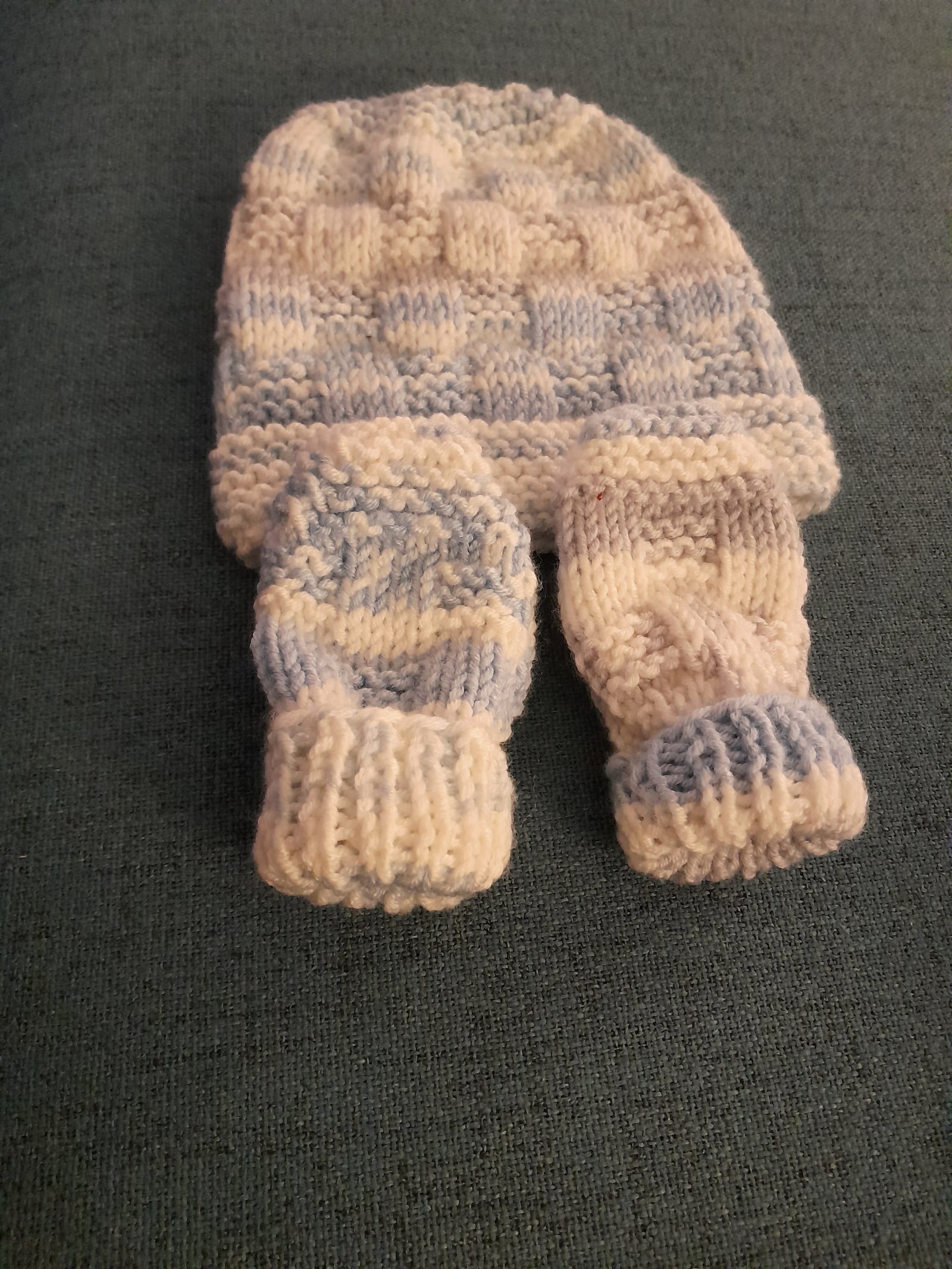
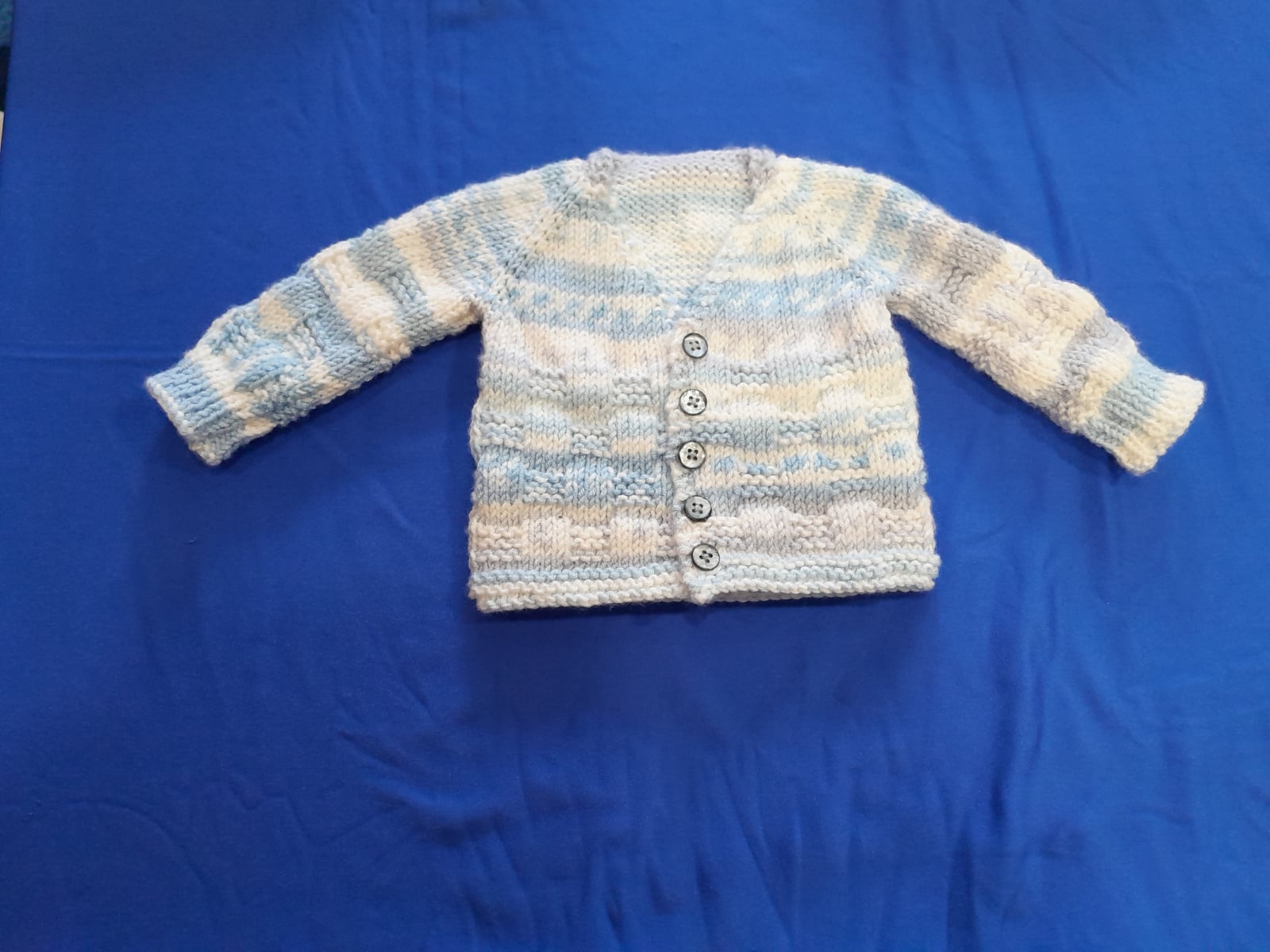
The over-excited Grandma to be is back from a trip to see DS and DDIL in Amsterdam. DiL loved the little cardigan I'd knitted, and I did a hat and bootees to match. Lost the game of yarn chicken on the hat, but fortunately I'd found a very friendly yarn shop so got something to finish it with, and you'd never know. Photos now added ...
I also have 2 more cardigans to knit in some lovely wool ... I'll do bigger sizes.
DiL said "my friend said a blanket might be useful," so I assured her it was already half-knitted, but too bulky for this trip. In the end I gave up on the fancy design and it's a Jordan blanket. The cardigan et al are similar.
Signature removed for peace of mind4 -
Veeeerrry nice, @Savvy_Sue ! They'll keep baby warm and cozy. 😊
2026 Fashion on the ration
Anorak = 11 coupons... total 11 used/66
Light anorak = 9 coupons...total used 20/66
3 t-shirts = 12 coupons...32/66
Sandals = 5 coupons...37/66 used2 -
AWWWW….. they’re lovely, @Savvy_Sue . Lucky you to find a yarn shop in Amsterdam!
- Pip
"Be the type of woman that when you get out of bed in the morning, the devil says 'Oh crap. She's up.'
It ain’t what you do, it’s the way that you do it - that’s what gets results!
2026 Fashion on the Ration Challenge 107.5 spent out of 80.5 coupons (66 plus 14.5 from 2025) 27 over
Coupon Spend
57.5 - yarn
12 - 3 M&S thermal bodies
4 - shorty pyjamas
1 - bra
8 - 2 t-shirts (Queens Club & 10CC Cricket)
5 - black leather loafers
5 - leather handbag
15 - DKNY black puffer coat3 -
Actually there were two, and as luck would have it, one was a few doors down from a shop selling Chess and Go sets and other board games. So I sent DH there, and he was happy …
Signature removed for peace of mind3










Confirm your email address to Create Threads and Reply

Categories
- All Categories
- 355.7K Banking & Borrowing
- 254.9K Reduce Debt & Boost Income
- 456.1K Spending & Discounts
- 248.3K Work, Benefits & Business
- 605.9K Mortgages, Homes & Bills
- 179K Life & Family
- 263.7K Travel & Transport
- 1.5M Hobbies & Leisure
- 16.2K Discuss & Feedback
- 37.7K Read-Only Boards