We’d like to remind Forumites to please avoid political debate on the Forum.
This is to keep it a safe and useful space for MoneySaving discussions. Threads that are – or become – political in nature may be removed in line with the Forum’s rules. Thank you for your understanding.
Strange Clause in Will !
Comments
-
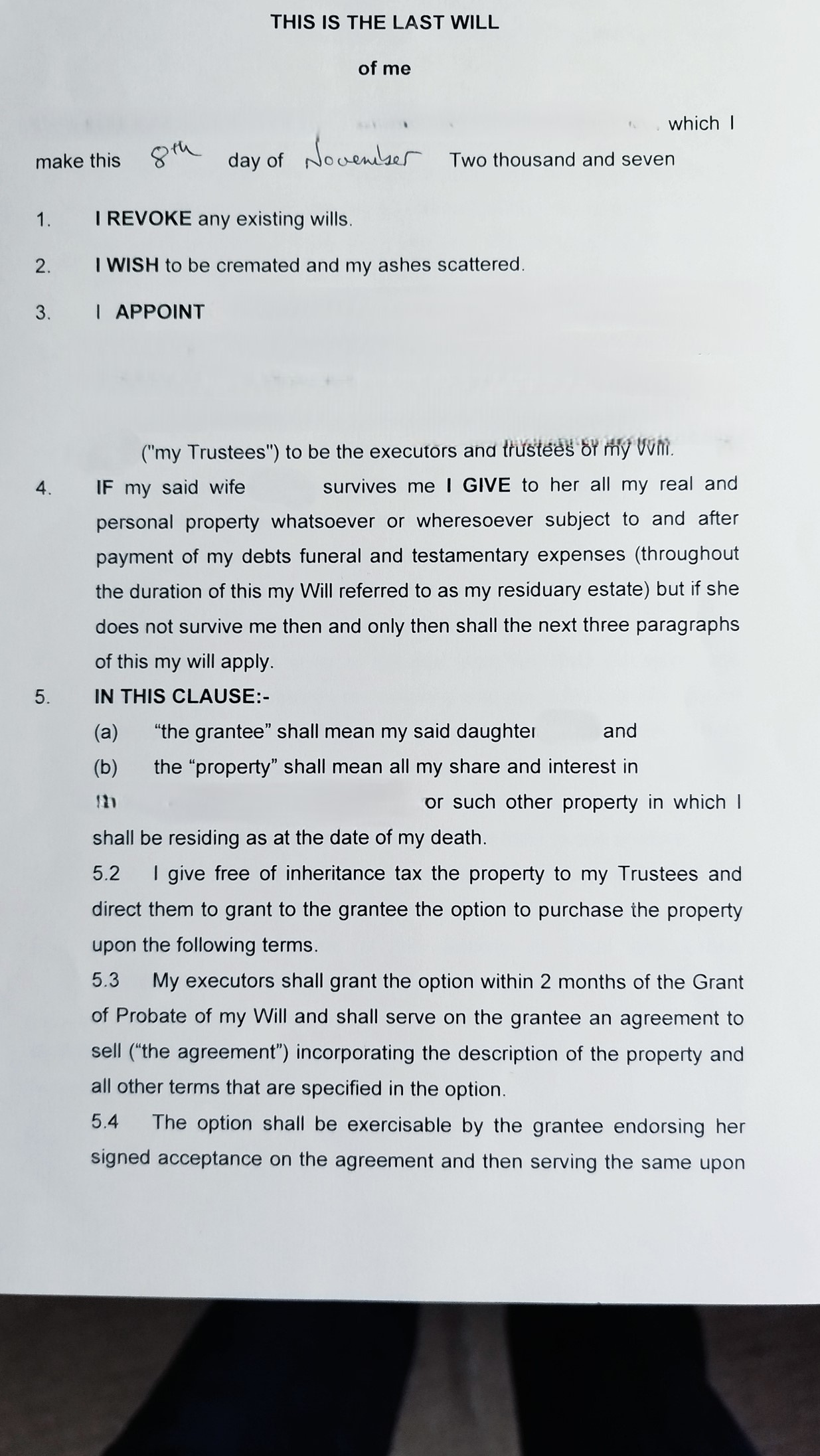
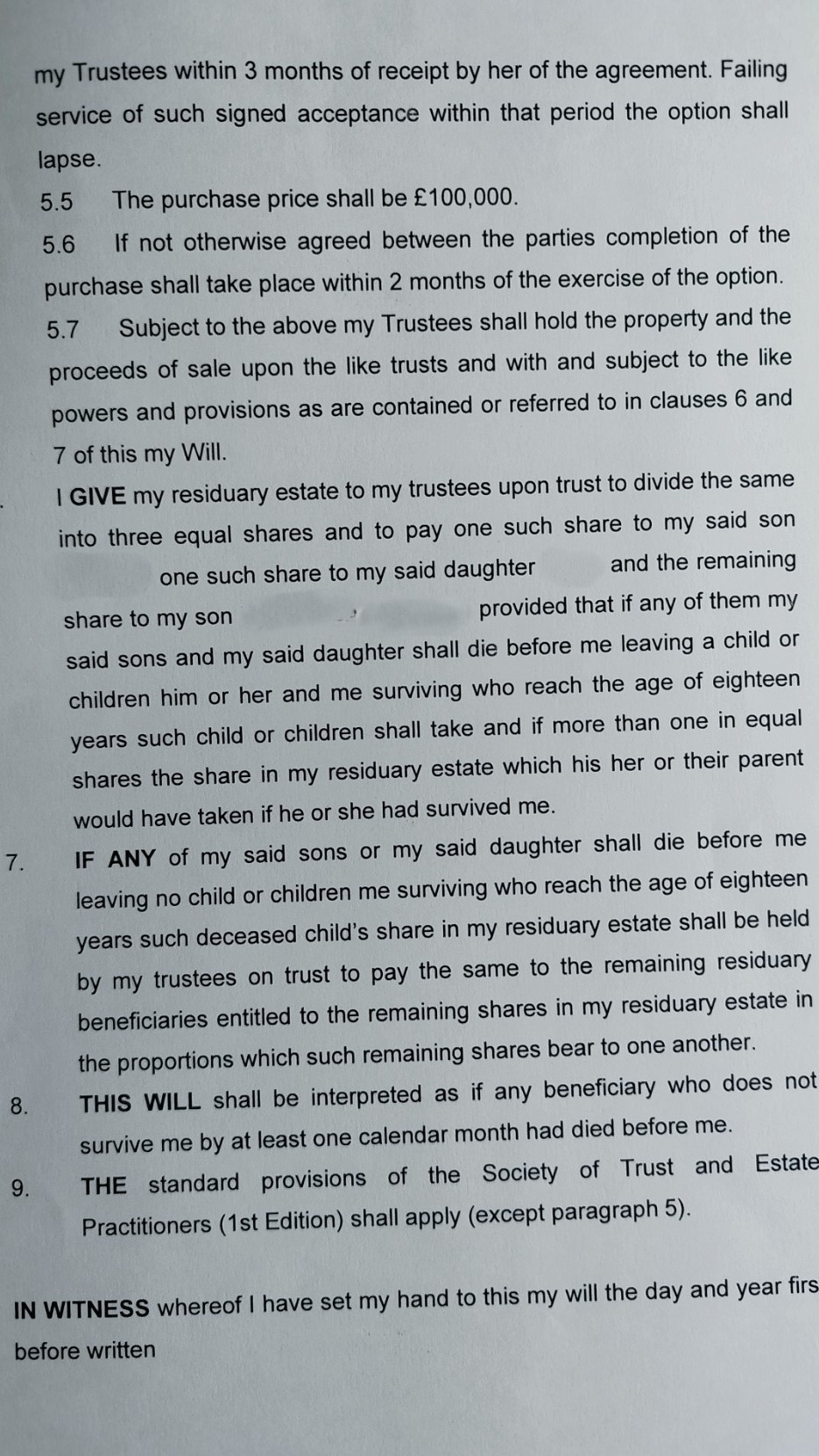
I’m a 1st time sole Executor for my late father’s estate. His Will contains a ridiculous (to me!) clause that I hope somebody can help me with. In the Will, his estate is generally divided equally between myself and my 2 siblings. He has instructed his Executor (me!) to give an option to purchase his house to one of the siblings. Unfortunately, he has set the buying price at a finite figure that would be approximately its market value at the time of the Will. The Will is now 17 years old and there is no market indexation. Clearly, this now puts one sibling at a great financial advantage compared with the other 2 siblings. The other 2 siblings see this clause as contrary to the whole ethos of the Will, which is to divide assets equally.
The relevant clause defines the ‘property’ as ‘all my share and interest in (dad’s address)
or such other property in which I shall be residing as at the date of my death’. Following several hospital stays and increasing frailness dad moved into one of the siblings’ homes but hadn’t sold his own house. At the date of his death he had resided there for 40 days. As his ‘share and interest’ in that property was zero, I believe the sibling’s option to purchase dad's own house is no longer applicable.What does the ‘jury’ think?
Sorry for your loss.
You might well require professional legal advice to understand exactly how this clause is to be interpreted and applied should the sibling with the option to purchase decide to take up that option.
They may not chose to do so as, even with the apparent £80k - £90k below market value, by the time SDLT (including the second property surcharge) has been paid the potential gain might be lower than warrants the effort. Of course, the individual with the option to purchase might currently rent and / or might wish to sell their current PPR and move into the father's home.
The first thing I'd expect a professional legal advisor to want to establish is whether the "loophole" around the father residing at the child's property applies. I think it is quite likely that could well not be the case. Five or six weeks is really quite a short time. Before the time staying at the sibling's house, the father was staying at hospitals, but that would not be classed as "residing". I think there could well be an argument that the Father was only staying (not "residing") at the siblings house. It would be quite a common thing for a child to say to a parent leaving hospital something along the lies of "why don't you come and stay with us for a short while to recuperate and get yourself back on your feet" without there being any intention of that being a permanent arrangement implying "residing".
What indicators of permanence / residing at the siblings house were there?
Had the father redirected all post?
Changed address for bank etc.?
Changed address for electoral role / voter registration?
Cleared home and marketed for sale?
Compare the "staying" at the sibling's house to the father having moved into a nursing home. That might well be considered rather more clearly a permanent "residing" status but would also, for many purposes, not forfeit PPR status for the house.
The second thing I'd expect a professional legal advisor to do would be read the Will in full and see if there is any indexation clause that might not have been apparent to the casual lay-reader and / or any notes that explain the rationale and intent that the fixed property value is truly fixed. Though the later part is probably not open to challenge as the father had 17 years in which that fixed value could be varied if he so desired.
Finally, how large is the total Estate? Does the potential £90k "advantage" in favour of one sibling really make that much difference?
It is not that sibling being better off by £90k anyway - if the proportion was shared equally as remainder Estate, it would be £30k for each of the three siblings, so the "advantage" is only £60k and that "pain" is suffered by the other two in equal measure.
Is the £30k delta really a significant proportion of the total inheritance that there might be for each individual?
Is it enough to risk jeopardising future family relationships?
2 -
@loiner wrote:
The relevant clause defines the ‘property’ as ‘all my share and interest in (dad’s address) or such other property in which I shall be residing as at the date of my death’.
I read that as the second half of the clause being irrelevant, as the first half of the clause is met given he still owned the named property at the time of his death.
The second half of the clause, after the "or such other property" only applies if he were to no longer owns the named property at the time of his death, and has purchased and was residing at another such property replacing his previously named property as his main residence.
I am a Forum Ambassador and I support the Forum Team on the Benefits & tax credits, Heat pumps and Green & Ethical MoneySaving forums. If you need any help on those boards, do let me know. Please note that Ambassadors are not moderators. Any post you spot in breach of the Forum Rules should be reported via the report button, or by emailing forumteam@moneysavingexpert.com. All views are my own & not the official line of Money Saving Expert.7 -
I would agree with that, I think the most likely intention was to cover him being the owner-occupier of a different property by the time of his death. In these circumstances I would interpret it as still referring to the original house.
1 -
My 2p is worth:
- I read it as messy drafting. The use of "property" in the second half of the property definition makes things a bit circular but as dad does not have an interest in the place he was living on death, it would be impossible to grant an option over that. So that just leaves an option over his proper house. That doesn't seem to be a perverse answer to me with those words
- I am used to purposive interpretation and, purposively, it make sense for it to be read as an option over his proper house.
- But I have no idea how a court would interpret it, I do have enough experience to know it would be expensive to find out. And I don't know how a court would feel about costs in the event that they thought that the executor was acting in his or her own interests in interpreting the will poorly.
- I would like to understand what will says rather than just the shorthand of what the OP says: "He has instructed his Executor (me!) to give an option to purchase his house to one of the siblings."
- Normally an option is granted for consideration or under deed (or both). With an option there needs to be certainty of the terms. Are these set out in the will? The big three are (i) the subject of the option (in this case the property), (ii) the price (which is specified), and (iii) when it can be exercised. If these are set out in the will, great. If not, then you would need to be careful in making up terms (e.g. here is the option, it will lapse in an hour, to exercise it you have to bring the cash to my dining room before I go to bed - this may not go down to well with a court).
- If these terms are not set out, I wonder whether the words in the will mean that the OP doesn't need to actually formally grant an option or whether it is a mere hope or something in between.
- I am not sure what happens if you have to, or choose to, sell the property to cover IHT. How can an option be granted over something that has to be sold? What does the will say about that or is there no IHT due?
- From a tax perspective, the rest is designed to get you to take professional advice because it is complicated and may mean a lot of tax is due, but it may depend on what the will actually says.
- If there is a formal option grant then that is a disposal by the executor (of the newly created option) and so gives rise to a capital gain based on the proceeds less a zero base cost. As there are no proceeds, nothing to pay CGT on? Hmmm.
- There is a CGT rule that can mean that the deemed market value rule applies to the grant of the option (s17 TCGA 1992 for those reading along at home). If it does apply then there would be a big CGT charge on the estate for the grant of the option. I would want to understand the wording in the will though as I'd hope it would be drafted in a way that means that the normal exemption for transferring asset to a legatee applies (s62(4) TCGA 1992 for those with ChatGPT). But I worry that the statutory exemption requires that the option must have been owned by dad on death, which is just not the case. I have no experience of that. So the risk here is that if the purchase price is £90,000 below market value then the option would be worth at least £90,000 at 24% tax and that is a chunky sum.
- Good news though. If the option is exercised that undoes the CGT on grant (if s17 did apply). So that means that the chunky CGT is not paid by the executor if the option is exercised (ideally in the same tax year as grant).
- There will be SDLT on exercise.
- But the bad news, if the option is not exercised and CGT was due on grant (i.e. if 17 did apply) then the executor still has to pay the CGT and it will never be refunded. That's not a nice place to be.
- So when the OP gets legal advice, make sure that the tax position is properly considered. The CGT tax treatment on the grant of options to non-employees is not something that a common-or-garden solicitor will know, especially with the interaction of s62.
5 -
He was 98 and extremely frail. He was never going to go back to his house.
He did suggest selling his house but I advised him not to in order to retain the RNRB. He is already over the NRB for other assets but below it for property (both including the unused spouse transfer).
0 -
The relevant clause defines the ‘property’ as ‘all my share and interest in (dad’s address)
orsuch other property in which I shall be residing as at the date of my death’.Not relevant, the clause says OR, so the 'property in which I shall be residing' doesn't create a requirement on the property he owns, it just gives an alternative property the sibling could also have a right to buy. So if dad owned A and moved into B, the sibling could buy either A OR B.
This isn't a loophole, you just need to consider why father might have given one child a right over others, eg if sibling invested in the house or supported father whereby he'd have wanted to preserve the value 17 years ago.
0 -
Attached are copies of dad's very simple Will, apart from the notorious clause! It may help answer some of the questions. To clarify, at the time the will was written, dad thought his home was far better than our sister's home, so his idea was for her to move into a better home. A couple of years ago, my sister moved into a more practical bungalow which is far superior to dad's home. There is no intention at all for her to move into the family home. The only reason dad retained his house was to preserve his RNRB allowance.
Our sister was originally also an Executor, but completed the Renunciation form. That means I will be putting in all the effort and our sister will receive significantly more reward. Our brother has also done a massive amount of work clearing the house of our compulsive hoarder father. Our sister and husband's effort was non existent, even though they only live 50m down the road from dad's house. Our sister originally stated she wasn’t interested in taking up her option to buy. Our brother then did all the work at the house and when he finished she said she had changed her mind and might take up the option after all.
0 -
Interesting that the direction to sell to daughter is expressed in the form of the trustees granting her an option to do so with specific time limits for acceptance and execution.
Whatever your father's original rational for giving your sister this preferential right to buy at a set price, I see no basis for the executors to challenge its validity.
The instructions are clear and in my view unambiguous, whether or not your sister ever intends to excercise the option the trustees are required nonetheless to grant the option ( in writing) within 2 months of probate. What happens thereafter is up to her. She either proceeds to buy or the option lapses and the property falls into residue.
As we all know it is a peculiar aspect of English testamentary freedom ( unlike Scotland for example) that testators are under no obligation to make any provision for their children or to provide for them on an equal basis.
If you are minded not to grant the option at all, you would be in breach of a key requirement of the Will thereby permitting your sister to sue for 'specific performance'.
3 -
I agree if the word 'either' was used, but it isn't! If she has an option to buy either A or B then it's her choice. The Will effectively says she has an option to buy A, but effectively that option moves to B if he no longer resides at A.
0 -
What Poseidon said. You may not like to hear it, but the terms of the will are clear and as Executor you have to be guided by them instead of your own preferences.
It all depends whether your sister has a spare £100k to speculate with at the cost of family harmony.
0












Confirm your email address to Create Threads and Reply

Categories
- All Categories
- 355.8K Banking & Borrowing
- 254.9K Reduce Debt & Boost Income
- 456.2K Spending & Discounts
- 248.3K Work, Benefits & Business
- 605.9K Mortgages, Homes & Bills
- 179K Life & Family
- 263.7K Travel & Transport
- 1.5M Hobbies & Leisure
- 16.2K Discuss & Feedback
- 37.7K Read-Only Boards