We’d like to remind Forumites to please avoid political debate on the Forum.
This is to keep it a safe and useful space for MoneySaving discussions. Threads that are – or become – political in nature may be removed in line with the Forum’s rules. Thank you for your understanding.
Check on battery only vs solar/battery thoughts
Comments
-
The set-up is:
- 23 LONGi 480 Watt Panels (LR7-54HVB-480M), with 13 on an area of roof facing south-south-west, and 10 on a different area of roof facing east-south-east.
- A Sigen 6kw Hybrid SP2 single-phase inverter
- SigenStor 9kwh battery
There isn't an installation date set as yet, but it should be sometime in January.
Expected generation is a low of 4kwh per day in December, rising to 39 in May. It is only the period Nov-Feb (inclusive) that production is expected to be below household use, with strong generation between April to September.
1 -
To me that sounds like a good balance of solar, battery, and consumption/ export.
Time scale for installation is a bit slow, others may comment is specific brands, but do make sure you get your installer to get DNO approval, system certified, long warranty and delivered paperwork for those.
1 -
The January date is at my request, the installer lead time is about 8-10 weeks, so they could have done it a bit sooner but I would prefer to avoid December.
0 -
I'm somewhat concerned for potential clipping with an 11kWp array on a 6kW inverter with only 9kW of storage.
For much of the year, that system may be capable of generating more than the 6kW inverter limit . Any excess can be stored in the battery as long as there is space and the excess does not exceed the rate at which the batteries can charge, but a 9kW battery will likely be full early in the day in summer, even more so if your strategy is to charge overnight on cheap rate EV tariff and export most of the solar generation during the day. Once the battery is full, you can only convert at a rate of 6kW for use/export even though your array may be capable of generating twice that. If the DNO were to restrict your export, you may be losing a lot of potential generation from that large solar array.
Saving space in the battery to then store otherwise clipped (and lost) generation completely changes your strategy, as you are then no longer charging the battery on cheap overnight electricity, but charging during the day from excess solar. Most battery AI systems are rubbish at managing clipping (if they are even aware it's an issue), so you'd most likely end up manually managing for best performance, and all of the ease of use / set and forget goes out of the window (unless you are into things like Home Assistant to automate control)
Are there any shading issues for the roof that may otherwise reduce the amount of solar generation?
The solution is to increase the size of the inverter and/or battery. It probably makes little sense to increase battery size if it is sufficient to meet your current usage requirements, so I would strongly consider a larger inverter, especially if adding a heat pump down the line is in your thinking*. The 8kW or 10kW options would make more sense to me unless you have substantial shading issues on your roof.
[*] with a heat pump pulling 1-2kW, the remaining inverter capacity is soon used up if you have an electric oven (3kW) going and a few other kitchen appliances. The look my wife gives me when I advise she probably shouldn't boil the kettle whilst the oven light is on when cooking dinner is not something I'd wish on anyone!
I am a Forum Ambassador and I support the Forum Team on the Benefits & tax credits, Heat pumps and Green & Ethical MoneySaving forums. If you need any help on those boards, do let me know. Please note that Ambassadors are not moderators. Any post you spot in breach of the Forum Rules should be reported via the report button, or by emailing forumteam@moneysavingexpert.com. All views are my own & not the official line of Money Saving Expert.2 -
Thanks for the comment @NedS, I've been doing some thinking about it. I agree the system will be coming up against capacity constraints at some points, both in terms of inverter and also battery capacity.
There are shade issues, primarily due a large oak tree directly south of the property, that is taller than the house and the branches come almost to the side of the house. There are also trees to the east, although those are set further back. The picture below shows the proposed layout, with panels facing two different directions. Note that the tree closest to the panels facing south west will not cause any shade issues, just the larger tree south of the house.
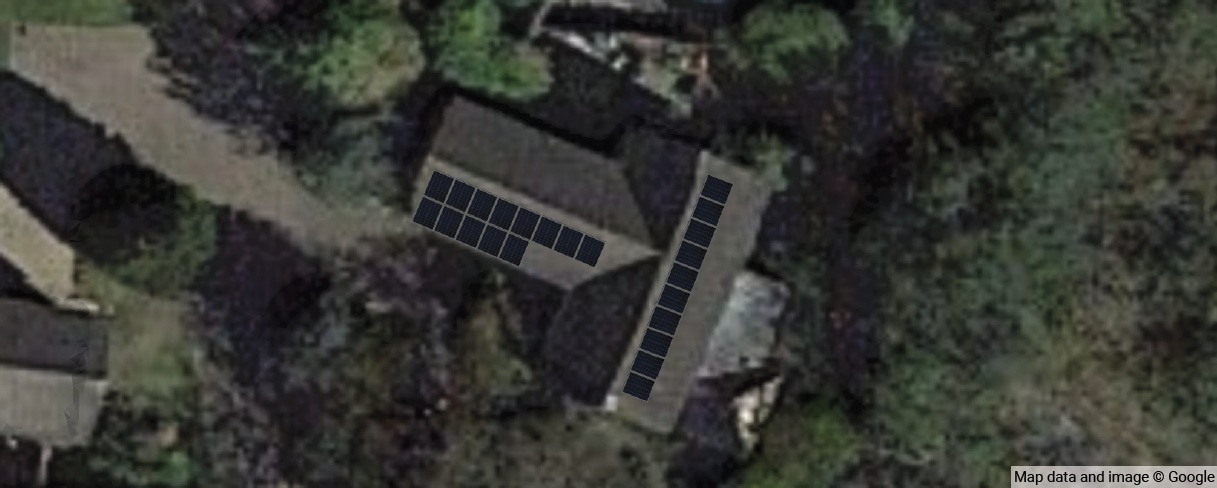
Fortunately, as the tree is due south, the sun will be highest when the tree would be causing most shade, so it should mostly cause issues in the morning. Estimates of generation reduction due to shade varied from about 6-13% in quotes from different installers I got, based on slightly different layouts. This layout was about 8% reduction. However, peak generation at midday in summer should face minimal shade on any panel, so generation over 6kw for a time may be an issue then.
Generation is expected to peak in May at 39 kWh per day on average.
If generation is climbing above 6kw in the summer months, I would stop charging the battery overnight and instead use stored charge in the battery to charge my EV overnight so the house battery could start every day empty. The house battery can charge at up to 4.6 kw, so along with the 6kw AC conversion from the inverter, that will be sufficient to take all the power the panels are generating, as long as the battery is not full. So in that scenario solar will be set first to self-consumption, second to export, and finally to battery charge during the period when input exceeds 6kw.
Financially, it shouldn't make a huge amount of difference. I would be getting overnight grid electricity at 7p per kWH, which after loss going through battery would probably be about 8p. Export is 13p, so the loss per kwh of consuming solar rather than overnight electric is only 5p per kwh during these periods of peak generation.I very much enjoy optimising, so don't mind playing around with the set-up during the seasons rather than having it all on a fixed preset.
The battery capacity should be enough to meet our daytime tariff electricity demands for at least 90% of days. I can use a bit of self-consumption for days I think might be within the 10% where I exceed battery capacity. Even if I do exceed capacity, it would only be by a trivial amount (about 0.5 kwh based on the last few months), so that wouldn't matter. So I agree, a bigger inverter would be better than a bigger battery.
I don't plan on a heat pump anytime soon, having got a new boiler a couple of years ago. But that could change depending on gas prices. However, our radiators could do with replacing, so as and when we next need a new boiler, getting new radiators and a heat pump could well be attractive. In that scenario, I'd need another battery. The battery to be installed can be easily expanded with new modules, so that would be simple. I do plan on a bit of new Air Con installation though. 6 kw should still be fine for us as there is only my wife and I, and we only mostly have kitchen devices that spike load, in addition to air con in summer and washing machine in winter (we use a condensor overnight to dry clothes in winter; in summer we use a washing line so we run the washing machine overnight).
So I agree it is worth chatting to the installers about a larger inverter, which would make the current set-up a bit easier to manage in summer, and future proof things. I think a 6 kw inverter will work in the proposed set-up with quite minor losses at peak generation, but only with some careful monitoring and tweaking of usage patterns between April and September (inclusive).
1 -
@hugheskevi Yes, as long as the DNO grants you permission to export at 6kW, the full rate of your inverter, you can use/export 6kWh and store an additional 4.6kWh, but the battery may still end up being full by lunchtime in summer. The strategy would be to force export (empty) the contents of the battery early in the morning (or at peak rate the evening before) with the aim of starting the day almost empty if the forecast is for a sunny day. You can then continue to use or export solar at 6kWh until generation exceeds that level and clipped solar refills the battery, which at 4.6kWh is only going to take 2h.
A larger inverter would certainly help (although I note it is quite a bit more expensive), but only if the DNO do not restrict your export.
Others who have first hand experience of managing clipping issues may be able to offer more advice.
One final consideration - I don't know anything about the EV charger module that Sigenergy supply (assuming you don't already have a wall charger?), but is there a DC charging option? If so, could this be used to route excess DC solar directly to the vehicle battery that would otherwise be clipped in the same way it can to the house battery, or is it an AC charging module?
All you can do in the first instance is apply and see what the DNO come back with. As it's basically a first come, first serve lottery, there is some value in applying now and installing the larger size for future proofing as you may not have the option to increase inverter size down the line if your needs change (and no one ever says I wish I'd bought a smaller inverter).
I am a Forum Ambassador and I support the Forum Team on the Benefits & tax credits, Heat pumps and Green & Ethical MoneySaving forums. If you need any help on those boards, do let me know. Please note that Ambassadors are not moderators. Any post you spot in breach of the Forum Rules should be reported via the report button, or by emailing forumteam@moneysavingexpert.com. All views are my own & not the official line of Money Saving Expert.1








Confirm your email address to Create Threads and Reply

Categories
- All Categories
- 355.7K Banking & Borrowing
- 254.9K Reduce Debt & Boost Income
- 456.1K Spending & Discounts
- 248.3K Work, Benefits & Business
- 605.8K Mortgages, Homes & Bills
- 179K Life & Family
- 263.6K Travel & Transport
- 1.5M Hobbies & Leisure
- 16.2K Discuss & Feedback
- 37.7K Read-Only Boards