We’d like to remind Forumites to please avoid political debate on the Forum.
This is to keep it a safe and useful space for MoneySaving discussions. Threads that are – or become – political in nature may be removed in line with the Forum’s rules. Thank you for your understanding.
Triple lock increase for April 2027 is 3.9% (probably)
Comments
-
As always, we vote for what we believe in (and not necessarily what is best for oneself because we think of people less fortunate than ourselves).
This doesn't read as sarcasm, but in my opinion this is horrendously naïve. You only have to take a step into the real world (and by this I mean speaking to ordinary people at work or out and about or in lieu reading the replies of any political post on Facebook) to see that not only are most people hideously misinformed, but typically self-serving - of course this doesn't apply to everyone. There's a reason that politicians have avoided touching the triple lock, it's been mentioned several times in this thread alone - pensioners always turn up to vote and most would vote against it's abandonment.
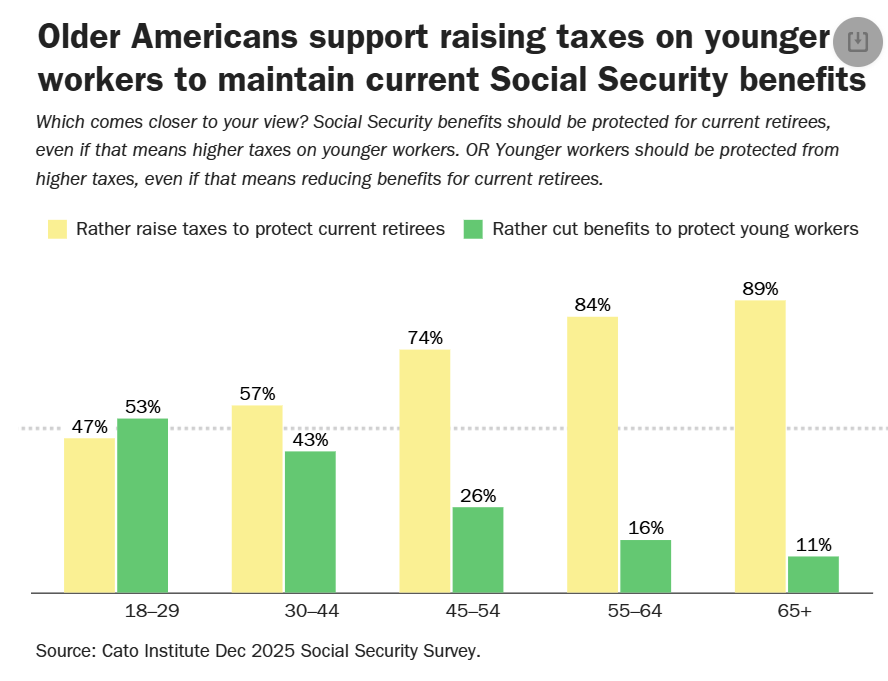
Now you might suggest that these are all just selfless pensioners whose only motive to maintain the triple lock is not to improve their own situations, but as a lasting act of generosity to the younger generation who may eventually benefit from it, and while I would be envious of this positive outlook on life, I sincerely doubt it and would point to a relatively recent US study that shows that this likely isn't the case:
It's quite long but to post some of the relevant points:
A majority (53%) of Americans under age 30 say younger workers should be protected from higher taxes even if doing so requires reducing benefits for current retirees. In sharp contrast, 89% of seniors age 65 and older believe current retirees’ benefits should be protected even if that means higher taxes on younger workers.
The chart that has been circulating social media recently (which I was surprised as this study is nearly a year old) which shows as mentioned 89% of Americans over 65 support increasing taxes to maintain their benefits. It's pretty obvious to see the clear correlation of age with direct benefit (where younger people vote for lower taxes on themselves and older people vote for higher benefits for themselves).
Perhaps to highlight the point even more clearly - if you scroll down to the section 'Generational Divide on Social Security' there is quite an interesting graph titled 'Only seniors favour increasing payroll taxes if young people get back less than they pay in' which shows most current retirees favour increasing taxes to maintain their own benefits, even if it means current workers would get back less than they put in in the future.
Now of course, this is based on US data, so maybe we can assume that everyone in the UK is much more selfless.
Sorry to add a degree of negativity - this thread has been refreshing and enlightening (I read all 19 pages - @SnowMan thanks for all the analysis!) with most recognising the obvious that the triple lock is inherently unsustainable, but while this forum is a mecca of intellectual discussion, I'm aware we're in a vacuum where most are numerate, well-informed and logical. When the same topic is discussed elsewhere, you generally see most being against it being scrapped typically accompanied by vapid arguments along the lines of 'worked hard all my life' and 'having paid in'… whatever that has to do with uprating mechanisms. Or a favourite is comparing it to other countries with no consideration for the varying levels of private pension provision or contribution rates.
The introduction of the National Care Service is to provide social care but to also ease the pressure on the National Health Service. In addition, the provision of social care will be free when required. Many pensioners may need to pay thousands to pay for the care they require but instead it would be free at the point of use but it does require funding.
Nobody, for decades, has wished to address the social care problem we have, due to not knowing how to fund it.
I've heard Andy Burnham say this a few times recently (that nobody else has tried to address it) but this isn't true? Just off the top of my head relatively recently you had Boris Johnson in 2021 implement the Health & Social Care Levy (via a 1.25% NI increase) under the promise that there would be £86k cap on lifetime personal care costs - later subsequently reversed shortly after by Kwasi Kwarteng during the (short) Liz Truss premiership and ultimately abandoned by Rishi Sunak after. 4 years before that you had Theresa May propose a big increase to £100k for how much someone could keep, however their house would be included in the means test - to which opposition and the media dubbed it dementia tax and it was ultimately reversed.
An optimist might suggest these were only skirting around the edges whereas what AB is proposing is a complete solution to the care crisis (e.g. one where no-one needs to sell their house) however the pessimists might struggle to see how the tinkering with SP uprating mechanisms could bring in anywhere near the sums to make this a reality. Personally I think this is a device to get away from the triple lock once and for all, by essentially bribing pensioner voters with something else that benefits them (or those that need care at least).
Know what you don't3 -
Central estimate is that after 10 years this might reduce pension costs by £5bn which would be enough to pay for the care element of social care but not the 'hotel element - leaving about £15bn uncovered - doesn't sound like solving the problem to me - and that is 10 years later.
However the good thing is that for richer current retirees, avoiding tax increases now will probably make them lifetime better off than maintaining the triple lock and increasing taxes to pay for it. Of course the further you are from retirement the more you lose out from slower increases in the state pension. Luckily we make sure the population and press are very bad at maths so the govt can get away with policies like this :)I think....1 -
And yet again we see people reading the headlines and not the full facts. A lifelong Labour supporter neighbour was crowing about Burnham's wonderful idea - ie, ensure that no-one would have to sell their house to pay for care. I pointed out that the 'free care' only covered the actual 'care' and that nursing home residents would still have to pay for their food and accommodation. Which would be costlier than the care. I don't think she believed me....
1 -
It’s always been a common misconception by people in England that Scottish residents get free care. The reality is that the care part of pays up to £377pw of qualifying for both personal and nursing care whilst care costs in a residential home are upwards of £10pm and usually closer to £1500pw.
1 -
Central estimate is that after 10 years this might reduce pension costs by £5bn which would be enough to pay for the care element of social care but not the 'hotel element - leaving about £15bn uncovered - doesn't sound like solving the problem to me - and that is 10 years later.
Indeed, which is what makes me suspect this is more about ending the triple lock than fixing the 'social care crisis'.
However the good thing is that for richer current retirees, avoiding tax increases now will probably make them lifetime better off than maintaining the triple lock and increasing taxes to pay for it. Of course the further you are from retirement the more you lose out from slower increases in the state pension. Luckily we make sure the population and press are very bad at maths so the govt can get away with policies like this :)
It depends on your perspective. As we know and statistics show, many young people are sceptical about their future entitlement to the state pension, which many of todays pensioners often dismiss as poppycock.
It is however not that unreasonable to imagine a scenario where the triple lock can't be ended. For example, Labour loses the next general election after all other parties seek to weaponise its abandonment and put pictures of freezing pensioners on their campaign material… this isn't that hard to imagine considering it's what happened with the WFP and the Conservatives have already made a website - see ProtectPensioners.com. You also see any post of Andy Burnhams being flooded with people threatening him that 'pensioners vote' and warning him he's gone at the next election because of this, with countless upvotes.
Such an event would reinforce to all politicians what they already mostly suspect - that touching the triple lock is political suicide.
So you have two possibilities.
The triple lock is eventually scrapped - but this would likely require either the majority of voters suddenly becoming lucid and rational, or all major political parties to agree/commit to it at the same time… unlikely since the opportunity to promise it and get elected is too much for people with ambitions to be in power.
The triple lock is not scrapped - the situation worsens as the SP becomes an ever-larger percentage of GDP and we follow France. A responsible government may eventually propose as the only means to counteract this that the state pension is means-tested in some way - I don't even think it's a particularly hard sell, point to autoenrollment private provision accrual, villainise people with big DC pension pots, refer to the 'generous' tax relief they've received, say "those with the broadest shoulders a few times" and job's a good 'un. Current pensioners could be excluded and it means the triple lock would be protected so they'll likely vote for it (at least that's what the poll I linked earlier suggested), and younger people who it would affect don't vote anyway.
If someone were to believe that the above is a possibility, then they can be against subsiding the continuation of the triple lock while not being 'very bad at maths' or not financially educated or the other things you've said.
Alternatively, the age could just keep going up to offset the increases, reducing the amount of time in receipt.
Your logic is only correct if we assume that everyone will always receive the State Pension in the future and the average amount of time in receipt remains constant.
There's a reason we see financial planners not including the SP for younger people, and many on this forum retirement planning without it included. Plan for the worse and hope for the best as they say.
That doesn't make them innumerate or uneducated, just pessimistic.
Know what you don't1 -
I am yet to see that nuanced argument in any media discussion of the issue when they are painting it as a battle of the generations.…
And if course depending on income you already have somewhere between 0% and 60% of you state pension deducted which seems like a pretty extreme means test.
I think....1 -
Although from what I have seen ( and may have missed some of it) the furore from changing the triple lock to a 2.5 lock seems more muted than I expected, so it might turn out to be quite a clever move.
0 -
I am not sure of my facts here, but away from care homes etc, would not the proposed new care rules, mean that everybody would get free care at home, regardless of their financial status?
0 -
I'm still not convinced about the triple aspect wrt to earnings...pretty much all Civil Service and other publuc sector DB schemes only increase at CPI (and if CPI is under 2.5pct so be it, no lock) so why does sp need to be linked to earnings, other than the arbitarty measure of "poverty" as being a certain percentage of average earnings??
......Gettin' There, Wherever There is......
I have a dodgy "i" key, so ignore spelling errors due to "i" issues, ...I blame Apple 0
-
Spending power. Not every item contributes to the inflation figure. You can have workers earning more, but inflation not increasing. Retired people generally spend, reduce spending power (eg buying that new TV, laptop or sofa) and it harms the wider economy.
1
















Confirm your email address to Create Threads and Reply

Categories
- All Categories
- 355.8K Banking & Borrowing
- 254.9K Reduce Debt & Boost Income
- 456.2K Spending & Discounts
- 248.3K Work, Benefits & Business
- 605.9K Mortgages, Homes & Bills
- 179K Life & Family
- 263.7K Travel & Transport
- 1.5M Hobbies & Leisure
- 16.2K Discuss & Feedback
- 37.7K Read-Only Boards