We’d like to remind Forumites to please avoid political debate on the Forum.
This is to keep it a safe and useful space for MoneySaving discussions. Threads that are – or become – political in nature may be removed in line with the Forum’s rules. Thank you for your understanding.
Our quest for Net Zero one year on
Comments
-
France has only built one nuclear plant in the last 20 years. Nuclear power generation peaked in the middle 2000s. Renewables have taken up the slack.
Ok, I feel a bit guilty about this, almost comes under 'kicking puppies', but since 'cheap' nuclear was being suggested, we should note some interesting points about that new reactor.
So, Flamanville 3 was to cost ~€3bn, and to be fair it did finally cost €3bn …… give or take an additional €20bn, so ~€23bn.
It was originally scheduled to be commissioned and then reach commercial operation in 2013. It actually began generating in 2024, reaching commercial operation in May 2026.
In September this year, it will be shutdown, so that the faulty reactor lid can be replaced, which will take about a year to complete.
As France's nuclear fleet of 56 reactors starts to age out, they have suggested constructing upto 14 new reactors. As the new ones are nearly twice the power of the older ones, then that suggests a roughly halving of nuclear generation. Of course, the word 'upto' is doing the heavy lifting here, especially as EDF and their nuclear fleet pretty much went bancrupt in 2017 due to soaring costs. The French Gov took over the majority stake in the company to keep it afloat, and then fully nationalised it a few years ago.
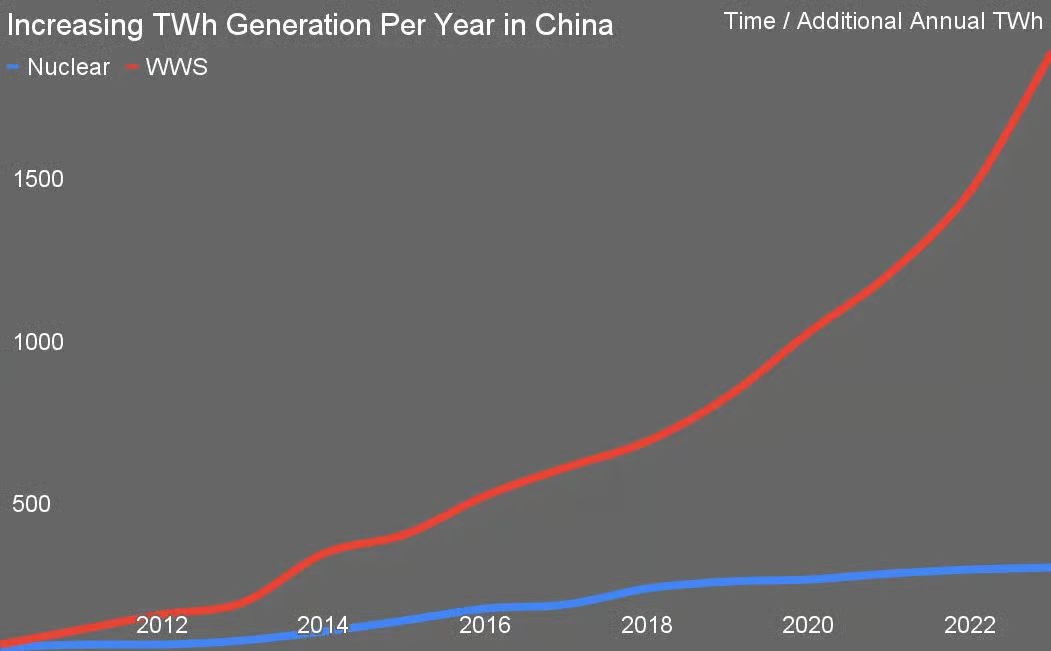
Only China really has the ability to build new nuclear rapidly and cheaply (and rapidly and cheaply compared to nuclear elsewhere in the world, not to renewable energy). Their progress can be seen in this chart showing actual generation from new nuclear and WWS (wind, water (hydro) and solar):
 Mart. Cardiff. 8.72 kWp PV systems (2.12 SSW 4.6 ESE & 2.0 WNW). 28kWh battery storage. Two A2A units for cleaner heating. Two BEV's for cleaner driving.
For general PV advice please see the PV FAQ thread on the Green & Ethical Board.2 -
Yes you're quite right, I didn't include that. Ok, that makes it more palatable. We use around 3000 KWh per year (the rest is standing charge).
I think the heat pump is definitely out, it makes no financial sense at the moment, however it seems that solar is definitely worth looking into in more detail.
Thanks.
3 -
I think the payback period is important. If it breaks even in 4–5 years based on your usage, then it’s a very profitable investment. Renewable energy should become even more widespread. Thanks.
1 -
I agree with your conclusion that a heat pump may not make much sense with a newish oil boiler in a stable world. That said, Trump just called off the ceasefire (again) and price volatility may once again return. This is where the disinflationary impact of a heat pump (with a SCOP > 4) + capable home battery + solar PV system combination can come into its own.
Go down the A2A multi split route and you may benefit from air conditioning, a higher SCOP and less disruption without having to give up the boiler. Decisions, decisions….- 10 x 400w LG Bifacial + 6 x 550W SHARP BiFacial + 2 x 570W SHARP Bifacial + 5kW SolarEdge Inverter + SolarEdge Optimizers. SE London.
- Triple aspect: ENE (2.7 kWp), WSW (3.3 kWp), SSE (2.4 kWp)
- Viessmann 200-W on Advanced Weather Comp. (The most efficient gas boiler sold)Feel free to DM me for help with any form of energy saving! Happy to help!1 -
March illustrated that perfectly. My monthly spreadsheet calculates the equivalent electricity price per kWh required to break even for the ASHP versus the current oil and gas prices (not that we are on the gas grid but it's a useful comparison). In March, as long as I was paying less than 73.62p/kWh for my electricity, the ASHP was cheaper than the oil boiler it replaced. In March, all of our ASHP usage was met by solar at an effective price of 12p/kWh that we otherwise would have received for exporting it had we not used it. So oil would have cost 6 times more in March (and gas was 2.66 times more expensive)
If we had run out of oil in March and needed to purchase at inflated prices at the time, it would have cost £225 in oil to deliver the 1368kWh of heat and hot water we used in March, or £102 in gas versus the £35 of solar generation is actually cost us. This is where calculating ROI becomes complicated - do I value that usage at the £35 of SEG export rates, or the £225 bill I have not had to pay? And what if I'd filled up my oil tank in Feb just before the crisis started?
I am a Forum Ambassador and I support the Forum Team on the Benefits & tax credits, Heat pumps and Green & Ethical MoneySaving forums. If you need any help on those boards, do let me know. Please note that Ambassadors are not moderators. Any post you spot in breach of the Forum Rules should be reported via the report button, or by emailing forumteam@moneysavingexpert.com. All views are my own & not the official line of Money Saving Expert.2 -
This is where calculating ROI becomes complicated - do I value that usage at the £35 of SEG export rates, or the £225 bill I have not had to pay?
That sounds like a £190 saving to me, but I'm not privy to your ROI spreadsheet!
And what if I'd filled up my oil tank in Feb just before the crisis started?
You could've re-sold it for double what you'd paid and count that as ROI too 😆
N. Hampshire, he/him. Octopus Intelligent Go elec / Fuse gas / Vodafone BB / iD mobile. Kirk Hill Co-op member.Ofgem cap table, Ofgem cap explainer. Economy 7 cap explainer. Gas vs E7 vs peak elec heating costs, Best kettle!
2.72kWp PV facing SSW installed Jan 2012. 11 x 247w panels, 3.6kw inverter. 37 MWh generated, long-term average 2.6 Os.2 -
I think it also depends on whether you are installing solar for other reasons besides cost. Both my sister and I installed solar and battery to provide stability of supply. Having some power available to keeping the house lit and warm is better than sitting in the dark for several hours/days worrying about the freezer defrosting!
Selling the surplus is a bonus, or course.
Sealed Pot Challenge no 14
Fashion on the Ration - 66 + 10 carried forward.
3 bras 3/76, + Tevas 8/76 + shorts 14/76 2 pairs of flipflops 24/76 2 bras 26/76 2 pairs black trousers 36/765 -
I haven’t used any oil since the beginning of March, instead using my A2A heat pumps for heating and immersion heater for hot water. I was lucky enough to top my tank up at around 50p/litre. My Worcester Greenstar oil boiler is apparently 90% efficient but let’s say 85% efficiency for the heat wasted in the boiler which doesn’t reach the radiators when it is turned off. So let’s say one kWh of heat delivered from the radiators costs me around 6p/kWh. (In March the replacement cost of oil was around 130p/litre so my effective one kWh would have cost me around 15p but I see that as a blip not long term reset of oil prices). I adopted a COP figure of 4 for my A2A heat pumps which applied to my overnight import cost of 5p would have cost me 1.25p/kWh of heat delivered or more realistically applying it to my export rate of 12p would cost me 3p/kWh of heat delivered. My hot water cost me 5p/kWh. Needless to say I am avoiding using oil until the price drops and I can fill up more cheaply. Currently it is 80p/kWh so the effective cost of a kWh of oil delivered heat would be around 9.5p.
It gets a bit more complicated for me when we get into winter as I won’t have enough battery capacity to see me through a whole day’s A2A space heating - in fact most of my 13kWh capacity will be used up on the house. I would then potentially be paying around 25p/kWh on my tariff or around 7.5p/kWh delivered to the room. If oil falls back to where it was last summer I can top up at 50p/litre and the cost of heat delivered to the radiator then is around 6p/kWh again so it will be back to oil.
I think an A2W heat pump would be less efficient - say COP of 3 and at say 9p/kWh (part 5p, part 12p/kWh) would cost around 3p/kWh delivered. The beauty of an A2A heat pump, though, is you can just heat the rooms you want when you want them which is ideal in spring and autumn. In winter I would potentially be paying 25p/kWh for electricity and at a COP of 3 that’s around 8p/kWh delivered to the room.Now we have 4 internal A2A units I could probably cope with heating most of the house with them except perhaps when temperatures outside were sub zero. Both A2A and A2W heat pumps become less efficient in that scenario and the cost would increase.
What none of us know is just what price electricity and oil (or gas) will be in the future. If following the Iran conflict world demand for oil drops and predictions of a glut of oil materialise we might see future prices even lower than 50p/litre for heating oil. Given the latest CfD contracts issued I don’t see the cost of producing electricity falling significantly but innovative tariffs may make it a bit cheaper for those with heat pumps.
To truly benefit from heat pump specific tariffs one needs a very well insulated house so that the time of delivery of heat does not impact significantly on comfort levels. My house is not bad but not to 2025 insulation standards. For the time being I am going to hang onto my oil boiler but only use it when it is cost effective to do so.Northern Lincolnshire. 7.8 kWp system, (4.2 kWwest facing panels , 3.6 kWeast facing), Solis inverters installed 2018, 5kW SSE facing system (shaded in afternoon) added in 2025 with Tesla PW3 battery, Mitsubishi SRK35ZS-S and SRK20ZS-S Wall Mounted A2A Heat Pumps, ex Nissan Leaf owner.2 -
There's aways an expansion pack for when you give up on oil. This renewables thing a slippery slope :P
- 10 x 400w LG Bifacial + 6 x 550W SHARP BiFacial + 2 x 570W SHARP Bifacial + 5kW SolarEdge Inverter + SolarEdge Optimizers. SE London.
- Triple aspect: ENE (2.7 kWp), WSW (3.3 kWp), SSE (2.4 kWp)
- Viessmann 200-W on Advanced Weather Comp. (The most efficient gas boiler sold)Feel free to DM me for help with any form of energy saving! Happy to help!3 -
@JKenH wrote:
What none of us know is just what price electricity and oil (or gas) will be in the future. If following the Iran conflict world demand for oil drops and predictions of a glut of oil materialise we might see future prices even lower than 50p/litre for heating oil. Given the latest CfD contracts issued I don’t see the cost of producing electricity falling significantly but innovative tariffs may make it a bit cheaper for those with heat pumps.
I agree that the further we go down the CfD road, the more stable our electricity prices become - a large part of our electricity supply will have the price locked in for the next 10-20 years, so fluctuation in gas (or oil) prices will have less effect. If the gas price fell off a cliff, our electricity prices would not automatically follow suit.
I am a Forum Ambassador and I support the Forum Team on the Benefits & tax credits, Heat pumps and Green & Ethical MoneySaving forums. If you need any help on those boards, do let me know. Please note that Ambassadors are not moderators. Any post you spot in breach of the Forum Rules should be reported via the report button, or by emailing forumteam@moneysavingexpert.com. All views are my own & not the official line of Money Saving Expert.1













Confirm your email address to Create Threads and Reply

Categories
- All Categories
- 355.6K Banking & Borrowing
- 254.8K Reduce Debt & Boost Income
- 456.1K Spending & Discounts
- 248.2K Work, Benefits & Business
- 605.7K Mortgages, Homes & Bills
- 179K Life & Family
- 263.5K Travel & Transport
- 1.5M Hobbies & Leisure
- 16.1K Discuss & Feedback
- 37.7K Read-Only Boards