We’d like to remind Forumites to please avoid political debate on the Forum.
This is to keep it a safe and useful space for MoneySaving discussions. Threads that are – or become – political in nature may be removed in line with the Forum’s rules. Thank you for your understanding.
📨 Have you signed up to the Forum's new Email Digest yet? Get a selection of trending threads sent straight to your inbox daily, weekly or monthly!
Extension Lead for Powerful Appliances - do they exist?





Hi,
I know you’re not supposed to use extension leads with powerful appliances but because of where ours plug in, it means I am unable to move the (freestanding) fridge and dishwasher out far enough to clean around them.
We’re getting a facelift in the kitchen and thought it might be an idea to add an extension lead so that I can pull them right out to clean - but obviously only if what I’m looking for exists.
Does anyone know if this sort of thing exists please?
Thank you.
Comments
-
We’re getting a facelift in the kitchen
While you are having the facelift done what about getting the sockets relocated or extended to positions where the cables can reach OK?
You'll probably get responses that normal extension leads are fine and the poster has been using them for years without an issue… but the insurance company won't be impressed by that if a situation ever arises where you have to make a claim and they discover you've run high load appliances using extension leads contrary to the manufacturer's instructions.
2 -
Thank you for the idea. Unfortunately, we’re in the thick of it so I don’t think that will be possible now. The dishwasher’s socket is really close but the way it’s situated means the dishwasher will only come out so far. The fridge is just non moveable without removing the plug. We can get to them to unplug but it means going under the cupboards and behind the kick boards - which is easy enough in terms of if they needed replacing but a faff on just for cleaning!
I definitely wouldn’t use a normal extension - I would only use something that was specifically for such a job, if it were to exist.1 -
I wouldnt worry about it if the extension lead was the minimal or correct lenght needed to reach the socket .
My fridges are on short extension leads of the correct lenght.
Using only 2 or 3 meters of a 20 meter coiled extension lead would be something I wouldnt do .
1 -
There are heavy duty extension leads available using 1.5mm 16A or 2.5mm 24A rated cable. They are generally listed as industrial and not usually available from standard retail outlets. Google "heavy duty extension leads".
Never associate with idiots on their own level, because, being an intelligent man, you'll try to deal with them on their level - and on their level they'll beat you every time.
Being hated by idiots is the price you pay for not being one of them.
Jean Cocteau 1889-1963
1 -
Hi Anon.
It would help to have a pic of sketch of your current setup.
For example, where are the existing sockets located? You say the DW one is 'very close', but still hard to get to - could you explain clearly, please?
If it's under w'top height, so hidden, then it should be very easy to hard-wire in a spur socket to a better location, without any cosmetic issues.
Alternatively, if there really is 'no' other option but an extension cable, would a hard-wired type be better, Ie safer? Ie, existing plug cut off, cable wired to the required amount of additional flex using a suitable inline junction box, and a new plug top?
1 -
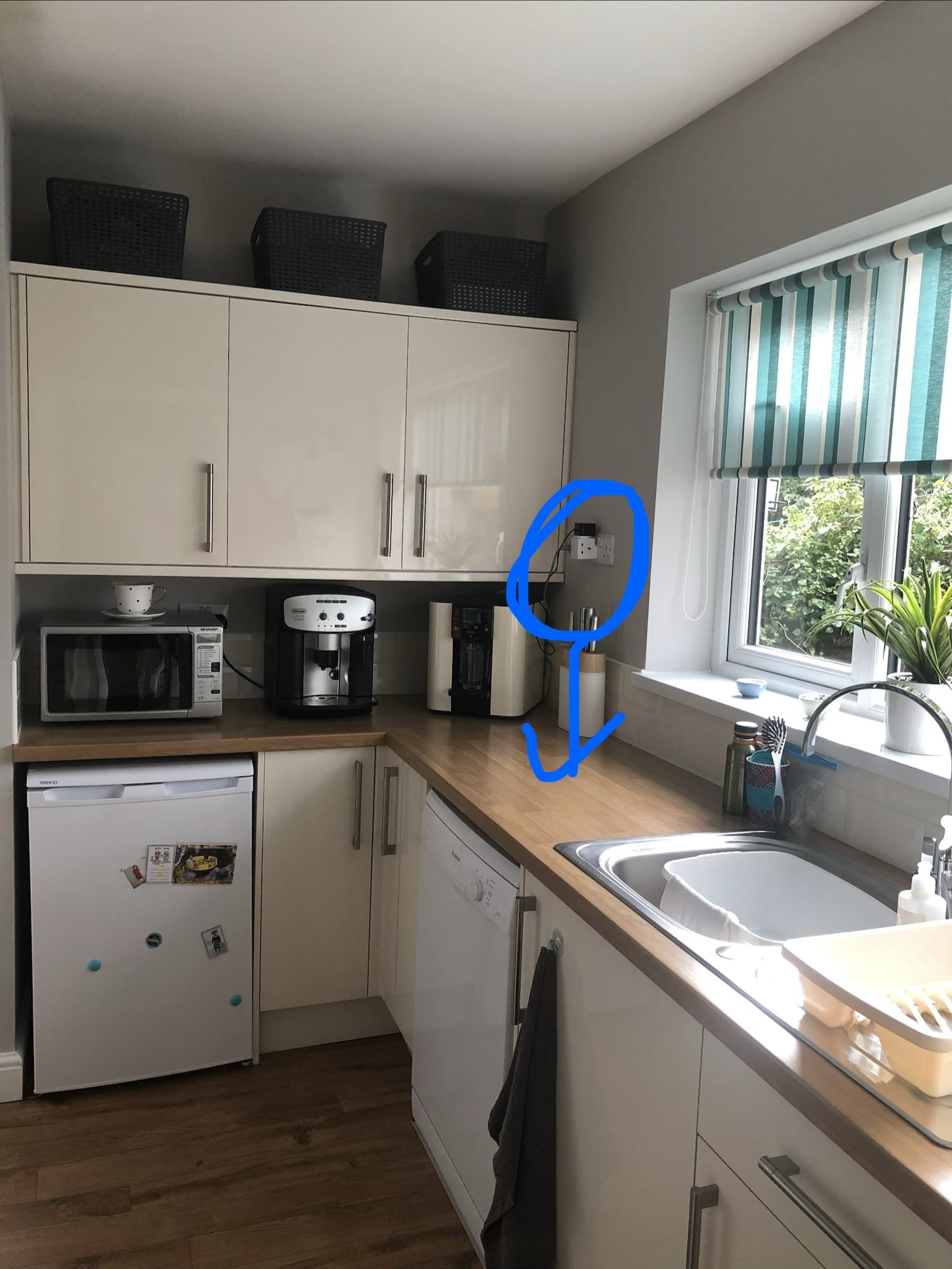
The kitchen is all out at the minute so I’ve added an old picture of it. The socket for the dishwasher is in the base unit next to it, which follows the line of the wall socket I’ve highlighted in blue. This means the dishwasher can come out a bit of the way but not fully to get behind it without unplugging. That said, maybe I should just get my husband to unplug when I need to clean and do it that way. I suppose it’s not that often. The socket it’s plugged into in the base unit is easily accessible to switch power on/off.
The fridge is plugged into the same socket as the dishwasher - the length of the cable fits pretty much exactly under the kick boards without being too taut. That’s more awkward to get to.I do have a good electrician I could run it by but he’s away for a couple of months, hence asking here.
The reason for the facelift is to level the floor and replace with something decent (as well as changing the doors/trims etc) so we only needed our joiner for most of it.1 -
Most usual extension leads are 13A max and the weakest point is its socket, not the cable.
Instead of using an extension lead, you can consider rewiring the appliance(s) with a longer flexible cable. AFAIK even 1.5mm2 cable can handle 13A, but you can use 2.5mm2.
3 -
If your appliance plugs into a standard plug socket it can plug into a standard extension lead. They aren't heavy duty pieces of kit. You do have to watch out for those reel type extension leads as they are only good for 13a items when fully extended, lower when not, and can be susceptible to heat build up. Just get a normal extension lead of a suitable length and plug one end into the wall, and the other end to the appliance. It isn't dangerous to do so. You are generally better plugging one appliance into one plug socket, so I generally apply the same principle for extension leads where something is connected long term.
3 -
Fridges are fairly low power and only run intermittently compared to the high power usage of a dishwasher. I personally would run the fridge off a good quality 1m extension lead but leave the dishwasher plugged into the main socket, unplugging it to clean behind it when necessary.
1 -
That is bad advice. For a start, there's no such thing as a "standard extension lead". Many 10A extension leads are on the market, plugging a high load appliance into one of those will almost certainly overload it.
With lots of cheap imports from China there is no guarantee that an extension lead marked as suitable for 13A is actually capable of carrying that load - without the tools and expertise to verify that the lead is capable of carrying the marked load the owner is taking a gamble that the manufacturer is being honest and truthful with their markings.
Extension leads are intended for temporary use - using one where the cable and trailing socket is hidden away behind an appliance which is rarely pulled out is risky. It means early warning signs of overload may not be seen. And being left on 24/7 and unattended means if something does go wrong there may not be someone around to switch the power off to prevent a bad situation getting worse.
For the sake of unplugging the appliance to allow the machine to be fully pulled out on the odd occasions this is necessary, not using an extension lead is the only sensible thing to do.
0






Confirm your email address to Create Threads and Reply

Categories
- All Categories
- 355.8K Banking & Borrowing
- 254.9K Reduce Debt & Boost Income
- 456.2K Spending & Discounts
- 248.3K Work, Benefits & Business
- 606K Mortgages, Homes & Bills
- 179K Life & Family
- 263.8K Travel & Transport
- 1.5M Hobbies & Leisure
- 16.2K Discuss & Feedback
- 37.7K Read-Only Boards