We’d like to remind Forumites to please avoid political debate on the Forum.
This is to keep it a safe and useful space for MoneySaving discussions. Threads that are – or become – political in nature may be removed in line with the Forum’s rules. Thank you for your understanding.
📨 Have you signed up to the Forum's new Email Digest yet? Get a selection of trending threads sent straight to your inbox daily, weekly or monthly!
The Forum now has a brand new text editor, adding a bunch of handy features to use when creating posts. Read more in our how-to guide
Roof leak - repair from inside?

BuyersRemorse
Posts: 20 Forumite


Over the past few months we've started noticing some leakage during periods of heavy rainfall, in an in-built cupboard in the rear back addition which also houses the boiler. We brought a roofer in to investigate, who had a look at the roof itself with a drone and concluded it must be an issue with the felt underlayment. Repairing this would require scaffolding and therefore cost thousands of pounds, and as it only happened during heavy rainfall we decided to make do by putting a bucket underneath for the time being. We thought we might be able to wait it out until we had other jobs that required scaffolding and do them all in one go.
Last night there was a lot of rain again and quite a bit more came down than before, some of it missing the bucket and seeping right through the floor down into the kitchen below.
I investigated further and noticed a damp piece of plywood covering a hole in the ceiling of the cupboard. Through the hole I could see a tin placed on the floor of the loft space above the room - a tiny space which can be accessed through a hatch. The tin was full and overflowing with water - clearly it had been placed there by the previous owners (we moved less than a year ago) as a stop gap solution. The wire you can see I believe is connected to an antenna on the roof so not an electric wire.
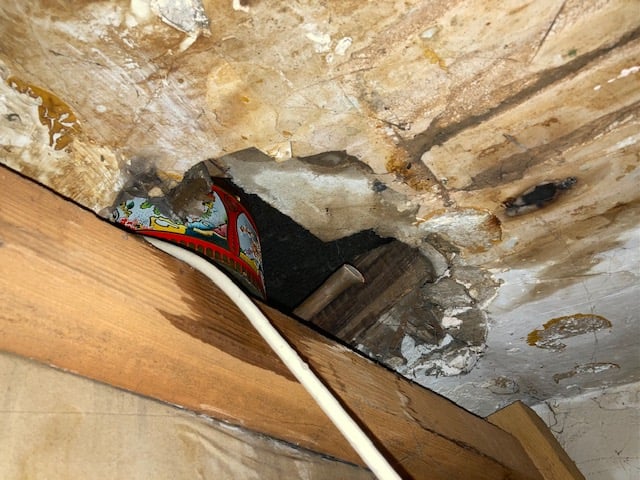
I climbed into the loft space and, lying down, could just about reach the tin to empty it and investigate the roof above it. There were several holes visible (see photos) which must be how the water is getting in. Our surveyors report didn't flag this, but did mention that birds had nested in this area in the past so it's possible that these birds (or perhaps rodents) caused the damage.
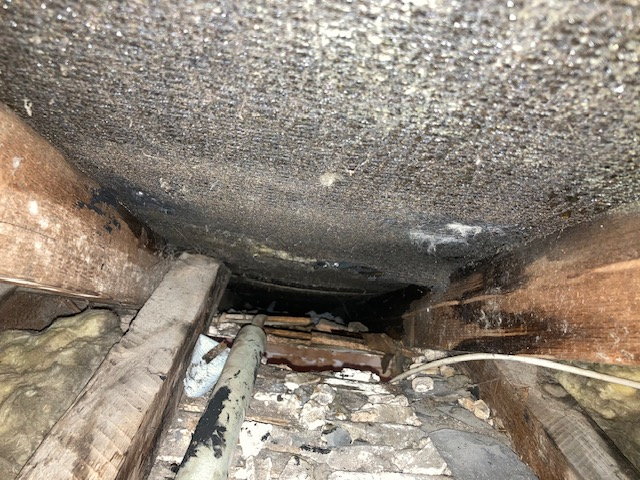
I assume what I'm looking at is the felt underlayment that is directly underneath the roof tiles. Can I repair this from the inside? From some googling, it seems you can sometimes patch the felt with a polyethylene sheet or tarpaulin. Access will be tricky as I can only reach there by lying down in the roof space, but it might be worth a try. If so, what is the best material to use? Anyone have any experience with this?
Last night there was a lot of rain again and quite a bit more came down than before, some of it missing the bucket and seeping right through the floor down into the kitchen below.
I investigated further and noticed a damp piece of plywood covering a hole in the ceiling of the cupboard. Through the hole I could see a tin placed on the floor of the loft space above the room - a tiny space which can be accessed through a hatch. The tin was full and overflowing with water - clearly it had been placed there by the previous owners (we moved less than a year ago) as a stop gap solution. The wire you can see I believe is connected to an antenna on the roof so not an electric wire.
I climbed into the loft space and, lying down, could just about reach the tin to empty it and investigate the roof above it. There were several holes visible (see photos) which must be how the water is getting in. Our surveyors report didn't flag this, but did mention that birds had nested in this area in the past so it's possible that these birds (or perhaps rodents) caused the damage.
I assume what I'm looking at is the felt underlayment that is directly underneath the roof tiles. Can I repair this from the inside? From some googling, it seems you can sometimes patch the felt with a polyethylene sheet or tarpaulin. Access will be tricky as I can only reach there by lying down in the roof space, but it might be worth a try. If so, what is the best material to use? Anyone have any experience with this?
0
Comments
-
In my experience you can effect a temporary repair - which would be better than a metal tin collecting water (that then has nowhere to go). But for the situation in your photo there is no long-term solution other than repairing from above.I've carried out a temporary repair with thick plastic sheet, pinned/nailed to the underside of the sloping roof timbers, extending out and into the soffit area. It means that any drips are (in effect) carried down the slope and outside the house.It is NOT a long-term solution, because (as you can see from your photo) the roof timbers will continue to get wet and they will eventually start to rot. When that happens, your eventual long-term fix will become more expensive, because not only will the membrane need to be replaced - they will also need to splice in replacement timber.0
-
Bear in mind that this issue is not caused by a failed 'felt' layer, but from water getting past whatever the proper roof of your house is - tiles, slate, lead flashing.The 'felt' layer should be very much secondary.On an associated point, I wonder - since it's pretty darned obvious that they knew - if there's the chance of a claim against the seller? Or the surveyor?0
-
As above- many older houses have no felt layer at all, but without any issues.
Your main problem is that the actual roof must be leaking.
0 -
The question about a claim occurred to us as well, but surely there's no obligation on the seller to proactively flag potential defects to the buyer? That's what we got the surveyor in for. The surveyor did note historic damp penetration in this area but failed to spot this issue. In fairness, you have to climb right up into the roof space and do a kind of snake crawl to even see it - it's not visible from the hatch. But he could have picked up on the damp patches in the ceiling of the cupboard, which he definitely inspected as he commented on the boiler.WIAWSNB said:Bear in mind that this issue is not caused by a failed 'felt' layer, but from water getting past whatever the proper roof of your house is - tiles, slate, lead flashing.The 'felt' layer should be very much secondary.On an associated point, I wonder - since it's pretty darned obvious that they knew - if there's the chance of a claim against the seller? Or the surveyor?
From the survey:The rear back addition roof space is accessed via the rear bedroom. There is no ladder present and one cannot be installed due to poor inaccessibility.Historic damp penetration is present to the valley. Birds have in the past, nested in this area. Timbers are damaged as a consequence of historic damp penetration though this area was found to be dry upon testing. When replacing the rear back addition roof covering, we recommend timbers are also replaced which are sound.Rot is still present, though no repair is currently required. Albeit, another leak in this area will cause more serious problems.This area should be kept under observation. Any problems to do with flashings and damp penetration affecting this part of the roof will lead to swift deterioration in the roof structure.
So it does highlight the risk of further leaks in this area, but doesn't flag the one already there. I suppose they might have some kind of professional insurance for this kind of thing?0 -
WIAWSNB said:Bear in mind that this issue is not caused by a failed 'felt' layer, but from water getting past whatever the proper roof of your house is - tiles, slate, lead flashing.The 'felt' layer should be very much secondary.On an associated point, I wonder - since it's pretty darned obvious that they knew - if there's the chance of a claim against the seller? Or the surveyor?
Makes sense, but that does make me question the aptitude of the roofer who had one look and said the roof itself looked pretty sound and it must be the felt layer underneath which doesn't provide a proper seal. It does seem worse when it's windy so perhaps there are small gaps somewhere which allow rainwater to penetrate in certain conditions.Albermarle said:As above- many older houses have no felt layer at all, but without any issues.
Your main problem is that the actual roof must be leaking.0 -
BuyersRemorse said:Makes sense, but that does make me question the aptitude of the roofer who had one look and said the roof itself looked pretty sound and it must be the felt layer underneath which doesn't provide a proper seal. It does seem worse when it's windy so perhaps there are small gaps somewhere which allow rainwater to penetrate in certain conditions.There's the aptitude or competence of the surveyor, and then there's the level of survey you paid to have carried out.I'm not clued-up on this, but others on here will be. Could you tell us what level of survey you had carried out?And then there's what the vendor is obliged to inform you of. I understand that this is a fair amount - what would be considered reasonable. Ie, not informing you of a significant issue - and water penetration clearly is - may be included. Known 'structural' issues certainly are.Again, I hope folk on here - or on the sister forum - https://forums.moneysavingexpert.com/categories/house-buying-renting-selling - will know, and can advise better.You could also call up your conveyancing solicitor and ask. (Tho' treat t'answer with some caution.)
1 -
Yes the felt can help to contain occasional minor water ingress, caused by unusual weather conditions/high winds etc.BuyersRemorse said:WIAWSNB said:Bear in mind that this issue is not caused by a failed 'felt' layer, but from water getting past whatever the proper roof of your house is - tiles, slate, lead flashing.The 'felt' layer should be very much secondary.On an associated point, I wonder - since it's pretty darned obvious that they knew - if there's the chance of a claim against the seller? Or the surveyor?
Makes sense, but that does make me question the aptitude of the roofer who had one look and said the roof itself looked pretty sound and it must be the felt layer underneath which doesn't provide a proper seal. It does seem worse when it's windy so perhaps there are small gaps somewhere which allow rainwater to penetrate in certain conditions.Albermarle said:As above- many older houses have no felt layer at all, but without any issues.
Your main problem is that the actual roof must be leaking.
However this sounds a bit worse than that, as it seems to have been happening in the same place for some time.
The roofer could be right that he can not spot anything from outside and the felt will have to come off in that area at least to have a look inside.
However just replacing the felt is not getting to the core problem.
I would get another roofer to have a look.2 -
It was a level 2 survey. We did consider a level 3 survey but the surveyor actually persuaded us that a level 2 would be sufficient. A level 2 survey does include some inspection of the too space but not as comprehensive as a level 3 survey, though I’m not sure of the exact difference.WIAWSNB said:BuyersRemorse said:Makes sense, but that does make me question the aptitude of the roofer who had one look and said the roof itself looked pretty sound and it must be the felt layer underneath which doesn't provide a proper seal. It does seem worse when it's windy so perhaps there are small gaps somewhere which allow rainwater to penetrate in certain conditions.There's the aptitude or competence of the surveyor, and then there's the level of survey you paid to have carried out.I'm not clued-up on this, but others on here will be. Could you tell us what level of survey you had carried out?And then there's what the vendor is obliged to inform you of. I understand that this is a fair amount - what would be considered reasonable. Ie, not informing you of a significant issue - and water penetration clearly is - may be included. Known 'structural' issues certainly are.Again, I hope folk on here - or on the sister forum - https://forums.moneysavingexpert.com/categories/house-buying-renting-selling - will know, and can advise better.You could also call up your conveyancing solicitor and ask. (Tho' treat t'answer with some caution.)To be fair, the surveyor did a really thorough job and provided us with a very comprehensive report flagging all sorts of other minor and a few major potential issues, so I would feel bad to make a big deal of it, but knowing there was a likely expensive roof repair lurking would have definitely impacted our negotiations with the seller, perhaps even our decision to go ahead.Interesting point about the responsibilities of the seller too. I think we’ll give our solicitor a call and see what they say.1 -
The surveyor has mentioned the previous damp problems. If the survey was done after and extended dry period it's entirely possible on problem was apparent. The surveyor also stated they couldn't access the roof area as no ladder was present. The possibility of further water ingress was also pointed out. I don't think the surveyor could have done much more.The OP needs to check with their solicitor to see if any questions were asked of the vendor about any issues with the property. Only then will the OP really know if they have a case against the vendor.3
-
The seller can only really be held responsible if they knew about the issue and lied to you about it. For example if a seller knows about an issue, is questioned about it and replied that he doesn't know that's a lie. However he can just refuse to answer any questions. Executors, especially professional ones, usually refuse to fill out a TA6 form. However I think in March it becomes compulsory.BuyersRemorse said:
It was a level 2 survey. We did consider a level 3 survey but the surveyor actually persuaded us that a level 2 would be sufficient. A level 2 survey does include some inspection of the too space but not as comprehensive as a level 3 survey, though I’m not sure of the exact difference.WIAWSNB said:BuyersRemorse said:Makes sense, but that does make me question the aptitude of the roofer who had one look and said the roof itself looked pretty sound and it must be the felt layer underneath which doesn't provide a proper seal. It does seem worse when it's windy so perhaps there are small gaps somewhere which allow rainwater to penetrate in certain conditions.There's the aptitude or competence of the surveyor, and then there's the level of survey you paid to have carried out.I'm not clued-up on this, but others on here will be. Could you tell us what level of survey you had carried out?And then there's what the vendor is obliged to inform you of. I understand that this is a fair amount - what would be considered reasonable. Ie, not informing you of a significant issue - and water penetration clearly is - may be included. Known 'structural' issues certainly are.Again, I hope folk on here - or on the sister forum - https://forums.moneysavingexpert.com/categories/house-buying-renting-selling - will know, and can advise better.You could also call up your conveyancing solicitor and ask. (Tho' treat t'answer with some caution.)To be fair, the surveyor did a really thorough job and provided us with a very comprehensive report flagging all sorts of other minor and a few major potential issues, so I would feel bad to make a big deal of it, but knowing there was a likely expensive roof repair lurking would have definitely impacted our negotiations with the seller, perhaps even our decision to go ahead.Interesting point about the responsibilities of the seller too. I think we’ll give our solicitor a call and see what they say.
Saying all this, I'm not a legal expert, so a solicitor will give you better advice.1






Confirm your email address to Create Threads and Reply

Categories
- All Categories
- 354.5K Banking & Borrowing
- 254.4K Reduce Debt & Boost Income
- 455.4K Spending & Discounts
- 247.4K Work, Benefits & Business
- 604.2K Mortgages, Homes & Bills
- 178.5K Life & Family
- 261.7K Travel & Transport
- 1.5M Hobbies & Leisure
- 16.1K Discuss & Feedback
- 37.7K Read-Only Boards