We’d like to remind Forumites to please avoid political debate on the Forum.
This is to keep it a safe and useful space for MoneySaving discussions. Threads that are – or become – political in nature may be removed in line with the Forum’s rules. Thank you for your understanding.
📨 Have you signed up to the Forum's new Email Digest yet? Get a selection of trending threads sent straight to your inbox daily, weekly or monthly!
Asset Allocations by Country and Asset Type
Comments
-
chiang_mai said:
My major worry in these discussions is the novice investor who buys a global tracker and forgets about it, because they think it will do everything for them and they don't have to know or do anything. I think this is a throw back to a distorted Warren Buffet message that was taken out of context, combined with media messages to begin investing the simple low risk way.masonic said:While all this data is informative, I think it is important to recognise the limitations of any analysis performed on it. I am generally less concerned about what other people are investing in, but the data does tell an interesting story. If 60% of inflows are passive, yet the average UK investor still has a massive home bias and low US exposure, it suggests they aren't just buying global trackers. Instead, active allocation decisions are being made elsewhere - likely by pension default fund managers, robo-firms, and multi-asset fund houses. OTOH, the US has a large population, a greater proportion of whom invest in stocks, and probably larger sums on average, which could drive country weightings the other way.
Data from the Opinium/IA survey suggests that UK investors (particularly younger ones) actually want a degree of home bias, so we may just be seeing the market provide what is being asked for. Interestingly, this is happening while pension funds have reportedly spent the last decade reducing UK exposure, through a long period of UK underperformance. That shows that even professional asset managers struggle with timing.
What I find more interesting are valuation models, but these have serious limitations. We have the CAPE ratio, which is a fairly blunt instrument and cannot easily differentiate between irrational exuberance and a structural shift in the market. Today's capital-light/intangible-heavy tech companies have high profit margins, moats, and massive share buybacks that make them look expensive by historical standards almost all of the time. The Vanguard Capital Asset Pricing Model is more sophisticated, but it still only gives us probabilistic outputs with large uncertainties. It has been predicting low US growth for two years now, but we won't know if it was actually right for another eight years.
In my recent shift to a 60/40 allocation (and tilt away from the US), I've tried to keep these unknowns at the front of my mind. I don't have high conviction in any prediction. In adjusting my portfolio, I am not necessarily betting against AI or even predicting a crash. I simply view the current risks as outweighing the potential returns and I've reflected that uncertainty in the extent of my tilt. For me, overconfidence in the models is also a significant risk. But the ability to obtain a risk free ~2% real return outside of equities allows me to be wrong and still meet my objectives.I don't think that's necessarily a problem if they have the risk tolerance and time horizon. The Warren Buffett message was not to buy a global tracker, rather the S&P500 alone. But he was suggesting this within the US to a predominantly US audience. Buying a global index is lower risk than single country investing, but it still sits within the high risk bucket, as does all pure equity investing.
Very few people do buy passive. They opt for their pension default fund, choose between their investment platform's ready-made risk graded portfolio options, or pick a multi-asset fund, all of which are managed options. Incidentally, all of which would have underperformed passive over the last decade (likely even 2 decades).chiang_mai said:I don’t think it’s sufficient to simply decide on passive versus managed investment funds and then go ahead and buy something. Actually, I'm not sure many people conciously make that choice, I suspect with many it's a bandwagon they simply jump on, without really understanding all the pro's and con's. Whichever appropach a person decides on, they have to look under the hood and understand what they're buying. They might decide that buying a passive global index tracker will give them the world that is low risk but this is not always as true as it first appears. Global trackers can include anywhere from 60% to 82% US equties allocations, Emerging markets and small and medium, capitalised companies. If they don’t know which they want and why, I’d question whether they should be buying in the first place? 60%/82% US, when equities represent only 48% of investable global assets, does the investor really agree with that massive tilt, let alone understand it?There are a few misunderstandings in what you've written here that need clarification:- "Passive" is generally taken to mean the opposite of "active" and relates to portfolio turnover. I don't think it makes sense to invest in funds with a high portfolio turnover as it increases hidden costs and runs counter to the long term investment philosophy. At one extreme, the global market cap-weighted index ensures only companies being promoted into/falling out of the index are traded by the fund, while all constituents are simply held without rebalancing. There is a lot to be said in favour of this approach, but it does mean certain companies/industries/countries can become concentrated if they do particularly well relative to others. Common usage of the term "passive" also includes fund-of-funds which use index funds as their building blocks. These can rebalance between their sub-funds to reduce concentration, and as such are more active than a global index fund, but not to the extent it would meaningfully impact costs. They can contain both equities and bonds. As such, they are more popular than global index funds because they also cater to people's risk tolerance.
- The 82% US equity allocation you've mentioned several times is not a feature of global trackers as far as I can see. I thought at first it was a figure from your first post for what US people allocate to their home market, but even that is only 78%, so I have no idea where it has come from. For reference, the FTSE All World contains 62% US equities and is the best representation of global equities, while in the narrower developed market index (which excludes EM) this rises to around 73%. MSCI indices are pretty much the same. When people buy a global index fund, they are seeking to capture the market return at low cost, which is a perfectly reasonable thing to do if they are a long term investor.
- From your figures shared in your first post, UK investors only hold an average of 34% US equities. I'm not sure many people consciously make that choice either. It is far more likely that this average is composed of a silent majority who invest with the home bias their chosen asset manager has selected for them, a minority who opt for a global index or S&P500 index, and a minority who focus largely or entirely on the domestic market. So I think there could be a mischaracterisation of what the bandwagon for the novice investor actually is.
- Finally, the mention of 60%/82% US in the context of equities representing 48% of investable global assets is a conflation. It should not be assumed that someone buying a global equity fund is 100% equities. Some will be, others will hold bonds separately, yet others will hold cash and equivalents instead. For those that hold 100% equities and do not have the necessary risk capacity and tolerance, then the solution would be to reallocate from equities to bonds. That's regardless of the composition of their equities.
This is where I would suggest a little knowledge is a dangerous thing. "Balanced" is a subjective term and an investor should question exactly what they are trying to achieve in seeking to reflect their views in their portfolio. I'm reminded of similar discussion that were taking place on this forum almost a decade ago. It's a completely rational approach to resign yourself to the fact that you can't know what the future holds, ignore the noise around valuation/concentration etc, and invest for the long term. Had the poster in the linked thread continued to underweight the US from May 2017 to now, this would have been the result:chiang_mai said:Investment portfolio’s contain so many variables that trying to maintain balance of all of them is very difficult. An investor might balance for geography and the percentages invested in different markets but then there’s capitalisation balance as well as sector, risk and asset class. One small tweak in one particular area can easily cause other areas to become unbalanced, depleted or concentrated. My experience is that it’s not enough to identify a good investment fund, you also have to see if it will fit within your portfolio and what the impact might be of acquiring the fund, on your other holdings.Of course, if an investor buys an off the shelf tracker, they probably don’t need to worry too much about balancing its components, because the tracker will do some of that for them. But it wont balance geographies to the extent they might want them to be balanced, which mean they must check and make sure they're happy with them from the outset. It's slightly ironic that investors can have strong views on say the US and its future economy, yet not make the connection between that thinking and the US dominant tracker, in which they've tied up their financial future. If they're not happy with 70% in the US and 3% in Japan, they either need a different tracker or will have to start adding other things, in order to achieve the desired balance (see the previous para).
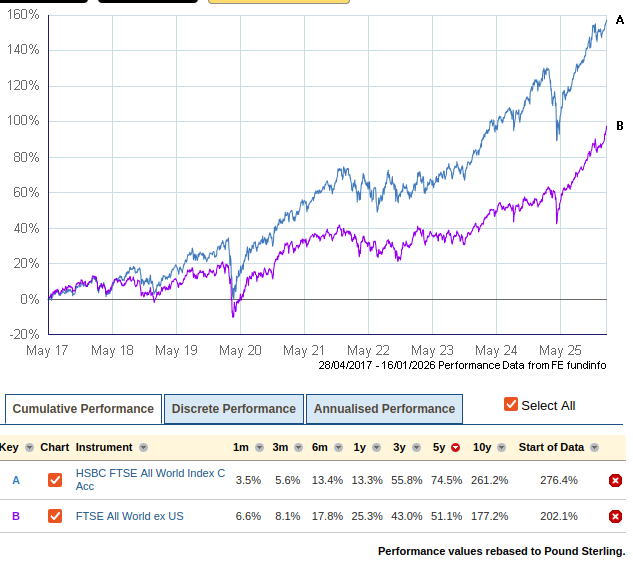 Now let's say the US suffers a major crash of 50%, but the ROW gets away with only 30%. That would leave them with only 30% gain vs the ex-US result of a 40% gain.Of course, anyone entering the arena today is doing so after an even longer cycle of US outperformance, but equally, nobody knows the future. Over a long enough time horizon, the waxing and waning of dominant companies/sectors/geographies is expected, and despite this the market generates an attractive return as a whole.So "balance" and "tilt" are a matter of personal preference. It is not necessary to have such a preference to meet your objectives if those objectives are reasonable and you are in it for the long game. It is those of us who have constraints on our time horizon that need to tread more carefully.3
 -
My first choice is an Exel spreadsheet, my second is a pen and paper.badger09 said:Interesting thread.Which online tools (available to all) do posters use to analyse weighting of their portfolios?
As if to say, I've always done it manually since I've yet to find any online tools that cover the breadth of funds that I hold.0 -
The usual intellectual justification for global indexing is that it represents the collective judgement of the world’s investors and to invest differently is claiming that one knows better.
The figures given here show this argument is fallacious. The figures instead show that the collective judgement of the world’s investors is to hold a significant home bias. The high US allocation in index trackers arises simply from the US being the largest “home”.
The effect of more non-US investors buying global trackers could be the % US will increase leading to further distortion in the world’s markets.4 -
I do think it's probable that investors get too hung up on beating the index versus concentrating on making the return that suits them. My major concern is to realise my 15% per year, it matters not a jot that one or two of my funds were beaten by trackers. That said, of the nine managed funds that I hold currently, all have beaten the index by a decent margin, otherwise I don't hold them.OldScientist said:I think the advocacy for a global cap weighted portfolio in equities is largely derived from Jack Bogle's work as then applied to the US stock market and derived from the fact that the average investor in any given market will receive the average returns of the market less costs (e.g., see https://johncbogle.com/speeches/JCB_MS0205.pdf ).
If a retail investor is willing to modify their holdings in equities in response to events or 'sentiment', to consistently earn a return above a 'global' fund (and as you point out there are a number of different indices) or with lower volatility their predictions of future events would have to be largely correct. For example, if the US stock market consistently has a lower return than ex-US over the next few years, then those who have reduced their US exposure will win their bet while otherwise they will not.
I agree that bond funds in general do need some digging into since 'cap weighting' in bond indices (i.e., issue weighting) is a rather odd feature of global bond funds (IMV, it makes more sense for single countries) since the most heavily indebted countries have the largest weighting. The fund duration is of particular importance - short duration, generally lower return and lower volatility, long duration generally higher return but greater volatility with intermediate duration somewhere between the two.0 -
A quick and partial response to one of the points you raised:masonic said:chiang_mai said:I don’t think it’s sufficient to simply decide on passive versus managed investment funds and then go ahead and buy something. Actually, I'm not sure many people conciously make that choice, I suspect with many it's a bandwagon they simply jump on, without really understanding all the pro's and con's. Whichever appropach a person decides on, they have to look under the hood and understand what they're buying. They might decide that buying a passive global index tracker will give them the world that is low risk but this is not always as true as it first appears. Global trackers can include anywhere from 60% to 82% US equties allocations, Emerging markets and small and medium, capitalised companies. If they don’t know which they want and why, I’d question whether they should be buying in the first place? 60%/82% US, when equities represent only 48% of investable global assets, does the investor really agree with that massive tilt, let alone understand it?- The 82% US equity allocation you've mentioned several times is not a feature of global trackers as far as I can see. I thought at first it was a figure from your first post for what US people allocate to their home market, but even that is only 78%, so I have no idea where it has come from. For reference, the FTSE All World contains 62% US equities and is the best representation of global equities, while in the narrower developed market index (which excludes EM) this rises to around 73%. MSCI indices are pretty much the same. When people buy a global index fund, they are seeking to capture the market return at low cost, which is a perfectly reasonable thing to do if they are a long term investor.
The 82% I refer to is actually 81% and is the L&G 100 global index trust.
https://www.fidelity.co.uk/markets-insights/investing-ideas/funds/which-global-index-fund-is-best-for-you/
I will read and respond to the other points, once I take care of my day job.1 -
Oh, so essentially just the largest 100ish companies in the world. That is not the sort of index I think anyone should have on their short-list for investment.chiang_mai said:
A quick and partial response to one of the points you raised:masonic said:chiang_mai said:I don’t think it’s sufficient to simply decide on passive versus managed investment funds and then go ahead and buy something. Actually, I'm not sure many people conciously make that choice, I suspect with many it's a bandwagon they simply jump on, without really understanding all the pro's and con's. Whichever appropach a person decides on, they have to look under the hood and understand what they're buying. They might decide that buying a passive global index tracker will give them the world that is low risk but this is not always as true as it first appears. Global trackers can include anywhere from 60% to 82% US equties allocations, Emerging markets and small and medium, capitalised companies. If they don’t know which they want and why, I’d question whether they should be buying in the first place? 60%/82% US, when equities represent only 48% of investable global assets, does the investor really agree with that massive tilt, let alone understand it?- The 82% US equity allocation you've mentioned several times is not a feature of global trackers as far as I can see. I thought at first it was a figure from your first post for what US people allocate to their home market, but even that is only 78%, so I have no idea where it has come from. For reference, the FTSE All World contains 62% US equities and is the best representation of global equities, while in the narrower developed market index (which excludes EM) this rises to around 73%. MSCI indices are pretty much the same. When people buy a global index fund, they are seeking to capture the market return at low cost, which is a perfectly reasonable thing to do if they are a long term investor.
The 82% I refer to is actually 81% and is the L&G 100 global index trust.
https://www.fidelity.co.uk/markets-insights/investing-ideas/funds/which-global-index-fund-is-best-for-you/
I will read and respond to the other points, once I take care of my day job.1 -
If you look for your fund(s) on Moringstar and find the relevant page, click on the portfolio tab and pretty much all the data you need is right there, country weights, capitalisation ratio's etc.badger09 said:Interesting thread.Which online tools (available to all) do posters use to analyse weighting of their portfolios?0 -
One problem is that investors don’t always quantify their risk, because they don’t know what’s inside their fund. Yet you hear those same investors say they want to reduce risk, when markets get scary. If you don’t know what your current risks are, how will you know when you’ve reduced them! Balance is of course subjective but there are also some broad guidelines that the novice might adopt. This novice shoots for 70/20/10 as a balanced capital ratio, it’s neither aggressive nor overly cautious and is a baseline against which I can measure where I am at any point in time. I’m currently 65/23/12, which means I’m still broadly balanced but I probably don’t want to add any more small caps soon…..that’s a useful piece of information for me to understand.
We’ve discussed geographic distribution several times so there’s no point in rehashing things. Suffice to say that it’s important to me to understand the geographic balance between markets because I have strong views on how deep I want to be in some markets and how much I want to exploit others. This is my subjective balance, if I don’t understand the internals of my holdings, I can’t maintain my preferred balance and will have no steerage.
0 -
What does the 65/23/12 represent? I'm presuming not equities/bonds/cash equivalents as I thought your % equities was lower than that. In my view investors who say they want to reduce risk are talking about maximum drawdowns, and will invariably be needing to dial down total equities to achieve that.chiang_mai said:One problem is that investors don’t always quantify their risk, because they don’t know what’s inside their fund. Yet you hear those same investors say they want to reduce risk, when markets get scary. If you don’t know what your current risks are, how will you know when you’ve reduced them! Balance is of course subjective but there are also some broad guidelines that the novice might adopt. This novice shoots for 70/20/10 as a balanced capital ratio, it’s neither aggressive nor overly cautious and is a baseline against which I can measure where I am at any point in time. I’m currently 65/23/12, which means I’m still broadly balanced but I probably don’t want to add any more small caps soon…..that’s a useful piece of information for me to understand.
We’ve discussed geographic distribution several times so there’s no point in rehashing things. Suffice to say that it’s important to me to understand the geographic balance between markets because I have strong views on how deep I want to be in some markets and how much I want to exploit others. This is my subjective balance, if I don’t understand the internals of my holdings, I can’t maintain my preferred balance and will have no steerage.
0 -
It's the capitalisation ration, 65% large/giant caps, 23% mid caps and 12% small caps.masonic said:
What does the 65/23/12 represent? I'm presuming not equities/bonds/cash equivalents as I thought your % equities was lower than that. In my view investors who say they want to reduce risk are talking about maximum drawdowns, and will invariably be needing to dial down total equities to achieve that.chiang_mai said:One problem is that investors don’t always quantify their risk, because they don’t know what’s inside their fund. Yet you hear those same investors say they want to reduce risk, when markets get scary. If you don’t know what your current risks are, how will you know when you’ve reduced them! Balance is of course subjective but there are also some broad guidelines that the novice might adopt. This novice shoots for 70/20/10 as a balanced capital ratio, it’s neither aggressive nor overly cautious and is a baseline against which I can measure where I am at any point in time. I’m currently 65/23/12, which means I’m still broadly balanced but I probably don’t want to add any more small caps soon…..that’s a useful piece of information for me to understand.
We’ve discussed geographic distribution several times so there’s no point in rehashing things. Suffice to say that it’s important to me to understand the geographic balance between markets because I have strong views on how deep I want to be in some markets and how much I want to exploit others. This is my subjective balance, if I don’t understand the internals of my holdings, I can’t maintain my preferred balance and will have no steerage.
My equities ratio currently is 46% (by value)
I understand drawdown to be the maximum peak to valley fall by the fund, the HSBC FTSE All World drawdown for example is 10.5%. I use that figure, along with volatility to help determine fund risk. For others who need a more detailed explanation of this measurement: https://www.investopedia.com/terms/p/peak-to-valley-drawdown.asp1








Confirm your email address to Create Threads and Reply

Categories
- All Categories
- 355.8K Banking & Borrowing
- 254.9K Reduce Debt & Boost Income
- 456.2K Spending & Discounts
- 248.3K Work, Benefits & Business
- 605.9K Mortgages, Homes & Bills
- 179K Life & Family
- 263.7K Travel & Transport
- 1.5M Hobbies & Leisure
- 16.2K Discuss & Feedback
- 37.7K Read-Only Boards