We’d like to remind Forumites to please avoid political debate on the Forum.
This is to keep it a safe and useful space for MoneySaving discussions. Threads that are – or become – political in nature may be removed in line with the Forum’s rules. Thank you for your understanding.
📨 Have you signed up to the Forum's new Email Digest yet? Get a selection of trending threads sent straight to your inbox daily, weekly or monthly!
Advice on fund
Comments
-
I actually get some great advice on this forum. You just have to be very careful and listen to the people genuinely wanting to give advice versus those think there are some kind of expert but never actually given any meaningful advice or listen & try to understand the poster & like to rage for some kind of self fulfilment.Bostonerimus1 said:The OP seems to have little grasp on different asset classes and is open to decision making based on advice from LLMs and because an investment seems to do doing well for other people. What could go wrong? BIPS looks like an expensive managed bond fund with a lot of less than "A" rated bonds that, like all bond funds, has had its value hit by interest rate increases. It should see an increase in value as rates fall in an effort to stimulate the economy. Anything that pays a dividend of 7% is swimming in some risky income waters. I like to split my risk between dividends and growth.
It's fairly easy to tell the difference, usually the tone & kind of dramatic language they use to describe thingsThe greatest prediction of your future is your daily actions.0 -
Yes better balance. Something for regular income to add to a small LGPS & interest from savings to cover alLinton said:
BIPS (or any other investment) could only be recommended in the light of your circumstances and what you want from your investment. It really is a niche fund bought for specific objectives. It is unclear what your objectives are and how your proposed addition fits in with the rest of your portfolio. Do you want more of the same or something to provide a better balance to your current holdings.dont_use_vistaprint said:Thanks for the comments.
So my understanding is it's an an income generating asset, and inside a SIPP it would regularly pay into the cash balance rather than focus on capital growth & you could re-invest that but would pay fees each time so it's more suited to someone drawing those dividends as regular income and it fairly reliable in the income of 6-7% and the capital is generally low risk but don't expect much or even any growth. And look for discounts when timing the initial buy.
Im assuming the dividends it pays inside a SIPP would be treated as uncrystallised currently? and may in future be subject to tax even before drawdown ?
is that about right ?Seems to me it was a very good recommendation
If your SIPP is fully uncrystallised or fully uncrystallised the income from a fund will retain the same status. However, I believe if your portfolio is partially crystalised exactly how income is treated will depend on the platform and whether it treats the crystallised and uncrystallised parts as separate portfolios.
Income within a SIPP wont be subject to tax unless the whole structure of pensions is drastically changed. Drawing down the income from a pension will be taxed exactly in the same way as any other drawdown.
the normal costs and with liquidy if I decide I need it. I have the VLS80 for longer term growth opportunity , money markets and savings for cash but with interest rates falling I'm inclined to keep less in those and so something paying 6-8% seems good.The high capital risks mentioned by some do not add up given its long history of being stable and the discounting looks attractive.The greatest prediction of your future is your daily actions.0 -
Past performance is no guarantee of future performance.dont_use_vistaprint said:
Yes better balance. Something for regular income to add to a small LGPS & interest from savings to cover alLinton said:
BIPS (or any other investment) could only be recommended in the light of your circumstances and what you want from your investment. It really is a niche fund bought for specific objectives. It is unclear what your objectives are and how your proposed addition fits in with the rest of your portfolio. Do you want more of the same or something to provide a better balance to your current holdings.dont_use_vistaprint said:Thanks for the comments.
So my understanding is it's an an income generating asset, and inside a SIPP it would regularly pay into the cash balance rather than focus on capital growth & you could re-invest that but would pay fees each time so it's more suited to someone drawing those dividends as regular income and it fairly reliable in the income of 6-7% and the capital is generally low risk but don't expect much or even any growth. And look for discounts when timing the initial buy.
Im assuming the dividends it pays inside a SIPP would be treated as uncrystallised currently? and may in future be subject to tax even before drawdown ?
is that about right ?Seems to me it was a very good recommendation
If your SIPP is fully uncrystallised or fully uncrystallised the income from a fund will retain the same status. However, I believe if your portfolio is partially crystalised exactly how income is treated will depend on the platform and whether it treats the crystallised and uncrystallised parts as separate portfolios.
Income within a SIPP wont be subject to tax unless the whole structure of pensions is drastically changed. Drawing down the income from a pension will be taxed exactly in the same way as any other drawdown.
the normal costs and with liquidy if I decide I need it. I have the VLS80 for longer term growth opportunity , money markets and savings for cash but with interest rates falling I'm inclined to keep less in those and so something paying 6-8% seems good.The high capital risks mentioned by some do not add up given its long history of being stable and the discounting looks attractive.
What are you referring to when you say, "...the discounting looks attractive"? Its 22/12 NAV is 172.44p per share and this morning it's being offered at 175.14p i.e. it's trading at a premium.
https://www.londonstockexchange.com/stock/BIPS/invesco-bond-income-plus-limited/company-page
https://www.londonstockexchange.com/news-article/BIPS/net-asset-value-s/17387306
1 -
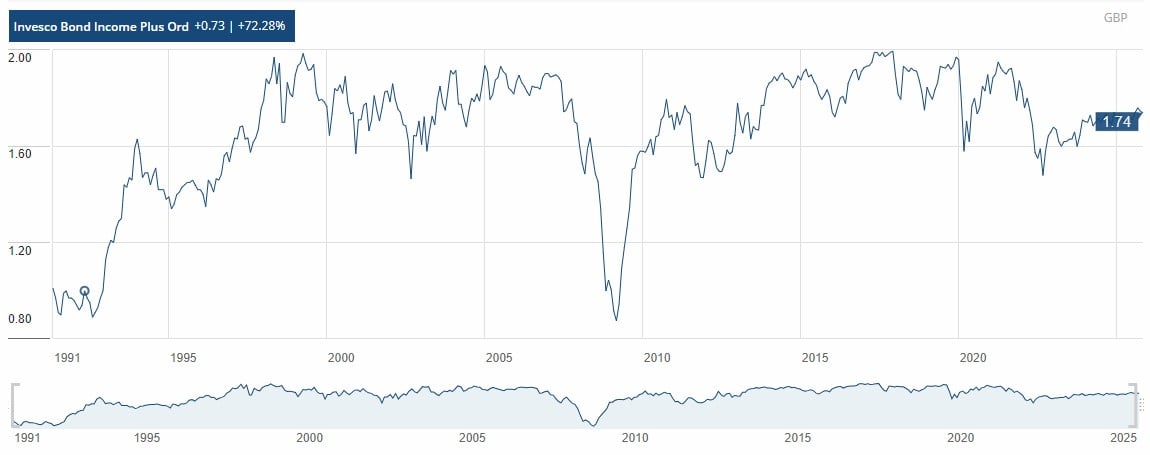
dont_use_vistaprint said:The high capital risks mentioned by some do not add up given its long history of being stable and the discounting looks attractive.What source are you using for evidence of this long history of being stable? To me it looks like the capital is not at all stable:
 0
0 -
dont_use_vistaprint said:
Yes better balance. Something for regular income to add to a small LGPS & interest from savings to cover alLinton said:
BIPS (or any other investment) could only be recommended in the light of your circumstances and what you want from your investment. It really is a niche fund bought for specific objectives. It is unclear what your objectives are and how your proposed addition fits in with the rest of your portfolio. Do you want more of the same or something to provide a better balance to your current holdings.dont_use_vistaprint said:Thanks for the comments.
So my understanding is it's an an income generating asset, and inside a SIPP it would regularly pay into the cash balance rather than focus on capital growth & you could re-invest that but would pay fees each time so it's more suited to someone drawing those dividends as regular income and it fairly reliable in the income of 6-7% and the capital is generally low risk but don't expect much or even any growth. And look for discounts when timing the initial buy.
Im assuming the dividends it pays inside a SIPP would be treated as uncrystallised currently? and may in future be subject to tax even before drawdown ?
is that about right ?Seems to me it was a very good recommendation
If your SIPP is fully uncrystallised or fully uncrystallised the income from a fund will retain the same status. However, I believe if your portfolio is partially crystalised exactly how income is treated will depend on the platform and whether it treats the crystallised and uncrystallised parts as separate portfolios.
Income within a SIPP wont be subject to tax unless the whole structure of pensions is drastically changed. Drawing down the income from a pension will be taxed exactly in the same way as any other drawdown.
the normal costs and with liquidy if I decide I need it. I have the VLS80 for longer term growth opportunity , money markets and savings for cash but with interest rates falling I'm inclined to keep less in those and so something paying 6-8% seems good.The high capital risks mentioned by some do not add up given its long history of being stable and the discounting looks attractive.How do you define "stable"? Bond funds can be subject to very large falls, eg BIPS fell by 60% in the GFC and 40% during covid.Discounts in ITs can be attractive in some scenarios but BIPS trades at a premium to its underlying assets, not a discount.0 -
Define stable ? the trend line is going the right way , looks good to me I've seen much worseInvesterJones said:dont_use_vistaprint said:The high capital risks mentioned by some do not add up given its long history of being stable and the discounting looks attractive.What source are you using for evidence of this long history of being stable? To me it looks like the capital is not at all stable:The greatest prediction of your future is your daily actions.0 -
For me stable would be non-volatile and avoiding capital loss. Many funds did lose capital in 22 as a rare event, but things like junk bonds also lost capital at many other times as you can see from the chart. If you're now not actually concerned with volatility or capital loss then equities should also be in the picture since the trend line is also positive.dont_use_vistaprint said:
Define stable ? the trend line is going the right way , looks good to me I've seen much worseInvesterJones said:dont_use_vistaprint said:The high capital risks mentioned by some do not add up given its long history of being stable and the discounting looks attractive.What source are you using for evidence of this long history of being stable? To me it looks like the capital is not at all stable:0 -
Yes, of course lots of things are in the picture but this post wasn't about them, or my investment requirements And whether it fits, It was about understanding the characteristics of this particular investmentInvesterJones said:
For me stable would be non-volatile and avoiding capital loss. Many funds did lose capital in 22 as a rare event, but things like junk bonds also lost capital at many other times as you can see from the chart. If you're now not actually concerned with volatility or capital loss then equities should also be in the picture since the trend line is also positive.dont_use_vistaprint said:
Define stable ? the trend line is going the right way , looks good to me I've seen much worseInvesterJones said:dont_use_vistaprint said:The high capital risks mentioned by some do not add up given its long history of being stable and the discounting looks attractive.What source are you using for evidence of this long history of being stable? To me it looks like the capital is not at all stable:The greatest prediction of your future is your daily actions.0 -
so why do people constantly post graphs of past performance to try and back up their statements on here?wmb194 said:
Past performance is no guarantee of future performance.dont_use_vistaprint said:
Yes better balance. Something for regular income to add to a small LGPS & interest from savings to cover alLinton said:
BIPS (or any other investment) could only be recommended in the light of your circumstances and what you want from your investment. It really is a niche fund bought for specific objectives. It is unclear what your objectives are and how your proposed addition fits in with the rest of your portfolio. Do you want more of the same or something to provide a better balance to your current holdings.dont_use_vistaprint said:Thanks for the comments.
So my understanding is it's an an income generating asset, and inside a SIPP it would regularly pay into the cash balance rather than focus on capital growth & you could re-invest that but would pay fees each time so it's more suited to someone drawing those dividends as regular income and it fairly reliable in the income of 6-7% and the capital is generally low risk but don't expect much or even any growth. And look for discounts when timing the initial buy.
Im assuming the dividends it pays inside a SIPP would be treated as uncrystallised currently? and may in future be subject to tax even before drawdown ?
is that about right ?Seems to me it was a very good recommendation
If your SIPP is fully uncrystallised or fully uncrystallised the income from a fund will retain the same status. However, I believe if your portfolio is partially crystalised exactly how income is treated will depend on the platform and whether it treats the crystallised and uncrystallised parts as separate portfolios.
Income within a SIPP wont be subject to tax unless the whole structure of pensions is drastically changed. Drawing down the income from a pension will be taxed exactly in the same way as any other drawdown.
the normal costs and with liquidy if I decide I need it. I have the VLS80 for longer term growth opportunity , money markets and savings for cash but with interest rates falling I'm inclined to keep less in those and so something paying 6-8% seems good.The high capital risks mentioned by some do not add up given its long history of being stable and the discounting looks attractive.no no one ever looks at the graphs of past performance right ? There's absolutely nothing to be learned from themThe greatest prediction of your future is your daily actions.0 -
dont_use_vistaprint said:
Yes, of course lots of things are in the picture but this post wasn't about them, or my investment requirements And whether it fits, It was about understanding the characteristics of this particular investmentInvesterJones said:
For me stable would be non-volatile and avoiding capital loss. Many funds did lose capital in 22 as a rare event, but things like junk bonds also lost capital at many other times as you can see from the chart. If you're now not actually concerned with volatility or capital loss then equities should also be in the picture since the trend line is also positive.dont_use_vistaprint said:
Define stable ? the trend line is going the right way , looks good to me I've seen much worseInvesterJones said:dont_use_vistaprint said:The high capital risks mentioned by some do not add up given its long history of being stable and the discounting looks attractive.What source are you using for evidence of this long history of being stable? To me it looks like the capital is not at all stable:
Ah OK. So are you clearer now about the characteristics of this fund? It's made up of junk bonds, which are non-stable and do suffer capital loss, and tend to behave more like equities than bonds. As a result, people demand a higher return. This credit spread is currently quite narrow/tight, meaning there's not much compensation for taking on equities-like risk.2










Confirm your email address to Create Threads and Reply

Categories
- All Categories
- 355.8K Banking & Borrowing
- 254.9K Reduce Debt & Boost Income
- 456.2K Spending & Discounts
- 248.3K Work, Benefits & Business
- 605.9K Mortgages, Homes & Bills
- 179K Life & Family
- 263.8K Travel & Transport
- 1.5M Hobbies & Leisure
- 16.2K Discuss & Feedback
- 37.7K Read-Only Boards