We’d like to remind Forumites to please avoid political debate on the Forum.
This is to keep it a safe and useful space for MoneySaving discussions. Threads that are – or become – political in nature may be removed in line with the Forum’s rules. Thank you for your understanding.
📨 Have you signed up to the Forum's new Email Digest yet? Get a selection of trending threads sent straight to your inbox daily, weekly or monthly!
The Forum now has a brand new text editor, adding a bunch of handy features to use when creating posts. Read more in our how-to guide
Equities exposure when approaching retirement age
Comments
-
I was probably not clear enough - the strategies I mentioned represent the two extremes of how income can be taken from the portfolio and nothing about whether this is sufficient. Method a will deliver a known constant real income for an unknown length of time (it is not variable at all until it fails), while Method b will deliver an unknown amount of real income for a known amount of time. Any other strategy (e.g., the vanguard dynamic withdrawals already mentioned in this thread, Carlson's endowment, Guyton Klinger, Bengen's floor and ceiling, etc.) will fall between these two extremes in that there will be a smaller income variation than Method B and less chance of portfolio failure, and hence catastrophic loss of income, than Method A.Linton said:
I disagree that these repesent the bounds of how you can sustain your essential expenditure from an investment portfolo. They both have the disadvantage that the primary driver of retirement income from an investment portfolio is the capital value of the investments which can be highly volatile.OldScientist said:Alexland said:I think we are getting to the point of all agreeing that it's fine to be 100% equities provided we are only talking about the equities part of the portfolio. Clearly some other assets will be needed to cover the bad periods in which case we're not really 100% equities but some proportion of it which takes us back to the original question of how much of a portfolio should be in equities.
Having a strategy that requires reduced spending during retirement isn't great. You might choose do do it anyway seeing the opportunity but it's a big difference choosing to do something for benefit versus being forced to do something because of the consequences even if it's the same thing you are doing.At the extremes, the choice for portfolio withdrawals lies betweena) constant inflation adjusted withdrawals (i.e., SWR strategy) where the real incomer is constant, but the length of time before portfolio exhaustion (and zero income) is unknown.b) percentage of portfolio (PoP) withdrawals (i.e., withdrawal=percentage*portfoliovalue) where the real income is variable but will last indefinitely (although withdrawals may get small).Of course, there are also a number of withdrawal strategies that fall between these two extremes.For the retiree, guaranteed income (state pension, DB pension, annuities, and ILG ladders) reduces the effect on overall income of the variability in portfolio income (whether due to portfolio exhaustion or using a variable withdrawal method).........
I dont see how a % of portfolio withdrawal approach can possibly sustain retirement expenditure without a multi-year buffer. Most expenditure is fixed in advance, you cant simply raise and lower it directly in response to movements in the market.
The alternative approach is generating a steady income by dividends and interest. So two extremes are better represented by taking income from selling growth investments or by using investments that generate income.
Unfortunately, income from natural yield is also not constant in real terms - e.g., see https://finalytiq.co.uk/natural-yield-totally-bonkers-retirement-income-strategy/ (to be clear, I disagree with with his assessment that this approach is 'bonkers' but it does require a good guaranteed income floor). In other words, it is another hybrid type although one that lies closer to Method B than Method A.
0 -
This is the key piece missing from many analyses - exactly how much of your expenditure is fixed - because it makes a gigantic difference to your tolerance to variability. If you are paying rent / mortgage, have no DB / Annuity income and not much slack in your budget, then even a small amount of variability causes genuine hardship. If you are lucky enough to have a paid-off house and a floor from SP / DB / Annuities that covers all your essential costs, then variability in your remaining income is really no big deal at all.Linton said:
I dont see how a % of portfolio withdrawal approach can possibly sustain retirement expenditure without a multi-year buffer. Most expenditure is fixed in advance, you cant simply raise and lower it directly in response to movements in the market.
It makes no sense to argue about % of portfoilio withdrawal without first being clear on your assumptions on fixed costs, simply because with one set of assumptions Linton is 100% right whilst with another he's 100% wrong. I'm lucky enough to be in the 100% wrong position, so fixed %age is perfect for me and my goals of maximising the amount to be passed on to my kids via lifetime gifts and eventual inheritance.0 -
Getting a bit off topic (although, to some extent, asset allocation does depend on income requirements and sources of guaranteed income)
The Vanguard dynamic spending strategy is effectively a percentage of portfolio approach that limits the change in real income from one year to the next by a fixed percentage (IIRC, the 'standard' amounts are 2.5% downwards and 5% upwards).
An example UK retirement with a 60/40 portfolio* starting in 1969 with 5 different strategies (CIAW=constant inflation adjusted withdrawals, i.e., SWR, VG=vanguard dynamic spending strategy, MX=a 37/63 mix of CIAW and constant percentage, GK=Guyton Klinger, and CP=constant percentage of portfolio) is shown in the following graph (top panel is the real portfolio value and the lower panel the real withdrawal both expressed as a percentage of the initial portfolio).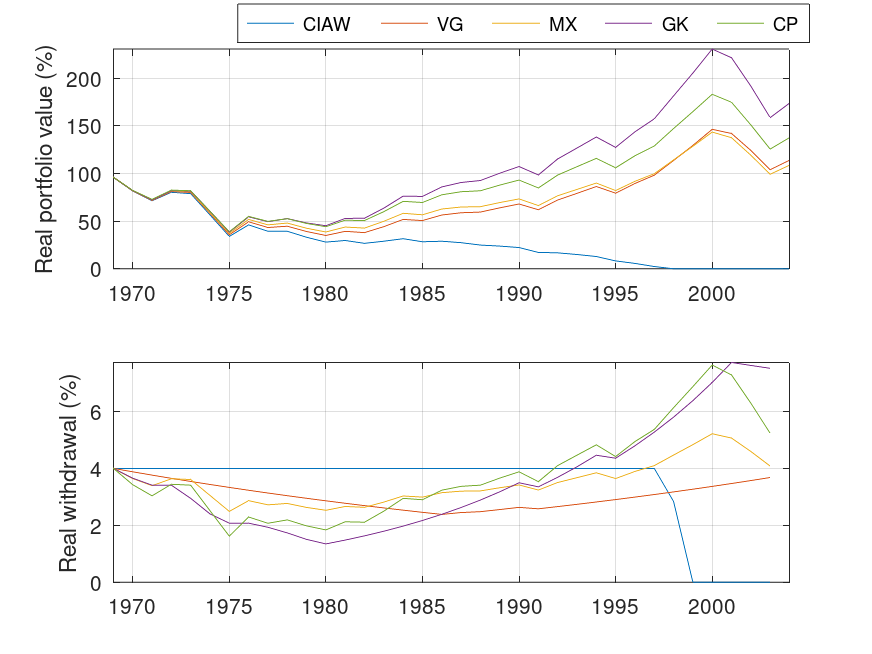
A few comments
1) As expected, constant inflation adjusted withdrawals delivered a constant (in real terms) income right up until the portfolio was exhausted in 1998 (i.e., just under 30 years after retirement).
2) Except for VG, each of the dynamic strategies has strong reductions in income for the first 20 years of retirement and then recovered to deliver relatively high income towards the end of retirement.
3) However, VG delivered much smoother year-to-year income than the other dynamic strategies.
4) The minimum of income varied between the strategies, with CIAW the lowest (zero), GK next (1.5%), VG (2.3%) to MX (2.5%).
5) The amount left after 35 years varied between the strategies with CIAW the lowest (zero) and GK the highest (170%).
The example illustrates the point that I made in my previous post that you can have known income for an unknown amount of time (CIAW) or variable income that will last a longer amount of time (indefinitely in the CP case, but not in the others).
The income variability in the Vanguard (VG) and mix (MX) strategies is fairly easy to set to taste (lower flexibility=more chance of portfolio exhaustion and vice versa).
Of course, other retirement start years had different outcomes as will future retirements.
* 30% UK equities, 30% US equities, 20% UK long bonds, 20% UK cash (asset returns and inflation from macrohistory.net)
1 -
Yes IT managers can and do hold back part of the income generated by underlying constituents and paying out in lean years. We can do this ourselves but it gives the IT team a purpose.phlebas192 said:
That's why I've based our retirement equity income on the AIC dividend heroes. We weren't investing in them before Covid, let alone the GFC. But the portfolio we now hold had a net increase in dividend income during both GFC and Covid. The increases didn't keep pace with inflation during those peirods, especially not in 2020-22, but every year the portfolio would have increased payments.Past performance is no guide to the future, etc, and we are giving up some current income for the expectation that future downturns won't affect us badly, but these investment trusts have a massive incentive to provide at least small annual increases - and means to do so - that individual companies or funds do not.But we also have substantial cash / gilt holdings that would fund us for many years even if dividend income fell dramatically - belts and braces!
City of London Investment Trusts fishes in the FTSE100 and could have been added with a 6.5% yield in 2020 the post covid rise was 0.5% but since then it's been near inflation.
There could be some ITs that have outstripped a global tracker long term, there are those with low volatility and wealth preservers and the dividend heroes have decades of income increases. A fair plan for the equity part and with substantial bond/gilt holdings you're in a position, even if the income is lagging inflation, to draw down the cash/bonds. An alternative to save fees by holding directly and reserve part of your income for lean times like the IT managers do.
0 -
I think these type of closed end funds are attractive to people because they promise regular and substantial dividends; so an income solution with little effort. However, I don't see the point of paying a manager to implement a Total Return portfolio and dole money out every year as I can do that myself. I suppose they can access certain investments and strategies that I can't, or won't, use, but that's not necessarily something that I want either.kempiejon said:
Yes IT managers can and do hold back part of the income generated by underlying constituents and paying out in lean years. We can do this ourselves but it gives the IT team a purpose.phlebas192 said:
That's why I've based our retirement equity income on the AIC dividend heroes. We weren't investing in them before Covid, let alone the GFC. But the portfolio we now hold had a net increase in dividend income during both GFC and Covid. The increases didn't keep pace with inflation during those peirods, especially not in 2020-22, but every year the portfolio would have increased payments.Past performance is no guide to the future, etc, and we are giving up some current income for the expectation that future downturns won't affect us badly, but these investment trusts have a massive incentive to provide at least small annual increases - and means to do so - that individual companies or funds do not.But we also have substantial cash / gilt holdings that would fund us for many years even if dividend income fell dramatically - belts and braces!
City of London Investment Trusts fishes in the FTSE100 and could have been added with a 6.5% yield in 2020 the post covid rise was 0.5% but since then it's been near inflation.
There could be some ITs that have outstripped a global tracker long term, there are those with low volatility and wealth preservers and the dividend heroes have decades of income increases. A fair plan for the equity part and with substantial bond/gilt holdings you're in a position, even if the income is lagging inflation, to draw down the cash/bonds. An alternative to save fees by holding directly and reserve part of your income for lean times like the IT managers do.And so we beat on, boats against the current, borne back ceaselessly into the past.1 -
My view is being a dividend hero is a pretty easy job if you are able to hold back dividends into an income reserve. We should only celebrate income investment trusts that have been able to keep both NAV (measured over the previous decade) and annual income growing with inflation.0 -
I looked at ITs some years ago and bought 3. I still have them City of London, Murray international and Murray income they are not a big part of my portfolio.Alexland said:
My view is being a dividend hero is a pretty easy job if you are able to hold back dividends into an income reserve. We should only celebrate income investment trusts that have been able to keep both NAV (measured over the previous decade) and annual income growing with inflation.kempiejon said:
and the dividend heroes have decades of income increases.
I believe that long term most managers can't beat the index and I don't know which can. I buy global ETF these days and a bit of stock picking which no doubt pulls my performance down too.
Those paying ITs for the income smoothing are probably getting a sub optimal strategy for that luxury and peace of mind.0 -
Every diversified investment strategy will end up having been sub-optimal......with hindsight......that's the nature of diversified investing!0
-
I am hoping the IT part of our portfolio will provide a steadily increasing income even if that doesn’t necessarily keep up with inflation. I am presuming a U shaped spending curve in retirement. It diversifies our income sources and whilst definitely sub optimal in terms of returns it fits our requirements. MIL has had an income generating portfolio of funds and bonds for 10+ years and these have provided her with a good solid income to allow her to pass on excess income (easily recordable) while keeping control/ownership to cover care costs, if needed, later on. Again sub optimal but meeting her needs. We are all unique and need to look at our own plans to see they meet our requirements.0














Confirm your email address to Create Threads and Reply

Categories
- All Categories
- 354.1K Banking & Borrowing
- 254.3K Reduce Debt & Boost Income
- 455.3K Spending & Discounts
- 247.1K Work, Benefits & Business
- 603.7K Mortgages, Homes & Bills
- 178.3K Life & Family
- 261.2K Travel & Transport
- 1.5M Hobbies & Leisure
- 16.1K Discuss & Feedback
- 37.7K Read-Only Boards