📨 Have you signed up to the Forum's new Email Digest yet? Get a selection of trending threads sent straight to your inbox daily, weekly or monthly!
Equities exposure when approaching retirement age
Comments
-
I forgot to mention the male ego - in so far as ceasing work for many blokes means a loss of credibility and self-worth. An old-fashioned perspective perhaps, but then again I am a child of the 60s...cfw1994 said:
Indeed!Hal17 said:
That's a perfect reason to retire.I also don't have much of a plan for retirement, but that is more because I haven't really thought about it - unless tinkering more with classic bikes in the garage counts....

I often feel that most people don’t think about retirement at all. By “most”, I mean the broader population, not people on MSE forums reading this!Of the rest, I suspect the majority focus a big chunk of their thinking about the financial side, and not much about what they will do with their time.
I understand that - nobody wants to retire then run out of money to pay the bills, of course.
BUT….a crucial part of a happy retirement is how you spend your days 👀
That was part of my reason for starting this thread a couple of years ago.
Prior to giving up work, we went to a retirement seminar. A lovely afternoon tea provided 😎
A big session was spent with the room considering how they would fill their 21 slots - morning, afternoon, evening, 7 days a week. One guy wrote “golf” across all his days 🤣
We felt it was ludicrously basic, but I could see how some struggled to think of things to do 🧐
FYI….I wrote a spreadsheet…..each row was a broad topic followed by a bunch of ideas. “Read more”, followed by some books I wanted to read. “DIY”, followed by jobs in subsequent cells. Other topics included “Friends”, “Travel”, “Sport”, “Garden”, “Culture”, “Holidays”, “Family”.
Pretty soon ended up with far too much, & it was nice to colour cells green once done 🙏
Don’t really use it now - we have a groove that works for us - but I think it is a good way to start. Failure to plan is planning to fail 🤪
I wonder whether Mick should focus more on the freedom he can afford rather than reworking questions about the money 🤷♂️3 -
Which is presumably why Trump keeps going at 79 - a massive ego to feed.Veloflyer said:
I forgot to mention the male ego - in so far as ceasing work for many blokes means a loss of credibility and self-worth. An old-fashioned perspective perhaps, but then again I am a child of the 60s...cfw1994 said:
Indeed!Hal17 said:
That's a perfect reason to retire.I also don't have much of a plan for retirement, but that is more because I haven't really thought about it - unless tinkering more with classic bikes in the garage counts....
I often feel that most people don’t think about retirement at all. By “most”, I mean the broader population, not people on MSE forums reading this!Of the rest, I suspect the majority focus a big chunk of their thinking about the financial side, and not much about what they will do with their time.
I understand that - nobody wants to retire then run out of money to pay the bills, of course.
BUT….a crucial part of a happy retirement is how you spend your days 👀
That was part of my reason for starting this thread a couple of years ago.
Prior to giving up work, we went to a retirement seminar. A lovely afternoon tea provided 😎
A big session was spent with the room considering how they would fill their 21 slots - morning, afternoon, evening, 7 days a week. One guy wrote “golf” across all his days 🤣
We felt it was ludicrously basic, but I could see how some struggled to think of things to do 🧐
FYI….I wrote a spreadsheet…..each row was a broad topic followed by a bunch of ideas. “Read more”, followed by some books I wanted to read. “DIY”, followed by jobs in subsequent cells. Other topics included “Friends”, “Travel”, “Sport”, “Garden”, “Culture”, “Holidays”, “Family”.
Pretty soon ended up with far too much, & it was nice to colour cells green once done 🙏
Don’t really use it now - we have a groove that works for us - but I think it is a good way to start. Failure to plan is planning to fail 🤪
I wonder whether Mick should focus more on the freedom he can afford rather than reworking questions about the money 🤷♂️3 -
If you want the DC pension to provide regular income (in addition to the DB) then 71% equities seems high so unless you are willing to reduce your spending from the DC in periods where market dips and crashes happen then I wouldn't suggest going higher than 60%.
The below Monevator graph of the past 55 years (accepting that's a selective time period) shows the outperformance of equities (blue line) compared to more diversified portfolios only happened recently in the past 5 years.
60/40 (orange line) did as well as equities for most of that period as interest rates were declining pulling forward bond returns creating a valuation premium against historic norms which painfully unwound in the recent bond market crash also contributing to that performance gap in the past 5 years during which bonds basically returned nothing in nominal terms as they returned to normal valuations.
However if you look at PE ratios of US shares over the 55 years they have roughly doubled so the outperformance of equities has been the result of increasing valuation premium rather than company performance. You can't eat the same cake twice and eventually investment returns usually mean-revert based on the performance of the underlying assets to normal valuations.
Monevator have just published an article on the permanent portfolio (green line) with 25% in cash, gold, bonds and shares showing how diversification using 4 different assets can reduce the correlation that is seen when both equites and bonds suffer at the same time. Might be of interest. None of this leads me to believe that going heavy on equites is a good strategy when approaching retirement.
https://monevator.com/the-permanent-portfolio/
4 -
You have started your graph just before one of the longest and deepest stock market crashes in history, yet still, the result shows equities returned 50% more profit than bonds. Your conclusion is that equities are over-valued... My conclusion is that equities are the better long-term investment
50 years ago, a company bought 10 parts and assembled them into a widget which they then sold. The process was carried out by people, managed by more people. If the company made a 10% profit, everyone was happy. Today, the product is often virtual, and produced at near-zero marginal cost. Many companies make more than £1 million per year per employee, and profit margins of 70% are common, with future growth expected.
P/E ratios should be 5 times higher, not twice as high. In any case, P/E ratios tell you nothing about returns over the next year, and, over the longer term, drift around on a tide of interest rates and sentiment. They are not a great reference for decision making.
If you are buying an annuity tomorrow, you should be 100% in fixed income. If you plan to draw down for 30 years, you should ideally be 100% in equities. I say 'ideally' because some people don't have the stomach to deal with the volatility that will inveitably occur, and there is room to make some costly mistakes if you invest beyond your risk tolerance. For plans between 0 and 30 years, adjust the balance accordingly.1 -
It's not my graph its from Monevator and I did caveat that the last 55 years is a selective time period. However there's likely to be a few bad crashes during any 50+ year period. The crash at the start obviously recovered and and arguably crashes can help generate additional return as dividend reinvestment happens at advantageous prices.Secret2ndAccount said:You have started your graph just before one of the longest and deepest stock market crashes in history, yet still, the result shows equities returned 50% more profit than bonds. Your conclusion is that equities are over-valued... My conclusion is that equities are the better long-term investment
PE ratios on US shares are higher than historic norms it's a fact and while profit margins might be higher people are still paying a lot more for those earnings than in the past. Maybe we have diverged from historic norms who knows but I suspect people are assuming that equities will simply produce a materially better return yet history suggests there are long periods where they disappoint people and our lives are finite so who wants to have a bad decade in retirement waiting for the thing they invested in to pickup. Better to diversify.
https://www.multpl.com/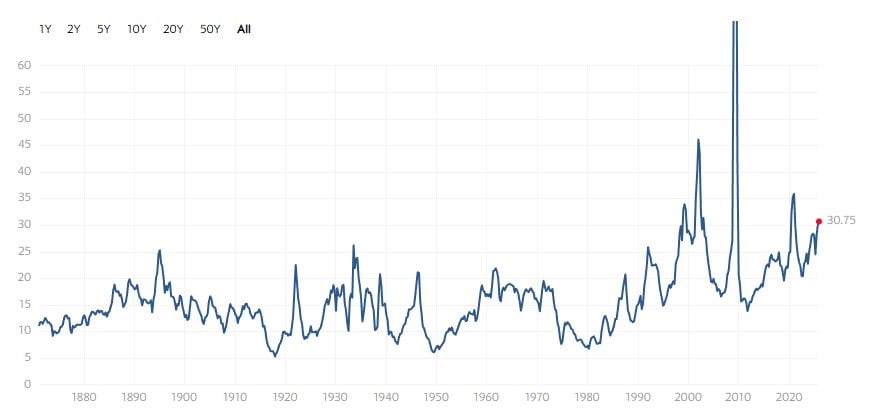
0 -
Maybe we have diverged from historic norms
Yes, maybe it is different this time ( or maybe not).0 -
My view on ‘this time’ (like every other ‘time’) is that this time will be different but in many ways the same. We should study history but not assume it will repeat itself.
My point was that p/e ratio is not a valuation method. p/e has some limited utility: suppose a company makes a new discovery which doubles its profit overnight without increasing costs. The share price should double overnight to keep the p/e the same. If the share price only goes up 50% you can argue that the company is cheaper than it was before the discovery, even though the price has gone up a lot. That’s the use of p/e ratios. p/e is not a guide to future share price. Pick 5 companies; go back 10 years; look at their p/e ratios. Now plot 1, 5, and 10 year returns against p/e ratio and try to find a correlation. There’s nothing there. Here are some p/e ratios of well known companies.
Alphabet (Google): 30.5
Coca-Cola: 23.5
Tesla: 317.6
JP Morgan: 15.6
Which one should I buy?
Based on studying history, my view on the AI bubble is that it won’t burst when everyone is saying “it’s a bubble and it’s about to burst”. It will burst when your Uber driver is saying “Just buy anything because everything just goes up every day”, and I don’t think we’re there yet. There is money being spent right now which will never return a profit. There are companies which will not be around ten years from now. However, I believe that there are vast improvements in efficiency which can be achieved, and there are ideas not yet thought of which will change our lives. Ultimately, I believe that companies will be more efficient in the future, and can continue to grow their profits, so I think equities are a good gamble for the long term.
Nobody should rush out and buy equities just because I hold them. Study equities, risk and volatility, then make a plan that provides for your needs and some of your wants, and allows you to sleep at night. Most people would view equities as part of that plan if you need long term growth.
2 -
To be clear @Secret2ndAccount, you're referring to trailing p/e not forward p/e ?0
-
I don't use p/e in my decision making - I don't think it's very useful. If you want to use it, just make sure you compare like with like. If you trust the forecast, forward p/e is arguably more useful - it's more reflective of the state of the company from here forward. Trailing is good because it's based on real data, not forecasts.1
-
Portfolios in drawdown can behave quite differently to those depicted in the graph above, even more so for UK early retirees who often front load their drawdowns prior to state pension age. Plus, unlike the accumulation phase, once retired and in drawdown there is no silver lining to a market crash, in the form of cheap acquisitions.Secret2ndAccount said:You have started your graph just before one of the longest and deepest stock market crashes in history, yet still, the result shows equities returned 50% more profit than bonds. Your conclusion is that equities are over-valued... My conclusion is that equities are the better long-term investment
50 years ago, a company bought 10 parts and assembled them into a widget which they then sold. The process was carried out by people, managed by more people. If the company made a 10% profit, everyone was happy. Today, the product is often virtual, and produced at near-zero marginal cost. Many companies make more than £1 million per year per employee, and profit margins of 70% are common, with future growth expected.
P/E ratios should be 5 times higher, not twice as high. In any case, P/E ratios tell you nothing about returns over the next year, and, over the longer term, drift around on a tide of interest rates and sentiment. They are not a great reference for decision making.
If you are buying an annuity tomorrow, you should be 100% in fixed income. If you plan to draw down for 30 years, you should ideally be 100% in equities. I say 'ideally' because some people don't have the stomach to deal with the volatility that will inveitably occur, and there is room to make some costly mistakes if you invest beyond your risk tolerance. For plans between 0 and 30 years, adjust the balance accordingly.
There is a reasonable chance, based on historical data, that a 100% equities portfolio will turn out to be the best choice in drawdown, but there is also a reasonable chance that it will be the worst........and therein lies the risk.......and if things do go sideways, there may be little you can do to rectify the situation other than take a large cut in income......a cut which could last many years. For many, that's simply too big a risk to take.3











Confirm your email address to Create Threads and Reply

Categories
- All Categories
- 355.8K Banking & Borrowing
- 254.9K Reduce Debt & Boost Income
- 456.2K Spending & Discounts
- 248.4K Work, Benefits & Business
- 606K Mortgages, Homes & Bills
- 179K Life & Family
- 263.8K Travel & Transport
- 1.5M Hobbies & Leisure
- 16.2K Discuss & Feedback
- 37.7K Read-Only Boards