📨 Have you signed up to the Forum's new Email Digest yet? Get a selection of trending threads sent straight to your inbox daily, weekly or monthly!
Equities exposure when approaching retirement age
Comments
-
On a per-company basis of course I agree as there will be loads of individual factors affecting that company's future prospects but when you look at a whole load of companies and people are on average paying a lot more than normal for earnings then either something has fundamentally changed or we are going through a period where valuations are looking rather optimistic.Secret2ndAccount said:p/e is not a guide to future share price
Valuation cycles can run for decades in the case of the recent bond market bubble where it got to the point where they were un-investable and investors were only buying them because they were forced to for compliance reasons or blindly following portfolio theory with no regard for how risk increases if you overpay.
I don't think US equities are so expensive that they are uninvestable yet, long term they should be fine, but it's prudent to proceed with caution when you see something unusual happening especially now that there are other good things to invest in and if the OP is looking to start drawdown. I'm sure AI will be a big profitable thing for some companies but we all know money spent on big themes often ends up getting wasted in the wrong places.2 -
Indeed. "History does not repeat, but it does rhyme"Secret2ndAccount said:My view on ‘this time’ (like every other ‘time’) is that this time will be different but in many ways the same. We should study history but not assume it will repeat itself.
0 -
My approach is to have 2 to 3 years income in cash, the rest 100% in equities with the intention of using guard rails (thereby reducing withdrawals) if necessary. Some use 3 buckets, I just use the two.
It’s not a matter of if there’ll be crashes during retirement, it will happen to all of us. But over time I’ve gotten used to yawning and doing nothing through biggish drops (20%).
It all boils down to how much your outgoings are going to be. If I had a £32k DB the rest of my pots would be 100% in equities.3 -
If you are 100% equities then a 20% drop that quickly recovers is a walk in the park compared to a 50% drop that takes more years than you have cash to recover. Below is the FTSE World with divi reinvestment from 2000-2010.ader42 said:My approach is to have 2 to 3 years income in cash, the rest 100% in equities with the intention of using guard rails (thereby reducing withdrawals) if necessary. Some use 3 buckets, I just use the two.
It’s not a matter of if there’ll be crashes during retirement, it will happen to all of us. But over time I’ve gotten used to yawning and doing nothing through biggish drops (20%).
Dragging out your 2-3 years of cash to last 6-7 years (while not knowing when the market will recover - it's still quite bad 4 years in) sounds like a pretty miserable period of retirement.
Then just after recovering from the dotcom bubble the GFC hits you.
The just over 30% gain at the end is spoilt by the 23% inflation during the decade and I was paying around 0.7% pa fund manager fees at the time so even if you managed to preserve the capital the spending power wouldn't have improved - a horrible and completely lost decade for the 100% equities investor.
A 10 year conventional gilt bought at the start of 2000 would have yielded 5.31% pa - a little more than now.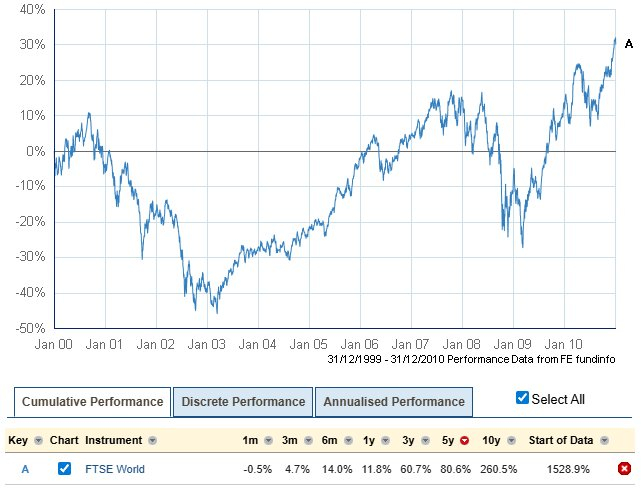
3 -
When you have a good DB pension you can think of it as the fixed income/annuity part of your portfolio and keep any ISAs and DC pensions heavily invested in equities. Because you aren't relying on that money for income you can take more risk with it and look for the growth of equities. This can lead to substantial inheritable assets so estate planning and gifting become important.And so we beat on, boats against the current, borne back ceaselessly into the past.1
-
I need to back down a bit. Something I said in my first post isn’t internally consistent and I would like to clarify my position. I said that for a purchase tomorrow, you should be in cash, but for a 30 year plan, you should be in 100% equities. Well, even a 30 year plan will involve some spend tomorrow, so you can’t be 100% in equities. For example, if you decide to buy a fishing rod, you shouldn’t have to choose which equities to sell to fund the purchase… I’m assuming people with an interest in this thread will be sitting on some cash or income somewhere. So, to restate my position: money to be spent in the short term should be in cash, or cash-like. Money for the long term should be in equities. There will obviously be a transitional zone in between, and people will choose different paths according to their circumstances.
If your pot is so big that it can pay for all of your needs and all of your wants for the rest of your days, I say invest it however you want. Your method has worked so far, and it will only take basic sensible decision making to keep you on the path.
If your pot is more than enough to meet your needs, and you decide to buy an annuity or bond ladder to protect that proportion of your income, I fully support that. I have done it myself, and would recommend it to others. You can then be more comfortable using equities with the rest to provide growth for the long term. If it all goes pear shaped in the worst way, you still have all your bills paid.
The fact that stocks might crash (or the knowledge that, in all likelihood, they will crash) shouldn’t prevent you from investing in equities. Unless you have more than you need, equities are required to provide growth to maintain your spending power in later life.
3 -
I think we are getting to the point of all agreeing that it's fine to be 100% equities provided we are only talking about the equities part of the portfolio. Clearly some other assets will be needed to cover the bad periods in which case we're not really 100% equities but some proportion of it which takes us back to the original question of how much of a portfolio should be in equities.
Having a strategy that requires reduced spending during retirement isn't great. You might choose do do it anyway seeing the opportunity but it's a big difference choosing to do something for benefit versus being forced to do something because of the consequences even if it's the same thing you are doing.
A few years ago equities (and as it turns out gold) were the only assets worth having. Now looking at valuations it seems to have flipped with both cash (for now) and bonds (locking in) are looking good for above inflation returns with the prices of equites and gold looking rather high (however gold might be valued) and at current valuations I have some doubts on if equities can even beat inflation let alone ILGs over the medium term even if long term they should be fine.
I've done well (been lucky maybe) making calls on asset allocation going heavy on equities when cash and bonds were unattractive and I hope to do well going more diversified now. There's a lot to be said for the 4 asset permanent portfolio (or a portfolio of just cash, bonds and equities in equal weights if you don't believe in gold and like to see a logical return) and getting some advantage from rebalancing in giving a smoother ride so you're not having to constantly adapt your lifestyle around portfolio performance.
0 -
Yeah I'm all stocks in my stock allocation bit. I've some gold and bonds say 10% of my retirement pot. I'm gradually looking to increase that but so far equities have grown faster making that hard. I'm not adding much to the retirement fund currently.Alexland said:I think we are getting to the point of all agreeing that it's fine to be 100% equities provided we are only talking about the equities part of the portfolio. Clearly some other assets will be needed to cover the bad periods in which case we're not really 100% equities but some proportion of it which takes us back to the original question of how much of a portfolio should be in equities.
I get the idea that cash is helpful to smooth out returns from equities especially if one goes from a regular salary of a known amount each month to harvesting equity gains and dividends.
As an accumulator I was 100% equities in my ISAs and SIPP. I had other day to year savings but I began to accumulate some cash and look at asset allocation a few years ago as the potential to give up work for a bit looked likely so I wanted to take risk-off some funds I might need for/in a couple of years.
I don't think of my cash as a percentage of my investments I like to hold around 3 years of expenses regardless of portfolio size but I'd flex down to one and a bit for a major purchase. Those owning some or all of property they live in have that asset allocation.
0 -
Yes it's hard and that's a combination or recency bias and FOMO at work putting a higher weighting to what has happened over the past 15 years, and the higher perceived opportunity with equities because they are more volatile, than what has happened before that especially where the history goes back beyond our own personal experiences.kempiejon said:I've some gold and bonds say 10% of my retirement pot. I'm gradually looking to increase that but so far equities have grown faster making that hard.
Market conditions have trained us to keep bidding up equities regardless of valuation and that's when things get dangerous and bubbles can form. Events happen that pop them. Similarly it's recently trained us that bonds have little growth and low opportunity (it's time to take a fresh look). It's trained us that there are no benefits to being diversified and rebalancing because it usually tends to be just equities going up.
My suggestion is to step back and try and imagine you are an alien who has just arrived with no experience of recent performance (so you are weighing the whole history of the markets equally) and consider where the opportunities and risks might, at current valuations, for your circumstances be when devising your asset allocation.
I've found it's interesting to read perspectives from the past Ben Graham etc when their recency bias was very different to ours and to cast my mind back to what I can either remember or imagine it would have been like investing in past time periods (such as the 2000s as above).1














Confirm your email address to Create Threads and Reply

Categories
- All Categories
- 355.8K Banking & Borrowing
- 254.9K Reduce Debt & Boost Income
- 456.2K Spending & Discounts
- 248.4K Work, Benefits & Business
- 606K Mortgages, Homes & Bills
- 179K Life & Family
- 263.8K Travel & Transport
- 1.5M Hobbies & Leisure
- 16.2K Discuss & Feedback
- 37.7K Read-Only Boards