We’d like to remind Forumites to please avoid political debate on the Forum.
This is to keep it a safe and useful space for MoneySaving discussions. Threads that are – or become – political in nature may be removed in line with the Forum’s rules. Thank you for your understanding.
📨 Have you signed up to the Forum's new Email Digest yet? Get a selection of trending threads sent straight to your inbox daily, weekly or monthly!
The Forum now has a brand new text editor, adding a bunch of handy features to use when creating posts. Read more in our how-to guide
Bathroom Leak - what to do?
Comments
-
Google california patch when it comes to fixing the hole you will cut in the ceiling.1
-
The lid's already off.1
-
I'm not going to say don't bother cutting a hole in the ceiling, but I personally wouldn't. 99.999% certain there's no need. At all.Maffy52 said:Based on what I have learnt from the comments, the following seems sensible/reasonable;
- Cut a hole in the ceiling below to check any problems under the floor, for peace of mind.
- I'm NOT going to remove the cistern and will replace the fill/inlet valve with a brass one (it does look cheap the one I have, this is likely what caused the problem!).
- Let the floor dry for a week or two, cut away thin sections of damaged wood. If things look okay, I will replace with thin pieces of ply cut to size (maybe some wood hardener wouldn't hurt!). If things are worse than expected, time to get a pro in I think!
- Refit the tiles (shame I didn't take a photo of how they were before I pulled them up!).
Thanks to everyone who gave helpful advice to me, much appreciated. Happy Christmas!
It takes the best part of a year for rot to start from constant damp, and once the timber is dry again, it should stop. Not that it started in the first place. Cos it didn't. Phew.
This is not a big leak, did not occur for very long, and only a tiny bit got through your bathroom floor to the ceiling below - you have only what appears to be the lightest of stains, and no swelling. There will currently be some damp in the void, but that will evaporate away naturally over the next week or so, now you've stopped the leak.
Ceilings are moisture permeable - there will be some airborne moisture from 'living' passing up through that ceiling into the void at all times, and it is simply ventilated away. Just not a problem.
So, replace the valve, reattach the flexi, and leave a sheet of newspaper under it for a couple of weeks to monitor.
Monitor the ply until it's bone dry, then assess any damage. All you need to concern yourself with is any swelling or raised bits that might interfere with you relaying the tiles - is, that could stop them going flat. That's all.
So, I'd say leave the floor until dry, and then take some close-up pics at a low angle, along with checking with a straight edge, and pressing down on any 'bubbles'. We can talk you through how to deal with it once we see how bad, or not, it is.
Have you laid the tiles out flat somewhere? If they are at all edge-curly, then turn them upside down on the flat surface - you want any raised edges to be curving 'down' when fitting.
That's a nice pre-Chrimbo jigsaw puzzle - position the shaped ones first, and the cut ones along the wall - the siliconed edges will help here - and then add the complete tiles. Add labels, or numbers with a pencil, to indicate the sequence and alignment of each for when you glue them down.
If you find they are a tad too tight, then it'll be fine to trim off a couple of mm from the edge that contacts the skirting boards - just enough to make them fit - as there will be a silicone bead laid along there afterwards. Hopefully they'll fit perfectly, tho'.
A Fugi will neatly sort the silicone.
I noticed some shredding of the floor ply in your pic - was this from the tool used to lift the tiles?
What are folks thoughts on sealing the ply with, say, SBR before regluing the tiles?
1 -
Might be an idea. It's possibly moisture resistant ply anyway. Some filler/screed could be used to smooth over the gaps.WIAWSNB said:Maffy52 said:Based on what I have learnt from the comments, the following seems sensible/reasonable;
- Cut a hole in the ceiling below to check any problems under the floor, for peace of mind.
- I'm NOT going to remove the cistern and will replace the fill/inlet valve with a brass one (it does look cheap the one I have, this is likely what caused the problem!).
- Let the floor dry for a week or two, cut away thin sections of damaged wood. If things look okay, I will replace with thin pieces of ply cut to size (maybe some wood hardener wouldn't hurt!). If things are worse than expected, time to get a pro in I think!
- Refit the tiles (shame I didn't take a photo of how they were before I pulled them up!).
Thanks to everyone who gave helpful advice to me, much appreciated. Happy Christmas!
What are folks thoughts on sealing the ply with, say, SBR before regluing the tiles?
Wickes sell SBR in a handy 1L tub size.
2 -
"don't bother cutting a hole in the ceiling.." - I suspect you are right, but, when I told the wife about the leak, she said the floor felt damp around the toilet in the summer (she didn't say anything as she thought it was condensation!). Just wondering if a slow leak have been going on for some time...WIAWSNB said:
I'm not going....Maffy52 said:Based on what I have learnt from the comments, the following seems sensible/reasonable;
- Cut a hole in the ceiling below to check any problems under the floor, for peace of mind.
- I'm NOT going to remove the cistern and will replace the fill/inlet valve with a brass one (it does look cheap the one I have, this is likely what caused the problem!).
- Let the floor dry for a week or two, cut away thin sections of damaged wood. If things look okay, I will replace with thin pieces of ply cut to size (maybe some wood hardener wouldn't hurt!). If things are worse than expected, time to get a pro in I think!
- Refit the tiles (shame I didn't take a photo of how they were before I pulled them up!).
Thanks to everyone who gave helpful advice to me, much appreciated. Happy Christmas!
...I noticed some shredding of the floor ply in your pic - was this from the tool used to lift the tiles?
What are folks thoughts on sealing the ply with, say, SBR before regluing the tiles?
I'm going to leave the floor now until January, get Christmas out the way, luckily don't use that bathroom really. Should be totally dry by then and I can do and you advise, checking and removing layers.
Good tips with the tiles, yeah, the tiles are all over the floor in the spare room, so nice and flat!
The shredding of the floor was me pulling up the wet and bent wood to get the floor to dry. I think this was probably a mistake now, should have been more careful! I may have caused the bubble on the floor ply by pulling up the layer glued to it while it was damp!
I have not pulled up the actual floor ply, just the thin layer on top used to lay the tiles. Just looked up SBR, sounds good idea!
Thanks again for all your amazing advice...!
One other question. Just about to order a new inlet valve with a brass thread. Didn't realise there were so many! Does this one look suitable?, it says 'for all cistern types';
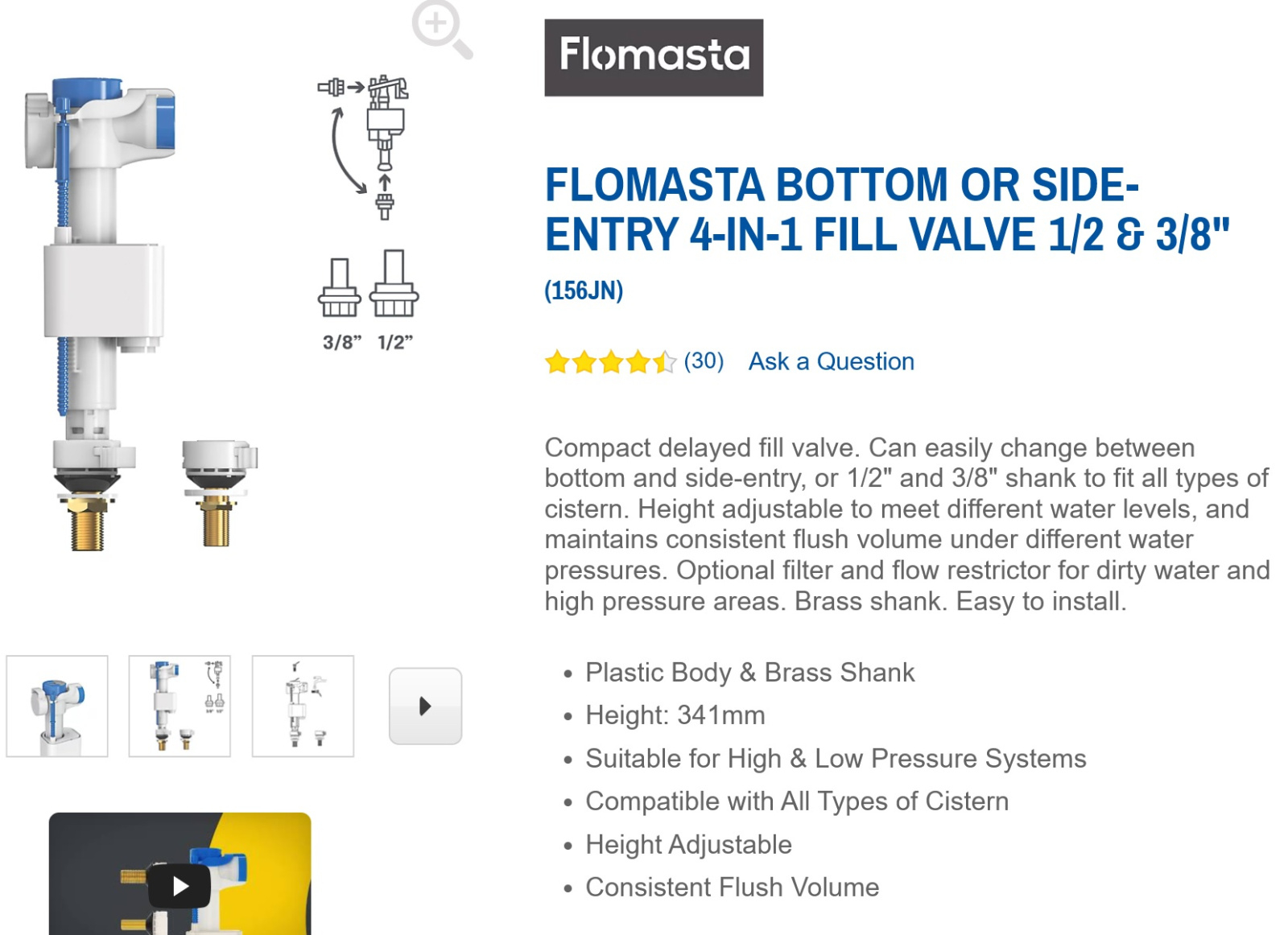
1 -
You should go like for like of the one that's in the cistern. But that's just me.Maffy52 said:
"don't bother cutting a hole in the ceiling.." - I suspect you are right, but, when I told the wife about the leak, she said the floor felt damp around the toilet in the summer (she didn't say anything as she thought it was condensation!). Just wondering if a slow leak have been going on for some time...WIAWSNB said:
I'm not going....Maffy52 said:Based on what I have learnt from the comments, the following seems sensible/reasonable;
- Cut a hole in the ceiling below to check any problems under the floor, for peace of mind.
- I'm NOT going to remove the cistern and will replace the fill/inlet valve with a brass one (it does look cheap the one I have, this is likely what caused the problem!).
- Let the floor dry for a week or two, cut away thin sections of damaged wood. If things look okay, I will replace with thin pieces of ply cut to size (maybe some wood hardener wouldn't hurt!). If things are worse than expected, time to get a pro in I think!
- Refit the tiles (shame I didn't take a photo of how they were before I pulled them up!).
Thanks to everyone who gave helpful advice to me, much appreciated. Happy Christmas!
...I noticed some shredding of the floor ply in your pic - was this from the tool used to lift the tiles?
What are folks thoughts on sealing the ply with, say, SBR before regluing the tiles?
I'm going to leave the floor now until January, get Christmas out the way, luckily don't use that bathroom really. Should be totally dry by then and I can do and you advise, checking and removing layers.
Good tips with the tiles, yeah, the tiles are all over the floor in the spare room, so nice and flat!
The shredding of the floor was me pulling up the wet and bent wood to get the floor to dry. I think this was probably a mistake now, should have been more careful! I may have caused the bubble on the floor ply by pulling up the layer glued to it while it was damp!
I have not pulled up the actual floor ply, just the thin layer on top used to lay the tiles. Just looked up SBR, sounds good idea!
Thanks again for all your amazing advice...!
One other question. Just about to order a new inlet valve with a brass thread. Didn't realise there were so many! Does this one look suitable?, it says 'for all cistern types';
If you're not using the toilet and the water is off securely then remove the inlet valve and see if there's a name on it and go from there.
I would take it to a plumber's merchant and get them to match it as some valves are different heights, width and may not fit in your cistern properly.
If you already know the type then online is a good way to buy and your all set to start in the new year.
Not sure of you family dynamics but you could use a bucket of water to flush the waste in the pan instead of the cistern as you have a shower hose there to refill the bucket and leave it on the shower tray.
1 -
Boohoo's advice is sound IF the inlet valve was fed by a copper pipe. Yours isn't, Maffy - it's a flexi, which is fab from a DIYing pov. (A rigid copper pipe will be harder to match up to a longer or shorter inlet valve thread.)That Flomasta is ideal, and will do the job. You don't really need the extra bits - the 'side' and 'size' options - but, hey, that's what the bin is for.Personally, I always smear a thin layer of silicone grease on such fittings, on the rubber washers, on the plastic washers, on the threads, etc. This lubes the parts, makes them easier to do up, helps make a good seal, preserves them against ageing, and also helps when the day comes to dismantle them again. But it ain't necessary
 But, with sili lube, you can do up the new inlet valve without using tools. Just follow the back-and-forth method mentioned before.But, if you can get a box spanner to fit that large white plastic nut, I ain't going to suggest you shouldn't buy one...0
 -
Oh, and the ply floor is fine. And your ceiling void is fine.The ply just needs these dips filling to make them level, that's all.0
-
I was on about the size of the bottom fed inlet valve Maffy has a picture of and not the connection from the Flexi.WIAWSNB said:Boohoo's advice is sound IF the inlet valve was fed by a copper pipe. Yours isn't, Maffy - it's a flexi, which is fab from a DIYing pov. (A rigid copper pipe will be harder to match up to a longer or shorter inlet valve thread.)That Flomasta is ideal, and will do the job. You don't really need the extra bits - the 'side' and 'size' options - but, hey, that's what the bin is for.Personally, I always smear a thin layer of silicone grease on such fittings, on the rubber washers, on the plastic washers, on the threads, etc. This lubes the parts, makes them easier to do up, helps make a good seal, preserves them against ageing, and also helps when the day comes to dismantle them again. But it ain't necessaryBut, with sili lube, you can do up the new inlet valve without using tools. Just follow the back-and-forth method mentioned before.But, if you can get a box spanner to fit that large white plastic nut, I ain't going to suggest you shouldn't buy one...
Some inlet valves may not fit inside the cistern due to the cistern size that's why I suggested like for like.
I have in the past had inlet valves that are too high for the cistern lid to close but nowadays they can be height adjustable but still worth checking.1






Confirm your email address to Create Threads and Reply

Categories
- All Categories
- 354.4K Banking & Borrowing
- 254.4K Reduce Debt & Boost Income
- 455.4K Spending & Discounts
- 247.3K Work, Benefits & Business
- 604.1K Mortgages, Homes & Bills
- 178.4K Life & Family
- 261.6K Travel & Transport
- 1.5M Hobbies & Leisure
- 16K Discuss & Feedback
- 37.7K Read-Only Boards