We’d like to remind Forumites to please avoid political debate on the Forum.
This is to keep it a safe and useful space for MoneySaving discussions. Threads that are – or become – political in nature may be removed in line with the Forum’s rules. Thank you for your understanding.
📨 Have you signed up to the Forum's new Email Digest yet? Get a selection of trending threads sent straight to your inbox daily, weekly or monthly!
The Forum now has a brand new text editor, adding a bunch of handy features to use when creating posts. Read more in our how-to guide
Bathroom Leak - what to do?
Comments
-
Yes, this is my concern now. How to assess the state of the floor, Need let it dry for a week or two first. The thin ply sheet the tiles were fixed to I guess I can remove and replace any sections which have been wet.danrv said:
The floor just needs to completely dry out and then be checked for any warping. Some wood hardener may help if the ply has softened.
It feels like the plywood floor itself also have some 'bubbles' (at least the top layer!). Should this also be replaced as a precaution, perhaps just cutting out affected parts up to the joists?0 -
I did contact the guy who serviced my boiler and cylinder but he was fully booked. Not a good time to get someone in so will leave it until the new year now and probably have a crack at it then myself. This is the en-suite that we don't use much so no rush.Boohoo said:The best thing in my opinion is to get a plumber in and they should do a better job than you
As it's near Xmas if it's fixed then that's one thing less to worry about.0 -
Maffy52 said:
Yes, this is my concern now. How to assess the state of the floor, Need let it dry for a week or two first. The thin ply sheet the tiles were fixed to I guess I can remove and replace any sections which have been wet.danrv said:
The floor just needs to completely dry out and then be checked for any warping. Some wood hardener may help if the ply has softened.
It feels like the plywood floor itself also have some 'bubbles' (at least the top layer!). Should this also be replaced as a precaution, perhaps just cutting out affected parts up to the joists?If the ply has 'delaminated', then the loose layers will need peeling/cutting off as it will obviously create problems when laying the tiles back down.However, it should only require very localised 'lifted' parts to be cut and peeled off, and only if really necessary. First, allow it to dry fully, and then use a straight edge across the floor to assess this. Take low-angle pics and post on here if needed. Most likely, if any bits do need trimming away, the resulting hollows can be filled with a suitable filler to get it all flat and level again.Try to avoid actually cutting away full-thickness 'sections' of flooring, as that will be a different order of pain.
1 -
Thanks, very helpful. Luckily there is no rush to sort this out, have another bathroom.WIAWSNB said:If the ply floor is warped or peeling, then we are talking a much bigger job, so I suspect an insurance claim may be advisable.
The floor is my concern now, wondering what damage has been done. There is the plywood floor itself, and then a 3mm layer of plywood that the tiles were stuck to.
the 3mm layer can be 'scrapped off and replaced no problem, just fiddly.
but, the floor itself has also got wet and in one place the 'top layer' of the ply has bubbled up. Not sure if this indicates it must be replaced or whether it can just be 'patched up' (someone suggested wood hardener?).
Maybe I could drill a hole and try to see what is going on (I have a cheapo endoscope type camera for my phone!), but not sure I will really be able to see anything useful..0 -
Probably not necessary. Sections of the top sheet of ply can be replaced where it's been affected. Just check the strength of the subfloor and for any flexing.Maffy52 said:
It feels like the plywood floor itself also have some 'bubbles' (at least the top layer!). Should this also be replaced as a precaution, perhaps just cutting out affected parts up to the joists?danrv said:
The floor just needs to completely dry out and then be checked for any warping. Some wood hardener may help if the ply has softened.1 -
I think you need to make a decent size hole in the downstairs ceiling so you can rule out rot. There probably isn’t any, but you should check. Use a 10cm hole saw, and when finished inspecting you can replace the plasterboard disc and fill it.If you remove the cistern, buy a new doughnut washer.No reliance should be placed on the above! Absolutely none, do you hear?2
-
As for the cistern, it looks completely sortable as it stands - no need to detach - and you are seemingly up for the task!If you look at the dribbles, it seems very clear it's coming from behind the plastic nut. If so, it's very fixable.There's a small chance the water is getting by the securing bolts (yellow arrow), then running along on the underside of the cistern, and finally dribbling down where you see them, but I suspect that isn't the case.
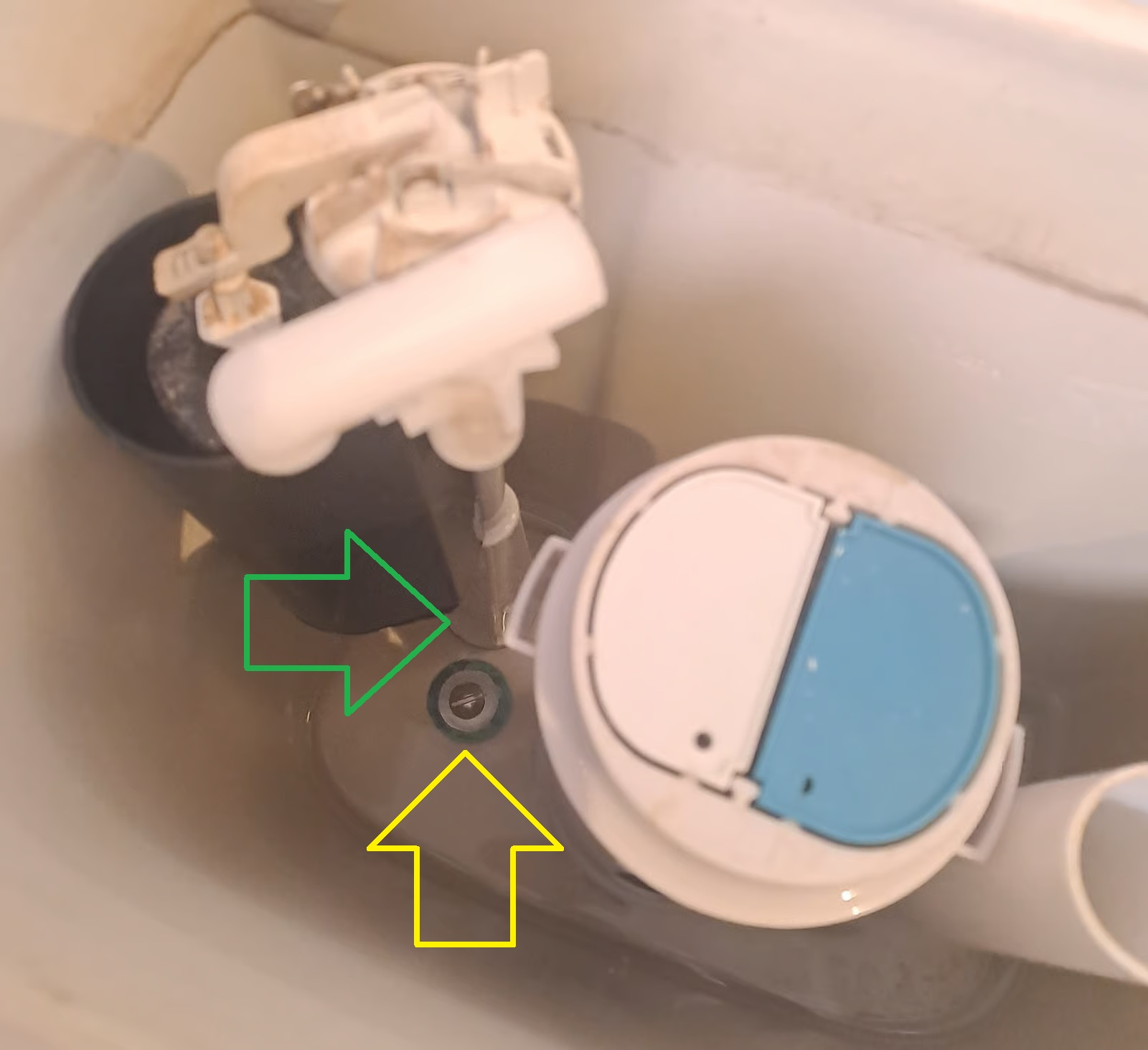 Sooo, no need to remove the cistern - a different level of pain.Instead, shut off the isolating valve on the flexi - you have - and mop up all the remaining water in the cistern.You now need to obtain a suitable spanner that'll reach that plastic nut.
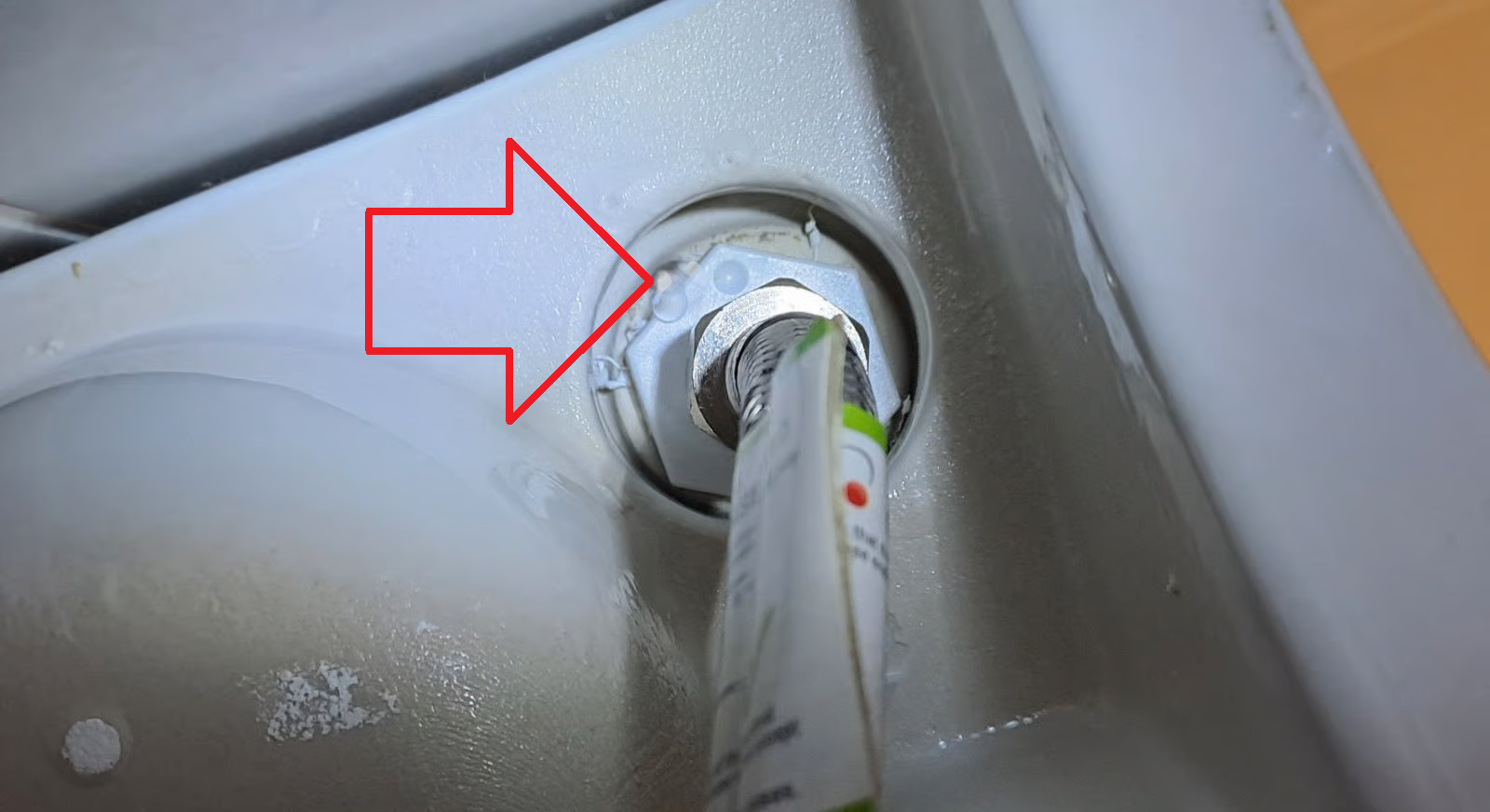 First, tho', all you need to do is remove that inlet valve. So, use a suitable spanner on the metal flexi nut - undo that and remove (watch out for a rubber or fibre washer).If your spanner doesn't reach the plastic nut, then try this - grab the inlet valve inside the cistern, and try and turn it anticlockwise. Keep an eye on the plastic nut as you do this - you want that nut to remain still and not turn. If so, then it's being undone.If it helps, grab the white nut with yer fingertips to hold it.If you can manage to turn the inlet valve even a quarter-turn, then not turn it clockwise back from whence it came, but this time turn the white nut with it - the same way.Then hold the white nut, and anti the valve. Then turn the nut with the valve. Then anti... do you get the idea?It should undo.Remove the inlet valve, and see what you have. Please report back. We should be able to tell what it needs in terms of sealing.
1 -
You can get very small diameter cameras to attach to your mobile now, I was quite fascinated when my Audiologist put one in my ears and let me see on their mobile. I am sure they could be utilised for to do minimum disruption inspection from the ceiling below.GDB2222 said:I think you need to make a decent size hole in the downstairs ceiling so you can rule out rot. There probably isn’t any, but you should check. Use a 10cm hole saw, and when finished inspecting you can replace the plasterboard disc and fill it.If you remove the cistern, buy a new doughnut washer.Play with the expectation of winning not the fear of failure. S.Clarke0 -
I have a couple of these borascope cameras and one of them is WiFi so handy.Eldi_Dos said:
You can get very small diameter cameras to attach to your mobile now, I was quite fascinated when my Audiologist put one in my ears and let me see on their mobile. I am sure they could be utilised for to do minimum disruption inspection from the ceiling below.GDB2222 said:I think you need to make a decent size hole in the downstairs ceiling so you can rule out rot. There probably isn’t any, but you should check. Use a 10cm hole saw, and when finished inspecting you can replace the plasterboard disc and fill it.If you remove the cistern, buy a new doughnut washer.
The only issue I have( maybe just a cheaper camera) is that there are good for close up images but not for away so anything further than 150 mm become blurry.1 -
I don't think Maffy should DIY a cistern removal. It shouldn't be necessary, and is a whole new order of pain.0










Confirm your email address to Create Threads and Reply

Categories
- All Categories
- 354.4K Banking & Borrowing
- 254.4K Reduce Debt & Boost Income
- 455.4K Spending & Discounts
- 247.3K Work, Benefits & Business
- 604.1K Mortgages, Homes & Bills
- 178.4K Life & Family
- 261.6K Travel & Transport
- 1.5M Hobbies & Leisure
- 16K Discuss & Feedback
- 37.7K Read-Only Boards