We’d like to remind Forumites to please avoid political debate on the Forum.
This is to keep it a safe and useful space for MoneySaving discussions. Threads that are – or become – political in nature may be removed in line with the Forum’s rules. Thank you for your understanding.
📨 Have you signed up to the Forum's new Email Digest yet? Get a selection of trending threads sent straight to your inbox daily, weekly or monthly!
Intelligent Octopus Go limiting cheap charging.
Comments
-
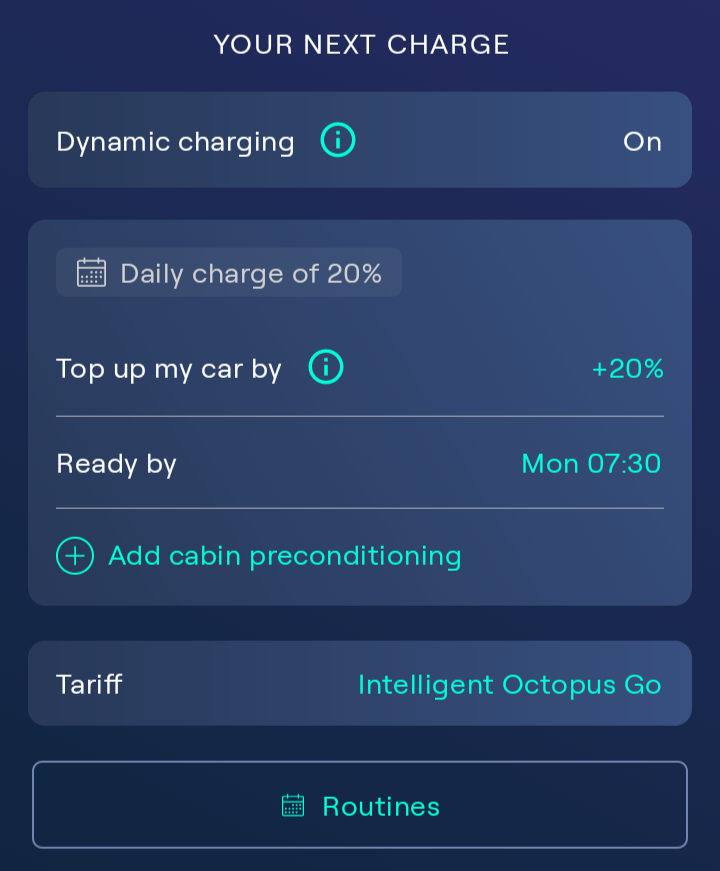
born_again said:Given I have a OHME Home Pro, you only have 2 options for departure time. 11:00 & 04:00. Any other time selected & it tells you to select either of the times.Really?My Ohme app (for my ePod, on IOG) will let me pick any time I want between 0400 and 1100.I have a daily schedule set that has a "ready by" time of 0730.Edit to add screenshot:
 N. Hampshire, he/him. Octopus Intelligent Go elec / Fuse gas / Vodafone BB / iD mobile. Kirk Hill Co-op member.Economy 7 cap explainer. Gas vs E7 vs peak elec heating costs, Ecoflow Stream, Best kettle :-)
2.72kWp PV facing SSW installed Jan 2012. 11 x 247w panels, 3.6kw inverter. 37 MWh generated, long-term average 2.6 Os.1 -
I am considering acquiring my first EV next year, which would have an 84 kWhr battery. Having not investigated EV / overnight tariffs in detail, is there a tariff limit (I appreciate that there are electrical considerations) to the amount of kWhrs that can be imported over the 6 hour cheaper period?0
-
pensionpawn said:I am considering acquiring my first EV next year, which would have an 84 kWhr battery. Having not investigated EV / overnight tariffs in detail, is there a tariff limit (I appreciate that there are electrical considerations) to the amount of kWhrs that can be imported over the 6 hour cheaper period?No tariff limit, AFAIK.However unless you're going to get clever with both the car and the charger, you'll be limited to charging at ~7kW (32A at whatever voltage you happen to have) so six hours will only give you 42kWh of charge.11kW and 22kW chargers exist, and some cars are able to use them, but that needs three phase power.
N. Hampshire, he/him. Octopus Intelligent Go elec / Fuse gas / Vodafone BB / iD mobile. Kirk Hill Co-op member.Economy 7 cap explainer. Gas vs E7 vs peak elec heating costs, Ecoflow Stream, Best kettle :-)
2.72kWp PV facing SSW installed Jan 2012. 11 x 247w panels, 3.6kw inverter. 37 MWh generated, long-term average 2.6 Os.0 -
I know that I have a 100A fuse to the house and that my electric shower can draw 10kWs without any issues, so I'm not sure why charging an EV at around 12 kWs should require an upgrade to 3 phase? I have seen my house occasionally demand similar when there's a combinational demand from oven, hob, under floor heating etc..QrizB said:pensionpawn said:I am considering acquiring my first EV next year, which would have an 84 kWhr battery. Having not investigated EV / overnight tariffs in detail, is there a tariff limit (I appreciate that there are electrical considerations) to the amount of kWhrs that can be imported over the 6 hour cheaper period?No tariff limit, AFAIK.However unless you're going to get clever with both the car and the charger, you'll be limited to charging at ~7kW (32A at whatever voltage you happen to have) so six hours will only give you 42kWh of charge.11kW and 22kW chargers exist, and some cars are able to use them, but that needs three phase power.0 -
pensionpawn said:
I know that I have a 100A fuse to the house and that my electric shower can draw 10kWs without any issues, so I'm not sure why charging an EV at around 12 kWs should require an upgrade to 3 phase?QrizB said:pensionpawn said:I am considering acquiring my first EV next year, which would have an 84 kWhr battery. Having not investigated EV / overnight tariffs in detail, is there a tariff limit (I appreciate that there are electrical considerations) to the amount of kWhrs that can be imported over the 6 hour cheaper period?No tariff limit, AFAIK.However unless you're going to get clever with both the car and the charger, you'll be limited to charging at ~7kW (32A at whatever voltage you happen to have) so six hours will only give you 42kWh of charge.11kW and 22kW chargers exist, and some cars are able to use them, but that needs three phase power.When AC charging, the wallbox just manages the supply to the vehicle. The battery charger (the bit that does AC to DC conversion) is built into the vehicle.Most cars only have 7kW built-in chargers (32A single-phase). Some manufacturers offer larger chargers on some models, either 11kW (16A 3-phase) or 22kW (32A 3-phase).I've not seen a light vehicle with a single-phase charger above 32A.Edit to add: EV geeks if I've got this wrong and there is a higher-power single-phase option, please let me know!N. Hampshire, he/him. Octopus Intelligent Go elec / Fuse gas / Vodafone BB / iD mobile. Kirk Hill Co-op member.Economy 7 cap explainer. Gas vs E7 vs peak elec heating costs, Ecoflow Stream, Best kettle :-)
2.72kWp PV facing SSW installed Jan 2012. 11 x 247w panels, 3.6kw inverter. 37 MWh generated, long-term average 2.6 Os.1 -
DC fast charging. Not available yet (hopefully next year, hence my original post timeline and query about tariff kWhr caps)QrizB said:pensionpawn said:
I know that I have a 100A fuse to the house and that my electric shower can draw 10kWs without any issues, so I'm not sure why charging an EV at around 12 kWs should require an upgrade to 3 phase?QrizB said:pensionpawn said:I am considering acquiring my first EV next year, which would have an 84 kWhr battery. Having not investigated EV / overnight tariffs in detail, is there a tariff limit (I appreciate that there are electrical considerations) to the amount of kWhrs that can be imported over the 6 hour cheaper period?No tariff limit, AFAIK.However unless you're going to get clever with both the car and the charger, you'll be limited to charging at ~7kW (32A at whatever voltage you happen to have) so six hours will only give you 42kWh of charge.11kW and 22kW chargers exist, and some cars are able to use them, but that needs three phase power.When AC charging, the wallbox just manages the supply to the vehicle. The battery charger (the bit that does AC to DC conversion) is built into the vehicle.Most cars only have 7kW built-in chargers (32A single-phase). Some manufacturers offer larger chargers on some models, either 11kW (16A 3-phase) or 22kW (32A 3-phase).I've not seen a light vehicle with a single-phase charger above 32A.Edit to add: EV geeks if I've got this wrong and there is a higher-power single-phase option, please let me know!
https://wallbox.com/en_uk/ev-charging-101
https://futurechargingsolutions.co.uk/bidirectional-storage/#:~:text=The Wallbox Quasar 2 is a bi-directional,mm x 338 mm x 127 mm
0 -
Well the good news is unless you are doing long runs everyday. You do not need to charge every day.pensionpawn said:I am considering acquiring my first EV next year, which would have an 84 kWhr battery. Having not investigated EV / overnight tariffs in detail, is there a tariff limit (I appreciate that there are electrical considerations) to the amount of kWhrs that can be imported over the 6 hour cheaper period?
So you can just add a % as & when required.
So given IOG new limits you would get 42kW in the 6 hours (subject to some loss)Life in the slow lane0 -
Well, hopefully 72 kWhrs as the Wallbox Quaser 2 charger is capable of 12 kWs..born_again said:
Well the good news is unless you are doing long runs everyday. You do not need to charge every day.pensionpawn said:I am considering acquiring my first EV next year, which would have an 84 kWhr battery. Having not investigated EV / overnight tariffs in detail, is there a tariff limit (I appreciate that there are electrical considerations) to the amount of kWhrs that can be imported over the 6 hour cheaper period?
So you can just add a % as & when required.
So given IOG new limits you would get 42kW in the 6 hours (subject to some loss)0 -
The 42kW assumes your charger gives you the full 7kWh for the whole 6 hours. Some will give a lower speed at times, depending on conditions.born_again said:
Well the good news is unless you are doing long runs everyday. You do not need to charge every day.pensionpawn said:I am considering acquiring my first EV next year, which would have an 84 kWhr battery. Having not investigated EV / overnight tariffs in detail, is there a tariff limit (I appreciate that there are electrical considerations) to the amount of kWhrs that can be imported over the 6 hour cheaper period?
So you can just add a % as & when required.
So given IOG new limits you would get 42kW in the 6 hours (subject to some loss)1 -
DC fast charging is already a thing on commercial installations, but it is very expensive, the AC to DC converters are costly to install, large and just really are not needed in a domestic situation. DC fast changing exists so people can put in a lot of miles in a short amount of time when on a journey, hence 150kW+ chargers, no one needs that speed at home because they are not trying to charge in twenty minutes, neither do you want to regularly fast charge the battery, whilst it is nowhere near as damaging as initially thought it will still accelerate battery degradation (probably cost an additional 5% capacity loss over ten years). Added to which the battery will throttle down the charge speed significantly when over 80% SOC.pensionpawn said:
DC fast charging. Not available yet (hopefully next year, hence my original post timeline and query about tariff kWhr caps)QrizB said:pensionpawn said:
I know that I have a 100A fuse to the house and that my electric shower can draw 10kWs without any issues, so I'm not sure why charging an EV at around 12 kWs should require an upgrade to 3 phase?QrizB said:pensionpawn said:I am considering acquiring my first EV next year, which would have an 84 kWhr battery. Having not investigated EV / overnight tariffs in detail, is there a tariff limit (I appreciate that there are electrical considerations) to the amount of kWhrs that can be imported over the 6 hour cheaper period?No tariff limit, AFAIK.However unless you're going to get clever with both the car and the charger, you'll be limited to charging at ~7kW (32A at whatever voltage you happen to have) so six hours will only give you 42kWh of charge.11kW and 22kW chargers exist, and some cars are able to use them, but that needs three phase power.When AC charging, the wallbox just manages the supply to the vehicle. The battery charger (the bit that does AC to DC conversion) is built into the vehicle.Most cars only have 7kW built-in chargers (32A single-phase). Some manufacturers offer larger chargers on some models, either 11kW (16A 3-phase) or 22kW (32A 3-phase).I've not seen a light vehicle with a single-phase charger above 32A.Edit to add: EV geeks if I've got this wrong and there is a higher-power single-phase option, please let me know!
https://wallbox.com/en_uk/ev-charging-101
https://futurechargingsolutions.co.uk/bidirectional-storage/#:~:text=The Wallbox Quasar 2 is a bi-directional,mm x 338 mm x 127 mm
Overnight charging should give all but the most extreme drivers, or incredibly inefficient vehicles, so unless people are driving a huge distance every day or drive an electric bus then they really do not need more at home.
7kW = 42kWh = 150-170 miles
11kW = 66kWh = 230-265 miles
Why do you think you need so much power every night?pensionpawn said:
Well, hopefully 72 kWhrs as the Wallbox Quaser 2 charger is capable of 12 kWs..born_again said:
Well the good news is unless you are doing long runs everyday. You do not need to charge every day.pensionpawn said:I am considering acquiring my first EV next year, which would have an 84 kWhr battery. Having not investigated EV / overnight tariffs in detail, is there a tariff limit (I appreciate that there are electrical considerations) to the amount of kWhrs that can be imported over the 6 hour cheaper period?
So you can just add a % as & when required.
So given IOG new limits you would get 42kW in the 6 hours (subject to some loss)
0











Confirm your email address to Create Threads and Reply

Categories
- All Categories
- 355.7K Banking & Borrowing
- 254.9K Reduce Debt & Boost Income
- 456.1K Spending & Discounts
- 248.3K Work, Benefits & Business
- 605.9K Mortgages, Homes & Bills
- 179K Life & Family
- 263.7K Travel & Transport
- 1.5M Hobbies & Leisure
- 16.2K Discuss & Feedback
- 37.7K Read-Only Boards