We’d like to remind Forumites to please avoid political debate on the Forum.
This is to keep it a safe and useful space for MoneySaving discussions. Threads that are – or become – political in nature may be removed in line with the Forum’s rules. Thank you for your understanding.
New £12,000 limit on Cash ISA
Comments
-
If it is like the pre-2014 ISA rules, the charge would apply to interest earned on uninvested cash in any S&S ISA - regardless of an individuals tax position.Section62 said:masonic said:
Nothing will be decided until after the consultation. Since they say a "charge" rather than tax, then that leaves an option for a flat rate deduction at source....hallmark said:- a charge on any interest paid on cash held in a stocks and shares or Innovative Finance ISA
If confirmed that would be complex and absolutely disgusting. Holding cash in a shares isa is entirely normal & reasonable, and in fact unavoidable for at least a certain amount of time (between depositing and buying, or between selling and buying).
Are we now going to have to keep track of this & report it? One of the attractions of ISAs is no tax stuff to worry about keeping track of.
I recently transferred a fair chunk out of a cash ISA and into a shares ISA where it's currently in a MMF waiting to be invested. So I'm now going to be penalised for that and treated like a tax-dodger? Despite having paid a shed-load of tax every year for over 40 years and adhered to every rule there is.
The question I'd have is whether that would apply to non-taxpayers, or how they would be exempted from the charge.An R85 for S&S ISAs ?
If a non-taxpayer, you were not entitled to claim it back or be exempt. It was deliberately called a charge and not tax..6 - a charge on any interest paid on cash held in a stocks and shares or Innovative Finance ISA
-
intalex said:Situation: Govt needs £££, savers want interest, Govt thinks investing earns more £££ than saving
Solution: Govt should issue savings products with attractive interest rates and then use that deposits cash to invest themselves and earn the more £££
What am I missing?If Fred has a 20K cash ISA with Nat West say (paying 3.5% pa although the rate is irrelevant) and then transfers that to a new tax free National Savings Account that pays 6%pa, this results in the government spending more money not borrowing money from Fred.Fred's balance with Nat West reduces by 20K, and in turn the affect is to reduce Nat West's reserve account* at the Bank of England (B of E) by 20K. National Savings then have to pay 6% interest to Fred on the 20K.The B of E pays base rate on bank reserves i.e. 4%pa (that's how monetary policy is conducted by setting the rate of interest paid on reserves, it wasn't always that way but I won't digress).So the net effect of Fred's ISA transfer on the government (and that's taking the B of E to be part of government along with the Treasury which it is despite it having limited independence in setting interest rates) is that it has to spend 2% of 20K extra, which is the 6% it is now paying to Fred vs the 4% it was paying to Nat West.So the government wouldn't have any money to invest because all Fred's transfer has done is to change the form of the government's liabilities. It has not provided the government with money to invest.In a simple sentence what you are missing is that the Government is an issuer and creator of money whereas Fred is a user of money and as a result you can't think of Fred investing in shares in the same way as the government investing. The goverment don't have to borrow money off you or I.The government can invest, but it does this by creating money by a click of a computer key. That is what government spending is, creation of money, and government taxation is the destruction of money.The government can create money to buy up all the shares of United Utilities for example. That is called nationalisation. The government doesn't have to borrow (but see below) it just creates the money. It has implications of course depending on what those who have had their shares bought up do with the money they now have, and so can cause inflation of asset prices and/or inflation of goods. What you are unknowingly advocating for is a more state run economy, albeit government investment can take different forms to nationalisation.By practice and because of legislation called the full funding rule (probably relating to when money was convertible into gold, the B of E didn't pay interest on bank reserve accounts, and because pension funds and other institutional investors need safe assets) when the government runs a deficit it issues bonds equal to the amount of the deficit. But this works in the same way, changing the government's liabilities from central bank reserve accounts (i.e the accounts of the private banks with the central bank, the B of E), to gilts. So it's only government borrowing in a loose sense. What they are really doing is creating money and adjusting the nature and term of their liabilities in relation to that created money to gilts instead of reserves, so keeping overall reserves and the money supply unchanged.* private banks themselves bank at the Bank of England and so have reserve accounts there, in the same way as Fred banks with Nat West and has an account there. If Fred transfers his ISA to HSBC instead of National Savings then the Nat West reserve account at the B of E goes down by 20K and the HSBC reserve account at the B of E goes up by 20K. What really happens is that all the transfers for all the customers during the day get netted out so the reserve accounts change by the net affect of all the transfers. That's how the payment system works.I came, I saw, I melted3 -
I think they might not have thought it through. There is already enough confusion about ISA limits and rules. The providers are going to love that extra bit of complexity...4
-
It seems to me that this will all get ridiculously complicated (and possibly blatantly unfair in some cases) for existing S&S ISAs........perhaps the cleanest solution would be to keep pre-2027 accounts as is, but mandate that from April 2027, all new contributions must go into a New Investment ISA (or whatever name seems appropriate), bar transfers from new to old, and implement any new investment restrictions only on the new style accounts. Transfers from old style accounts to new could be allowed if and when the old style account was made compliant with the new style account rules. (there is a sort of precedent for this when LISAs were introduced in place of Help-to-Buy ISAs).Aretnap said:
MMFs could be sold and held as cash instead - and transferred to a cash ISA in the next 18 months. They're effectively cash anyway, which is why until this afternoon all the geniuses were telling us that they were going to get round the new rules by investing in money market funds within S&S ISAs.zagfles said:
Where would gilts, MMFs etc go?Aretnap said:
Well, they'll have 18 months to transfer the 50% from a S&S ISA to a cash ISA if they want to. So a bit of minor hassle but hardly a disaster if they're reasonably aware of what's happening (which they should really be, if they're savvy enough to set up an investment structure like that).zagfles said:
Also some people will have been feeding the full ISA allowance into a S&S ISA for years and maybe have structured it to say 50% "cash like" and 50% equities, and it seems they'll now be forced to either remove/sell the "cash like" element or pay tax on it. Whereas if they'd been investing half in a cash ISA and half in a pure equity S&S ISA they'd be fine.wmb194 said:
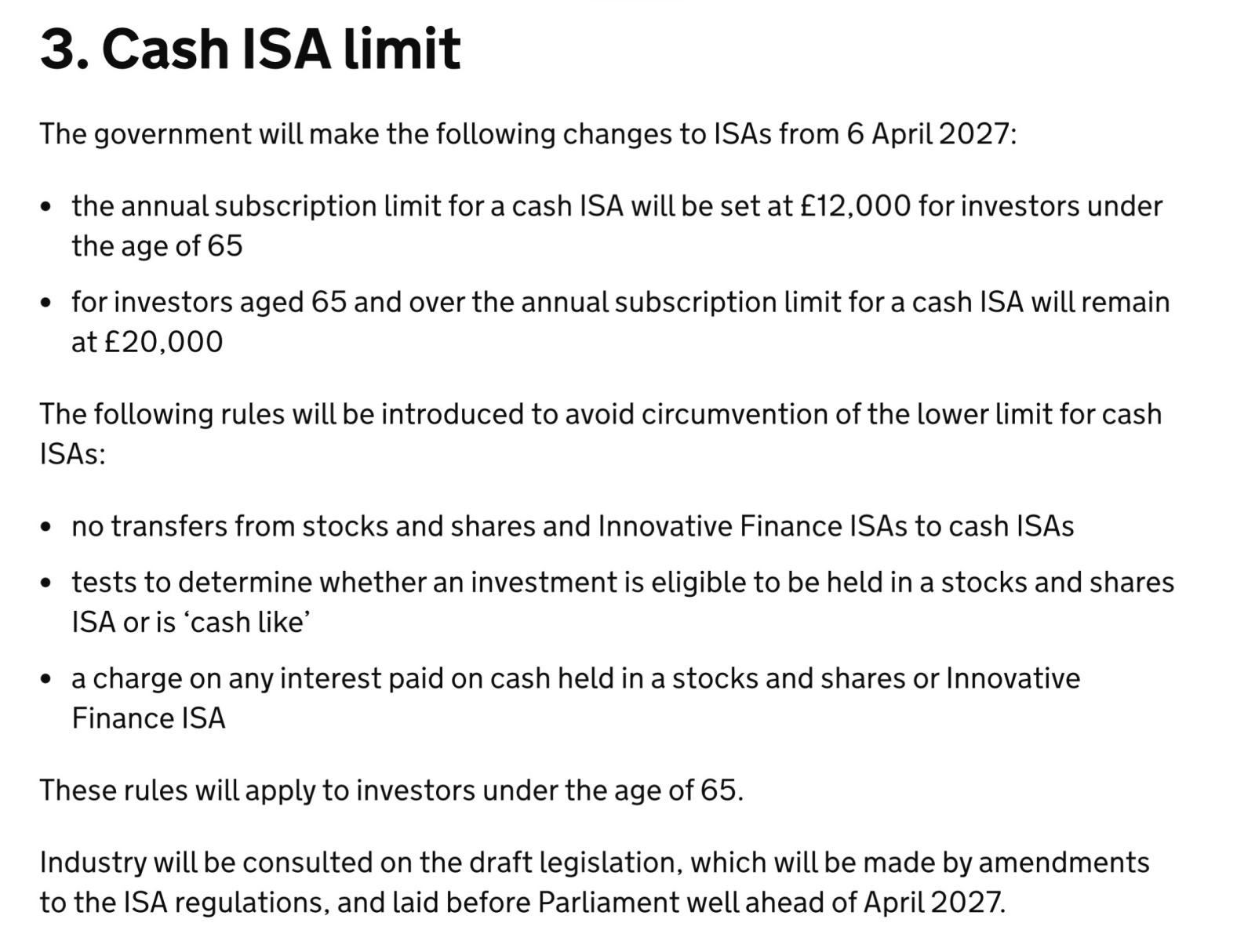
The link to this: https://www.gov.uk/government/publications/tax-free-savings-newsletter-19/tax-free-savings-newsletter-19-november-2025Time2Go_25 said:The following rules will be introduced to avoid circumvention of the lower limit for cash ISAs:
- no transfers from stocks and shares and Innovative Finance ISAs to cash ISAs
- tests to determine whether an investment is eligible to be held in a stocks and shares ISA or is ‘cash like’
- a charge on any interest paid on cash held in a stocks and shares or Innovative Finance ISA
Gilts, dunno, we'll have to see the finer detail on whether they can be held to maturity. Though if you have gilts with only a couple of years to run they're also effectively cash anyway at this point, so you might as well sell them and transfer to a cash ISA if that's your wont.
Surely the government would not force people to sell investments which were compliant with the rules when purchased, but are suddenly no longer compliant with any new rules.......some could be looking at investment losses into the thousands.6 -
boingy said:I think they might not have thought it through. There is already enough confusion about ISA limits and rules. The providers are going to love that extra bit of complexity...Seems to me, if you want to get reluctant people to invest rather than save, then the last thing you should do is to make the 'investment' ISA rules even more complicated than the average punter already finds them.The new rules may also have the unintended consequence of driving some existing investors away from their S&S ISAs. Not being able to transfer into (or hold) as cash may mean nervous investors (and/or those needing temporary access to cash) might sell up and transfer to a cash ISA while they still can, or simply not invest in the first place.10
-
I just read the following.
Guidance published on the HM Revenue and Customs (HMRC) website said rules will be introduced "to avoid circumvention of the lower limit for cash ISAs".These rules are expected to include charges on interest earned on cash held within stocks and shares ISAs, as well as checks to determine whether money is being kept in "cash-like" accounts.
The greatest prediction of your future is your daily actions.0 -
Where di you read this?dont_use_vistaprint said:I just read the following.
Guidance published on the HM Revenue and Customs (HMRC) website said rules will be introduced "to avoid circumvention of the lower limit for cash ISAs".These rules are expected to include charges on interest earned on cash held within stocks and shares ISAs, as well as checks to determine whether money is being kept in "cash-like" accounts.
16 Panel (250W JASolar) 4kWp, facing 170 degrees, 40 degree slope, Solis Inverter. Installed 29/9/2015 - £4700 (Norfolk Solar Together Scheme); 9.6kWh US2000C Pylontech batteries + Solis Inverter installed 12/4/2022 Year target (PVGIS-CMSAF) = 3880kWh - Installer estimate 3452 kWh:Average over 6 years = 4400 :j0 -
From 6th April 2027 if it doesn't get U-turned beforehand0
-
There are about four threads running in this already. Why start another one?
The finer details remain to be announced, but it is likely that they will mirror the rules that existed until 2014, the last time ther was a separate limit for cash ISAs. If that's how it works out:
(1) Interest paid on cash balances within a S&S ISA will be subject to some form of deduction (possibly a flat rate levy of say 20% rather that your marginal tax rate - the announcement speaks of a "charge" rather than tax)
(2) Money market funds and some other cash-equivalents (short dated gilts being the obvious ones) will not be eligible to be held within a S&S ISA. It won't be a case of the interest on them being taxed - they simply won't be on the list of funds that appears when you click "buy".
Whether existing holdings will have to be sold is one of the finer details to be worked out during the consultation. In the meantime if you want to keep your money in something that looks, walks and quacks like cash in a tax free environment, you have sixteen months to sell your money market holdings and transfer the proceeds to a cash ISA. So plenty of time to see the finer details.8 -
Section62 said:boingy said:I think they might not have thought it through. There is already enough confusion about ISA limits and rules. The providers are going to love that extra bit of complexity...Seems to me, if you want to get reluctant people to invest rather than save, then the last thing you should do is to make the 'investment' ISA rules even more complicated than the average punter already finds them.I do think they have missed a trick here. Had they continued to allow cash-like investments in a S&S ISA, it potentially would have increased the number of people with S&S ISAs and a low barrier to using these to buy investments alongside the cash-like instruments. This, coupled with an information piece, perhaps driven through the providers, would promote and remove barriers to investment when it is appropriate, while treating individuals like adults and letting them make an informed decision themselves.Part of Osbourne's reforms in the 2010s was the launch of the "NISA" which initially appeared to blur the distinction between cash & S&S so that there wasn't the barrier of opening a new strange product to dip your toe in the water - yet this rhetoric never seemed to materialise in practice (save for the most recent generation of ISAs using QMMF).7











Confirm your email address to Create Threads and Reply

Categories
- All Categories
- 355.8K Banking & Borrowing
- 254.9K Reduce Debt & Boost Income
- 456.2K Spending & Discounts
- 248.3K Work, Benefits & Business
- 605.9K Mortgages, Homes & Bills
- 179K Life & Family
- 263.8K Travel & Transport
- 1.5M Hobbies & Leisure
- 16.2K Discuss & Feedback
- 37.7K Read-Only Boards