We’d like to remind Forumites to please avoid political debate on the Forum.
This is to keep it a safe and useful space for MoneySaving discussions. Threads that are – or become – political in nature may be removed in line with the Forum’s rules. Thank you for your understanding.
📨 Have you signed up to the Forum's new Email Digest yet? Get a selection of trending threads sent straight to your inbox daily, weekly or monthly!
Can you do this Social Test for me please?
Comments
-
True but it is all subjective, I would expect that to change the speed but the results do not show a significant speed change.born_again said:You need to remember that location & time of day can make a big difference to results people get.0 -
Why are you so concerned about latency? Anything under 20ms is fine even for competitive gaming, anything under 100ms does not matter for pretty much anything else. They do not alter the latency on social tariffs, they just speed cap them.
You mentioned in one post delayed notifications on Ring doorbells, do you realise that 100ms is 0.1 of a second? Even 1,000ms would not impact the notification time on a Ring doorbell in a perceptible way, the delays will be based on Ring's processing time, and mostly down to the the app/device receiving the notifications etc. latency on the broadband network is such a small factor it is an irrelevance.1 -
Thanks for your replyMattMattMattUK said:Why are you so concerned about latency? Anything under 20ms is fine even for competitive gaming, anything under 100ms does not matter for pretty much anything else. They do not alter the latency on social tariffs, they just speed cap them.
You mentioned in one post delayed notifications on Ring doorbells, do you realise that 100ms is 0.1 of a second? Even 1,000ms would not impact the notification time on a Ring doorbell in a perceptible way, the delays will be based on Ring's processing time, and mostly down to the the app/device receiving the notifications etc. latency on the broadband network is such a small factor it is an irrelevance.
I do not do gaming, I find latency affects all kinds of things,it is hard to name all of them but you just feel it on many devices.
I expect latency because I am on a wireless bridge but when discussing with friends none of them feel their internet is super responsive so we each started asking friends and family in UK and abroad. Between us we have had visitors from abroad and some have gone abroad and the general consensus is other than California internet feels faster abroad. I was shown some similar reports to those I suggested above, in Bangladesh a mobile phone data was more responsive that UK household internet. In Spain a household had 68mb and felt superfast but in a remote area where you would expect it to be worse it was actually better.
Ring notifications was just one that I discussed with a friend who was having similar issues, you are right about the processing time, app, device etc but these were constants. The complaint on Alexa was that by the time they got the notification the courier had gone, so it clearly was not just milliseconds and whilst it may be other factors in my experience latency (particularly under load) is a good benchmark for responsiveness.
I visited a family member who had 150mb Virgin and they were also complaining about responsiveness. They said Virgin only count a speed to their devices from a directly wired PC.
For me it is just a question of whether I would get an improved performance if I signed up, I am not convinced I would so I ask people who are on 35mb to run the tests. Of course many things are subjective but I do not want to waste money if performance is not substantially improved.
0 -
At home I have FTTP, I get 4-6ms latency. The response time of most non-gaming monitors is 20ms or more, the response time of Windows or Mac OS is around 3ms, the response time of Android or iOS is similar and most phones are running at 60hz so another 16.6ms delay in response time. Latency on broadband when doing anything other than gaming is imperceptible to humans below 100ms because other factors are more important, display, device, throughput on the connection etc.NotArobot24 said:
Thanks for your replyMattMattMattUK said:Why are you so concerned about latency? Anything under 20ms is fine even for competitive gaming, anything under 100ms does not matter for pretty much anything else. They do not alter the latency on social tariffs, they just speed cap them.
You mentioned in one post delayed notifications on Ring doorbells, do you realise that 100ms is 0.1 of a second? Even 1,000ms would not impact the notification time on a Ring doorbell in a perceptible way, the delays will be based on Ring's processing time, and mostly down to the the app/device receiving the notifications etc. latency on the broadband network is such a small factor it is an irrelevance.
I do not do gaming, I find latency affects all kinds of things,it is hard to name all of them but you just feel it on many devices.
I expect latency because I am on a wireless bridge but when discussing with friends none of them feel their internet is super responsive so we each started asking friends and family in UK and abroad. Between us we have had visitors from abroad and some have gone abroad and the general consensus is other than California internet feels faster abroad. I was shown some similar reports to those I suggested above, in Bangladesh a mobile phone data was more responsive that UK household internet. In Spain a household had 68mb and felt superfast but in a remote area where you would expect it to be worse it was actually better.
For me it is just a question of whether I would get an improved performance if I signed up, I am not convinced I would so I ask people who are on 35mb to run the tests. Of course many things are subjective but I do not want to waste money if performance is not substantially improved.
Globally there can be differences, but equally there can be nationally. As an example FTTP usually operates around 5ms, FTTC in the 15-30ms range and legacy copper etc. can push that higher, but still under 100ms. Some less developed countries skipped the cooper stage entirely and went to FTTP, in South Korea nearly every connection is FTTP, it can be similar in the better off parts of the US. Similar happens with mobile data, some countries went straight to 4/5G. Speeds in the middle of nowhere can be faster because there are no other devices sharing the connection on mobile and on FTTP distance is almost irrelevant.
All broadband suppliers only count wired connections because WiFi introduces additional latency, a good quality router on the 5Ghz spectrum with no contention issues should be no more than 5ms, often in the 1-2ms range, however cheaper kit, 2.4Ghz channels, older devices, congested spectrum, etc. can easily add 40ms to the base connection. However none of that is really relevant, for non-gaming anything less than 100ms is imperceptible so the issue was not latency. Lack of responsiveness is almost certainly a device issue.NotArobot24 said:I visited a family member who had 150mb Virgin and they were also complaining about responsiveness. They said Virgin only count a speed to their devices from a directly wired PC.
You need to think about what you actually want, speed vs budget, but focusing on latency is totally the wrong thing to focus on and is not going to make the slightest bit of difference because you are not a competitive FPS gamer and will likely have latency in the 20-40ms range. Your actual latency will depend on the connection type (FTTP, FTTC, copper), wired or wireless connection and devices.NotArobot24 said:For me it is just a question of whether I would get an improved performance if I signed up, I am not convinced I would so I ask people who are on 35mb to run the tests. Of course many things are subjective but I do not want to waste money if performance is not substantially improved.
2 -
I would still appreciate the test results if there are any people on 35mb social plan with BT0
-
Yes I am; I've had it for a couple of years now (was £15 went up to £16 a couple of months back) and I been very happy with it.It does everything that I want and isn't subject to drops or outages.I'd usually look at Ping time rather than latency, but whichever you are happier with.For those not sure about Latency (or Ping) times then this is a decent beginers article:
https://www.virginmedia.com/the-edit/glossary/what-is-latencyWhat’s a good latency speed?
That depends on what you’re doing! For most online activities, a latency of 20ms to 50ms is considered excellent, while anything under 100ms is usually considered good enough for everything to work as it should.Still, for activities that rely on real-time interactions like online gaming or video calls, your latency needs to be even better Online gaming in particular usually needs a latency of less than 50ms plus fast enough broadband speeds so players can react instantly to the action on-screen. If latency goes over 100ms in games, you might start to experience game stuttering or lag, where actions feel delayed or unresponsive.
Some activities, like live streaming or downloading files, are less sensitive to latency. In these cases, even a latency of 100ms to 200ms might not noticeably affect performance. But if latency gets over 300ms, it can disrupt almost any online activity, making it feel slow or frustrating.
So any latency of under 20ms is 'excelent plus'.
For what it's worth here are my results from your tests.I have FTTC, theres a 10 meter extension cable from the BT socket to my SmartHub2, and the tests were done over wifi (about 2 metres) on a Lenovo laptop running Windows 11.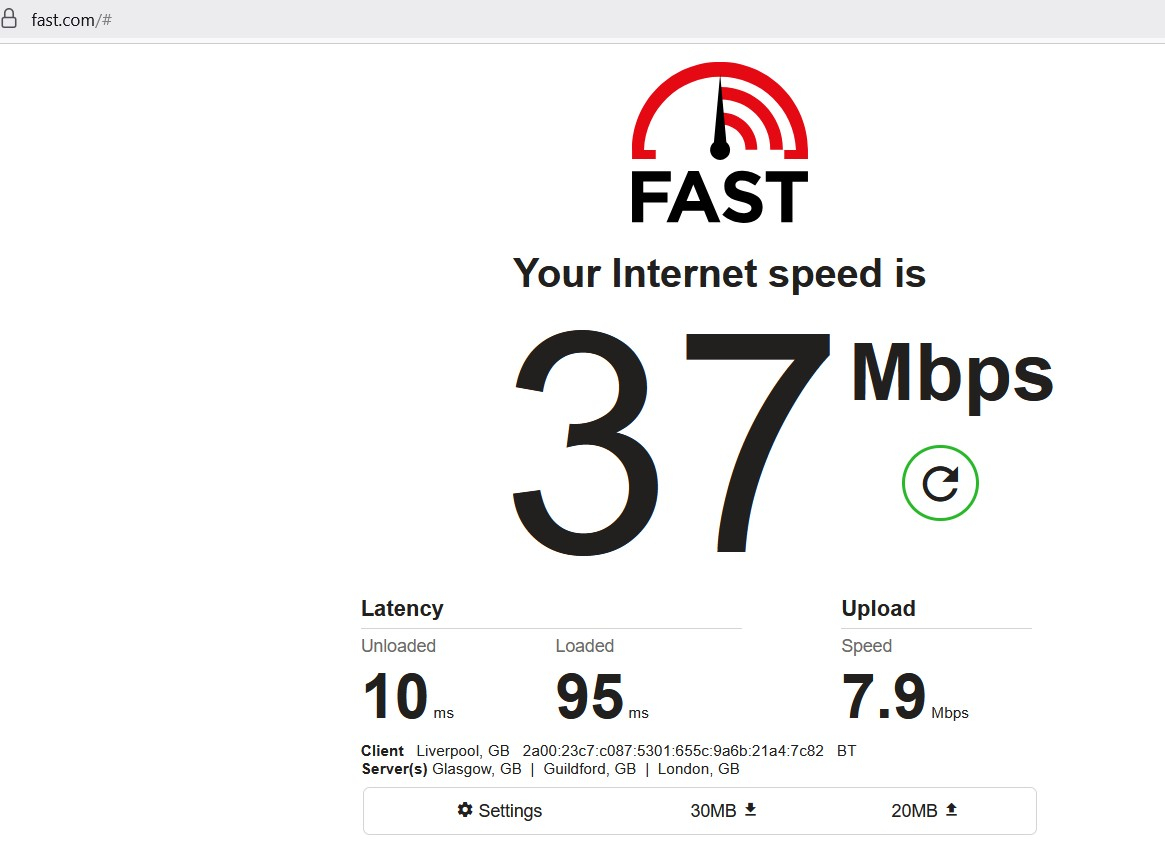
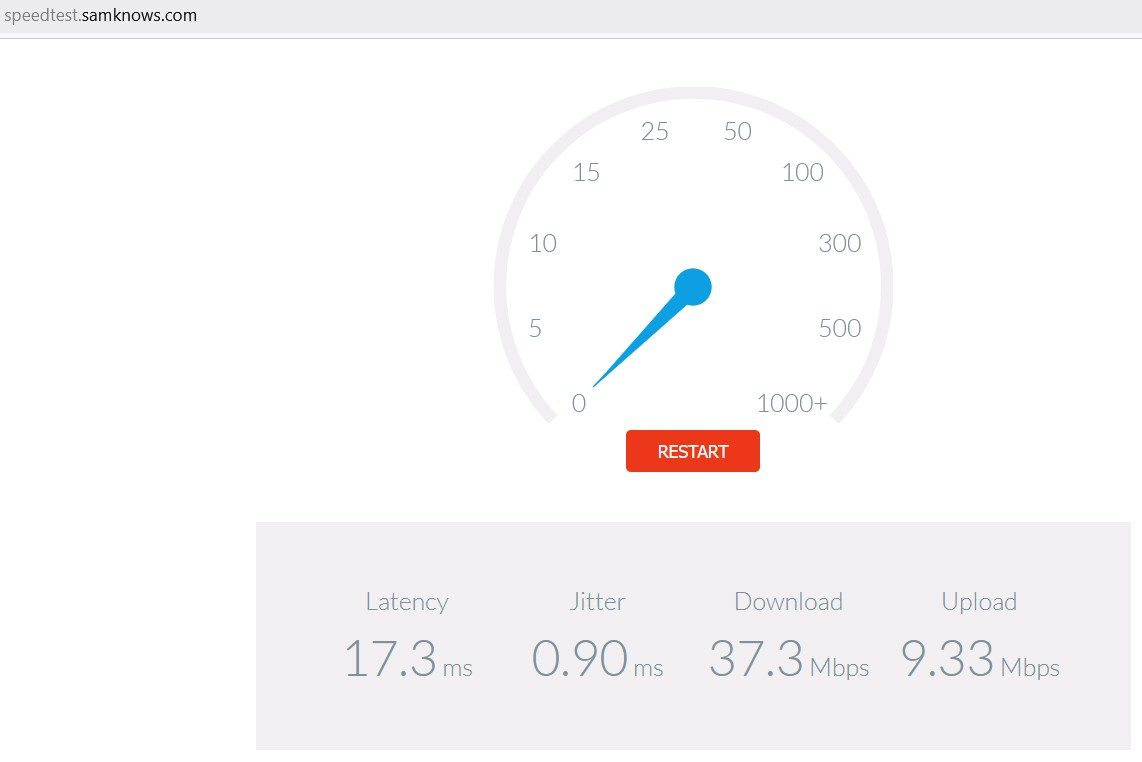
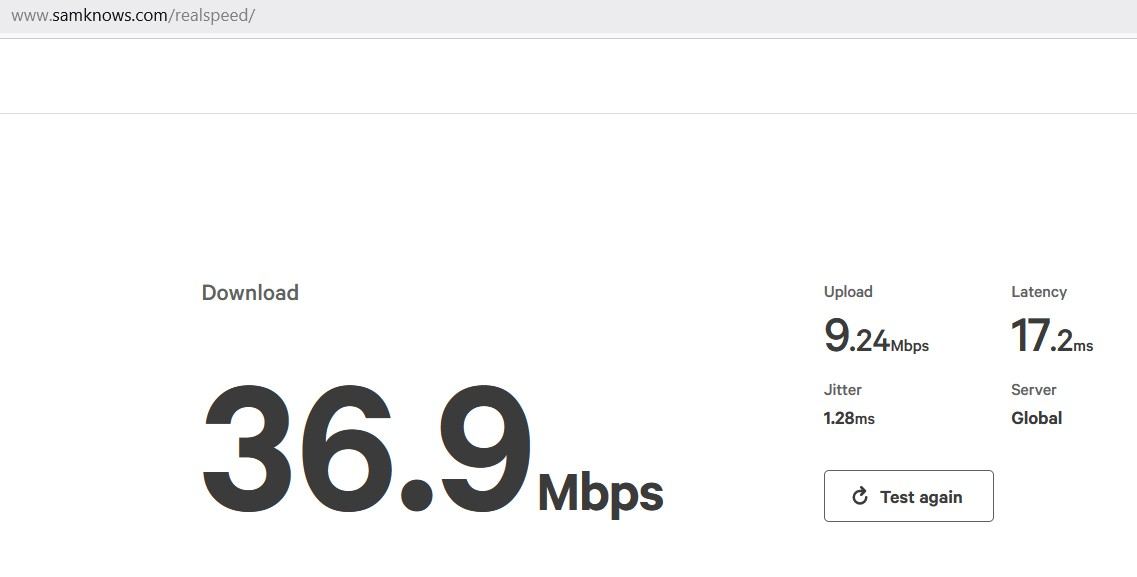 And for good measure here's the result from the Ookla Speedtest app which is what I normally use: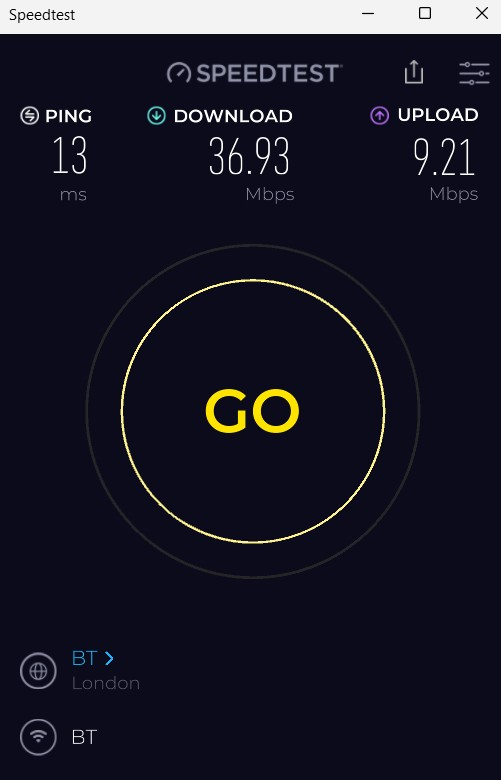
1 -
These comparisons are meaningless; latency depends on the full path between you and the server, not just the first leg. Moreover people on that tariff will be on a mixture of FTTC and FTTP.NotArobot24 said:
I am also interested to see if the social tariff is any way inferior, whilst people say it is not, the latency figures quoted by the one person who has run the test show pretty bad latency figures.
This suggests to me that it is in fact inferior, especially as that person did the test on an Ethernet connection which I would be much better than wifi.
If you go with that tariff you will be put on FTTP if it's available, without the option of staying on FTTC. If you are currently on FTTC then likely your latency will improve.
Some companies have their own fibre for FTTP, but most broadband is provided by BT Openreach, which is required to operate at arms length from the rest of BT. I doubt they would want to go to the trouble of grooming social tariffs.
0 -
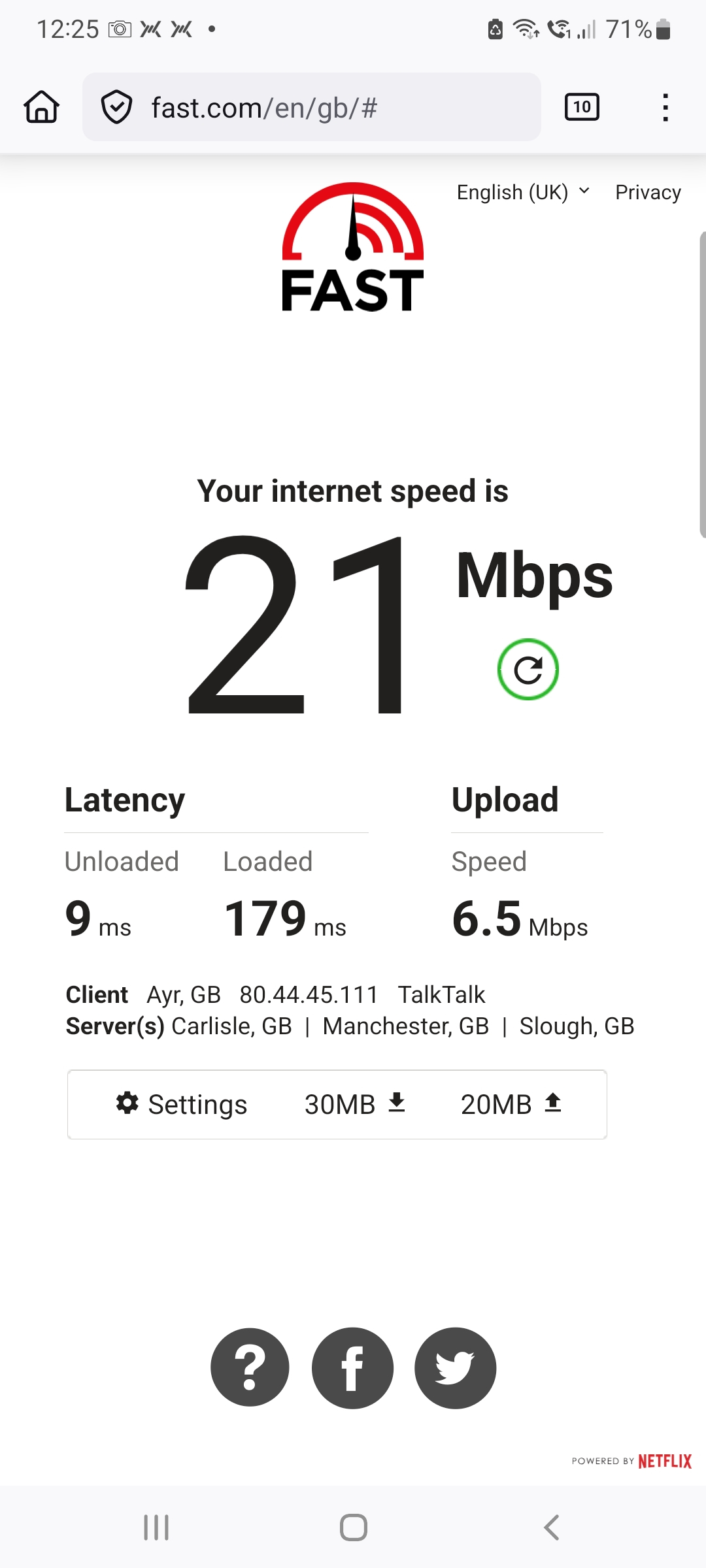
I suggest you should take the advice from other posters that latency can be a factor in performance...but only for certain types of data.Most often virtually irrelevant not associated with tariffs but with devices and web hop numbers and locations. A little use network ( such as in some of the countries you mention) can have a significant affect as can the servers and apps in use.You may well ignore the following if you choose but I am on an Open reach network ( my BB supplier uses Talktalk servers) but is copper to the exchange and smat phone over wifi so you would expect it to be less responsive than many including yourself at all times.My download speed is usually 30Mb/s and up about 8. Latency in the order or 16mS frequently. Speed is adequate for me but a tad slower this morning.So am I getting significantly higher latency? Well unloaded is jut 9mS, loaded ( whatever that means ) 179mS and download down by a third.A slight perceptible delay but not enough to be of a concern for general use.I maintain this difference is nothing to do with my link to the exchange ( Cu vc Fibre) but the overall business of the WWW and how may hops I am currently routed on. Ir is still giving good video results.Incidentally a ping test ( 64bytes)just to my router is taking 9mS...
 0
0 -
Thanks for further replies, I do accept that there are many additional factors, things like copper to the door, quality of wiring, age and quality of router, wired or wireless.
The reason I chose latency is because I used to work in an environment where we tested networks, intranet, servers, PC's graphics cards, CPU's, Memory, Databases and application for a city firm when they felt that a nanosecond delay cost them money. Not the delay itself but the cascading effect of that delay.
Obviously broadband is a very different situation with many moving parts, but I have found latency to be a key factor in what "feels" responsive.
0 -
NotArobot24 said:
The reason I chose latency is because I used to work in an environment where we tested networks, intranet, servers, PC's graphics cards, CPU's, Memory, Databases and application for a city firm when they felt that a nanosecond delay cost them money.How long ago? Things like that change quickly.And what some "City firm" CEO "knows" is not always correct - people are just people with all our biases.If they were paying you for testing their biases then then take the money and move on to the next.
0












Confirm your email address to Create Threads and Reply

Categories
- All Categories
- 355.8K Banking & Borrowing
- 254.9K Reduce Debt & Boost Income
- 456.2K Spending & Discounts
- 248.3K Work, Benefits & Business
- 606K Mortgages, Homes & Bills
- 179K Life & Family
- 263.8K Travel & Transport
- 1.5M Hobbies & Leisure
- 16.2K Discuss & Feedback
- 37.7K Read-Only Boards