We’d like to remind Forumites to please avoid political debate on the Forum.
This is to keep it a safe and useful space for MoneySaving discussions. Threads that are – or become – political in nature may be removed in line with the Forum’s rules. Thank you for your understanding.
📨 Have you signed up to the Forum's new Email Digest yet? Get a selection of trending threads sent straight to your inbox daily, weekly or monthly!
The Forum now has a brand new text editor, adding a bunch of handy features to use when creating posts. Read more in our how-to guide
MSE News: Don't cut Cash ISA limit, MPs urge Government
Comments
-
It's only in the past year or so that they've become available to retail investors so they're new to everyone but in my experience one month bills are issued at a yield in touching distance +/- of Bank rate so there isn't much risk.poseidon1 said:wmb194 said:
UK Treasury bills would be the closest to cash: short dated, you buy them at issue and as there's no market so you have to hold them to maturity. The only quirk is that capital gains are classified as interest but when held in an Isa this doesn't matter.poseidon1 said:Can't see any likelihood of gilts being disallowed in S&S ISAs.
Gilts are in no way a cash proxy; can and do go up and down in value daily; are sufficiently complex in the range and type of gilts available together with how they are taxed, to baffle and discourage the vast majority of cash savers.
I would warrant that those of us on this forum who do invest in gilts are a very small percentage of all investors here.
Certainly agree these 3 month to 1 year Bills are the nearest instrument which equate to conventional short duration bonds available from some banks and building societies ( I have an Oxbury Bank 4.4% 3 month savings bond on the go right now).
However, if few investors here invest in gilts, even fewer partake of short duration bills ( I have done so twice in the last year). HL flagged a new 3 month issue last week, which I ignored. Worth noting you don't actually know what your rate of return will be until after the Bill has been issued so lacks the visibility and transparency of return compared to a bank short duration savings bond.
I cannot see the untutored mass of cash savers gravitating to a short term gilt they know nothing about and which even seasoned retail gilt investors seem to largely ignore.
There's a learning curve to everything but I don't think Treasury bills and conventional gilts are too challenging. If they remain available and people are desperate to contribute £20k to an Isa rather than £12k but only want something very low risk then gilts and bills would be a good option.2 -
As an individual you've always been able to buy gilts - you used to be able to buy them via the Post Office - but I'm not sure what the rules were with Peps but even if you were able to hold them in a Pep your broker might not have offered them.intalex said:
Could individuals buy into individual gilts back then? Wasn't it just gilt-based funds?jimjames said:
When there was a restriction on cash held in S&S ISAs gilts could still be held so I can't see the rules being any different if they were restricted againposeidon1 said:Can't see any likelihood of gilts being disallowed in S&S ISAs.
Edit: Originally they weren't allowed but then the rules were changed. From Google: "Yes, it was possible to hold gilts (UK government bonds) in a Personal Equity Plan (PEP). The rules for PEPs were changed in 2001 to permit investment in gilts, which had not been allowed previously. "1 -
I don't think it was something supported by DIY investment platforms of the era, but I do recall that HMRC had some rules around eligibility and I think it was only short duration funds that were ineligible. I suppose for individual gilts to be allowed at all, they would have to allow them to be held to maturity.intalex said:
Could individuals buy into individual gilts back then? Wasn't it just gilt-based funds?jimjames said:
When there was a restriction on cash held in S&S ISAs gilts could still be held so I can't see the rules being any different if they were restricted againposeidon1 said:Can't see any likelihood of gilts being disallowed in S&S ISAs.0 -
Private investors could indeed at one time buy gilts via the post office which were adminstered by National Savings.In those days all NSI products were bought via the post officeThe snag was there was only a limited selection of gilts available though this channel and I do recall there were no low coupon type gilts available at all.I really cannot remember if at that time were were any index linked gilts at all in the UK market.We are talking maybe 25 to 30 years ago after all when gilts on the NSI register ceased!0
-
There won't have been: low coupon conventional gilts are a quirk of low rates in the wake of the Financial Crisis. There were some low-ish (2.5%?) coupon perpetuals but they were a bit different and you couldn't plan on redemption. Index linked gilts were introduced in 1981.x44 said:Private investors could indeed at one time buy gilts via the post office which were adminstered by National Savings.In those days all NSI products were bought via the post officeThe snag was there was only a limited selection of gilts available though this channel and I do recall there were no low coupon type gilts available at all.I really cannot remember if at that time were were any index linked gilts at all in the UK market.We are talking maybe 25 to 30 years ago after all when gilts on the NSI register ceased!
Edit: It was in 2002 that the PO gilt service ended.
https://www.thisismoney.co.uk/money/news/article-1541741/No-gilts-at-the-Post-Office.html
0 -
Already covered in other threads, but just to clarify in this one:4.228 ISA Reform – From 6 April 2027 the annual ISA cash limit will be set at £12,000, within the overall annual ISA limit of £20,000. Annual subscription limits will remain at £20,000 for ISAs, £4,000 for Lifetime ISAs and £9,000 for Junior ISAs and Child Trust Funds until 5 April 2031. Savers over the age of 65 will continue to be able to save up to £20,000 in a cash ISA each year. In addition, financial services firms will be providing new, easily navigable ways for people to find the right UK investment for them.https://assets.publishing.service.gov.uk/media/6926eb102a37784b16ecf525/E03444720_Budget_2025_Web_Accessible.pdf2
-
Is it not just easier to invest in an ETF that concentrates on UK Government Bonds than try to navigate the intricacies of individual Gilt issues? I noticed that AJ Bell is offering Gilts now too, but it seems an overly complex and dareisay anoraky area of low risk investments for your average individual investor to want to waste their time trying to get to grips with?0
-
*gilt (all lowercase). Might be but the problem with longer dated bond ETFs is they don't have maturity dates so you don't have a guaranteed value on a particular date and losses might not be recouped. Individual gilts held to maturity have guaranteed cash flows.Ceejay3000 said:Is it not just easier to invest in an ETF that concentrates on UK Government Bonds than try to navigate the intricacies of individual Gilt issues? I noticed that AJ Bell is offering Gilts now too, but it seems an overly complex and dareisay anoraky area of low risk investments for your average individual investor to want to waste their time trying to get to grips with?
There's a small learning curve but conventional gilts are pretty simple, IMO not much more complicated than a fixed rate savings bond. Capital gains are tax free and you just need to declare interest if held in a GIA.
The other day I bought some via Freetrade (now owned by IG) and it was the best experience I've had buying gilts yet - tell it the amount you want to invest and it makes the adjustment it needs for accrued interest and the trade was executed in seconds.
0 -
Ceejay3000 said:Is it not just easier to invest in an ETF that concentrates on UK Government Bonds than try to navigate the intricacies of individual Gilt issues? I noticed that AJ Bell is offering Gilts now too, but it seems an overly complex and dareisay anoraky area of low risk investments for your average individual investor to want to waste their time trying to get to grips with?What like this one?
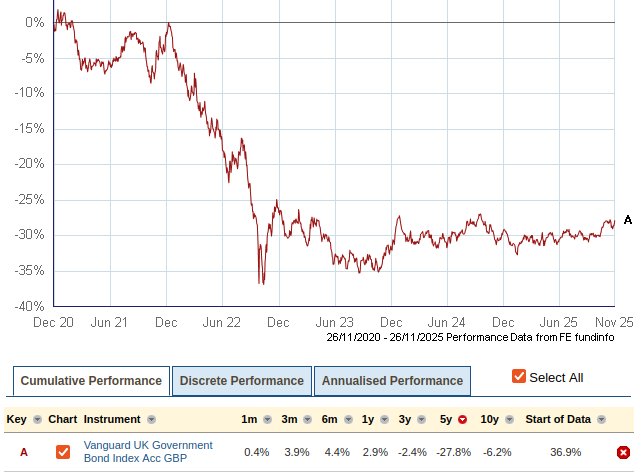 Many think they understand bond funds and that they can be substituted into a portfolio as a like for like replacement. Yet I would contend that a bond ETF is more complex and difficult to understand. A 5 year return of nearly minus 30% is not something most people would have expected from a simple UK gilt index fund.2












Confirm your email address to Create Threads and Reply

Categories
- All Categories
- 354.6K Banking & Borrowing
- 254.5K Reduce Debt & Boost Income
- 455.5K Spending & Discounts
- 247.5K Work, Benefits & Business
- 604.3K Mortgages, Homes & Bills
- 178.5K Life & Family
- 261.8K Travel & Transport
- 1.5M Hobbies & Leisure
- 16.1K Discuss & Feedback
- 37.7K Read-Only Boards