We’d like to remind Forumites to please avoid political debate on the Forum.
This is to keep it a safe and useful space for MoneySaving discussions. Threads that are – or become – political in nature may be removed in line with the Forum’s rules. Thank you for your understanding.
PLEASE READ BEFORE POSTING:
Hello Forumites! In order to help keep the Forum a useful, safe and friendly place for our users, discussions around non-MoneySaving matters are not permitted per the Forum rules. While we understand that mentioning house prices may sometimes be relevant to a user's specific MoneySaving situation, we ask that you please avoid veering into broad, general debates about the market, the economy and politics, as these can unfortunately lead to abusive or hateful behaviour.
Threads that are found to have derailed into wider discussions may be removed. Users who repeatedly disregard this may have their Forum account banned. Please also avoid posting personally identifiable information, including links to your own online property listing which may reveal your address. Thank you for your understanding.
📨 Have you signed up to the Forum's new Email Digest yet? Get a selection of trending threads sent straight to your inbox daily, weekly or monthly!
My ongoing boundary dispute ordeal/odyssey (advice sought)





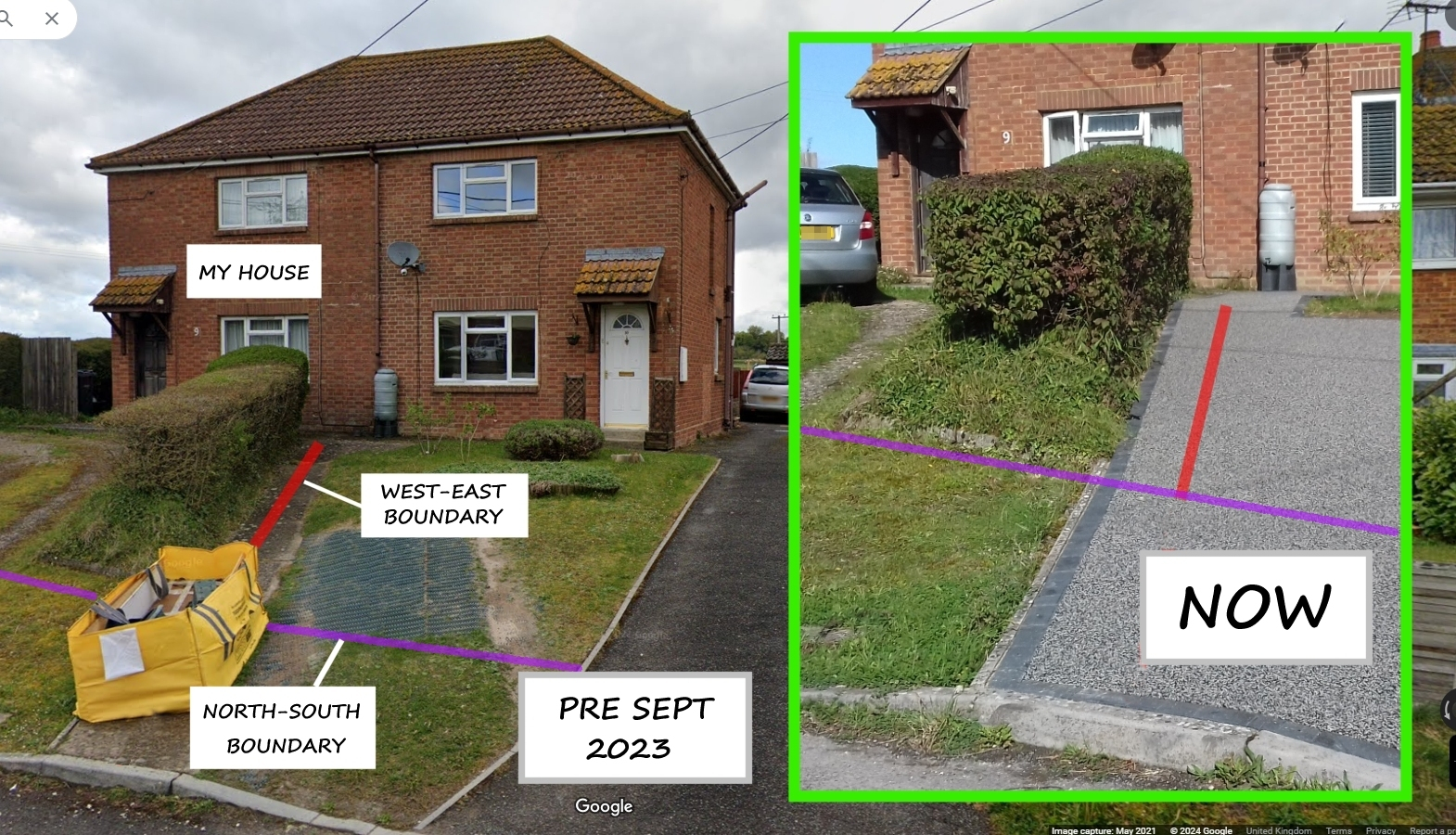
In September of last year, without warning me in advance, my previously trustworthy/friendly neighbours began turning their front garden into a resin-topped parking area. On the first day their contractors removed a shared concrete path that defined the boundary between our front gardens, and installed a cement-like base, and brick surround. Realising something was amiss but, at the time, not entirely sure of the boundary position (the concrete path - an original feature - isn't explicitly mentioned in the deeds, and a hedge wholly in my garden visually confuses things) I went round the following day and made them aware that there could be a big problem. Unfortunately they ignored my concerns and ploughed on. A week later, the contractors turned up again and laid the resin surface.

In the weeks that followed I researched the boundary position, sought advice, and attempted to explain to my neighbours that they had a) destroyed an important boundary feature, and b) effectively purloined a strip of my property. When they refused to accept this, insisting in emails and letters (they'd stopped talking to me in person by this point) that their project had made no difference, and didn't take up my mediation suggestion, I eventually paid around £1000 for a local solicitor to send them a letter of claim for trespass along with a letter suggesting possible alternative solutions (reinstatement of the path, or purchase of the strip of my land they'd encroached on).


Obviously it has occurred to me that my neighbours might be deliberately time-wasting in the hope that I lose interest (There's zero chance of this as the destruction of the path has rendered certain clauses in my deeds nonsensical, and the dispute has probably made my house almost unsaleable) but recently while re-examining the council's online planning permission map I noticed another possible reason for the delays. My neighbours' new parking surface doesn't just encroach on my land, it covers a piece of council-owned land between the road and legal boundary of their front garden. The road-end of the old path - and the land either side of it - was/is owned by the local Highways dept, while the remaining two-thirds of the path is divided longitudinally between my property and my neighbours'. I think it's quite possible that my neighbours only realised this quite recently, and are now in something of a quandary. Obviously, while I can sell them some of the land on which the path once stood, I can't sell them all of it as a portion belongs to the local council.


On Nov 8, I provided my neighbours' solicitor with a "crude mock-up" of what I believe would be an appropriate plan in our situation (see above). They have yet to respond to this mail.


As I pointed out in my next email to the conveyancer, if I signed the plan and it was used in the transaction, post-transfer I would still own a sizeable strip of nextdoor's parking area...

On Jan 31, I was informed my neighbours had approved my plan. On Feb 4, the partner with responsibility for handlings complaints, who by then seemed to be handling/overseeing the transfer directly, told me he would be "in further contact shortly".
Comments
-
Personally
I'd let it go
These disputes can turn into money eating pits
It's not right but there's a point where you have to look past itEx forum ambassador
Long term forum member3 -
You haven't mentioned that you have Legal Protection included in your house insurance, so I presume you haven't? Tsk-tsk - what a shame - this issue would have been fun to resolve if you had.Your neighbours are utter twerps; arrogant, entitled, 'oles. Always will be - so do not get sucked in by any seeming change of 'attitude' such as suddenly becoming contrite; they won't be. It'll be an act to try and gain what they want. Do not trust them an iota.Yes, the land transfer - assuming this will still go ahead - will need to be done correctly, and changes made to both sets of deeds - for which they also cover the cost (watch out for anything they 'forget' to include like this). This shouldn't cost you a penny, but should obviously gain you the full actual sum you have agreed - so clarify, no deductions. On that note, any expenditure you have been forced to make so far, they should reimburse you for. So, keep tallying it up. In any comm, you may wish to remind them what that figure currently is...This is all of THEIR making - remind yourself of that - and them too, if need be.Meanwhile, that strip of land you've drawn in red on the 'after' photo, is fully yours, so I hope you still walk down 'their' new paved area? You should. Also, you have the right to go over what was/is their bit, as that is outlined in your deeds. So I hope you do that too? And, since they have blurred that boundary - ie, removed all trace of where their land begins - they cannot blame you if you wander over too far - that could be fun.Ok, don't be provocative, but - really - do continue to use that 'old' pathway; do not provide any sense whatsoever that they have taken ownership of it in any way.Do not be intimidated by them either - they are now on the back foot, and are getting exactly what they deserve. Remind yourself - and them if you talk to them - "This is all of their doing..."I don't quite follow what's on the ground compared to the deeds maps; the latter appears to show this path (and boundary) as heading at a steep angle towards the neighbour's side driveway, whereas the 'before' photo seems to show that path ending further towards your side? But this could be photo angle, and also the fact that their side driveway isn't tight to their house.There are two things I would personally add to what's going on; one is a proper land survey to determine, as accurately as possible, where the true boundary lies. This is at the neighbour's cost. And the other - I suggest you consider this very carefully, even tho' it'll cheese them off - is that you should draw a straight line, perpendicular to your house, coming out from where your two properties join - very easy to determine - and that they should not have ownership of anything beyond that line. Their new drive is currently going across part of the front of your property - that is completely outrageous and unacceptable. If you allow this - and you shouldn't - when you come to sell, potential buyers will wonder, 'what the hell?!' It will be off-putting to many.So, I would look to do this:

 With this, you should suffer no significant loss from the change - it's kind of wasted land - and you should gain a few deserved £k. If/when they moan, you can tell them, "Fortunately, since you and your solicitor procrastinated and prevaricated*, I've had time to obtain proper advice, and this makes it clear you should not own any land directly in front of my house." And, the catch-all, "Why are you complaining - this is all of your making?" Obviously, temper such comments to what you would say - and you appear to be a calm, measured fellow :-)If you haven't done so, also write down a brief chronological summary of what has taken place, with all the significant comms, dated, and with any evidence you have to back it up. Eg, definitely the fact that you informed them of a probable issue the day after you noticed them starting, and well before they undertook the bulk of the work ("I went round the following day and made them aware that there could be a big problem. Unfortunately they ignored my concerns and ploughed on. A week later, the contractors turned up again and laid the resin surface.")* 'my neighbours accusing me of harassment for daring to post a hard copy of the above evidence through their letterbox' Pernicious 'oles.* 'a letter from a solicitor representing my neighbour and a denial that the parking surface had encroached on my land'. Lying whatsits.
0 -
Browntoa said:Personally
I'd let it go
These disputes can turn into money eating pits
It's not right but there's a point where you have to look past itIf you are going to consider 'letting it go', then at least understand that your rights of way over that strip remain the same, so do continue to use it as if it were the old path. If you aren't currently doing this, then really you should on occasion, because these folk need to realise the full ongoing consequences of what they've done. I'd love to see them try and stop you from going down that side of their resin drive!And, without any markings, where the RoW meets their land is now undefined on the ground, so you cannot be held responsible should you go 'over' it.I would not let this go. But then I do have LegPro who would love such an open-and-shut case.
0 -
I'm not suggesting this as a serious action to take, as it would be extremely antagonistic. But, legally, if that part of the tarmac is on the OP's land, can they then modify it? E.g. cut back that part of the tarmac and put the path back again? Or plant more bushes?0
-
pobjoy said:
.I think you probably know already, but what the neighbours are saying there in the first two points is nonsense. The 'visible demarcation line' was the middle of the path (it appears) - if anyone wanted to know where the boundary was all they had to do was measure the width of the path and the boundary was halfway across.The third point appears to confirm the belief that the land on the left side of the centreline belongs to you.One way forward - the pragmatic one - might be to get the boundary line identified using stainless steel 'demarcation studs' which can be installed by drilling into the surface and bonding them with resin. That will only work if they re-adopt their previous position that the "...actual boundary..." "...still exists...".If you are confident that the boundary position is where you think it is, then you might want to consider getting a contractor to quote for installing (say) 5 studs - then write to the neighbour (/or preferably their solicitor) informing them that since they accepted the historic position of the boundary down the centre of the path you expect they will have no objection to you engaging the contractor (at your own cost) to install demarcation studs along the boundary line, and if they wish to agree/be present in establishing the line for the contractor to work to then they should let you know.How confident are you that the highway land is as shown on the plan? Does it match your and the neighbour's deed plans? TBH I doubt the council will be very interested in doing any enforcement, provided the neighbour hasn't done anything other than changing the surface. It would be different if they were putting up a fence or wall on highway land. (if you don't own the land up to the kerb at the back of the layby then on personal experience I'd expect the housing department to possibly be the owner of that strip). As the neighbour has a dropped kerb I don't think there's much that highways will want to do.One thing you probably should do is to record the position of the full-height kerb between the two sections of dropped kerb, as that can be used as a reference for where the path met the kerbline. Use a long fibre tape* to measure from both corners of the layby to where that kerb starts and finishes. Likewise measure from your own dropped kerb to that kerb. Take pictures of the tape measure in-situ, one showing the whole length of the tape plus one close enough to see the numbers on the tape.*Like this -It is unlikely the neighbour will have that kerb moved now their driveway is laid, but as your only easy reference point you shouldn't risk the neighbour or the council coming along and altering the kerbline, and destroying your only evidence in the process.3 -
Section62 said:One way forward - the pragmatic one - might be to get the boundary line identified using stainless steel 'demarcation studs' which can be installed by drilling into the surface and bonding them with resin. That will only work if they re-adopt their previous position that the "...actual boundary..." "...still exists...".If you are confident that the boundary position is where you think it is, then you might want to consider getting a contractor to quote for installing (say) 5 studs - then write to the neighbour (/or preferably their solicitor) informing them that since they accepted the historic position of the boundary down the centre of the path you expect they will have no objection to you engaging the contractor (at your own cost) to install demarcation studs along the boundary line, and if they wish to agree/be present in establishing the line for the contractor to work to then they should let you know.Nice.Any mileage in suggesting that the OP suggest that the neighbours also install their own parallel demarcation studs - perhaps in a nice blue colour - to indicate the boundary of their land that the OP is entitled to access?0
-
Could the neighbour actually stop the OP putting some sort of demarcation line just inside their side of the boundary. Or, could that be classes a criminal damage, even the neighbour's drive has been built on the OP's land?
I'd be tempted to (but probably wouldn't) put a chalk mark down for now, just to make a point 0
-
MeteredOut said:Could the neighbour actually stop the OP putting some sort of demarcation line just inside their side of the boundary. Or, could that be classes a criminal damage, even the neighbour's drive has been built on the OP's land?I don't think it would be, if the land is definitely the OP's.Conversely, if it was, then the neighbour digging up the OP's half of a perfectly adequate concrete path should be treated likewise - and IMV digging up and disposing of the concrete is a far more permanent form of damage than drilling a 12mm dia hole and bonding a stainless steel stud into it.1
-
Probably not.... I'd wait for the neighbour to start complaining if the OP strays over the centreline and then suggest they are at liberty to install their own demarcation of the limit of the RoW (subject to it accurately reflecting the width of the deeds/the historic RoW)ThisIsWeird said:Nice.Any mileage in suggesting that the OP suggest that the neighbours also install their own parallel demarcation studs - perhaps in a nice blue colour - to indicate the boundary of their land that the OP is entitled to access?Depending on attitude I might go further and suggest they consider fitting retro-reflecting studs which would enable me to better see the RoW boundary when coming home late at night. 1
-
You could put up a fence just a couple of inches inside your boundary? Then you have a nice resin path on your land, thank you very much neighbour0







Confirm your email address to Create Threads and Reply

Categories
- All Categories
- 355.8K Banking & Borrowing
- 254.9K Reduce Debt & Boost Income
- 456.2K Spending & Discounts
- 248.3K Work, Benefits & Business
- 605.9K Mortgages, Homes & Bills
- 179K Life & Family
- 263.8K Travel & Transport
- 1.5M Hobbies & Leisure
- 16.2K Discuss & Feedback
- 37.7K Read-Only Boards