We’d like to remind Forumites to please avoid political debate on the Forum.
This is to keep it a safe and useful space for MoneySaving discussions. Threads that are – or become – political in nature may be removed in line with the Forum’s rules. Thank you for your understanding.
📨 Have you signed up to the Forum's new Email Digest yet? Get a selection of trending threads sent straight to your inbox daily, weekly or monthly!
The Forum now has a brand new text editor, adding a bunch of handy features to use when creating posts. Read more in our how-to guide
How much for a new wall socket ?
Comments
-
Tough. You can't have it at skirting board level.MouldyOldDough said:
It would look odd if it was 2 feet off the groundFreeBear said:
Plus £3-6 for some surface mount trunking, so say £20 for materials. An hour to fit at what ever exorbitant rate an NICEIC electrician would charge... Adding an extra socket would be well within the capabilities of a competent handyman. And if you wanted the socket at (or just above) skirting level, he/she is more likely to put it there rather than claiming it is illegal. Building regs only state a socket should be a minimum of 450mm above floor level, not must - A subtle difference.the_lunatic_is_in_my_head said: *A back box is £1-2, a 2 plug white plastic socket face is £4 and 10m of 2.5mm twin and earth cable is £10
We want it at skirting board level0 -
553.1.6 - REQUIREMENTS for Electrical Installations.FreeBear said:
Plus £3-6 for some surface mount trunking, so say £20 for materials. An hour to fit at what ever exorbitant rate an NICEIC electrician would charge... Adding an extra socket would be well within the capabilities of a competent handyman. And if you wanted the socket at (or just above) skirting level, he/she is more likely to put it there rather than claiming it is illegal. Building regs only state a socket should be a minimum of 450mm above floor level, not must - A subtle difference.the_lunatic_is_in_my_head said: *A back box is £1-2, a 2 plug white plastic socket face is £4 and 10m of 2.5mm twin and earth cable is £101 -
So I am confusedI understand that the rules state that the socket SHOULD be / rather than MUST be 450mm above floor level ?So it's up to us ?Why should we not be allowed to have the socket where we want ?
If I was half as smart as I think I am - I'd be twice as smart as I REALLY am.0 -
Both are "should", which legally isn't as strong as "shall" or "must", but gets pretty close and you would need an extremely good reason to not do it.MouldyOldDough said:So I am confusedI understand that the rules state that the socket SHOULD be / rather than MUST be 450mm above floor level ?So it's up to us ?Why should we not be allowed to have the socket where we want ?
The 450mm comes from the Building Regulations part M - accessibility.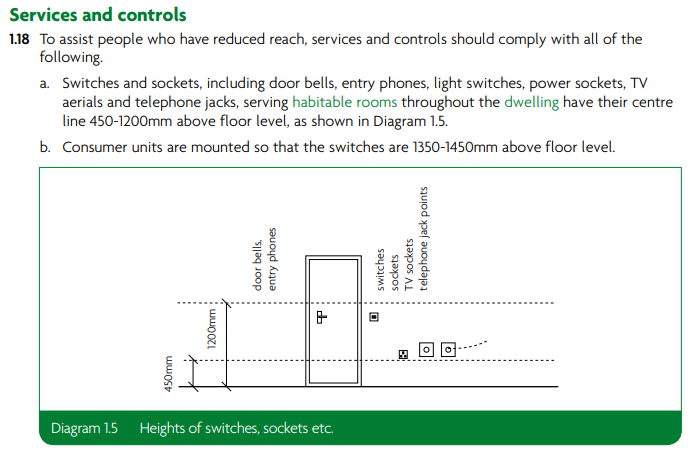
They only come into play for new buildings or buildings undergoing material alteration such as change of use. They do not apply to extensions and wouldn't apply to you.
The Wiring Regulations have the other wording, which doesn't specify a distance but does specify a requirement:
"Regulation 553.1. 6 requires that a wall-mounted socket-outlet is at a sufficient height above the floor or any working surface to minimise the risk of mechanical damage to the socket-outlet or to an associated plug and flexible cord during insertion, use or withdrawal of the plug." (from the NICEIC site guide).
So as long as the height above the floor is "sufficient" to minimise damage to any plug, cable, or the socket, then that's fine. The base of the faceplate at the top of a standard height skirting board would seem "sufficient" to me, but that's up to the installer/designer/inspector to defend.
As for why you can't just put it where you want, well, Building Regulations and the Wiring Regulations exist for a reason, not just to ignore on a whim.0 -
BarelySentientAI said: The 450mm comes from the Building Regulations part M - accessibility.And if you read the introductory pages, it clearly states that it is "guidance" and there is no obligation to adopt any particular solution contained in an approval document. But any deviation should be discussed with the relevant building control body.On the question of socket & switch height, if the room is not wheelchair accessible, there isn't any real need to put sockets at 450mm (or higher). As long as they are a sufficient distance from the floor to minimise the risk of damage, job done. But as someone that is putting sockets at ~450mm, it saves me having to grovel on the floor to unplug something.Any language construct that forces such insanity in this case should be abandoned without regrets. –
Erik Aronesty, 2014
Treasure the moments that you have. Savour them for as long as you can for they will never come back again.0 -
Converting a single socket into a double, adding a double socket alongside an existing double socket and replacing a dimmer switch came to £222 inc VAT (I bought dimmer switch, electrician supplied the sockets etc) SE England a couple of months ago.
This was in a I970s lounge, all at same height as existing sockets at 350mm above floor. Which suits me fine. A new socket in the dining room where none existed before was put 400mm above floor level.0 -
Sufficient is generally considered to be around 150mm (6") clearance - NOT skirting board height.BarelySentientAI said:
Both are "should", which legally isn't as strong as "shall" or "must", but gets pretty close and you would need an extremely good reason to not do it.MouldyOldDough said:So I am confusedI understand that the rules state that the socket SHOULD be / rather than MUST be 450mm above floor level ?So it's up to us ?Why should we not be allowed to have the socket where we want ?
The 450mm comes from the Building Regulations part M - accessibility.
They only come into play for new buildings or buildings undergoing material alteration such as change of use. They do not apply to extensions and wouldn't apply to you.
The Wiring Regulations have the other wording, which doesn't specify a distance but does specify a requirement:
"Regulation 553.1. 6 requires that a wall-mounted socket-outlet is at a sufficient height above the floor or any working surface to minimise the risk of mechanical damage to the socket-outlet or to an associated plug and flexible cord during insertion, use or withdrawal of the plug." (from the NICEIC site guide).
So as long as the height above the floor is "sufficient" to minimise damage to any plug, cable, or the socket, then that's fine. The base of the faceplate at the top of a standard height skirting board would seem "sufficient" to me, but that's up to the installer/designer/inspector to defend.
As for why you can't just put it where you want, well, Building Regulations and the Wiring Regulations exist for a reason, not just to ignore on a whim.0 -
The top of my skirting board is 5". Add the 2" to get to the centre line of the socket, and that's higher than your generally accepted situation. Even if you add 1" to get to the bottom pin position, that's still 6".Risteard said:
Sufficient is generally considered to be around 150mm (6") clearance - NOT skirting board height.BarelySentientAI said:
Both are "should", which legally isn't as strong as "shall" or "must", but gets pretty close and you would need an extremely good reason to not do it.MouldyOldDough said:So I am confusedI understand that the rules state that the socket SHOULD be / rather than MUST be 450mm above floor level ?So it's up to us ?Why should we not be allowed to have the socket where we want ?
The 450mm comes from the Building Regulations part M - accessibility.
They only come into play for new buildings or buildings undergoing material alteration such as change of use. They do not apply to extensions and wouldn't apply to you.
The Wiring Regulations have the other wording, which doesn't specify a distance but does specify a requirement:
"Regulation 553.1. 6 requires that a wall-mounted socket-outlet is at a sufficient height above the floor or any working surface to minimise the risk of mechanical damage to the socket-outlet or to an associated plug and flexible cord during insertion, use or withdrawal of the plug." (from the NICEIC site guide).
So as long as the height above the floor is "sufficient" to minimise damage to any plug, cable, or the socket, then that's fine. The base of the faceplate at the top of a standard height skirting board would seem "sufficient" to me, but that's up to the installer/designer/inspector to defend.
As for why you can't just put it where you want, well, Building Regulations and the Wiring Regulations exist for a reason, not just to ignore on a whim.
Yep. That's a benefit and problem with a lot of UK legislation - it says something like "things shall be safe and nice, and here's one way you can do it that we consider meets the requirement"FreeBear said:BarelySentientAI said: The 450mm comes from the Building Regulations part M - accessibility.And if you read the introductory pages, it clearly states that it is "guidance" and there is no obligation to adopt any particular solution contained in an approval document. But any deviation should be discussed with the relevant building control body.1 -
Most of my sockets were mounted on the skirting, so the bottom of the box were about 30mm off the floor. As I redecorate each room, sockets are moving up the wall, flush fitted, with 20mm conduit for the cables. A lot of work & mess that many wouldn't want.BarelySentientAI said: The top of my skirting board is 5". Add the 2" to get to the centre line of the socket, and that's higher than your generally accepted situation. Even if you add 1" to get to the bottom pin position, that's still 6".
Any language construct that forces such insanity in this case should be abandoned without regrets. –
Erik Aronesty, 2014
Treasure the moments that you have. Savour them for as long as you can for they will never come back again.0 -
Should building control really be involved?FreeBear said:BarelySentientAI said: The 450mm comes from the Building Regulations part M - accessibility.And if you read the introductory pages, it clearly states that it is "guidance" and there is no o. ligation to adopt any particular solution contained in an approval document. But any deviation should be discussed with the relevant building control body.On the question of socket & switch height, if the room is not wheelchair accessible, there isn't any real need to put sockets at 450mm (or higher). As long as they are a sufficient distance from the floor to minimise the risk of damage, job done. But as someone that is putting sockets at ~450mm, it saves me having to grovel on the floor to unplug something.
For a simple additional socket
If I was half as smart as I think I am - I'd be twice as smart as I REALLY am.0






Confirm your email address to Create Threads and Reply

Categories
- All Categories
- 354.2K Banking & Borrowing
- 254.3K Reduce Debt & Boost Income
- 455.3K Spending & Discounts
- 247.1K Work, Benefits & Business
- 603.8K Mortgages, Homes & Bills
- 178.4K Life & Family
- 261.3K Travel & Transport
- 1.5M Hobbies & Leisure
- 16.1K Discuss & Feedback
- 37.7K Read-Only Boards