We’d like to remind Forumites to please avoid political debate on the Forum.
This is to keep it a safe and useful space for MoneySaving discussions. Threads that are – or become – political in nature may be removed in line with the Forum’s rules. Thank you for your understanding.
📨 Have you signed up to the Forum's new Email Digest yet? Get a selection of trending threads sent straight to your inbox daily, weekly or monthly!
The Forum now has a brand new text editor, adding a bunch of handy features to use when creating posts. Read more in our how-to guide
Challenge to Financial Advisers
Comments
-
However, price history alone is of little use until it is compared with volatility. Then it starts to become useful.You have measured in a cycle where tech and the US were the main growth areas.
I arrived at this portfolio by carefully analysing 50,000 registered funds in europe and picking the best. I then ran the funds through an Efficient Frontier calculator to get the best spread.
Now run it again for the first decade of the millennium. i.e. 1st Jan 2000 to 31st Dec 2009. You won't get the same outcome because US and tech were amongst the worst areas.
Looking at volality during a period of high growth for an asset type but ignoring the period when it was more volatile is a recipe for bad outcomes. You do not know if the decade ahead will be like the last decade or the decade before that. Both were very diffrent decades for US and tech. You have used past performance in a strong growth period with the benefit of hindsight to suggest a portfolio that should be used going forward. Tech is known for being boom and bust. So, its great on the way up but hell on the way down. Your period only includes the way up.It annoys me when people like you use sophistry to bamboozle less informed people into thinking you actually know what you are talking about.And you are coming across as a Daily Mail reader who has read the headline and now thinks they are an expert. All-the-gear-and-no-idea.
I am an Independent Financial Adviser (IFA). The comments I make are just my opinion and are for discussion purposes only. They are not financial advice and you should not treat them as such. If you feel an area discussed may be relevant to you, then please seek advice from an Independent Financial Adviser local to you.1 -
If it was easy as you suggest here would be no financial services industry. To be fair to Financial Advisors their not going to be on experts global markets. Nor is it their remit.
To give the matter some perspective how did your friends portfolio's perform? I bet they made a sizeable return over the same time frame. Comfortably beating inflation.0 -
In 2000 Fidelity Global Tech dropped by 70%. It did not return to its previous high until 2014.And the fund launched in 2000 and missed the start of the fall. So, 70% was understating the fall across the sector from peak to trough.
Long term investors may recall the period when Health was the fashionable place to be (before tech was). It sky rocketed in that period without much volatility before having over a decade of nothing. It would have been the fund replacing tech in this portfolio had it been back then.
Then tech replaced healthcare as the place to but many of us recall the carnage of 90% peak to trough that followed.
Financials was the sector to be in following the tech crash but what happened after that.... the credit crunch.
So, for the last 35 years, if you put half your portfolio in the fashionable sector of high growth, you would have burned big time at some point.
I am an Independent Financial Adviser (IFA). The comments I make are just my opinion and are for discussion purposes only. They are not financial advice and you should not treat them as such. If you feel an area discussed may be relevant to you, then please seek advice from an Independent Financial Adviser local to you.2 -
The performance with annual rebalancing would be interesting to see. With Technology, looking back further will get you even better results at least until the tech crash in the early 2000s, and it might well continue to show excellent results into the future, but this is nothing new or groundbreaking - single sector concentrations can provide fantastic historical results and also big losses. I'd be interested to see your portfolio's performance going back to 2000 or 1995.daimes said:
Actually it's more like 15 years... how long before it actually means something?Bostonerimus1 said:Portfolios with a 50% allocation to "Technology" will show excellent returns over the last decade. Whether that is a sensible asset allocation for most investors with a long time horizon is debatable. How do you manage this portfolio? Are you going to do any rebalancing? I agree with your point that portfolio construction is not that difficult, but I'm not sure your example proves that.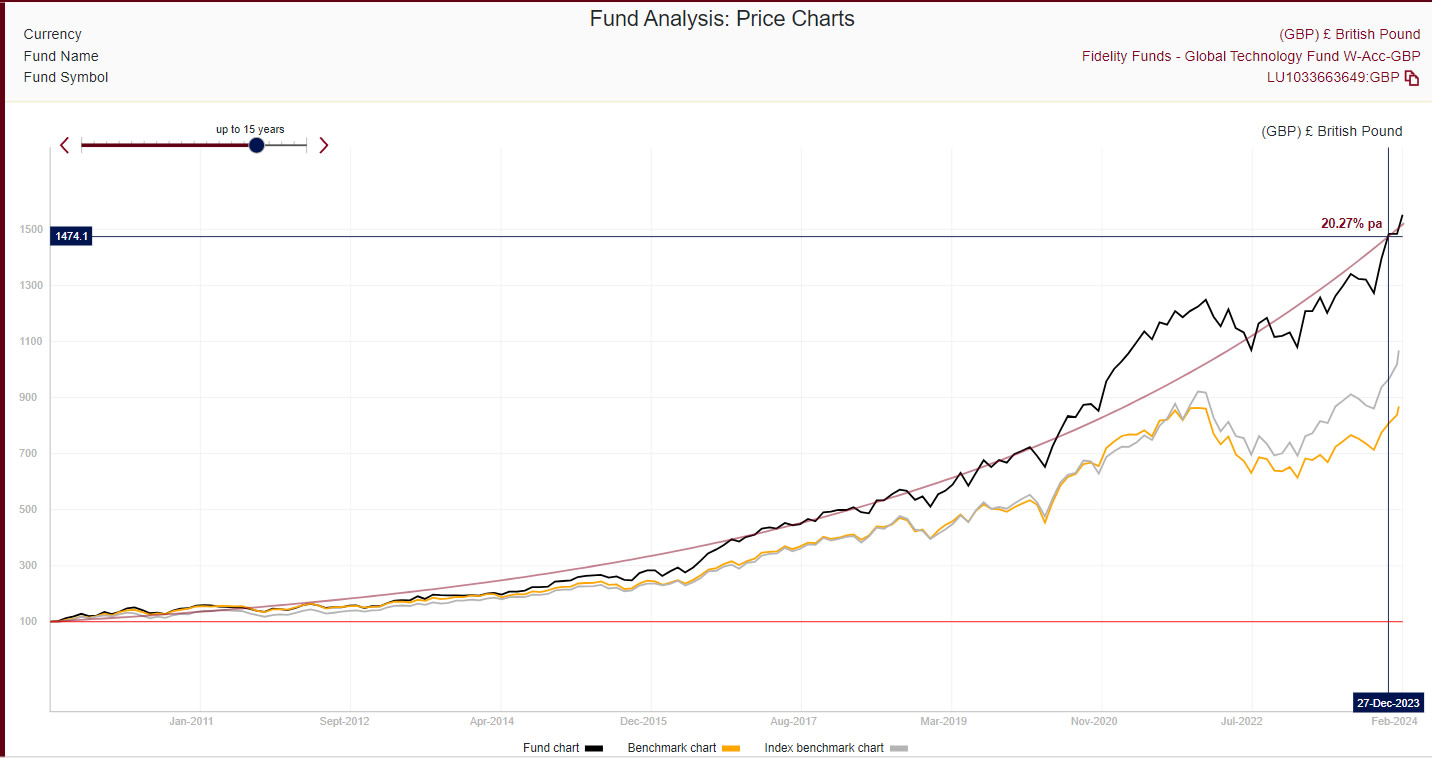
Also, rebalancing... absolutely, every 1-3 years would do it.And so we beat on, boats against the current, borne back ceaselessly into the past.0 -
daimes said:
So I'll make it easier for you.... come up any portfolio you want an I'll show you a better alternative based on risk and return over the past 10 years... Let's both exclude tech funds.
But what actually is the point of this, because all that shows us is what the best portfolio was for the last 10 years.
People aren't investing for the last 10 years, they are investing for the next 10/20/30.
Before the Japan bubble burst, the best performing portfolio of the 10 years prior would have been heavy on Japan. Then it burst and it was a rubbish place to be for many years.
Showing what has done well in the past means absolutely nothing as to what may happen in the future.
P.S I also think you're sorely mistaken if you think that people pay for a financial adviser to show them what the best portfolio of the last 10 years was.
8 -
Many financial advisors outsource their portfolio construction and I would not use them for that service anyway. I think they have their greatest utility for people that need hand holding to navigate the basics of their finances and taxes, but anyone with an ounce of common sense and a bit of time to read a few books can successfully DIY as long as they follow a few simple rules and don't cherry pick well performing single sectors as the OP has done.Hoenir said:If it was easy as you suggest here would be no financial services industry. To be fair to Financial Advisors their not going to be on experts global markets. Nor is it their remit.
To give the matter some perspective how did your friends portfolio's perform? I bet they made a sizeable return over the same time frame. Comfortably beating inflation.And so we beat on, boats against the current, borne back ceaselessly into the past.0 -
I see so far not a single suggestion... lots of silly excuses, but nothing to show... disappointing!
Ah what the hell... here's one with no technology...Royal London Duration Hedged Credit Fund GB00B4K6P774 24.90% Fundsmith Equity Acc GB00B41YBW71 64.30% L&G Global 100 Index GB00B0CNH056 10.80%
Before you start claiming that Terry Smith is a Woodford risk this challenge is all about trying to see if you guy are capable of designing a performing portfolio... you can break all the rules you want, just find any investment that can beat this one over 10 years for risk and return..
here's the performance.. 10 yrs 13.6% return 9% volatility.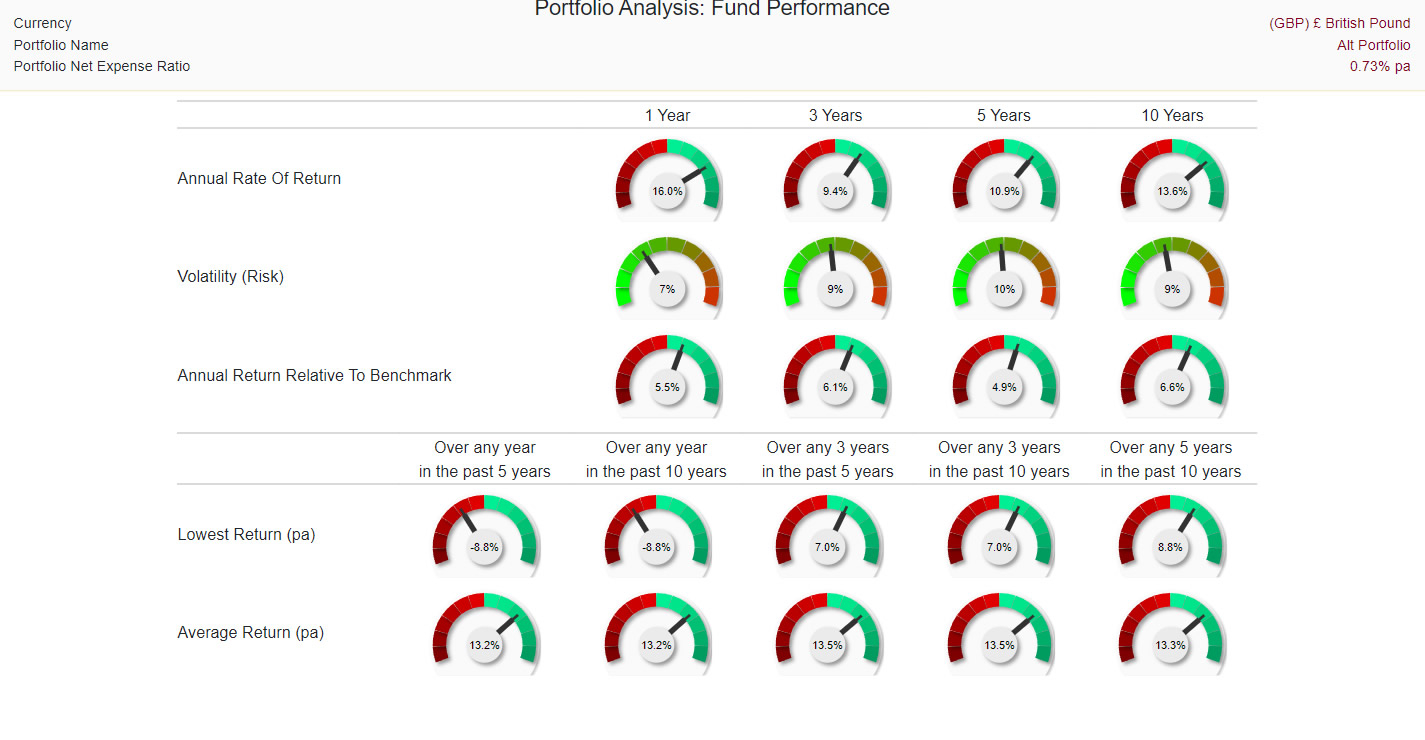
And here the risk dynamics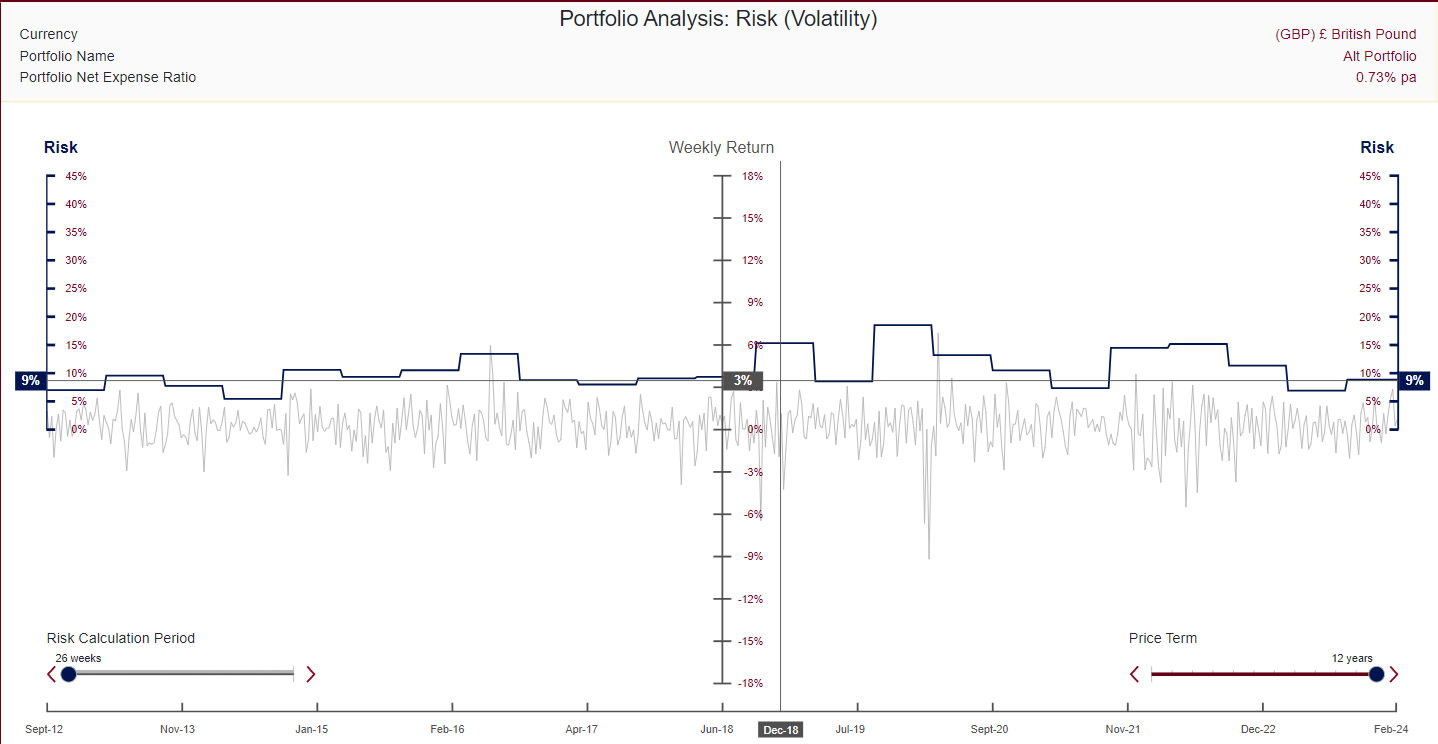
Very few dips to worry about.
You advisers are charging people to tell them where to invest... well show us you know what you are talking about.
0 -
So I'll make it easier for you.... come up any portfolio you want an I'll show you a better alternative based on risk and return over the past 10 years... Lets both exclude tech funds.How about we go to the Racing Post and look at yesterday's results and debate who won the 3.15 at Lingfield?
After all, that is exactly what you are doing with your portfolio build.
You are clearly losing your rag because no-one agrees with you or your crystal ball. You are coming over as a Grandiose Dillusionist. We get it. You have invented the wheel and are now the master of the universe and everyone must bow before you.
I am an Independent Financial Adviser (IFA). The comments I make are just my opinion and are for discussion purposes only. They are not financial advice and you should not treat them as such. If you feel an area discussed may be relevant to you, then please seek advice from an Independent Financial Adviser local to you.7 -
I think the OP needs to calm down a bit. My portfolio over the last 35 years has been designed to provide long term growth with minimal expenses and minimal effort. I'm an index investor so the idea of sector concentration is an anathema to me and any portfolio I come up with will lose on a return basis. But, I was not interested in maximizing return, but maximizing the probability of hitting goals that would make me financially independent. So through my work life I had a US equity index/ Global equity index/ US Bond index allocation of roughly 40/20/40 that from 1987 to 2014 produced an annual average return of just over 8%. Since then I have been 65/20/15 with an annual return of just over 9%. These returns include several crashes. I'm retired and do not depend on investments for my income and reached my goal of Financial Independence which I define as never having to worry about money again...so frankly I don't really think about annual return anymore, it just happens and gets compounded. I'm more worried about taxation.daimes said:
Stop prevaricating, I'm getting tiered of responding to arguments that have little real substance....Linton said:Perhaps you should have analysed your results over a longer timeframe:
In 2000 Fidelity Global Tech dropped by 70%. It did not return to its previous high until 2014. That is what high risk can mean and is why sensible investors pay careful attention to diversification. An IFA would not recommend a portfolio that is likely to show this type of behaviour. Inexperienced investors would be likely to have sold out immediately after the crash at a loss rather than wait for the recovery, most experienced investors would not want to get in that position in the first place.
It's time to put up or shut up ... where is your alternative suggestion?
If you want me to respond to your points then start with an alternative portfolio. One that you would comfortably say to a client (assuming you are an adviser) don't buy that one... buy this one.
10 years investment horizon.
Rather than trying to score points in a portfolio competition I think you should think about your financial goals and the reasons for using the portfolio you are advocating and its potential dangers.And so we beat on, boats against the current, borne back ceaselessly into the past.5 -
I am not an adviser, I am not an expert. I have a reasonable S&S portfolio but my aim has never been to try and "shoot the lights out" with returns, but to generate a steady return to provide an income (largely natural income) which is significantly unaffected by the volatility levels of the funds I have chosen (and I use more than just 3).My portfolio is moderately unchanged in components since inception (although each has increased over the years) and has generated a consistent unitised annual return of >6% for the last 14 (& a half) years.So >70% return over 14 years. I'm happy.
2












This discussion has been closed.
Confirm your email address to Create Threads and Reply

Categories
- All Categories
- 354.3K Banking & Borrowing
- 254.4K Reduce Debt & Boost Income
- 455.4K Spending & Discounts
- 247.3K Work, Benefits & Business
- 604K Mortgages, Homes & Bills
- 178.4K Life & Family
- 261.5K Travel & Transport
- 1.5M Hobbies & Leisure
- 16.1K Discuss & Feedback
- 37.7K Read-Only Boards