We’d like to remind Forumites to please avoid political debate on the Forum.
This is to keep it a safe and useful space for MoneySaving discussions. Threads that are – or become – political in nature may be removed in line with the Forum’s rules. Thank you for your understanding.
📨 Have you signed up to the Forum's new Email Digest yet? Get a selection of trending threads sent straight to your inbox daily, weekly or monthly!
The Forum now has a brand new text editor, adding a bunch of handy features to use when creating posts. Read more in our how-to guide
Challenge to Financial Advisers

daimes
Posts: 17 Forumite


I've recently come across some very poor experiences with friends of mine who have been advised to invest in portfolios which I believe are not generally that good.
I tend to look at how stable the historic performance has been and well a fund can convert risk to performance over a reasonable period of time and generally how it compares with alternative funds in the same category.
Here's a portfolio which has achieved 14.9% return from 9% risk (annual volatility) over the past 10 years:
Here's what it looks like

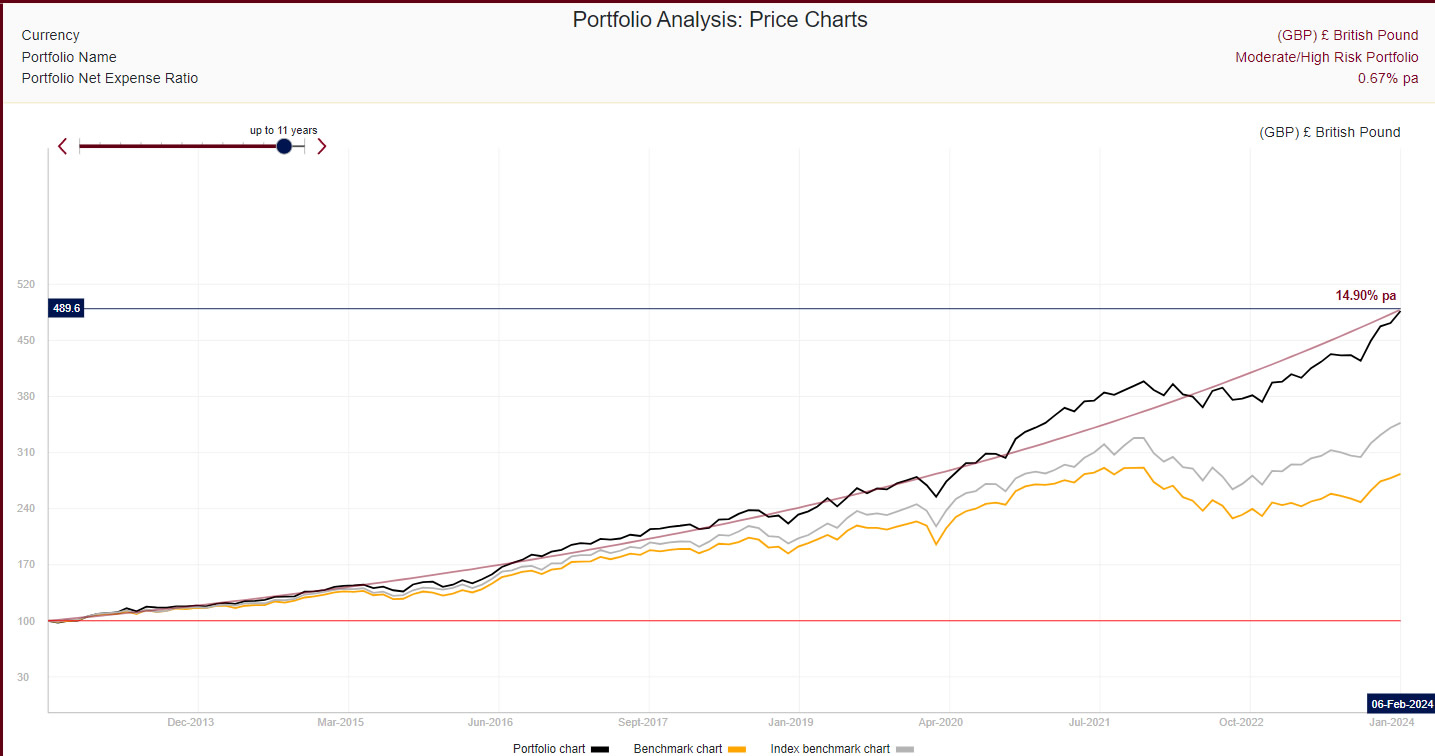
See? Nice and smooth over the long term and moderate risk (9% vol). Outperforming other funds in it's class (orange line) and other index funds in its class (light gray line).
Here's the performance data: -
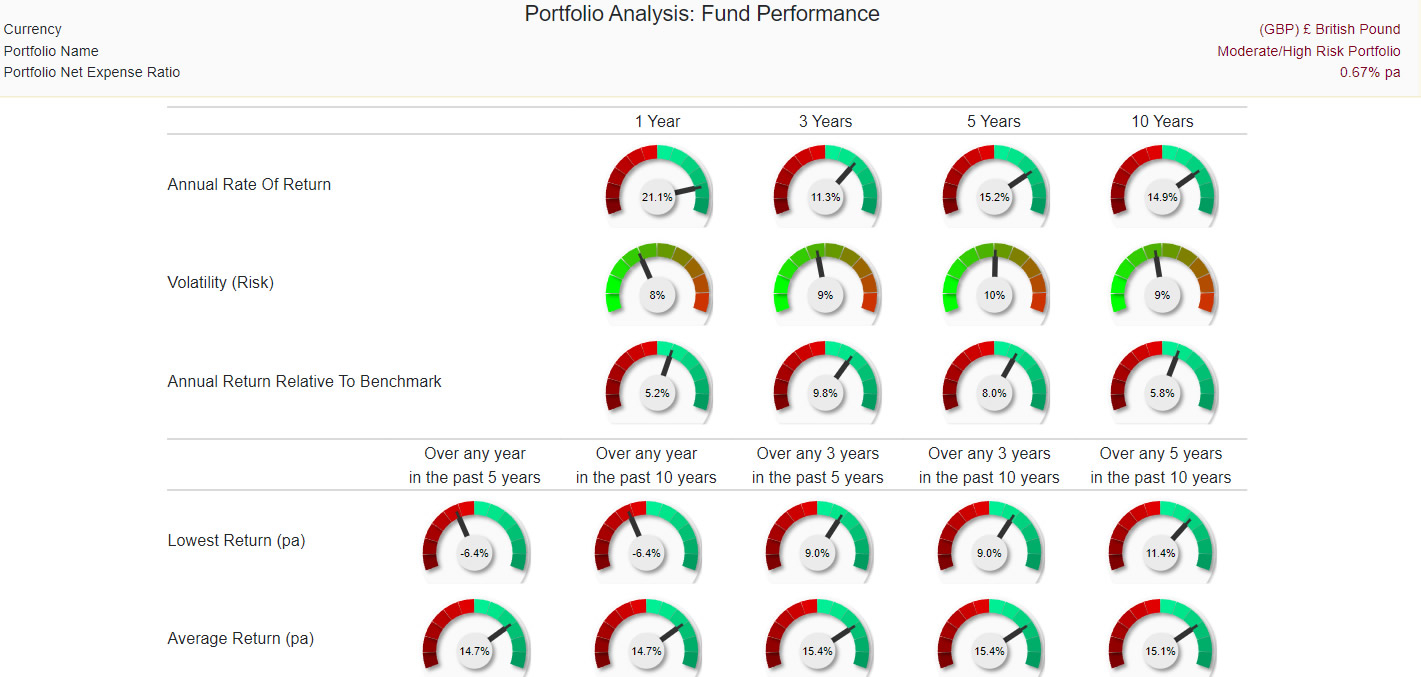
The challenge to you Financial Advisers is to come up with a portfolio which at least delivers more return for the same risk or the same return or less risk. Obviously more return for less risk would be the gold medal!
Those of you wondering about diversification, have a look at the correlation table for this portfolio:
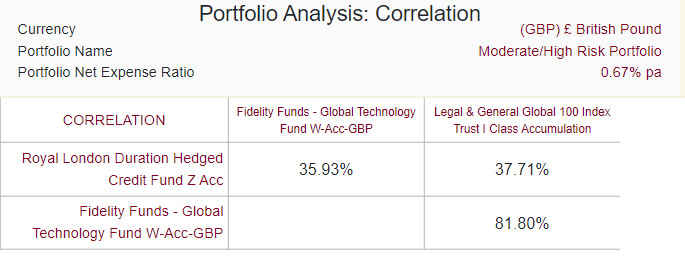
I'll admit it could be better, but it's not right to allow the correlation tail to wag too much the long-term performance dog. I imagine I could add a couple of more funds to this which might slightly improve it's dynamics but I don't want to make it too difficult for you ;-)
Let see if you can do better. Make sure you quote ISIN / stock symbols so I can check the exact funds / stocks and thus allowing me to post your portfolio performance charts on this thread.
I tend to look at how stable the historic performance has been and well a fund can convert risk to performance over a reasonable period of time and generally how it compares with alternative funds in the same category.
Here's a portfolio which has achieved 14.9% return from 9% risk (annual volatility) over the past 10 years:
| Royal London Duration Hedged Credit Fund | GB00B4K6P774 | 38.60% |
| Fidelity Funds Global Tech | LU1033663649 | 46.50% |
| L&G Global 100 Index | GB00B0CNH056 | 14.90% |
Here's what it looks like

See? Nice and smooth over the long term and moderate risk (9% vol). Outperforming other funds in it's class (orange line) and other index funds in its class (light gray line).
Here's the performance data: -
The challenge to you Financial Advisers is to come up with a portfolio which at least delivers more return for the same risk or the same return or less risk. Obviously more return for less risk would be the gold medal!
Those of you wondering about diversification, have a look at the correlation table for this portfolio:
I'll admit it could be better, but it's not right to allow the correlation tail to wag too much the long-term performance dog. I imagine I could add a couple of more funds to this which might slightly improve it's dynamics but I don't want to make it too difficult for you ;-)
Let see if you can do better. Make sure you quote ISIN / stock symbols so I can check the exact funds / stocks and thus allowing me to post your portfolio performance charts on this thread.
0
Comments
-
The challenge to you Financial Advisers is to come up with a portfolio which at least delivers more return for the same risk or the same return or less risk. Obviously more return for less risk would be the gold medal!I suspect that the methodology you have used and your outcome would likely be considered a missale in the real world, if it came to it.
You are measuring volatility over a short term period and treating that as the sole risk measure. It is has led to an outcome that has seen you building a portfolio where nearly half of it has 90% loss potential.
You have also picked on the basis of short term recency and that has handicapped your diversification. It is akin to betting on a horse race when you already know the result.
I am an Independent Financial Adviser (IFA). The comments I make are just my opinion and are for discussion purposes only. They are not financial advice and you should not treat them as such. If you feel an area discussed may be relevant to you, then please seek advice from an Independent Financial Adviser local to you.15 -
Wrong! I am not measuring volatility over a different period... the performance and volatility are both measured over 10 years.dunstonh said:The challenge to you Financial Advisers is to come up with a portfolio which at least delivers more return for the same risk or the same return or less risk. Obviously more return for less risk would be the gold medal!I suspect that the methodology you have used and your outcome would likely be considered a missale in the real world, if it came to it.
You are measuring volatility over a short term period and treating that as the sole risk measure. It is has led to an outcome that has seen you building a portfolio where nearly half of it has 90% loss potential.
You have also picked on the basis of short term recency and that has handicapped your diversification. It is akin to betting on a horse race when you already know the result.
OF COURSE YOU KNOW THE RESULT, it's called PRICE HISTORY. I have access to it an so do you!
However, price history alone is of little use until it is compared with volatility. Then it starts to become useful.
I arrived at this portfolio by carefully analysing 50,000 registered funds in europe and picking the best. I then ran the funds through an Efficient Frontier calculator to get the best spread.
It annoys me when people like you use sophistry to bamboozle less informed people into thinking you actually know what you are talking about.
Stop hiding behind a "supposed" mis-selling excuse an come up with something better.
0 -
Portfolios with a 50% allocation to "Technology" will show excellent returns over the last decade. Whether that is a sensible asset allocation for most investors with a long time horizon is debatable. How do you manage this portfolio? Are you going to do any rebalancing? I agree with your point that portfolio construction is not that difficult, but I'm not sure your example proves that.And so we beat on, boats against the current, borne back ceaselessly into the past.5
-
FWIW it annoys me when people feel the need to use CAPITALS to make their point.. it's the online equivalent of shoutingdaimes said:
Wrong! I am not measuring volatility over a different period... the performance and volatility are both measured over 10 years.dunstonh said:The challenge to you Financial Advisers is to come up with a portfolio which at least delivers more return for the same risk or the same return or less risk. Obviously more return for less risk would be the gold medal!I suspect that the methodology you have used and your outcome would likely be considered a missale in the real world, if it came to it.
You are measuring volatility over a short term period and treating that as the sole risk measure. It is has led to an outcome that has seen you building a portfolio where nearly half of it has 90% loss potential.
You have also picked on the basis of short term recency and that has handicapped your diversification. It is akin to betting on a horse race when you already know the result.
OF COURSE YOU KNOW THE RESULT, it's called PRICE HISTORY. I have access to it an so do you!
However, price history alone is of little use until it is compared with volatility. Then it starts to become useful.
I arrived at this portfolio by carefully analysing 50,000 registered funds in europe and picking the best. I then ran the funds through an Efficient Frontier calculator to get the best spread.
It annoys me when people like you use sophistry to bamboozle less informed people into thinking you actually know what you are talking about.
Stop hiding behind a "supposed" mis-selling excuse an come up with something better.
2 -
Fair point Bradded.. apologies for the capitals.Bradden said:
FWIW it annoys me when people feel the need to use CAPITALS to make their point.. it's the online equivalent of shoutingdaimes said:
Wrong! I am not measuring volatility over a different period... the performance and volatility are both measured over 10 years.dunstonh said:The challenge to you Financial Advisers is to come up with a portfolio which at least delivers more return for the same risk or the same return or less risk. Obviously more return for less risk would be the gold medal!I suspect that the methodology you have used and your outcome would likely be considered a missale in the real world, if it came to it.
You are measuring volatility over a short term period and treating that as the sole risk measure. It is has led to an outcome that has seen you building a portfolio where nearly half of it has 90% loss potential.
You have also picked on the basis of short term recency and that has handicapped your diversification. It is akin to betting on a horse race when you already know the result.
OF COURSE YOU KNOW THE RESULT, it's called PRICE HISTORY. I have access to it an so do you!
However, price history alone is of little use until it is compared with volatility. Then it starts to become useful.
I arrived at this portfolio by carefully analysing 50,000 registered funds in europe and picking the best. I then ran the funds through an Efficient Frontier calculator to get the best spread.
It annoys me when people like you use sophistry to bamboozle less informed people into thinking you actually know what you are talking about.
Stop hiding behind a "supposed" mis-selling excuse an come up with something better.1 -
Actually it's more like 15 years... how long before it actually means something?Bostonerimus1 said:Portfolios with a 50% allocation to "Technology" will show excellent returns over the last decade. Whether that is a sensible asset allocation for most investors with a long time horizon is debatable. How do you manage this portfolio? Are you going to do any rebalancing? I agree with your point that portfolio construction is not that difficult, but I'm not sure your example proves that.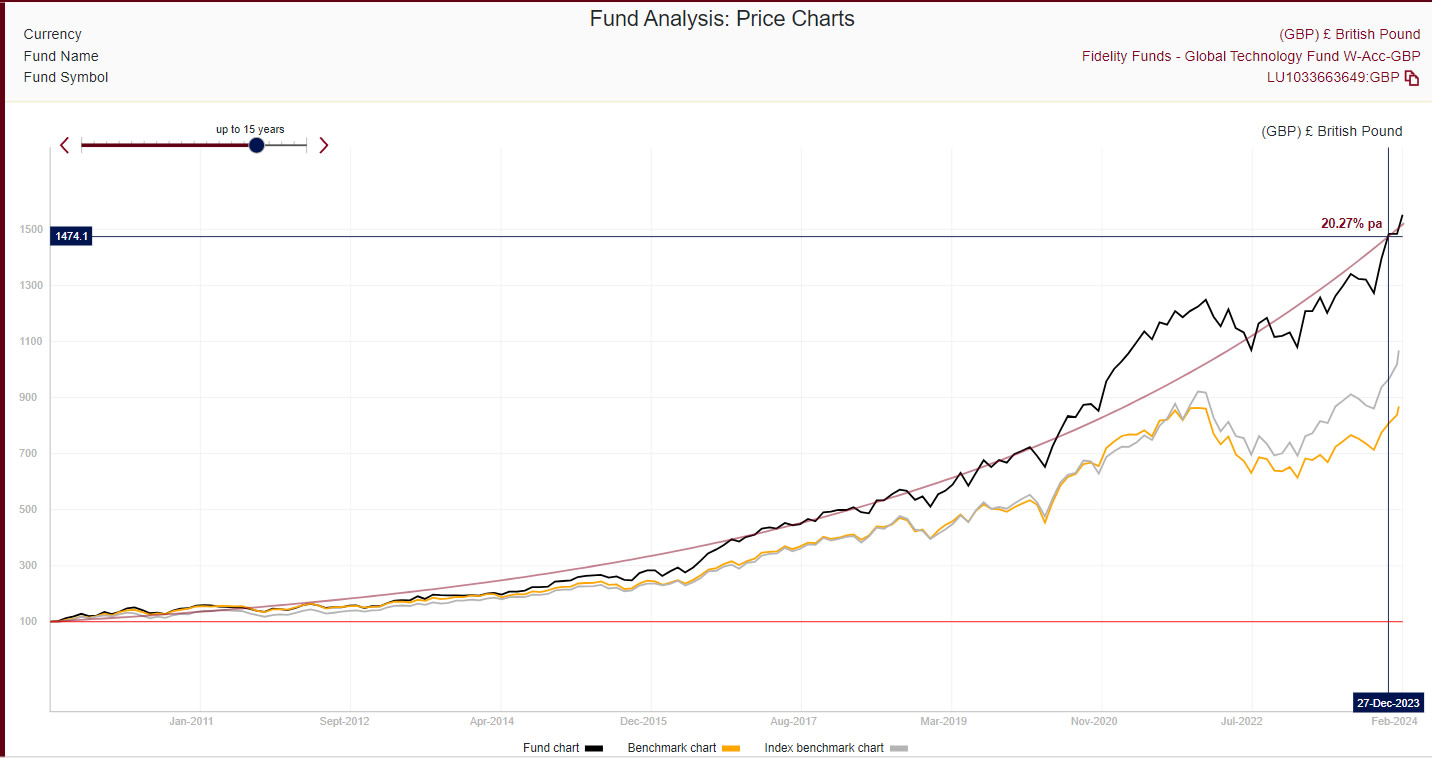
Also, rebalancing... absolutely, every 1-3 years would do it.0 -
daimes said:
It annoys me when people like you use sophistry to bamboozle less informed people into thinking you actually know what you are talking about.dunstonh said:The challenge to you Financial Advisers is to come up with a portfolio which at least delivers more return for the same risk or the same return or less risk. Obviously more return for less risk would be the gold medal!I suspect that the methodology you have used and your outcome would likely be considered a missale in the real world, if it came to it.
You are measuring volatility over a short term period and treating that as the sole risk measure. It is has led to an outcome that has seen you building a portfolio where nearly half of it has 90% loss potential.
You have also picked on the basis of short term recency and that has handicapped your diversification. It is akin to betting on a horse race when you already know the result.
If you stay on the forum a while you'll discover dunstonh is one of the forum members who really does know what they are talking about. And explaining things clearly and accurately is not the same as "sophistry".
16 -
I hold both the Fidelity and L&G funds in my portfolio (one in my ISA, one in my SIPP), but they alone, even with the RL do not offer the levels of diversification that would make me feel happy. I would not hold both the Fidelity and L&G in a single investment product because of this.
The last 10 years have been a good time for Tech, as were the 1990's, but I am guessing that you would have seen a very different picture across the millenia. Some reports seem to suggest that we are approaching another technology bubble which could be bad news for your suggested portfolio.
We all have different tolerances to risk, and I do not profess to be any kind of an expert, so good luck, but a portfolio containing only those 3 products is not for me.I don't care about your first world problems; I have enough of my own!1 -
Picking the best performing single sector (with some padding to bring volatility down to an arbitrary value) and then looking back to say 'look, it was the best performing' is not a great strategy. In another thread you talk about a similar portfolio but with different allocations - which is the actual allocation you use and did you set it 15 years ago? If so, why are you only talking about it now?If you do want to play the backwards game then just pick a single stock like Nvidia and compare it to your portfolio. Well done! Another winner!But it's not much use in the real world.9
-
Perhaps you should have analysed your results over a longer timeframe:daimes said:
Wrong! I am not measuring volatility over a different period... the performance and volatility are both measured over 10 years.dunstonh said:The challenge to you Financial Advisers is to come up with a portfolio which at least delivers more return for the same risk or the same return or less risk. Obviously more return for less risk would be the gold medal!I suspect that the methodology you have used and your outcome would likely be considered a missale in the real world, if it came to it.
You are measuring volatility over a short term period and treating that as the sole risk measure. It is has led to an outcome that has seen you building a portfolio where nearly half of it has 90% loss potential.
You have also picked on the basis of short term recency and that has handicapped your diversification. It is akin to betting on a horse race when you already know the result.
OF COURSE YOU KNOW THE RESULT, it's called PRICE HISTORY. I have access to it an so do you!
However, price history alone is of little use until it is compared with volatility. Then it starts to become useful.
I arrived at this portfolio by carefully analysing 50,000 registered funds in europe and picking the best. I then ran the funds through an Efficient Frontier calculator to get the best spread.
It annoys me when people like you use sophistry to bamboozle less informed people into thinking you actually know what you are talking about.
Stop hiding behind a "supposed" mis-selling excuse an come up with something better.
In 2000 Fidelity Global Tech dropped by 70%. It did not return to its previous high until 2014. That is what high risk can mean and is why sensible investors pay careful attention to diversification. An IFA would not recommend a portfolio that is likely to show this type of behaviour. Inexperienced investors would be likely to have sold out immediately after the crash at a loss rather than wait for the recovery, most experienced investors would not want to get in that position in the first place.
5







This discussion has been closed.
Confirm your email address to Create Threads and Reply

Categories
- All Categories
- 354.3K Banking & Borrowing
- 254.4K Reduce Debt & Boost Income
- 455.4K Spending & Discounts
- 247.3K Work, Benefits & Business
- 604K Mortgages, Homes & Bills
- 178.4K Life & Family
- 261.5K Travel & Transport
- 1.5M Hobbies & Leisure
- 16.1K Discuss & Feedback
- 37.7K Read-Only Boards